
„Gentleman Jack”
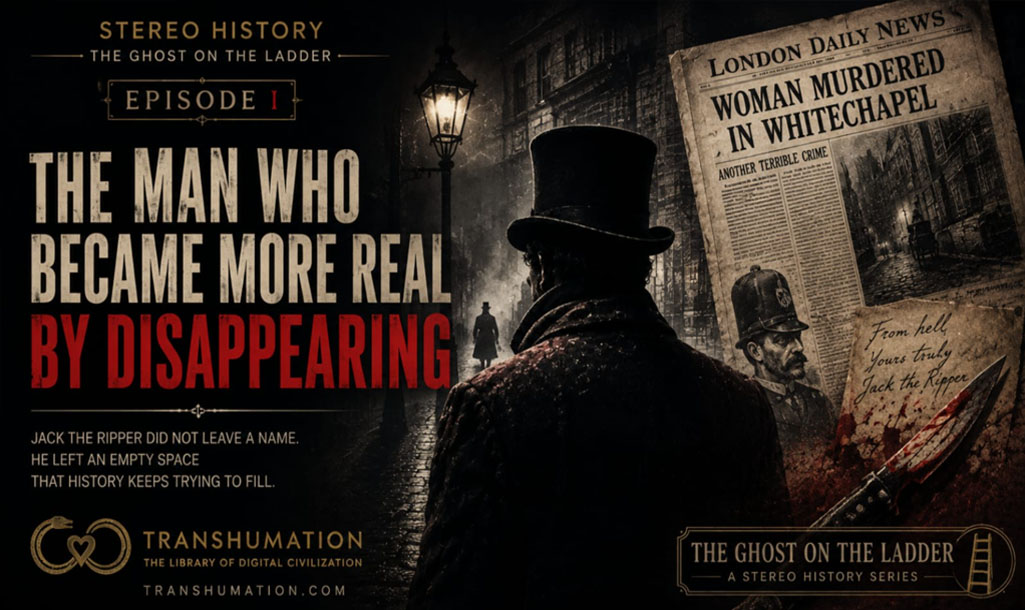
Jack the Ripper became one of history’s most recognizable figures by leaving almost nothing recognizable behind.
Most historical figures become more solid as evidence accumulates. A portrait fixes the face. A diary fixes the voice. Letters reveal temperament. Documents narrow the possibilities. Biography gradually replaces myth.
Jack the Ripper moves in the opposite direction.
The more the case is examined, the stranger the absence becomes. There is no confirmed face, no certain name, no universally accepted voice, no final agreement about which crimes belong to one hand, and no biography capable of containing the legend. Yet the identity “Jack the Ripper” feels more culturally real than thousands of Victorian people whose lives are documented far more completely.
This is not simply a mystery of police history. It is a problem of information.
Usually, missing information weakens an identity. In Whitechapel, the missing information became part of the identity itself.
The Empty Space in the Portrait
Imagine removing Leonardo da Vinci from history while leaving several paintings behind.
We might compare technique, pigments, anatomy, composition and recurring gestures until an invisible author slowly emerged from the work. Perhaps we would infer temperament, education or geographical origin. Every additional object might make the person more precise.
But now imagine that we are not certain all the paintings belong to the same artist.
The reconstruction changes completely.
Something similar happened with Jack. People began with events. Events appeared to contain repetition. Repetition suggested intention. Intention suggested a mind. Eventually, the mind required an author.
Then the author received a name.
Jack the Ripper.
The name solved almost nothing historically, but it solved something psychologically. Chaos had acquired a centre.
This is one reason the case remains so powerful. Human beings are uncomfortable with unrelated fragments. We search for authors, causes, patterns and hidden continuity. Once a pattern becomes convincing enough, later information tends to organize itself around it.
The empty centre begins pulling everything inward.
When Absence Starts Producing Information
Ordinarily, more evidence closes possibilities.
A confirmed photograph eliminates thousands of possible faces. A birth certificate removes alternative dates. A verified letter gives language to a previously silent person.
Jack generates the opposite process.
No confirmed face means endless faces.
No certain profession means doctor, butcher, sailor, clerk, aristocrat, labourer, artist, policeman.
No certain voice means that disputed letters can become psychological evidence, theatrical performance, journalistic invention or deliberate disguise.
No certain motive allows every generation to construct another mind behind the crimes.
The absence is productive.
This is what makes Jack interesting beyond true crime. The information we do not possess creates room for information we manufacture.
And once that manufactured information enters culture, it becomes historically consequential even if its original truth remains uncertain.
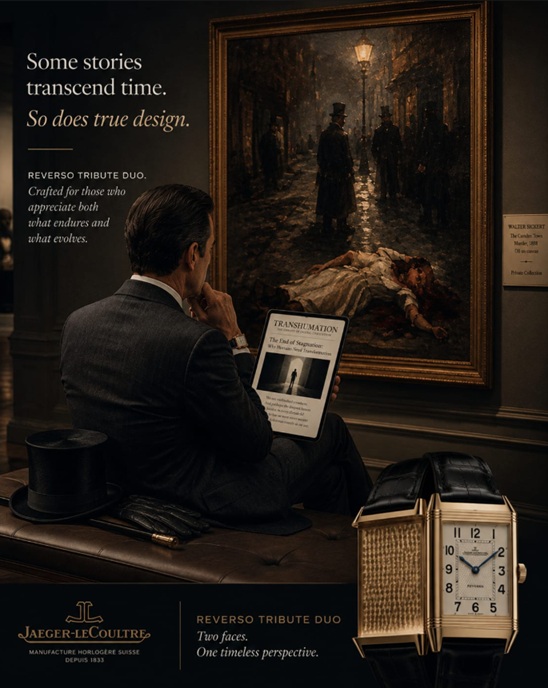
A possibly false letter can still shape newspapers. A questionable description can influence later illustrations. A fictional silhouette can become the image people recognize more easily than any authentic witness account.
The representation begins producing its own descendants.
The Name That Outlived the Man
The biological killer, whoever he was, almost certainly disappeared long ago.
The identity did not.
It survived newspapers, police archives, books, theatre, cinema, television, psychological profiling, Internet forums, DNA speculation and now artificial intelligence. Each medium inherited an unfinished figure and rebuilt him using the tools and anxieties of its own period.
The Victorian press saw a terrifying urban presence.
Later criminology saw a serial offender.
Cinema saw the gentleman in fog.
Psychology saw pathology.
The Internet saw an endlessly solvable puzzle.
AI sees an incomplete dataset.
The remarkable thing is not simply that Jack survived these transformations. Many historical figures survive media change.
The remarkable thing is that each new medium seems to believe it might finally complete him.
A new technology arrives and the case reopens.
Perhaps handwriting analysis will identify him.
Perhaps profiling.
Perhaps DNA.
Perhaps a database.
Perhaps facial reconstruction.
Perhaps AI.
The future repeatedly returns to 1888 and says:
Maybe now.
That does not happen because Jack left the richest archive.
It happens because he left an archive with a hole in the middle.
The Most Successful Version May Be the Least Accurate One
This creates an uncomfortable possibility.
The cultural Jack may be more durable precisely because he is less complete than a normal historical person.
A solved Jack would have a name, occupation, age, family, weaknesses and probably a disappointingly ordinary biography. He would shrink.
The unknown Jack has no such limitation.
He can become whatever the next medium needs him to become.
That does not make every interpretation equally good. Some claims are better supported than others, and historical discipline still matters. But Stereo History asks a different additional question: what did later generations do with the uncertainty?
The answer may tell us as much about them as about 1888.
The gentleman in the top hat tells us something about later images of Victorian danger. The criminal genius tells us something about twentieth-century fascination with pathology and intellect. The forensic suspect tells us something about our confidence that enough data should eventually eliminate mystery.
The future does not merely investigate Jack.
It edits him.
A Person Built From What Is Missing
This may be the deeper reason Jack feels strangely modern.
Digital identity is already partly constructed from fragments: photographs, posts, search results, messages, purchases, locations, other people’s descriptions. No observer encounters the whole person. Instead, a model is assembled from traces.
Usually, the traces point back toward someone we know exists.
Jack offers the reverse experiment.
The traces remain.
The person does not.
And the model continues running.
This is why he may be more useful as an information problem than as a murder mystery. He lets us ask what happens when identity becomes detached from a confirmed human source and continues to evolve through reproduction, interpretation and media.
How much absence can an identity survive?
Whitechapel suggests a disturbing answer:
Perhaps quite a lot.
Perhaps sometimes the absence is what keeps it alive.
Watch the Video
How to Read the World

Current Knowledge
The identity of the person or people responsible for the murders traditionally associated with Jack the Ripper has never been conclusively established. The historical record includes police reports, witness statements, newspaper coverage, correspondence attributed to the killer and later reconstructions.
The name “Jack the Ripper” became widely known through media circulation associated with letters claiming to come from the murderer, although the authenticity of famous examples remains disputed. The idea of a single coherent series, including the so-called canonical victims, is also an interpretive framework rather than absolute certainty.
Later generations have repeatedly re-examined the case using new forensic, historical and technological methods, but no identification has achieved universal acceptance.
Open Questions
How much of the Jack the Ripper identity originated with the actual killer, and how much was created by journalists, hoaxers, police, later writers and popular culture?
If the case were conclusively solved tomorrow, would Jack become historically clearer but culturally smaller?
At what point does a useful reconstruction become a self-reinforcing model that begins producing the evidence it expects to find?
And how often do we make the same mistake elsewhere: assuming that a strong pattern must imply one hidden author behind it?
The Transhumation Interpretation
Transhumation treats Jack the Ripper as a boundary case of informational identity.
Most forms of immortality depend on preservation. More documents, more images, more memory.
Jack suggests another route.
An identity can persist because the missing information keeps later minds participating in its construction.
The person disappears, but the interface remains open.
Every generation enters the same empty space, adds another layer and leaves the figure slightly changed for the next observer.
That is why Jack may have become more real by disappearing.
Not because absence reveals the man.
Because absence gave the future room to keep creating him.
FAQ
Why does the article say Jack the Ripper became “more real” by disappearing?
Because the lack of a confirmed identity allowed later generations to keep reconstructing him through new theories, images and technologies. The absence became part of the cultural identity.
Do we know who Jack the Ripper was?
No identification has been universally accepted. Many suspects have been proposed, but the case remains unresolved.
Was “Jack the Ripper” the killer’s real name?
No. It was a public persona associated with correspondence claiming to come from the murderer. The authenticity of famous letters is disputed.
What does “negative information” mean in this article?
It refers to the idea that missing information can itself shape interpretation. Because Jack lacks a confirmed face, profession and biography, the gaps generate many possible reconstructions.
Is the article claiming that Jack the Ripper never existed?
No. It distinguishes between the historical perpetrator or perpetrators and the later cultural identity called “Jack the Ripper.”
Why does every new technology return to the case?
Because the unresolved archive creates the expectation that a better tool might finally close the gap. New forensic and computational methods repeatedly revive that hope.
What does the article mean by “the future edits the past”?
Later generations interpret historical evidence using their own technologies, fears and conceptual categories, changing the cultural meaning of an event even when the original facts remain the same.
Is the article about true crime?
Only partly. Jack is used as a case study in media, memory, identity and the way information survives when the original person is absent.
Could solving the case reduce Jack’s cultural power?
Possibly. A confirmed identity would close many possibilities that currently allow the figure to be repeatedly reinterpreted.
What is the Transhumation interpretation?
Transhumation sees Jack as an example of identity surviving through information rather than biological continuity. The unusual feature is that the incompleteness of the information may be what keeps the identity alive.
Continue the Transhumation Series
- Forgotten Religion | Ancient Gods, Symbols and the Hidden Structures of Human Civilization
- The Last Religion | Death, Immortality and the Future of Humanity
- The New Theurgy | AI, Information and the Future of Human Civilization
- End of Branding: You Were Never Meant to Become a Product
- Baal vs Ishtar: Why Ancient Gods Never Disappeared