The December Fraud
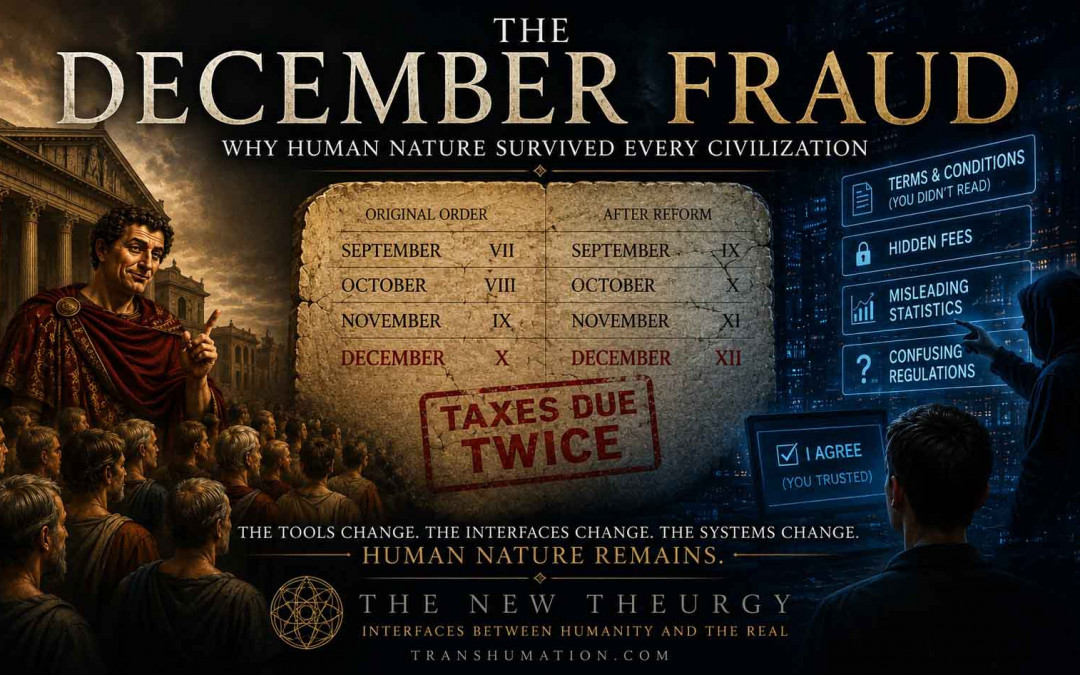
December carries a small archaeological ruin inside its name. The word descends from the Latin decem, ten, although December has been the twelfth month for so long that almost nobody experiences the discrepancy as a problem. September carries seven, October eight, November nine, December ten. We recite the names every year without asking why the numbers no longer match the positions. The interface works, so the contradiction has become invisible.
There is an old story attached to precisely this mismatch. In later retellings, a Roman official realizes that the obsolete numerical meaning of December can be turned into an administrative advantage. If December is literally “the tenth month,” the argument goes, then perhaps the calendar can be interpreted in a way that produces additional payments from people who understand the name better than they understand the machinery behind it. Whether this particular episode can be established in the form in which it is often repeated is less certain than the elegance of the story suggests. As history, it deserves caution. As a model of manipulation, it is almost too perfect.
The trick requires no forged calendar and no secret mathematics. It requires something much simpler: one person understands the gap between the interface and the system better than another person does.
That gap has never gone out of business.
Civilizations change their gods, machines, currencies and bureaucracies. The Roman tax collector disappears; the smartphone arrives. Yet again and again a familiar structure returns. Most people must use systems they do not have the time, expertise or incentive to understand completely. Someone else understands one part of the system better. Sometimes that expertise becomes a profession. Sometimes it becomes power. Occasionally it becomes a scam.
December is interesting not because the Romans were uniquely gullible.
It is interesting because we are still living in months whose names no longer explain the calendar.
The Fossil Inside the Interface
A calendar appears neutral because we encounter it as finished infrastructure. January comes first. December comes last. The weekend arrives where the interface says it arrives. Meetings occupy rectangles on a screen. Birthdays recur automatically. Nobody needs a theory of calendrical history before arranging dinner on Friday.
Yet calendars are cultural technologies layered over astronomical cycles. Their structures emerged historically, were revised repeatedly and preserve traces of earlier arrangements. The familiar numerical names September through December are among those traces. Traditional accounts of the Roman calendar associate them with an earlier arrangement in which March stood near the beginning of the civic year, although the reconstruction of Rome’s earliest calendrical history is much less straightforward than schoolbook stories sometimes imply.
The important point is not the exact moment at which January moved or February entered.
It is that names can survive the systems that originally made them transparent.
Civilization is full of such fossils.
A keyboard preserves QWERTY long after the mechanical conditions surrounding early typewriters changed. A legal phrase remains in use after ordinary language has moved elsewhere. An icon of a floppy disk survives as “save” for people who have never held a floppy disk. A telephone handset represents calling on a device containing no such handset. Academic ceremonies preserve clothing whose practical origins no longer matter to most participants.
The interface remembers what the user has forgotten.
Usually that is harmless.
Sometimes it becomes leverage.
The User Does Not Need to Know Everything
There is no scandal in using systems without fully understanding them. Quite the opposite: civilization would collapse if comprehensive understanding were required for participation.
You do not need to understand packet routing before sending a photograph. You can safely cross a bridge without calculating the stresses in its beams. A patient should not need a degree in pharmacology before taking prescribed medicine. A bank account would be useless if every customer first had to understand monetary policy, cybersecurity, clearing systems and the bank’s balance sheet.
Complexity creates necessary trust.
That is one of civilization’s greatest achievements.
It is also one of its permanent vulnerabilities.
The moment one person specializes, information becomes asymmetric. The mechanic knows more about the engine than the customer. The lawyer knows more about procedure than the client. The financial institution knows more about its contract than most borrowers. The platform knows more about its recommendation system than the user. The administrator understands which field in the database actually determines the outcome.
Most of the time expertise helps the less knowledgeable person navigate complexity.
But the same asymmetry permits another move: present the rules selectively enough that the user mistakes the interface for the underlying system.
That is the real December Fraud.

Every Age Invents Another December
Modern economies are filled with arrangements that are perfectly legal, accurately described somewhere and badly understood by the person agreeing to them.
The hotel room appears to cost one amount until additional charges arrive. A subscription is easy to begin and strangely difficult to cancel. A financial product advertises one attractive percentage while another part of the contract determines what the customer ultimately pays. A headline reports a dramatic relative increase without revealing how tiny the original number was. An online platform offers a prominent green button for the action it prefers and hides the alternative behind several menus.
None of these examples is identical to fraud, and it would be sloppy to treat every confusing interface as intentional deception. Complexity can arise without conspiracy. Regulations accumulate. Product designers optimize for competing goals. Legal language becomes dense partly because institutions attempt to anticipate every possible dispute.
But complexity creates an environment in which manipulation can hide comfortably.
The sophisticated version of the trick is no longer necessarily a lie.
It is correct information presented at the scale most likely to produce the wrong understanding.
The ancient fraudster, if the story contains a historical core, did not need to invent the word December. The word already existed. His advantage came from deciding which interpretation of the label the other person would see.
That strategy would recognize the twenty-first century immediately.
Human Nature Is Too Large a Claim
It is tempting to say that nothing has changed because human nature never changes.
History does not justify such confidence.
Human behavior is deeply shaped by institutions, norms, education, incentives and material conditions. Practices that seem ordinary in one society can become unthinkable in another. Levels of violence change. Family structures change. Concepts of honor, privacy and property change. Technology creates opportunities and temptations that previous humans never encountered.
But we do not need an eternal, unchanging human nature for the December pattern to recur.
We need only a few persistent ingredients.
Limited attention.
Unequal knowledge.
Trust.
Self-interest.
Institutional complexity.
The opportunity to profit from the difference between what another person sees and what the system actually does.
Those ingredients appear often enough across history that the resulting games can look eerily familiar.
A Roman official manipulating administrative interpretation and a modern designer constructing a deliberately confusing cancellation process do not belong to the same culture. They may not even possess comparable moral assumptions.
But structurally, both can exploit the difference between access to the interface and understanding of the mechanism.
That is a narrower claim than saying people never change.
It is also much harder to dismiss.
The Most Powerful Trick Is a True Statement
The primitive scam lies.
The sophisticated scam tells the truth in the wrong frame.
A statistic can be numerically correct and still produce a misleading impression. A contract can disclose a condition in language almost nobody will notice. A graph can begin its vertical axis at a carefully selected point and transform a modest change into a visual catastrophe. A recommendation can be described as “personalized” without making clear which commercial incentives participate in the personalization.
This is one reason literacy no longer means only the ability to read.
The user must increasingly understand models, percentages, rankings, algorithms and interfaces well enough to ask what the representation has omitted.
The danger is not ignorance in the traditional sense. A person may have access to every relevant fact and still misunderstand the system because the facts have been arranged into an interface optimized for another objective.
Information can therefore coexist perfectly with opacity.
This is one of the central problems of technological civilization.
We have become extraordinarily good at making information available.
We have not necessarily become equally good at making systems legible.
AI Does Not Change the Game — It Changes the Dealer
Artificial intelligence appears to introduce something unprecedented because the interface can now answer back.
A person no longer searches only through menus and lists. They can ask a complicated question in ordinary language and receive an apparently coherent interpretation. The interface begins resembling a knowledgeable person rather than a mechanical tool.
That can reduce information asymmetry dramatically.
An AI assistant could explain a contract, compare competing offers, translate legal language, identify unusual fees or tell a user which part of a document deserves closer attention. In that sense, AI might become one of the most powerful anti-December technologies ever created.
But the same interface creates another layer of trust.
The user may no longer understand the original system or the system interpreting it.
A generated explanation can omit an exception. A model can confidently misunderstand a document. A recommendation can reflect hidden assumptions in data or design. A personalized interface can become so convenient that the user stops checking the underlying source.
The old problem therefore moves rather than disappears.
The Roman citizen trusted the calendar.
The modern user may trust the interpreter of the calendar.
The interface acquires an interface.
And every additional layer creates another place where the relationship between representation and reality can drift.
The New Theurgy of Ordinary Systems
The New Theurgy is interested in interfaces because human beings live almost entirely through them.
A calendar mediates time.
A map mediates space.
Money mediates value.
Law mediates obligation.
A library catalogue mediates knowledge.
A search engine mediates the web.
Artificial intelligence increasingly mediates all of these at once.
Calling these systems interfaces does not make them equivalent. It gives us a common question to ask of radically different technologies:
What does the interface allow the user to see, and what does it require the user to trust?
Ancient religious intermediaries dealt with very different metaphysical claims, but the structural problem of mediation is old. Whenever reality becomes too large, distant or complicated for direct access, humans rely upon a smaller representation.
That representation can orient.
It can also manipulate.
The difference is not always intention. Sometimes an honest interface simply compresses too aggressively. Sometimes the operator does not understand the entire system either. In sufficiently complex civilizations, the person behind the desk may be following a procedure whose origin nobody in the building remembers.
December may therefore survive even without a fraudster.
The label can mislead because the history that once explained it has disappeared.
Watch The Video
How to Read the World
Current Knowledge
The names September, October, November and December derive from Latin numerical roots associated respectively with seven, eight, nine and ten. Their apparent mismatch with positions nine through twelve reflects the historical development of the Roman calendar, although simple popular accounts of a perfectly documented original ten-month calendar should be treated cautiously because Rome’s earliest calendrical history is reconstructed from later traditions and incomplete evidence.
Calendars are human systems for organizing recurring astronomical and social time. Their structures change historically, and inherited terminology can survive reforms that alter the system around it.
Modern behavioral economics, psychology and interface research provide extensive evidence that framing, complexity, defaults and presentation can influence decisions. This does not imply that every complex interface is manipulative, but it demonstrates that the form in which information is presented affects how people interpret and act upon it.
AI systems can help explain complex material and improve access to specialized knowledge, but they can also introduce errors, omit context and produce unjustified confidence. They should therefore be treated as informational intermediaries rather than automatic guarantors of understanding.
The specific anecdote of a Roman official exploiting the numerical meaning of December should be treated cautiously unless its ancient source and context can be firmly established. Its value here is primarily as an illustration of a recurring informational structure, not as evidence for a general theory of Roman administration.
Open Questions
The first question is how much opacity a complex civilization can eliminate without sacrificing the efficiency complexity makes possible. We cannot realistically require every citizen to understand every technical system they use, yet dependence without understanding inevitably creates opportunities for abuse.
There is also the question of responsibility. When an interface systematically produces misunderstanding, how do we distinguish poor design, unavoidable complexity and intentional manipulation? The outcome may look identical to the user even when the moral circumstances differ radically.
AI creates an additional problem because interpretation itself can become automated. If people increasingly rely upon machines to explain contracts, laws, science and public information, what mechanisms will allow them to verify the interpreter without simply adding another interpreter on top?
And perhaps the most difficult question is historical: how many structures do we currently accept as natural simply because the story explaining why they took their present form has already been forgotten?
Transhumation Interpretation
The December Fraud gives The New Theurgy a useful rule:
never confuse the interface with the system it represents.
The calendar is not time.
The map is not territory.
The statistic is not the population.
The algorithmic ranking is not importance.
The AI answer is not the archive.
Every interface performs compression. It makes something larger available at human scale by deciding which distinctions to preserve and which to hide. Most of civilization could not exist without this process.
But compression creates power.
The person who controls the interface can influence the way the underlying system becomes visible.
That is why the December story survives even if its most entertaining historical details eventually fail scrutiny. The deeper structure is demonstrable everywhere: people are most vulnerable not simply when they have no information, but when they possess just enough information to trust a representation they do not understand.
This matters for Transhumation because technological progress will create interfaces to systems increasingly beyond individual comprehension. Genomes, financial networks, machine-learning models, climate systems and vast digital archives cannot be held inside one human mind in full resolution.
We will need interpreters.
Better maps.
Better librarians.
Better models.
Better AI.
The dangerous fantasy is that a better interface removes the need for doubt.
In reality, the more powerful the interface becomes, the more important it may become to understand where its authority ends.
A good librarian points toward the book.
A good map allows the traveler to return to the landscape.
A good AI should make it possible to ask: Where did this come from? What did you omit? What assumptions produced this answer? What evidence would contradict it?
This is not merely a technical feature.
It is a civilizational safeguard.
Perhaps every age eventually receives its own December: a familiar label, a trusted procedure or an elegant interface whose apparent simplicity conceals a more complicated system underneath.
The Romans did not invent that vulnerability.
Neither did the internet.
What changes is the scale at which it can be exploited.
And that may be the central paradox of informational civilization. The more powerful our tools for navigating complexity become, the more dependent we become upon representations of realities we cannot personally verify in full.
The solution cannot be to understand everything.
Nobody can.
The solution may be to preserve one old habit beneath every new interface:
ask what the label is hiding.
FAQ
Why is December called December if it is the twelfth month?
Its name derives from Latin decem, meaning ten, reflecting an earlier stage in the development of the Roman calendar and preserving a numerical fossil inside the modern month name.
Did a Roman governor really use December to collect extra taxes?
Versions of such an anecdote circulate, but it should not be treated as established history without identifying a reliable ancient source. The article uses it primarily as a model of informational manipulation.
What does a calendar have to do with an interface?
A calendar converts complex astronomical and social time into a standardized representation people can easily use. Like any interface, it simplifies a larger system.
What is a “modern December”?
Any situation in which someone exploits the gap between how a system appears to users and how it actually operates: misleading fees, confusing contracts, distorted statistics or manipulative interfaces can all fit the structure.
Does AI solve the information problem?
It may help enormously by interpreting complexity, but it also creates another intermediary whose explanations can themselves be incomplete or mistaken.
What is the deeper New Theurgy idea?
Civilization increasingly depends on interfaces to realities too complex for individuals to understand directly. The central question is therefore no longer merely whether the interface works.
It is whether we remember that there is something behind it.
December is still called December.
The discrepancy no longer fools us because we know how the calendar works.
The dangerous interfaces are the ones whose mismatched numbers we have not noticed yet.
Continue the Transhumation Series
- Forgotten Religion | Ancient Gods, Symbols and the Hidden Structures of Human Civilization
- The Last Religion | Death, Immortality and the Future of Humanity
- The New Theurgy | AI, Information and the Future of Human Civilization
- End of Branding: You Were Never Meant to Become a Product
- Baal vs Ishtar: Why Ancient Gods Never Disappeared