
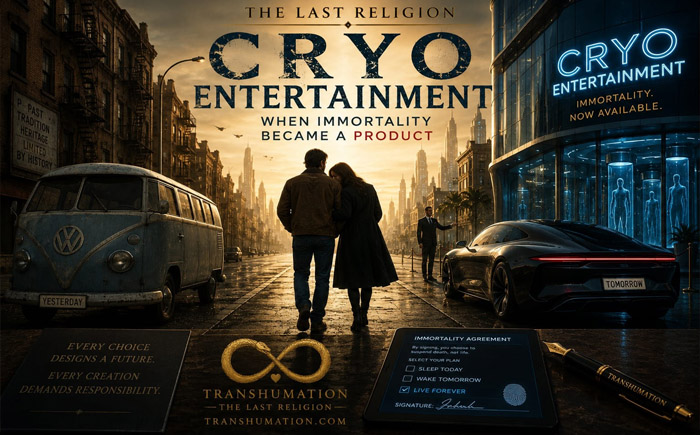
Open Your Eyes
In Vanilla Sky, the most unsettling idea is not that a man might survive death.
Science fiction had imagined that long before.
The unsettling part is the paperwork.
There is a company. A service. A procedure. Terms have been agreed upon. The impossible has entered the administrative world of contracts, customer expectations and technical support. Death has not been conquered in any demonstrated scientific sense; it has been reorganized as a consumer problem.
That change is easy to miss because the film surrounds it with dream logic, romance and uncertainty. But beneath all of that is an extraordinarily modern proposition.
Suppose the future could be purchased.
Not guaranteed.
Purchased.
You pay a company in the present to preserve enough of you that another civilization, one you will never meet, may someday attempt to continue the story.
The ancient question—Will there be a tomorrow for me?—has acquired an invoice.
That may be stranger than immortality itself.
What Does Vanilla Sky Change About the Immortality Story?
Traditional immortality stories usually require a god, a curse, a miracle, an enchanted object or some exceptional violation of nature.
Vanilla Sky gives us customer service.
That is an enormous cultural shift.
Once eternity enters the marketplace, it stops belonging exclusively to theology and myth. It begins acquiring the language of access, affordability, technical failure and corporate responsibility.
What exactly was promised?
What counts as successful restoration?
Who is liable if the person wakes into circumstances radically different from those expected?
Who maintains the body or brain during the intervening decades?
What happens if the company fails?
A religious promise can remain metaphysically absolute even when its fulfillment lies beyond empirical inspection. A commercial promise cannot enjoy that luxury forever. Products create expectations, and expectations create standards.
This is where Cryo Entertainment becomes philosophically interesting.
The moment immortality becomes a service, eternity acquires terms and conditions.
Is Cryonics Proven to Work?
No.
This distinction needs to remain visible throughout any serious discussion.
Cryonics attempts to preserve people at extremely low temperatures after legal death in the hope that future technology might someday reverse the underlying cause of death, repair preservation damage and restore sufficient brain structure for meaningful recovery.
That chain contains several unresolved problems.
No human being has been revived after whole-body cryonic preservation.
Current medicine can cryopreserve some cells, embryos and limited biological materials under appropriate conditions. That does not mean an adult human brain and body can be stored for decades and later restored to conscious life.
Cryonics should therefore not be confused with suspended animation.
The person is not known to be sleeping.
We do not know that the original subject remains recoverable.
The procedure is better understood as a wager on future capability.
Its philosophical appeal lies in one proposition:
if ordinary burial or cremation leaves essentially no plausible route back, perhaps preservation leaves at least a non-zero possibility.
Whether that possibility is meaningful remains disputed.
The Business of Tomorrow
Cryonics is unusual because the product cannot be fully evaluated by the customer who purchases it.
You can test a car.
Return a defective television.
Complain about a hotel.
Cryonic preservation asks a person to buy a service whose promised outcome may occur after everyone currently responsible for the transaction is dead.
This is almost the perfect long-duration contract.
The customer has disappeared.
The company may have disappeared.
The legal system may have changed.
The currency may no longer exist.
The country may not have the same borders.
And yet someone, somewhere, must still preserve the chain of obligation.
This makes cryonics not only a biological problem but an institutional one.
The capsule is visible.
The trust structure around the capsule may matter just as much.
Eternity needs refrigeration.
Refrigeration needs maintenance.
Maintenance needs money.
Money needs institutions.
Institutions need continuity.
The fantasy of escaping death therefore returns almost immediately to the oldest problem of civilization:
who keeps the system working after the founder has left the room?

Could Cryonics Ever Become Entertainment?
This is where the idea becomes genuinely strange.
Today cryonics is associated primarily with death avoidance.
Imagine that changed.
Suppose the procedure became safe enough that a healthy person could enter a reversible state for a chosen period. Not after terminal illness. Not because medicine had failed.
Because they wanted to skip ahead.
A century.
Five centuries.
A thousand years.
Now the technology is no longer simply preservation.
It becomes temporal travel by absence.
Someone might choose it because the present feels boring. Another because they want to see whether humanity reaches another planet. A scientist might leap forward to discover whether a problem has been solved. A wealthy person might treat centuries the way contemporary travelers treat continents.
At that point immortality changes category.
It becomes experience design.
The question is no longer How can I avoid death?
It becomes Which part of history do I want to attend?
That is the real meaning of Cryo Entertainment.
A technology born from fear could eventually become a technology of curiosity.
Why Would a Healthy Person Choose the Future?
Because humans do not pursue possibility only when forced.
We climb mountains without needing to.
Sail oceans recreationally after navigation stopped being existentially necessary.
Enter caves.
Build racing cars.
Send probes to places with no immediate economic return.
Play games whose difficulties we deliberately invented.
This does not mean curiosity explains every technological revolution.
Necessity, profit, warfare, scarcity and medicine have driven enormous amounts of innovation.
But once a capability exists, humans often discover uses its original designers did not need.
The telephone becomes entertainment.
The computer becomes a game machine.
GPS becomes a way to locate a restaurant.
The internet becomes a place to watch cats fall off furniture.
Technologies migrate between seriousness and play constantly.
Cryonics could, in principle, undergo the same transformation.
First desperate.
Then medical.
Then optional.
Then fashionable.
Then ordinary.
The fascinating threshold occurs when a technology designed to preserve life stops asking whether preservation is necessary and starts asking whether a different future might simply be more interesting.
Play Before Necessity
There is a tempting story in which toys always predict technology.
The child builds a castle from blocks.
The architect later builds a city.
The gamer explores virtual worlds.
The engineer constructs a digital twin.
The resemblance is real, but it should not be turned into a historical law.
Play does something more precise.
It creates a relatively cheap environment in which relationships can be rearranged without demanding immediate usefulness.
A child can make the block a ship, then a house, then an animal.
A game can impose fictional physics.
A simulation can test possible systems before anyone commits concrete, steel or billions of dollars.
This does not mean entertainment automatically becomes engineering.
It means play increases the number of possibilities available for inspection.
Civilization sometimes discovers future functions in spaces where nobody was yet required to make them practical.
That may be why science fiction matters technologically even when its predictions are wrong.
It does not provide blueprints.
It enlarges the menu of imaginable problems.
Vanilla Sky does not tell engineers how to preserve a brain.
It asks what kind of human would purchase tomorrow if tomorrow became a product.
That is a different kind of experiment.
From Survival to Luxury
Most technologies change morally when they stop being scarce medical interventions and become elective enhancements.
A prosthetic limb restores lost function.
An enhanced limb might exceed ordinary capability.
A neural interface could begin as therapy and later become convenience.
Cryonic preservation could follow the same conceptual progression.
First:
Save me because I am dying.
Later:
Preserve me because this century no longer interests me.
Those requests look technically similar.
Socially, they belong to different worlds.
Medical rescue invokes compassion.
Optional temporal migration invokes privilege, preference and consumption.
Who receives access first?
Can wealth purchase entry into a better future?
If the future becomes dramatically richer, healthier and more technologically capable than the present, cryonic suspension could become the strangest form of capital mobility ever created.
The wealthy would no longer merely move money across borders.
They could attempt to move themselves across centuries.
Who Owns a Person in Cryonic Storage?
This question sounds absurd until one remembers how many ordinary legal concepts assume an active living person.
Property.
Marriage.
Debt.
Citizenship.
Inheritance.
Consent.
Criminal liability.
Political rights.
Suppose a person is preserved for three hundred years and successfully revived.
Did their marriage continue?
Who owned their house while they were absent?
Were assets inherited, or held in trust?
Can someone return and discover that their descendants have spent what they regarded as their property?
Which country’s citizen are they if the state that issued their passport no longer exists?
The cryonic capsule therefore becomes a time machine for law.
A society capable of restoring people would need institutions capable of restoring status—or deliberately refusing to.
The body might be repairable.
The biography is harder.
You cannot simply restart a human being without restarting some relationship between that person and the social world.
Immortality is always sold as biological continuation.
In practice, it would be an institutional reconstruction too.
Would Revival Mean the Same Person Came Back?
This is the hardest question, and cryonics does not solve it merely by becoming technically successful.
Suppose a future civilization can repair every damaged cell and restore the brain closely enough that the revived person remembers entering preservation.
They recognize family photographs.
Recall childhood.
Continue old jokes.
Insist that the process worked.
That would be extraordinary evidence of psychological continuity.
But philosophers would still ask whether memory and functional restoration are sufficient for first-person continuity.
The problem is especially difficult if reconstruction required extensive rebuilding.
How much structure can be replaced?
What if missing neural information must be inferred?
At what point does restoration become reconstruction?
A rebuilt cathedral may reasonably be called the same cathedral.
A conscious subject creates a more difficult problem because there is a first-person perspective at stake.
Cryonics therefore sits precisely on the boundary Transhumation cares about.
Preserving enough structure for recognition is not obviously the same as preserving the subject who once inhabited that structure.
Success would narrow the problem.
It would not necessarily eliminate it.
The Creator’s Burden
Every powerful technology begins by expanding capability and ends by forcing a question about responsibility.
If cryonics worked, engineers would not be the only people responsible for its consequences.
Lawyers would define continuity.
Governments would regulate access.
Families would negotiate absence.
Economists would confront accumulated property.
Philosophers would be dragged unwillingly into administrative meetings because suddenly the Ship of Theseus has a pension account.
The familiar question Can we build it? is therefore only the first half of technological maturity.
The second is:
What new world begins if it works?
That question should be asked before success, not afterward.
AI teaches the same lesson.
Life extension teaches it.
Genetic engineering teaches it.
Advanced technology rarely removes moral problems.
It upgrades them.
Religion and the Technological Promise
Religion and cryonics should not be collapsed into one historical trajectory.
A resurrection is not a reanimated body maintained by a corporation.
Rebirth is not restoration from storage.
A soul is not a backup file.
Heaven is not a server farm.
These differences are not details.
They define the categories.
Yet a structural resemblance remains.
Both religious and technological responses to death can emerge from the refusal to treat the visible end of the body as the only imaginable horizon.
Religion asks whether reality contains a form of continuation that transcends death.
Cryonics asks whether enough physical structure can be preserved for future technology to attempt restoration.
One rests upon metaphysical claims.
The other upon an empirical gamble.
They should be compared without pretending they are the same.
The interesting continuity lies not in the answer.
It lies in the question:
Must this really be the end?
When Hope Gets a Price Tag
The marketplace changes hope because it turns an aspiration into a purchasable option.
This can be useful.
Medicine works partly because societies learned to turn impossible hopes into institutions, research programs, hospitals and products.
But monetized hope has dangers.
A company can sell certainty more easily than science can justify it.
The more emotionally unbearable the alternative, the easier it becomes to market possibility as probability.
Cryonics occupies precisely this vulnerable territory.
The buyer may rationally decide that a tiny unknown chance is preferable to a known burial.
That does not make revival probable.
The ethical requirement is therefore not to eliminate hope.
It is to label uncertainty honestly.
A civilization sophisticated enough to sell access to the future must also be sophisticated enough to say:
We do not know whether you will ever wake.
The Future as Consumer Experience
If cryonic suspension ever became reversible and routine, the most important cultural shift might be surprisingly ordinary.
The future would cease being something inherited only by descendants.
It could become something selected.
That would change our relationship with time.
Today every person is trapped inside one historical corridor.
You can visit the past through records.
You can imagine the future.
You cannot choose to skip two hundred years and continue afterward.
A reliable suspension technology would break that rule.
History would acquire passengers.
People might leave because of illness, curiosity, grief, political despair or simple appetite for novelty.
Some would return to worlds that no longer remembered them.
Others might discover that everything they cared about existed only in the century they abandoned.
The technology would therefore provide access to the future without guaranteeing belonging inside it.
The customer bought tomorrow.
They did not buy a home there.
Watch the Video
How to Read the World
Current Knowledge
Cryonics is an experimental practice involving preservation at very low temperatures after legal death with the hope that future technology may someday enable repair and revival. No human being has been successfully revived after whole-body cryonic preservation.
Cryonics should be distinguished from established cryopreservation of embryos, cells and some biological tissues, as well as from medical cooling techniques used in contemporary care. Success in those areas does not demonstrate reversibility of whole-human cryonic preservation.
The degree to which information relevant to memory, personality and consciousness can remain recoverable after present preservation procedures is unresolved. Even successful structural preservation would not automatically settle philosophical questions about personal continuity.
Technological innovation arises from multiple pressures including necessity, curiosity, commercial opportunity, competition, warfare, play and scientific investigation. There is no single historical rule by which entertainment always precedes serious technology or vice versa.
Science fiction can influence technological imagination by exploring possible uses and social consequences, but fictional representations should not be treated as evidence that the represented technology is feasible.
Open Questions
One major uncertainty is biological: whether future technology could repair preservation damage and restore a human brain to functioning conscious life while preserving relevant neural structure.
A second problem concerns identity. Even if biological function and autobiographical memory were restored, philosophers would still debate whether sufficient first-person continuity had been preserved.
There is also an institutional question. Cryonic preservation may require organizations to remain financially and technically competent across periods longer than most companies, governments or legal regimes currently survive.
If reversible suspension ever becomes safe for healthy people, a new ethical territory appears. Access, inequality, property, family obligations and political rights would all become questions of temporal mobility rather than merely lifespan.
The deepest uncertainty is whether future people would regard revival as rescue, reconstruction or creation of a successor who merely possesses the original person’s past.
Transhumation Interpretation
For Transhumation, cryonics is interesting less as a promise of immortality than as a test of continuity.
The body can be preserved.
Perhaps one day memory can be restored.
Perhaps personality can be reconstructed with extraordinary fidelity.
The question remains whether the subject crossed the interval with them.
That is the boundary.
The future may eventually teach us how to preserve astonishing amounts of a human being.
It may also force us to admit that preserving from a person and preserving the person were never guaranteed to be the same task.
FAQ
What does “Cryo Entertainment” mean?
It describes a hypothetical future in which reversible cryonic suspension becomes safe enough to be chosen for curiosity, travel through time or experience rather than only as a last attempt to avoid permanent death.
Is cryonics currently proven to work?
No. No cryonically preserved human has been successfully revived.
Is cryonics the same as immortality?
No. Even successful future revival would amount to surviving an interval, not necessarily living forever. It would also raise unresolved questions about identity and continuity.
Why use Vanilla Sky as the starting point?
Because the film turns radical preservation into a purchasable service. That allows us to examine what happens when an ancient wish for another chance enters the language of technology and commerce.
Could healthy people someday choose cryonic suspension?
Only hypothetically. If reversible human suspension ever became safe, it could potentially acquire uses beyond medicine, but nothing close to that capability currently exists.
What is the deeper Transhumation question?
The deepest question is not whether humanity will eventually sell immortality.
It is what exactly the customer would be buying.
A preserved body?
A preserved brain?
A statistical reconstruction of a personality?
A future organism carrying the right memories?
Or continuity of the original point of view?
Those options can look remarkably similar from outside.
From inside, they may be the difference between survival and replacement.
That is why Vanilla Sky remains philosophically interesting long after the cryonics hardware dates.
The film does not merely ask whether technology can defeat death.
It asks what happens when hope becomes a service, tomorrow becomes inventory, and someone finally puts a price beside the oldest human wish:
I want the story to continue.
The dangerous part is not wanting it.
The dangerous part is forgetting to ask who, exactly, wakes up in the next chapter.
Continue the Transhumation Series
- Forgotten Religion | Ancient Gods, Symbols and the Hidden Structures of Human Civilization
- The Last Religion | Death, Immortality and the Future of Humanity
- The New Theurgy | AI, Information and the Future of Human Civilization
- End of Branding: You Were Never Meant to Become a Product
- Baal vs Ishtar: Why Ancient Gods Never Disappeared