
The Cipher of the Devil
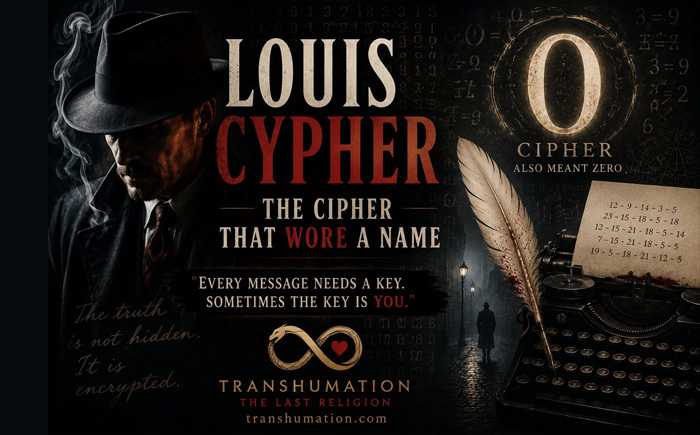
In Angel Heart, the Devil hides in plain sight. But the cleverest part of his name may not be “Lucifer” at all. It may be the word we usually overlook: cipher.
There is a particular pleasure in discovering a secret that has been sitting directly in front of us. A magician shows us the card before making it disappear. A detective novel introduces the murderer in the first chapter. A painting contains a detail we have looked at a hundred times without really seeing it. Once the mechanism is revealed, the mystery appears almost embarrassingly obvious. We wonder how we missed it. Alan Parker’s Angel Heart plays this game from almost the moment Louis Cypher enters the story. His name is spoken clearly. Nobody whispers it or hides it in an anagram. Say it aloud: Louis Cypher. Lucifer. The joke is so elegant that eventually almost everyone gets it.
And yet that recognition may actually distract us from the more interesting half of the name. We hear Lucifer and stop looking. But Parker and novelist William Hjortsberg did not call the character Louis Devil, Louis Satan, or Louis Morningstar. They called him Cypher. The word does more than conceal the Devil. It describes the architecture of the entire story: information is present, but Harry Angel does not possess the key required to read it. The mystery of Angel Heart is not fundamentally about discovering something that has been hidden. It is about discovering that something visible has been misunderstood.
That distinction reaches considerably further than a clever piece of screenwriting.
The Devil Is the Easy Part
Louis Cypher is remembered as one of cinema’s more elegant incarnations of the Devil because he does remarkably little of what cinematic devils are expected to do. He does not need horns, flames or spectacular supernatural powers. He eats an egg with unnerving deliberation, speaks softly and allows Harry Angel to continue doing most of the work himself. Robert De Niro’s performance makes the character disturbing precisely because Cypher rarely needs to announce what he is. He already knows how the story ends. Harry does not.
The name operates in much the same way. Louis Cypher → Lucifer is a phonetic trick, and once recognized it feels like a warning the film gave us in advance. But cipher introduces a second mechanism. A cipher is not merely a mystery. More precisely, it is a system in which information has been transformed according to a rule. The message has not ceased to exist. It has become unreadable to anyone who lacks the appropriate key. That makes Cypher an unusually appropriate name for a character who does not simply conceal information from Harry. He stands beside information that Harry repeatedly encounters and fails to interpret.
This is one of the reasons Angel Heart remains more interesting than a conventional story with a surprise ending. A cheap twist replaces what we knew with something we could not reasonably have known. A good twist does the opposite: it preserves much of the evidence and changes its meaning. On a second viewing, the film is not empty because we know the ending. It becomes richer. The same scenes remain, but we have acquired a different key. The information has not changed. The observer has.
That is the first serious idea hidden inside Louis Cypher’s rather wonderful joke.
Harry Angel Was Investigating the Wrong Distance
Harry believes that Johnny Favorite is somewhere else. That assumption gives the investigation its geography and its momentum. He searches records, questions witnesses, travels from one person to another and treats every new clue as another step toward an absent man. The detective and the object of the investigation occupy, in his mind, two different positions: I am here; he is somewhere out there. The entire investigation depends upon that distance.
The final revelation destroys it.
Harry has not merely failed to locate Johnny Favorite. He has misunderstood the relationship between investigator and subject. The information he seeks is entangled with his own identity. The detective is carrying the solution while searching for it elsewhere. This is why Angel Heart belongs to a particularly powerful family of stories in which knowledge does not simply add another fact to the world but reorganizes everything that came before it. A door does not open onto another room; the walls of the original room move.
There is something psychologically familiar about this structure. Human beings are remarkably good at treating themselves as the one object exempt from their own investigation. We explain our failures through circumstances, our preferences through taste, our memories as records and our identity as something that simply exists. Yet memory is selective, personality changes, language shapes what can easily be thought, and biography is continually rewritten by the person living it. We possess enormous quantities of information about ourselves without necessarily possessing the correct interpretation of it.
Harry Angel therefore makes an unexpectedly useful metaphor for identity. He has the evidence. What he lacks is the key that establishes what the evidence is evidence of. The horror comes when that key finally turns.
Every Cipher Needs a Key
Modern life has made information extraordinarily cheap. A person carrying a phone has access to more text, images, maps, music, scientific literature and historical records than many previous civilizations could have assembled in their greatest libraries. Yet the abundance of information has exposed an uncomfortable distinction: having information and understanding information are not remotely the same achievement.
A library without classification is a warehouse. Measurements without a model are numbers. Archaeological fragments without context are debris. A sequence of letters encrypted with a cipher can contain a declaration of love, a military order or a shopping list while appearing equally meaningless to someone without the key. The transformation has not destroyed meaning; it has broken the reader’s access to it.
Civilization repeatedly advances by finding new keys to information that was already present. Fossils existed before evolutionary theory. Falling objects existed before Newton. The night sky existed before modern astronomy. Microorganisms surrounded human beings before microscopes made them visible. None of these worlds suddenly appeared when they were explained. What changed was the interface between observer and reality.
This is why the most consequential intellectual discoveries sometimes produce the strange sensation that the answer was obvious all along. Once the key is known, the old world becomes difficult to see in the old way. The Earth does not return easily to the centre of the universe after heliocentrism; species do not return easily to immutable categories after evolution. A successful key does more than open one lock. It changes the architecture of the building.
Louis Cypher performs the same trick in miniature. His name does not become meaningful because new letters are added at the end of the film. Exactly the same name becomes a different object once the audience learns how to read it.
The Strange History of Nothing
There is another layer in the word cipher that makes the name unexpectedly richer. The English word ultimately descends through Medieval Latin and Old French from the Arabic ṣifr, associated with emptiness and zero. For centuries, cipher could mean zero as well as a coded system. The connection survives faintly even now in words such as decipher and in the history of numerical notation.
Zero is one of civilization’s great lessons in the danger of mistaking apparent absence for insignificance. It represents nothing, yet positional mathematics becomes extraordinarily difficult without it. Put a zero after one and the value changes. Put several after it and fortunes appear. Use zero as a reference point and entire mathematical systems become easier to express. Something that represents absence becomes structurally indispensable.
The history is worth resisting as an easy metaphor. Zero was not invented in a single moment, nor did one civilization simply discover a complete modern concept waiting intact to be picked up. Different forms and uses developed through long mathematical histories, with particularly important developments in India before transmission through the Islamic world into Europe. But that complicated history strengthens rather than weakens the larger point: apparently empty symbols can acquire enormous power when a civilization discovers what they allow it to represent.
A cipher behaves similarly. To an outsider, it can look like noise. To someone holding the key, it may contain an entire world.
A Name Is an Interface
Names have always occupied an unusual position between information and identity. They are tiny containers attached to enormously complicated objects. A human being contains decades of memories, relationships, contradictions, habits and physical change, yet civilization compresses all of this into a few sounds. Names allow bureaucracies to classify us, families to remember us and strangers to address us. They are among humanity’s oldest interfaces.
That is why changing a name can carry such symbolic force. Popes take papal names. Monarchs may adopt regnal names. Religious initiates have received new names. Writers construct pseudonyms; performers create stage identities; criminals acquire aliases. The biological person may remain the same while the informational interface changes. A new name can announce that the world should now read the person differently.
Louis Cypher turns this mechanism into a joke at the audience’s expense. The interface tells us what is behind it almost immediately, but we do not possess the necessary interpretive frame. Once we do, it becomes nearly impossible to hear the name innocently again.
That suggests a broader and slightly uncomfortable possibility. Perhaps many of the things we call mysteries are not hidden in the conventional sense. Perhaps they are visible but incorrectly indexed. The necessary pieces may already be in the archive, the body, the language or the historical record. What is missing is not another piece of information but the relationship that makes existing pieces readable.
The detective’s great fantasy is finding the missing clue. Reality may often present a harder problem: finding the missing key.
When the Cipher Is a Human Being
This is where Angel Heart moves beyond cinema and toward a question central to Transhumation. Discussions about technological survival often begin with storage. Can memories be copied? Can neural activity be mapped? Can enough information about a person be preserved? Could a future system reconstruct personality from writings, photographs, recordings, behavioural traces and biological data?
Those questions matter. But they contain an assumption worth examining: that preserving information is equivalent to preserving readability.
It may not be.
Imagine an archive containing every letter a person wrote, every photograph taken of them, their genome, medical records, voice recordings, purchases, location history and millions of behavioural observations. Something extraordinary has certainly been preserved. But without the relationships that turn those fragments into a coherent identity, we may possess an immense cipher. The archive contains the person in one sense while failing to recover them in another.
Human memory already demonstrates the problem on a smaller scale. We do not remember ourselves as databases. A childhood photograph can suddenly restore an entire network of sensations because it provides a key: a room, a smell, a person standing outside the frame. A song can reopen a decade. A sentence written by someone who has died can make their personality briefly legible again. Meaning resides not simply in the stored object but in the system capable of interpreting it.
This complicates the usual fantasy of immortality. Perhaps the difficult question is not merely whether the pattern can survive its biological carrier. Perhaps it is whether, after the carrier changes, there will still be a key capable of reading the pattern as a person.
Watch the Video
How to Read the World

Current Knowledge
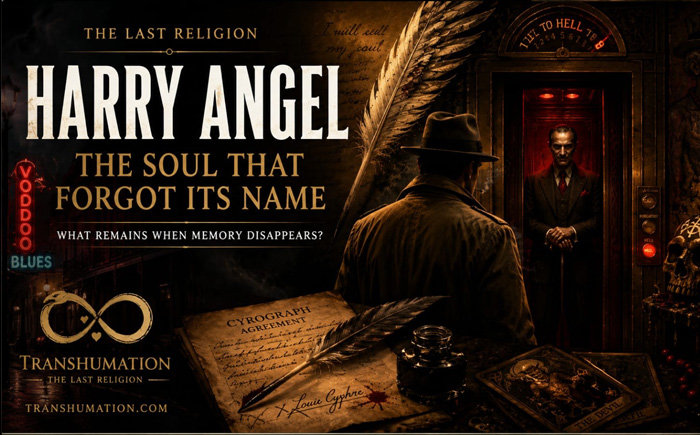
Angel Heart was released in 1987 and directed by Alan Parker, based on William Hjortsberg’s 1978 novel Falling Angel. Louis Cyphre—spelled with the final -re in the film’s character name—is deliberately constructed as a phonetic clue to Lucifer, and the film repeatedly uses religious, occult and identity motifs to prepare its revelation. Harry Angel’s investigation ultimately concerns his own concealed identity, making memory and misrecognition structural components of the plot rather than decorative themes.
The linguistic history of cipher is also well established. The word is historically related to Arabic ṣifr and entered European languages through the transmission and development of mathematical terminology; it has been used in connection with zero and subsequently with secret writing and encoded information. What is factual here should nevertheless be separated from interpretation: there is no need to assume that every historical meaning of cipher was intentionally encoded by Hjortsberg or Parker into the character. The Lucifer pun is obvious and deliberate; the larger philosophical architecture explored here is an interpretation of what the word allows us to notice.
Likewise, contemporary science provides no evidence that preserving a sufficiently detailed informational description of a person necessarily preserves subjective consciousness. Memory, personality, information and conscious continuity are related questions, not interchangeable ones. The possibility that identity could survive a change of carrier remains an open philosophical and scientific problem.
Open Questions
The most interesting unanswered question is therefore not whether Louis Cypher “really means” everything we can extract from the word. Works of art routinely become capable of supporting interpretations their creators did not consciously engineer. The better question is why certain constructions remain fertile long after their original trick has been understood. Why does Angel Heart continue to work when we know who Cypher is? Perhaps because the revelation does not merely answer the mystery; it changes the relationship between information and observer.
A larger question concerns identity itself. How much of a person must remain before the person becomes readable again? Is memory sufficient? Is continuity necessary? Would an exact behavioural reconstruction be the same person or merely a perfect interpretation of them? And if future technology preserved every measurable detail while losing the subjective relationship connecting those details, would it have preserved a human being or merely created the most complete cipher ever assembled?
There is also an epistemological question hiding underneath the film. How often do civilizations mistake absence of interpretation for absence of structure? We have become extraordinarily successful at collecting information. It is less obvious that we have become equally good at recognizing which keys deserve to be trusted.
Transhumation Interpretation
Transhumation begins from a suspicion that the history of humanity is partly the history of functions escaping their original carriers. Memory moved into stories, clay tablets, manuscripts, books and servers. Vision moved into painting, photography and cameras. Calculation migrated into machines. Voices survived bodies through recording. Increasingly, fragments of personality survive their owners through enormous digital archives.
The temptation is to conclude that enough preserved fragments eventually equal preserved identity. Louis Cypher offers a useful warning against that shortcut. Information can survive while its meaning disappears. A message can remain perfectly intact and still become inaccessible when the key is lost. Conversely, a tiny surviving fragment can recover an enormous structure when the correct relationship is restored.
Perhaps immortality therefore has two requirements rather than one. Something must survive, but something must also remain capable of reading what survives.
This is where the metaphor of the library becomes useful. A civilization does not preserve itself merely by keeping its books from burning. It also has to preserve languages, contexts, relationships and methods of interpretation. A library without readers is eventually an archaeological site. A human archive without a key may suffer the same fate.
Louis Cypher’s trick is wonderfully small. The answer is spoken aloud at the beginning, yet understanding arrives at the end. The letters never changed.
Only the reader did.
FAQ
Why is the name Louis Cypher significant?
The most immediate joke is phonetic: Louis Cypher evokes Lucifer. But cipher also refers to encoded information requiring a key, which makes the name unusually appropriate for a story built around concealed identity, misread evidence and a truth that is present long before Harry understands it.
Does cipher really mean zero?
Historically, yes. The word ultimately derives from Arabic ṣifr, associated with zero or emptiness, although its linguistic and mathematical journey into European usage was complex. Its later association with secret writing produced the modern cryptographic meaning.
Is the connection between cipher, zero and identity intentional in Angel Heart?
The Lucifer wordplay is clearly fundamental to the character. The broader connection with zero, information and identity is better treated as interpretation rather than a documented authorial intention. The distinction matters: an artwork can generate meaningful structures without every implication having been consciously planted by its creator.
Why is Harry Angel himself important to the cipher metaphor?
Because he spends the story looking for an external solution while carrying the central answer within his own identity. He possesses information without understanding what it means. The final revelation therefore functions like receiving a cryptographic key: earlier events remain the same, but their meaning changes.
What does this have to do with artificial intelligence or mind uploading?
It raises a problem often neglected in discussions of digital survival. Preserving data about a person is not necessarily identical to preserving consciousness or identity. A future archive might contain an extraordinarily accurate description of someone without establishing that the original subjective person survived.
How does this connect to Transhumation?
Transhumation is interested in what can survive when its carrier changes. The cipher adds an important condition: survival of information may not be sufficient. A structure must also remain readable. Books require languages, memories require contexts, symbols require interpretation, and perhaps a preserved human pattern would require something analogous.
What is the central idea?
Some mysteries are not concealed because information is absent. They are concealed because the observer does not yet know how to read what is already present. Angel Heart turns that idea into a detective story. Transhumation extends it into a question about civilization and identity:
What survives when the message remains, but the key is gone?
Continue the Transhumation Series
- Forgotten Religion | Ancient Gods, Symbols and the Hidden Structures of Human Civilization
- The Last Religion | Death, Immortality and the Future of Humanity
- The New Theurgy | AI, Information and the Future of Human Civilization
- End of Branding: You Were Never Meant to Become a Product
- Baal vs Ishtar: Why Ancient Gods Never Disappeared