
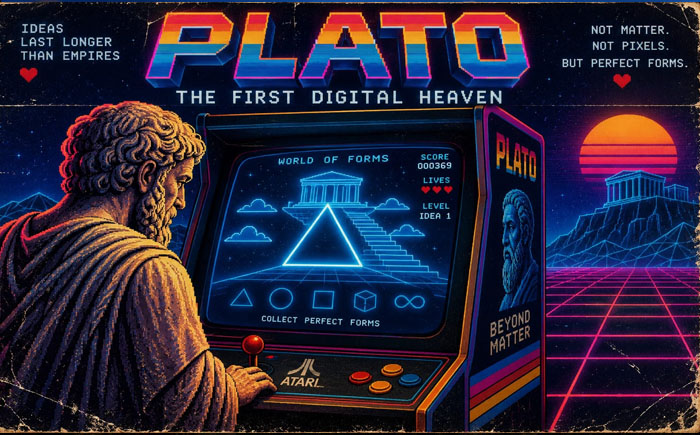
Reality Has Levels
Imagine giving Plato a modern laptop and beginning with the least impressive thing on it. No artificial intelligence. No satellite image of Earth. No simulated universe. Open an ordinary vector-design program and draw a triangle. Then enlarge it until it fills the screen, shrink it until it almost disappears, rotate it, copy it, send the file to another machine and print it ten thousand kilometers away. The pixels will change. The display will change. The printer, processor and storage medium may have nothing physically in common with the device on which the triangle was first created. Yet throughout the exercise we will comfortably speak of the same triangle.
That sentence would probably interest Plato more than the computer’s speed.
For more than two thousand years, the philosophical discomfort surrounding geometry has remained remarkably simple. We know what a perfect triangle means, yet no physical triangle appears to satisfy the definition perfectly. A pencil line has thickness. Stone has irregularities. A supposedly straight edge becomes a landscape under sufficient magnification. Even the sharpest manufactured corner occupies physical space rather than meeting at the dimensionless point described by geometry.
The mathematical relation nevertheless remains intelligible. We can reason about it, calculate from it and recognize instances of it despite the imperfections of every material example.
Plato turned this tension into one of philosophy’s most famous problems. The visible world changes, decays and presents imperfect particulars; knowledge seems capable of grasping structures that do not change in the same way. His theory of Forms was much richer than the popular image of perfect triangles floating in a supernatural warehouse, but geometry has always made the intuition unusually easy to feel.
Then humanity built computers for reasons that had almost nothing to do with Plato.
And the old problem acquired a new stage.
The Triangle That Refuses to Belong to the Screen
A triangle drawn on paper is tied to that particular mark. Copy it and you produce another drawing. Enlarge it photographically and eventually the imperfections enlarge with it. The physical inscription carries the geometry, but it also carries its own accidents.
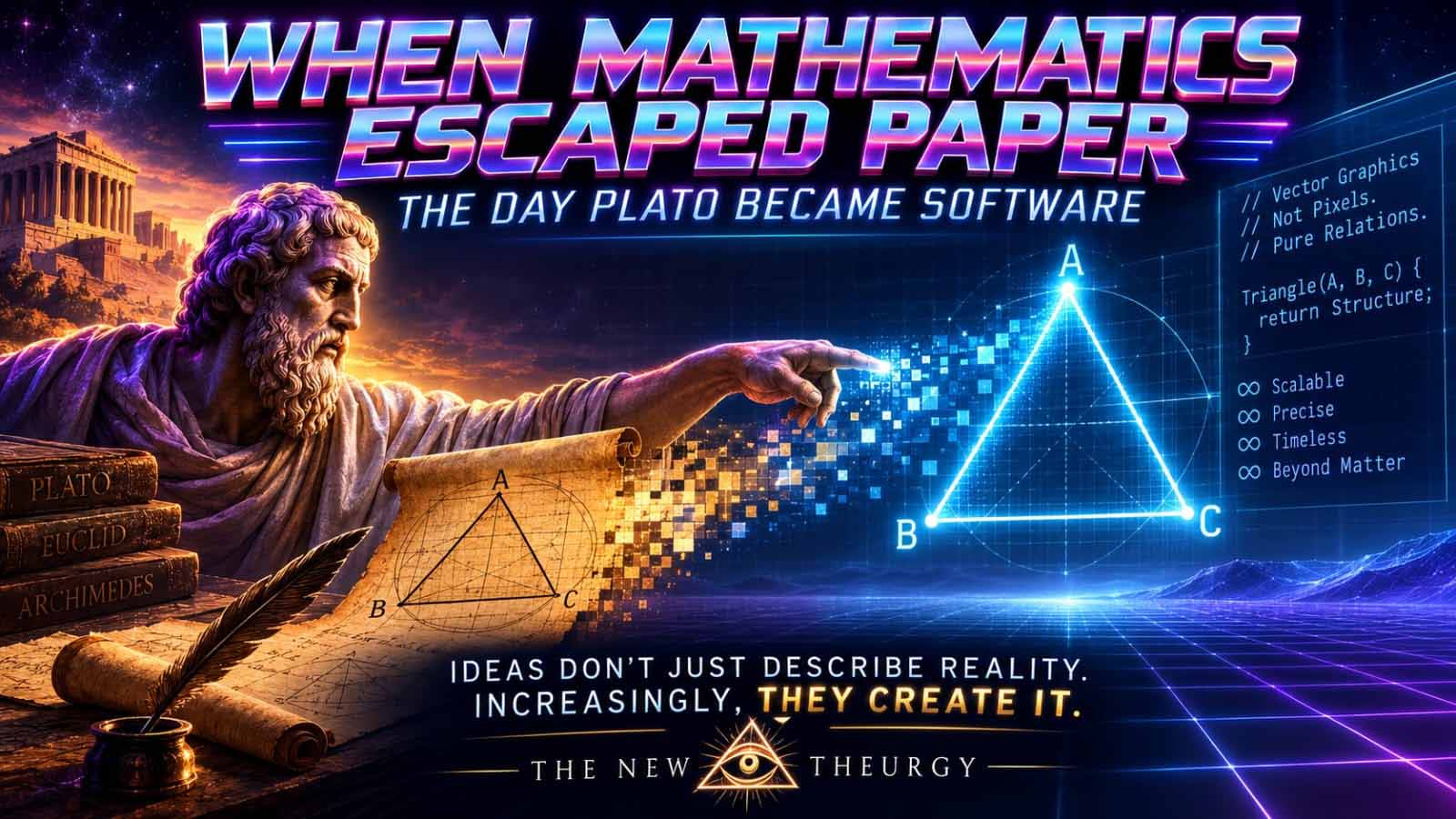
Vector graphics alter the relationship between representation and object. Instead of preserving only a fixed arrangement of colored pixels, software can represent a shape through mathematical descriptions: coordinates, paths, transformations and relations among points. When the image is displayed at a new scale, the system does not need to uncover a larger hidden photograph. It calculates another manifestation of the same defined structure.
This does not create a literally perfect triangle. Computers have finite memory. Numerical representations have finite precision. Screens have pixels and printers have tolerances. At some scale, every implementation reveals its physical limitations.
But something important has nevertheless changed.
The visible triangle has become temporary.
The relation used to generate it has become comparatively persistent.
One screen can disappear without destroying the object in the sense that matters to the software. One display can contain millions of different physical states from the next display while both instantiate what users recognize as the same vector form. The identity has migrated away from one particular picture and toward a rule capable of producing pictures.
This is not Plato’s world of Forms.
But it is a world in which Plato’s question suddenly feels less antique.
A Heaven Made of Instructions
The phrase digital heaven risks sounding mystical, which is precisely why it needs discipline.
Nothing inside a computer floats outside physics. Data requires material states. Servers occupy buildings. Processors heat up. Bits are implemented physically. Information does not hover in an immaterial electronic ether simply because a user cannot see the transistors working.
The strange achievement of digital civilization is different.
It has created environments in which the continuity of certain objects depends less upon preserving one physical instance than upon preserving enough structure to instantiate the object again.
A song can migrate from one storage technology to another. A text can pass from paper to magnetic disk to solid-state memory and still remain recognizably the same text. Software can move across compatible hardware. A three-dimensional model can become an image, a simulation or instructions for manufacturing a physical object.
The carrier never disappears.
The requirement for one particular carrier does.
That is the sense in which the digital world can feel Platonic. It has made carrier-independent structure part of ordinary life.
We no longer find it strange to say that the file survived after the laptop was destroyed.
A Roman philosopher might have found the sentence considerably stranger.

Reality Is Increasingly Built Twice
Walk through a modern aircraft factory and much of the aircraft has existed before the metal was assembled.
Not as an airplane.
As models.
Geometry.
Simulations.
Material specifications.
Control systems.
Stress calculations.
Software.
The same is increasingly true of buildings, automobiles, consumer objects and industrial machines. Designers manipulate informational representations before matter receives its final arrangement. Engineers can test a structure against simulated forces, examine airflow around a virtual wing or discover collisions between components before the corresponding physical object exists.
It would be exaggerated to say that matter now simply obeys information. Real materials refuse instructions every day. Manufacturing tolerances matter. Weather interferes. Concrete cracks. Biology ignores elegant models. Engineers remain employed precisely because a design does not automatically become reality merely because the mathematics is beautiful.
Still, the ordering has changed in a historically important way.
More of the physical world is preceded by an informational double.
The model is tested before the object.
The structure is altered before the steel is cut.
Increasingly, we manufacture matter by first manipulating relationships.
Civilizational power therefore shifts partly toward whoever can design, model, encode and control those relationships.
The blueprint was always important.
Now the blueprint can simulate the building before the building exists.
Plato Returns Without Winning
It would be easy to turn this into a triumphant headline: Plato was right.
Technology does not justify it.
Software does not prove that mathematical objects exist independently of minds. Vector graphics do not establish a transcendent realm. A Platonist, formalist, structuralist and nominalist can look at the same computer and continue disagreeing about what mathematics ultimately is.
What computing changes is the emotional plausibility of the problem.
Before digital technology, the distinction between ideal structure and material manifestation could feel remote from ordinary life. Today billions of people interact with it without philosophical training. They know intuitively that the same document can appear on several screens. They understand that deleting one shortcut does not necessarily delete the program. They distinguish a game from the particular console currently running it.
Digital culture has trained ordinary people to think in layers.
Instance.
File.
Model.
System.
Interface.
That hierarchy resembles an old philosophical instinct: the visible object may not exhaust the structure responsible for its appearance.
Again, resemblance is not proof.
But it changes the conversation.
Plato no longer needs only a cave.
He has a rendering engine.
The Digital World Is Less Perfect Than It Looks
There is an irony here. The more digital technology seems to approach ideal forms, the more closely engineering reveals imperfection inside the supposedly perfect world.
Files become corrupted.
Floating-point calculations accumulate error.
Formats become obsolete.
Software behaves differently across implementations.
Models contain approximations.
Algorithms fail at boundaries designers did not anticipate.
Even the immaculate mathematical triangle on the screen eventually reaches hardware.
The digital world is not heaven.
It merely allows us to separate certain structures from particular instances with unprecedented flexibility.
That distinction is valuable because it protects the idea from mysticism while making the genuine achievement more remarkable. Human civilization learned not to build an immaterial realm, but to construct long chains of re-instantiation.
The pattern passes through matter.
Matter changes.
Another material system reconstructs enough of the relation for continuity to survive.
The miracle, if we insist on using the word, is not escape from matter.
It is successful translation between matter.
The Ladder of Information
Seen over a longer period, computing becomes part of a much older civilizational trajectory.
Writing allowed an utterance to persist after the speaker had stopped speaking. Copying allowed a text to survive the destruction of one manuscript. Printing multiplied instances until the fate of one physical book mattered less to the fate of the work. Telegraphy and telecommunications loosened the relationship between information and geographic travel. Digital networks made copying and transmission dramatically easier across distance.
Each step reduced dependence on a particular carrier while creating new dependencies of its own.
The internet did not free knowledge from infrastructure. It made knowledge dependent upon electricity, networks, protocols, servers, formats and institutions.
Cloud computing did not place information in a cloud.
It placed it in somebody else’s machines.
That qualification matters because otherwise the Ladder of Information becomes a fairy tale in which civilization gradually ascends from matter toward pure spirit.
The historical pattern is subtler.
Civilization repeatedly invents better ways of moving structures between carriers.
That is already enough to change the world.
The Temptation of the Human Mind
Once we notice this pattern, the forbidden analogy arrives almost automatically.
The triangle can change screens.
The melody can change instruments.
The text can change paper.
Software can change hardware.
Why not the mind?
This is where the elegance of the argument becomes dangerous.
A triangle has no biography. A copy of a triangle does not wake up asking whether it is the original. A melody does not experience the transition from violin to piano. Software can be duplicated without creating an obvious metaphysical crisis because software does not ordinarily claim one unique first-person continuity through every instance.
A conscious person appears to introduce something else.
Imagine a future system capable of reconstructing your memories, language, preferences, emotional tendencies and neural organization with extraordinary fidelity. It runs on another substrate. It recognizes your family. It remembers childhood episodes that no other person knows. It completes your unfinished sentences.
Would that prove that you crossed?
Now leave your biological body alive while the reconstruction starts.
There are suddenly two subjects claiming the same history.
The carrier-independent pattern may have survived.
The continuity problem has not disappeared.
This is why mind uploading should not yet be described as the inevitable next rung of information technology. The history of media proves that many patterns can migrate. It does not prove that first-person consciousness belongs to the same category.
The question has become technologically imaginable.
It has not become technologically answered.
When the Model Becomes More Valuable Than the Object
Digital civilization also changes value.
In many industries the expensive thing is no longer simply the manufactured object. It is the design, software, process knowledge, dataset, patent, model or network that allows the object to be produced repeatedly.
Destroy one manufactured unit and production continues.
Destroy the relevant knowledge and manufacturing may stop.
This does not mean information is universally more fundamental than matter. A semiconductor design without fabrication capacity is not a semiconductor. A drug formula without chemistry, manufacturing and regulatory infrastructure does not treat anyone. A digital architectural model does not keep rain off the inhabitants.
But it reveals another important distinction.
The object can be replaceable while the generative pattern is scarce.
That reverses one of the intuitions of material civilization. The visible artifact may no longer be the most valuable layer.
The treasure is increasingly the ability to make it appear again.
Perhaps this is the most genuinely Platonic quality of the digital economy: power migrates from possession of instances toward control of generative structures.
The First Digital Heaven
So where is this supposed heaven?
Not in the cloud.
Not beyond matter.
Not inside some hidden metaphysical server room.
It exists, if the metaphor is worth keeping, in the strange cultural space where civilization has learned to treat some relationships as more continuous than the physical objects through which they temporarily appear.
The digital triangle appears, disappears and appears again.
The machine can be replaced.
The file can move.
The rendering changes.
Enough structure persists for the object to remain recognizable.
This is not immortality.
It is not transcendence.
It is not evidence of God, Plato’s Forms or the independence of consciousness from biology.
It is something historically narrower and philosophically enormous.
Humanity has built an environment in which re-instantiation is normal.
Once that becomes ordinary for texts, images, algorithms, simulations and artificial worlds, it becomes almost inevitable that we will begin asking which other things might survive the same treatment.
That is where Plato becomes dangerous again.
Not because he told us the answer.
Because after two thousand years, technology has made his question practical.
Watch the Video
How to Read the World
Current Knowledge
Plato’s theory of Forms concerns stable intelligible realities or structures in contrast with changing particular things, although its precise interpretation is debated and varies across his dialogues. Modern digital technology does not provide experimental evidence for Platonic metaphysics.
Vector graphics represent visual forms through mathematical descriptions such as points, paths and curves rather than relying solely on a fixed grid of pixels. This allows the same defined object to be rendered at different resolutions and sizes, while actual implementations remain limited by numerical precision, hardware and display technology.
Digital information always requires physical implementation when stored, transmitted or processed. A file can migrate among different devices, but it never exists operationally without some physical carrier. What digital systems demonstrate is therefore not independence from matter but reduced dependence on one particular material instance.
Modern engineering increasingly uses digital modeling, simulation and software before physical manufacture. These models can predict and test selected properties of future objects, but they remain approximations whose usefulness depends upon correspondence with physical conditions.
There is currently no scientific evidence that the transferability of software, files or mathematical descriptions establishes the transferability of human consciousness between substrates.
Open Questions
One open question remains philosophical: are mathematical structures discovered, invented or better understood through some position that does not fit cleanly into either category? The remarkable effectiveness of mathematics in technology keeps the question alive without resolving it.
Another concerns identity. We can often define which features must remain invariant for a digital object to count as the same file or model, but increasingly complex systems make those criteria less obvious. At what point does modification produce another object rather than another instance?
The biological case is harder because living systems depend upon chemistry, embodiment, developmental history and continuous interaction with environments. It remains unknown how much of the organization associated with a mind could be transferred to another substrate without changing the phenomenon we are trying to preserve.
Artificial intelligence intensifies the problem by showing that sophisticated behavior can emerge from executable mathematical structures. Whether increasingly human-like behavior would imply human-like subjective experience remains unresolved.
Transhumation Interpretation
The First Digital Heaven should not become a story about humanity escaping matter.
It should become a story about civilization learning how to preserve relationships while matter changes.
That distinction is the foundation.
A book survives when another carrier can reproduce its text.
A vector form survives when another system can reproduce its geometry.
Software survives when another compatible machine can implement its operations.
A mathematical structure survives because no single sheet of paper owns it.
This gives Transhumation a powerful but falsifiable principle: some things appear to have identities that are at least partly carrier-independent.
The mistake would be turning some into everything.
We do not yet know whether consciousness belongs in the same category.
This is where the First Digital Heaven meets the Carrier and the Pattern, the Triangle and the Julian Experiment. Together they lead toward a sequence of increasingly difficult questions. Can a structure survive a new carrier? Which properties must remain invariant? Does replication preserve identity or merely resemblance? And if two perfect instances exist at once, what exactly would make either one the continuation of the original observer?
The digital world solves the first question constantly.
It has barely touched the last.
That is why I would resist the seductive line that artificial intelligence will “separate intelligence from biology.” We may eventually discover forms of machine intelligence genuinely independent of biological cognition, but that would not mean human intelligence had been extracted from biology. A new intelligence and a transferred intelligence are very different achievements.
The distinction is the entire philosophical problem.
A submarine does not prove that fish have escaped biology merely because both can move underwater.
Likewise, an artificial cognitive system could demonstrate that some forms of intelligence are possible in non-biological carriers without proving that a biological person’s consciousness can migrate into one.
Plato’s relevance therefore lies somewhere more interesting than prediction.
He forces us to ask what survives behind changing appearances.
Digital technology forces us to make that question operational.
For a triangle, we can specify the invariant relations.
For a program, we can define enough functional continuity to execute it elsewhere.
For a human being, the relevant invariants remain unknown.
Memory?
Personality?
Embodiment?
Causal continuity?
A particular dynamic process?
Something about consciousness we have not yet identified?
Perhaps several of these together?
This uncertainty is not a weakness in the argument.
It is the reason the argument matters.
The digital world has taught civilization that some patterns can travel.
The philosophical error would be assuming that because the road exists, everything can travel on it.
That is the boundary of the First Digital Heaven.
It is not a paradise where matter has finally been defeated.
It is a laboratory in which humanity discovered that the same structure can repeatedly return through different matter.
Plato did not tell us where that road ends.
Neither does the computer.
For the first time, however, we have begun to walk far enough along it that the next question no longer sounds entirely metaphysical.
What else can cross?
FAQ
What is “The First Digital Heaven”?
It is a metaphor for digital environments in which some structures can be recreated across many different physical carriers without depending on one original material instance.
Do perfect triangles exist inside computers?
Not literally. Computers have finite precision and physical limits. They can, however, represent mathematical relationships with enough abstraction that the same geometric structure can be rendered across very different devices.
Does digital technology prove Plato was right?
No. It makes some Platonic questions unusually intuitive, but it does not establish the existence of a separate realm of Forms.
Is information independent of matter?
Not according to established science. Information always requires physical implementation. What can become relatively independent is its dependence on one particular carrier.
Is civilization becoming more Platonic?
In a limited sense, perhaps. Modern engineering increasingly manipulates models, relationships and generative descriptions before creating particular physical objects. That is an analogy, not proof of Platonic metaphysics.
Could a human mind eventually change carriers?
We do not know. Technology demonstrates that many patterns can migrate between carriers, but personal consciousness adds unresolved questions about embodiment and first-person continuity.
The digital world has already taught us how to preserve a triangle without preserving its screen.
The question is whether a human being is the same kind of thing.
That is where the metaphor ends—and the real problem begins.
Continue the Transhumation Series
- Forgotten Religion | Ancient Gods, Symbols and the Hidden Structures of Human Civilization
- The Last Religion | Death, Immortality and the Future of Humanity
- The New Theurgy | AI, Information and the Future of Human Civilization
- End of Branding: You Were Never Meant to Become a Product
- Baal vs Ishtar: Why Ancient Gods Never Disappeared