
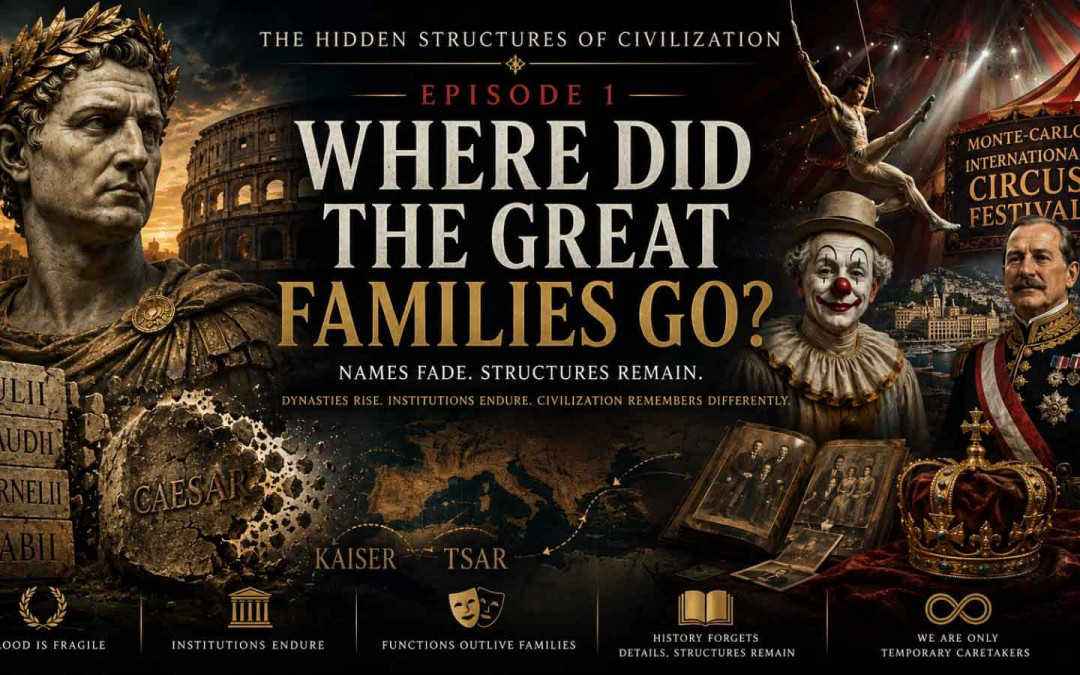
Institutions Learn to Live Without Their Founders.
In a wealthy Roman house, the dead could remain politically useful.
Aristocratic families preserved imagines—ancestral portraits or masks associated with distinguished forebears—and displayed lineage as a form of public capital. At elite funerals, the past could appear to walk beside the living. The message was difficult to misunderstand: this man does not arrive alone. Behind him stand magistrates, generals, senators and the accumulated authority of a name.
To a Roman aristocrat, inheritance was therefore more than property.
It was expectation.
A son inherited allies, enemies, obligations, stories and the burden of ancestors whose achievements had already established a standard against which his own life would be measured. The family name functioned almost like an institution before modern corporations existed.
Then history performs one of its favorite tricks.
The name remains visible while the people carrying it become harder to find.
The Julii, Claudii, Cornelii, Fabii and Aemilii dominate the narratives of republican Rome, yet the later empire fills with new elites, provincial aristocracies, military dynasties and emperors whose paths to power would have looked strange to the political world of Scipio or Caesar.
What disappeared?
Not simply families.
Something more interesting happened.
Blood, name, function and institution began to separate.
That process never stopped.
What Happened to the Great Roman Families?
It would be misleading to imagine the Roman Republic as a neat club of a few biological families that simply vanished when Augustus arrived.
Roman elite continuity was messier.
Family lines could die out biologically, but aristocratic identity could also move through adoption, marriage, inheritance and political alliance. A prestigious name might be preserved or incorporated even when direct descent became complicated. The Romans themselves were therefore less obsessed with our modern genetic idea of authenticity than the phrase ancient bloodline sometimes suggests.
Augustus makes the point beautifully.
He was born Gaius Octavius, not Julius Caesar’s biological son. Caesar adopted him testamentarily, and the young Octavian entered the Julian political inheritance. The transfer did not rewrite biology. It rewrote political identity.
That distinction matters.
Rome had discovered that continuity could be institutionalized.
An heir did not need to reproduce every biological relation of the predecessor in order to inherit the structure surrounding the name.
As the empire expanded, this became increasingly important. Political competence, military support, imperial administration, wealth and provincial networks competed with old republican pedigree. Ancient family prestige remained valuable, but it was no longer the only route into the center.
The Empire did not simply abandon blood.
It enlarged the number of ways power could reproduce itself.
Why Do Great Families Disappear?
The obvious answer is biological.
Families are fragile.
A line can end because there is no surviving child, because heirs die young, because disease intervenes or because daughters carry ancestry into another surname. War can destroy a generation. Political purges can remove several branches at once.
But biological extinction is only one mechanism.
A family can survive genetically while disappearing politically.
Its descendants may still exist, but no longer possess the fortune, office, land or network that once made the name historically consequential.
The reverse can also happen.
The biological line may end while the name becomes more powerful than ever.
This is the strange point.
Historical survival has several different carriers.
DNA.
Surname.
Property.
Institution.
Brand.
Title.
Memory.
They often begin attached to the same family.
History gradually pulls them apart.
When the Name Escapes the Family
McDonald’s is an almost absurdly clean modern example.
The company began with Richard and Maurice McDonald, yet the global institution that carries their surname long ago ceased to be their family enterprise. The name survived because it became attached to an operating system larger than the people who originated it.
Gucci tells another version of the story.
A family name became an international luxury brand whose commercial identity eventually detached from family control. Consumers can recognize the word, the typography, the aesthetic and the prestige without knowing which members of the Gucci family are alive or whether any of them control the company.
Halston shows an even stranger possibility.
A creator can turn his own name into a commercial object and eventually lose control over the object bearing that name.
At that point a name stops behaving like ordinary identity.
It becomes transferable capital.
The person remains biological.
The name becomes infrastructure.
This is why founders often discover a disturbing truth too late: once a symbol becomes useful to enough other people, its future may no longer belong to its creator.
Why Did Caesar Become a Title?
Julius Caesar provides perhaps the most spectacular example of a name escaping its owner.
Caesar began as the cognomen of a branch of the Julian family.
Then Julius Caesar’s political legacy and the succession surrounding Augustus transformed the word.
Over time, Caesar became attached to imperial office and rank rather than merely one family identity. Long after any plausible continuity with Julius Caesar’s household had vanished, the sound survived in new political languages.
Kaiser.
Tsar.
The biological Caesar was gone.
The phonetic and political pattern continued moving.
This is almost the opposite of genealogy.
Normally, a name identifies a person through a family.
Here, the person transformed the name so radically that the name escaped the family and became a function.
A Roman cognomen turned into a reusable symbol for sovereignty.
Very few human beings have ever achieved that peculiar form of survival.
Not immortality.
Not even lineage.
Semantic succession.
Can a Family Name Outlive the Family?
Yes, because a name can migrate to another carrier.
This seems obvious once stated, but it has deep implications.
A surname originally depends upon people repeatedly giving it to descendants.
A brand depends upon contracts, trademarks, institutions and consumers.
A title depends upon political recognition.
A reputation depends upon archives and repeated cultural reference.
These are very different survival mechanisms.
The same word can move from one to another.
This is why cultural continuity can persist after biological continuity breaks.
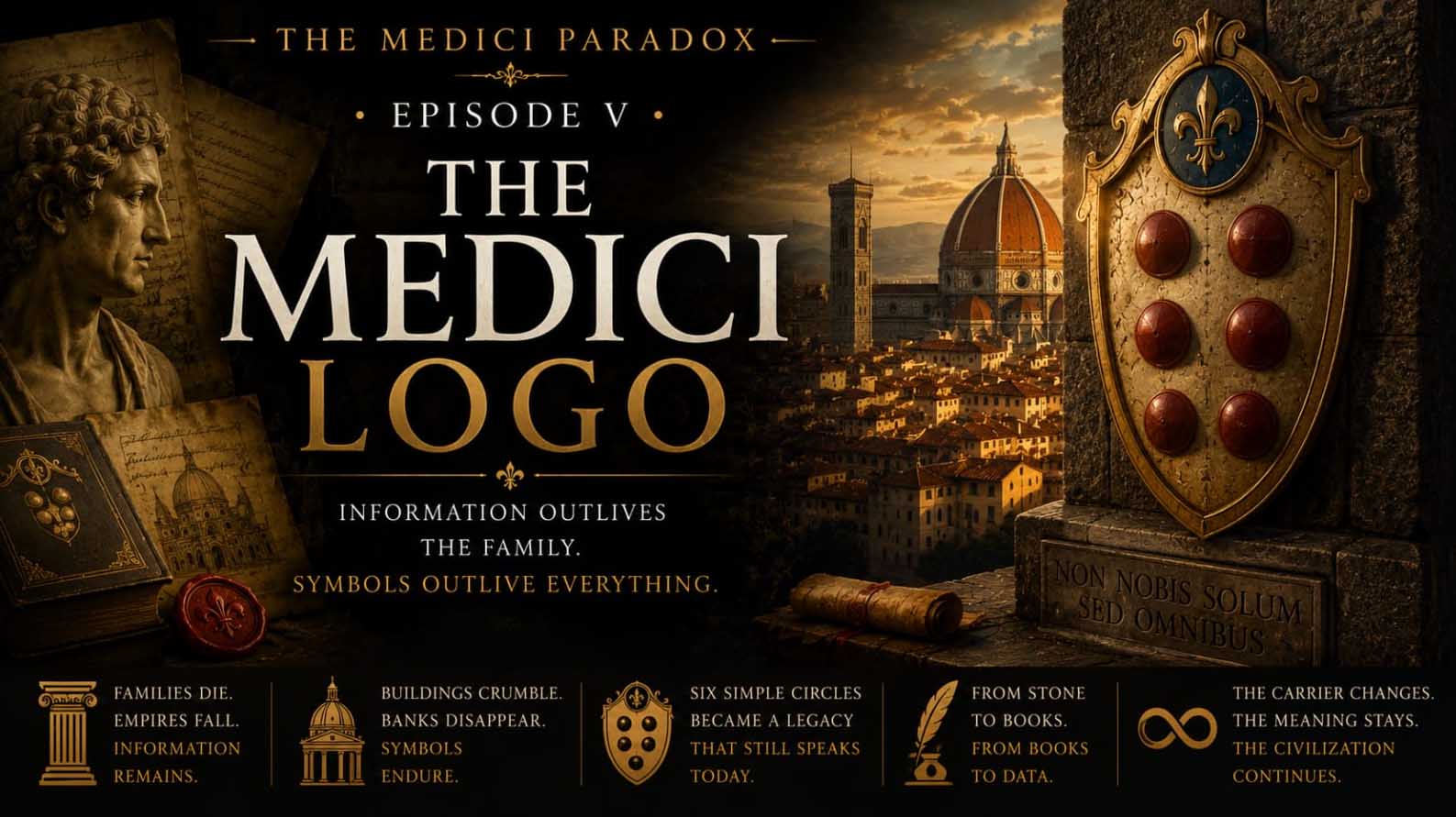
The Medici provide a powerful example. The ruling grand-ducal line ended in the eighteenth century, yet the name remains attached to Florence, art patronage, banking, political history and the Renaissance with extraordinary force.
The Medici no longer need to govern Florence for the word Medici to function.
It has become an address inside cultural memory.
The family produced the carrier.
Civilization kept copying it.
The Grimaldi Counterexample
Then there is Monaco.
The Grimaldi name is useful precisely because it prevents the theory from becoming too elegant.
Not every famous dynasty dissolves into abstraction.
Some survive.
The House of Grimaldi has remained associated with Monaco across centuries, even though dynastic continuity, like all dynastic histories, is more complicated than a simple uninterrupted line of genetically identical surnames marching through time.
This tells us something important.
History does not contain a law saying that institutions inevitably replace bloodlines.
Sometimes family, title, political institution and cultural image remain connected for extraordinary periods.
That survival requires conditions.
Succession has to work.
The political structure must remain viable.
The name must retain legitimacy.
External forces must fail to destroy the institution completely.
The dynasty must adapt enough to survive without changing so much that recognition disappears.
This resembles the problem faced by every durable structure.
Too little change and it becomes brittle.
Too much change and continuity becomes meaningless.
A dynasty survives not because nothing changes.
It survives because change remains constrained by recognition.
Rome Was Built by Families — and Something Larger
The republican Roman elite demonstrates the strengths and limitations of family organization.
Families preserve long memory well.
They can transmit education, alliances, property, political technique and social expectations through generations. A child raised inside such a structure begins life with access to a library of relationships accumulated before birth.
But family systems have a built-in weakness.
Biology is unpredictable.
Competence is not inherited reliably.
A brilliant founder can produce an incompetent heir.
A dynasty can fail because one generation happens to contain no suitable successor.
Institutions solve part of this problem by separating function from blood.
An army does not need the commander’s son to be the best next commander.
A university does not need the founder’s descendants to become professors.
A corporation can appoint managers unrelated to its creator.
A state can, at least in principle, transfer authority according to rules rather than chromosomes.
Institutional civilization gains resilience by making important functions portable between people.
The office survives the officeholder.
The archive survives the archivist.
The crown survives the king.
That is one of civilization’s great inventions.
Why Do Family Businesses Lose Their Founders?
Because founding and maintaining are different skills.
The individual who creates a company may excel at risk, improvisation, product intuition or persuasion. A mature company requires accounting, governance, succession, legal systems, logistics and increasingly impersonal forms of management.
The very success of the founder creates a structure that becomes difficult for one family to control.
Capital may be required.
Investors arrive.
Shares spread.
Professional management appears.
A family conflict creates pressure to sell.
Eventually the institution becomes valuable enough that its continuity matters more commercially than the founder’s emotional ownership.
This can feel like betrayal.
Structurally, however, it is often a sign that the thing has become larger than the conditions that produced it.
A restaurant can remain inseparable from its cook.
A global chain cannot.
The founder’s greatest success may therefore contain the mechanism of their own displacement.
They created something capable of surviving them.
Then they discover that survival sometimes requires independence from them.
The Founder’s Paradox
This is one of the least romantic facts about creation.
We celebrate founders as though successful creation should grant permanent authority.
But the better the creation succeeds, the less reasonable that assumption can become.
A city belongs to more than its architect.
A language belongs to more than the people who first spoke a particular form of it.
A religion becomes larger than its first generation.
A scientific theory, once published, belongs partly to the community capable of testing and modifying it.
Even a book escapes its author in a limited sense.
The author controls the words placed on the page.
They do not control every interpretation that future readers will produce.
Creation therefore contains a quiet transfer.
At first:
I made this.
Later:
This exists.
Eventually:
Others are responsible for what happens to it now.
That movement from creator to caretaker may be one of the central architectures of civilization.
Civilization Does Not Preserve Everything
There is a dangerous temptation here to make history sound wiser than it is.
Civilization does not automatically preserve the best functions.
It preserves what receives carriers.
A brilliant institution can disappear.
A terrible institution can survive.
A mediocre book can remain because copies happened to endure while a better work vanished in a fire.
Families with enormous cultural importance can disappear from public memory while trivial surnames continue without interruption.
Survival is not a verdict of merit.
It depends upon copying, power, institutions, accidents, archives and attention.
This is crucial.
To say that Roman law influenced later civilizations does not mean civilization objectively “chose” Roman law because it was superior in every respect.
Historical transmission is not natural selection with a moral scorecard.
Carriers matter.
The copyist matters.
The archive matters.
The conqueror matters.
The teacher matters.
The caretaker matters.
Blood Is Fragile. Information Is Fragile Too.
The original article says that blood is fragile while information is resilient.
That needs one correction.
Information is resilient only when something keeps carrying it.
A manuscript can burn.
A language can lose its speakers.
A file format can become unreadable.
A password can disappear with its owner.
A brand can collapse.
A title can become meaningless when the institution recognizing it vanishes.
Information does not float outside matter waiting eternally to be recovered.
It requires physical carriers, interpreters and repeated transfer.
But it possesses one extraordinary advantage over biological inheritance:
it can sometimes change carriers.
A genetic lineage cannot simply decide that a better unrelated person will become the biological son.
An institution can.
A poem can move from papyrus to parchment, print, microfilm and server.
A political title can migrate between languages.
A company can survive owners.
This makes cultural patterns potentially more flexible than bloodlines.
Not immortal.
Carrier-independent in a limited sense.
Never carrier-free.
From Dynasty to Institution
There may be a broad historical movement here, although it should not be exaggerated into a law.
Early political systems often attach authority strongly to persons, households and dynasties because personal relationships provide trust where formal institutions are weak.
As institutions become more complex, some functions become increasingly detached from the identity of the person performing them.
The tax office should work when its director retires.
The court should not collapse when a judge dies.
The railway should not require the founder’s grandson to understand the timetable.
This is a profound transformation.
A family asks:
Who are you descended from?
An institution increasingly asks:
Can you perform the role?
Civilization becomes scalable when function can survive replacement of personnel.
This is also why bureaucracies feel impersonal.
Their great strength is precisely what can make them feel cold.
The system does not need to love the officeholder.
It needs the position filled.
The Caretaker Instead of the Owner
This returns us to the garden.
A dynasty may believe it owns the kingdom.
A founder may believe they own the company.
A generation may believe it owns the civilization it inherited.
Time eventually corrects all three.
Ownership is temporary even when law pretends otherwise.
The Medici had Florence for a while.
The Caesars had Rome for a while.
A modern CEO has an institution for a while.
Even an extraordinarily long-lived person would eventually discover that control and permanence are different things.
Caretaker is therefore not a sentimental word.
It is a more accurate description of the temporal position.
You inherit a structure whose origin predates you.
You modify it.
Some parts improve.
Some parts deteriorate.
Then control passes onward.
The mature question is not simply:
What do I possess?
It is:
In what condition will this be when it no longer belongs to me?
What Makes a Dynasty Survive?
Longevity requires several forms of continuity at once.
There must be biological or legally recognized succession.
The name must remain legitimate.
Enough property or institutional power must survive.
The surrounding political environment must continue recognizing the dynasty.
The family must adapt without dissolving its recognizable identity.
This last condition may be the most important.
Absolute preservation is impossible.
A dynasty that survives seven centuries cannot behave exactly as it did in its first century.
The world around it changes too much.
The successful dynasty therefore preserves an invariant while allowing almost everything else to move.
The difficulty lies in identifying the invariant.
The name?
The territory?
The office?
The public ritual?
The story?
This is the same problem that appears throughout Transhumation.
What can change while something remains recognizably itself?
A dynasty is simply the historical version of the Ship of Theseus.
The Last Descendant Is Not the End
Suppose the last member of a famous family dies tomorrow.
What has ended?
One biological lineage, perhaps.
But the answer depends upon which structure interests us.
If the family’s archive remains, historical memory continues.
If a foundation carries the name, institutional action continues.
If a brand survives, commercial recognition continues.
If buildings remain, architectural consequence continues.
If laws or ideas shaped by the family still influence behavior, causal effects continue.
None of this means the family itself remains alive.
That distinction matters.
We should not call cultural persistence biological survival.
But neither should we treat death of the lineage as complete erasure.
A person can disappear while consequences remain.
A family can disappear while a name continues functioning.
An institution can disappear while its rules survive elsewhere.
Civilization is filled with these partial continuities.
The mistake is demanding that they all mean the same thing.
Watch the Video
How to Read the World
Current Knowledge
Roman elite society placed major importance on family lineage, ancestry and inherited status, but Roman continuity was not based solely on biological descent. Adoption, marriage, inheritance and political alliance could transmit names, property and social position.
Many prominent republican families declined, fragmented or lost political importance over time, while imperial elites increasingly included individuals from wider geographic and social backgrounds. This was gradual rather than an abrupt disappearance of all old families.
The name Caesar evolved from a Roman family cognomen into an imperial designation. Later political titles including Kaiser and Tsar derive historically from that name, demonstrating how a personal or familial identifier can become detached from its biological origin.
Modern family names can similarly become independent brands or institutions. McDonald’s and Gucci are examples of commercial identities that continued after the founding families lost control of the enterprises associated with their names.
Cultural and institutional continuity requires carriers. Names, laws, texts and organizations can sometimes survive changes of people and material form, but none survives automatically or without repeated preservation and recognition.
Open Questions
One major question is what historians should count as the survival of a family. Biological descent, surname continuity, property, political office and cultural identity can persist independently, making “dynastic survival” less simple than it appears.
Another concerns institutions. Detaching function from family succession can make systems more resilient, but impersonal institutions can also lose the long-term responsibility and memory that strong family structures sometimes provide.
Brands create a modern version of the same problem. When a name becomes commercially valuable independently of the people who created it, who meaningfully owns the identity represented by the name: descendants, shareholders, customers or the institution itself?
The deepest question concerns continuity. If almost every individual component of a dynasty, company or civilization is replaced over time, what invariant must remain before we are justified in calling it the same structure?
Transhumation Interpretation
For Transhumation, great families are useful because they reveal the difference between origin and continuity.
Blood can produce a structure without remaining necessary for the structure’s later survival.
A name may become a title.
A family enterprise may become an institution.
A founder may become a symbol.
The important question is not whether something survives unchanged.
Almost nothing does.
It is whether enough of the relevant pattern crosses from one carrier to another for later generations still to recognize the structure.
That is where genealogy becomes civilization.
FAQ
Why do great families disappear?
Some biological lines end, while others lose wealth, political power or cultural relevance. A family can also continue genetically while the name ceases to matter historically.
Did Rome’s great republican families simply vanish under the Empire?
No. The transition was gradual. Some families continued, while new elites rose and adoption, marriage and political change altered the structure of aristocratic continuity.
Why did “Caesar” become a title?
The prestige of Julius Caesar and the imperial succession attached his name increasingly to rulership. Over time the word moved beyond one family and became part of imperial political language.
Can a family name survive after the family loses control?
Yes. Brands such as Gucci or McDonald’s show how a surname can become an independent commercial institution recognized by millions of people with no direct relationship to the original family.
What makes a dynasty survive for centuries?
Successful succession, institutional stability, political legitimacy and the ability to adapt while preserving a recognizable core all matter. There is no single guaranteed formula.
What is the deeper Transhumation question?
The deepest question is not where the great families went.
It is what left with them, and what discovered how to survive without them.
Julius Caesar died.
Caesar continued.
The Medici ceased to rule.
Medici remained a permanent address inside the history of Florence.
The McDonald brothers left the company.
Their surname crossed the planet.
A family begins as bodies connected by descent.
A dynasty adds memory and authority.
An institution adds rules.
A brand adds recognition.
A civilization adds the ability to pass useful structures into hands that have no biological relationship with the people who began them.
Perhaps that is the larger movement hidden inside the disappearance of great families.
Civilization does not escape mortality by keeping the same people alive.
It survives by learning how to continue important structures after the people who created them are gone.
The great family therefore does not always fail when it loses control.
Sometimes losing control is the proof that what it created has become larger than the family itself.
And perhaps the most mature founder, dynasty or generation eventually faces the same uncomfortable truth:
you were never the final owner.
You were holding the keys for a while.
Continue the Transhumation Series
- Forgotten Religion | Ancient Gods, Symbols and the Hidden Structures of Human Civilization
- The Last Religion | Death, Immortality and the Future of Humanity
- The New Theurgy | AI, Information and the Future of Human Civilization
- End of Branding: You Were Never Meant to Become a Product
- Baal vs Ishtar: Why Ancient Gods Never Disappeared