
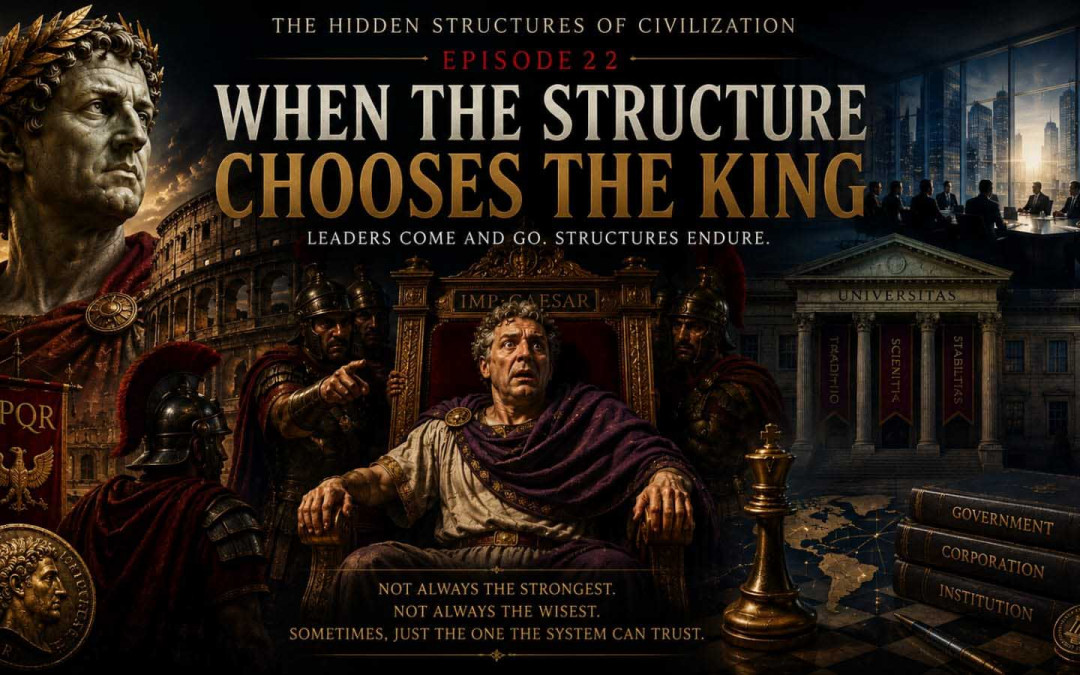
Kings & Structures
On January 24, AD 41, Rome discovered an uncomfortable fact about political systems.
An emperor could be murdered.
The imperial office was harder to kill.
Caligula was dead, struck down in a conspiracy involving officers of the Praetorian Guard. For several hours the political future of Rome became genuinely uncertain. Senators discussed what should follow. Some could imagine a restoration of republican authority, or at least a redistribution of powers that had accumulated around one man and his household. The palace, meanwhile, had become a dangerous place filled with assassins, soldiers, servants and members of a dynasty suddenly unsure whether they were relatives of the former emperor or potential victims of the next purge.
Then Claudius emerged.
Ancient sources preserve the memorable story that soldiers discovered him hiding inside the palace and, instead of killing him, proclaimed him emperor. The scene has survived because it possesses almost theatrical perfection: the reluctant, underestimated man concealed behind the machinery of power is suddenly dragged into its center.
The story should not be taken too literally.
Claudius was no accidental civilian. He belonged to the ruling family and carried one of the most valuable political currencies in the Roman world: recognizable dynastic legitimacy. Yet the episode still reveals something larger than the personality of one man.
Rome had lost its emperor.
Rome discovered that it still required an emperor-shaped solution.
Why Did Claudius Become Emperor?
The easiest version of the story is also the most misleading.
Caligula dies. Claudius is found. The guards need somebody. They choose him.
Reality was more complicated.
Claudius was the surviving adult male of an extraordinary political family. He was the brother of Germanicus, whose memory remained powerful, and a member of the Julio-Claudian dynasty created through an intricate architecture of birth, marriage, adoption and political inheritance.
This matters because Roman imperial succession was never simply hereditary monarchy in the later European sense.
There was no single clean rule saying that the eldest biological son automatically inherited the empire.
Legitimacy could move through blood, adoption, marriage, military support, senatorial recognition and the accumulated prestige of names.
Claudius therefore possessed something a random senator did not.
He fitted the existing structure.
That may be more important than saying the structure “wanted” him.
Institutions do not possess desires in the way people do.
But they create constraints.
After Caligula’s death, several futures were theoretically imaginable. In practice, some were much easier to stabilize than others.
A recognizable member of the imperial family backed by the Praetorian Guard offered continuity with comparatively little conceptual reconstruction.
The system had found a compatible carrier.
The Throne Survived the Emperor
This is the deeper point.
Early in a political order, the person and the institution can be difficult to separate.
Alexander’s empire depended enormously on Alexander.
When he died, succession became a struggle over pieces of a structure that had not yet fully learned how to exist without its creator.
By AD 41, the Roman principate had crossed into a different condition.
Augustus had been dead for more than two decades.
Tiberius had ruled.
Caligula had ruled.
Now Caligula was dead too.
The office remained imaginable.
People knew what an emperor was supposed to look like socially even when they disagreed about who should become one.
There was an imperial household.
There was a Praetorian Guard.
There were provinces accustomed to receiving instructions through imperial authority.
There were legal, financial and military relationships that assumed somebody occupied the center.
The structure had accumulated dependencies.
The emperor was still extraordinarily powerful.
But paradoxically, the office had begun becoming more durable than any emperor.
This is one of civilization’s most important transitions.
A founder creates a role.
Eventually the role learns how to survive the founder.
Can an Institution Choose Its Leader?
Not literally.
A corporation does not wake in the night and decide whom it prefers as CEO.
A university does not possess one mind that evaluates candidates.
A country does not exist separately from the people, procedures and institutions through which decisions are made.
But mature systems create selection pressures.
A large bureaucracy favors some forms of competence over others.
A military crisis may elevate people capable of commanding armed forces.
An organization obsessed with quarterly performance may reward executives good at producing short-term numbers.
A political party structured around media attention may favor candidates who perform well in media environments.
The structure does not choose like a person.
It filters.
This distinction is useful because it keeps us away from mysticism while preserving the phenomenon.
People build institutions.
Institutions establish rules, incentives and expectations.
Then those rules begin influencing which kinds of people rise inside them.
Eventually a system can repeatedly produce leaders who resemble one another even though nobody consciously designed the outcome.
The structure has become part of the selection mechanism.
When the Office Becomes Bigger Than the Officeholder
Modern life is full of offices that survive their occupants so successfully that we barely notice the achievement.
A president leaves.
The presidency remains.
A pope dies.
The papacy continues.
A rector retires.
The university does not return to its founder’s dining room and begin again.
A chief executive disappears and, in a sufficiently mature corporation, salaries are still paid the following month.
This seems ordinary because institutional continuity has become one of the background technologies of civilization.
It is anything but ordinary.
For most of human experience, authority has repeatedly been vulnerable to the bodies carrying it.
The king becomes sick.
The general dies.
The family line fails.
The charismatic founder leaves.
Succession crises are dangerous precisely because political and social functions do not automatically survive the people performing them.
Institutions solve part of this problem by making function portable.
The office can move to another person.
The keys change hands.
The structure continues.
This is the political equivalent of carrier independence.
Not carrier-free.
There must still be an officeholder.
But the office no longer depends upon one particular body.
The Founder and the Caretaker
This changes what leadership means.
Founders are rewarded for seeing structures that do not yet exist.
They tolerate uncertainty.
Break conventions.
Invent language.
Persuade others to enter a system that has not yet demonstrated that it deserves to survive.
Caretakers face almost the opposite problem.
The structure already exists.
People depend upon it.
Some rules are load-bearing.
Others are historical debris.
The caretaker must know which is which.
This is why the qualities that create an institution are not always the qualities required to preserve it.
A brilliant revolutionary can be a terrible administrator.
A founder capable of making reckless bets may become dangerous once thousands of people depend upon stability.
Conversely, an excellent steward may never have created the system from nothing.
Civilization often commits the mistake of treating these abilities as interchangeable because both are called leadership.
They are not.
One produces discontinuity intentionally.
The other decides how much discontinuity the structure can survive.
What Makes a Good Successor?
The romantic answer is greatness.
The institutional answer is compatibility plus judgment.
A successor has to understand enough of the inherited structure to know what can be changed safely. At the same time, simple obedience to tradition is insufficient because environments change.
The ideal successor therefore occupies a difficult middle position.
Too loyal to the inherited system, and the institution becomes brittle.
Too eager to remake everything, and continuity disappears.
This is the same problem we encountered with dynasties and gardens.
A living structure survives by changing while preserving relationships that remain essential.
Succession is therefore an experiment in identifying the invariant.
What must survive when the leader changes?
The mission?
The law?
The institutional memory?
The public trust?
The distribution of authority?
The answer differs across systems, which is precisely why succession is so revealing.
When the person leaves, we discover what the institution was actually made of.
Claudius and the Myth of the Weak Man
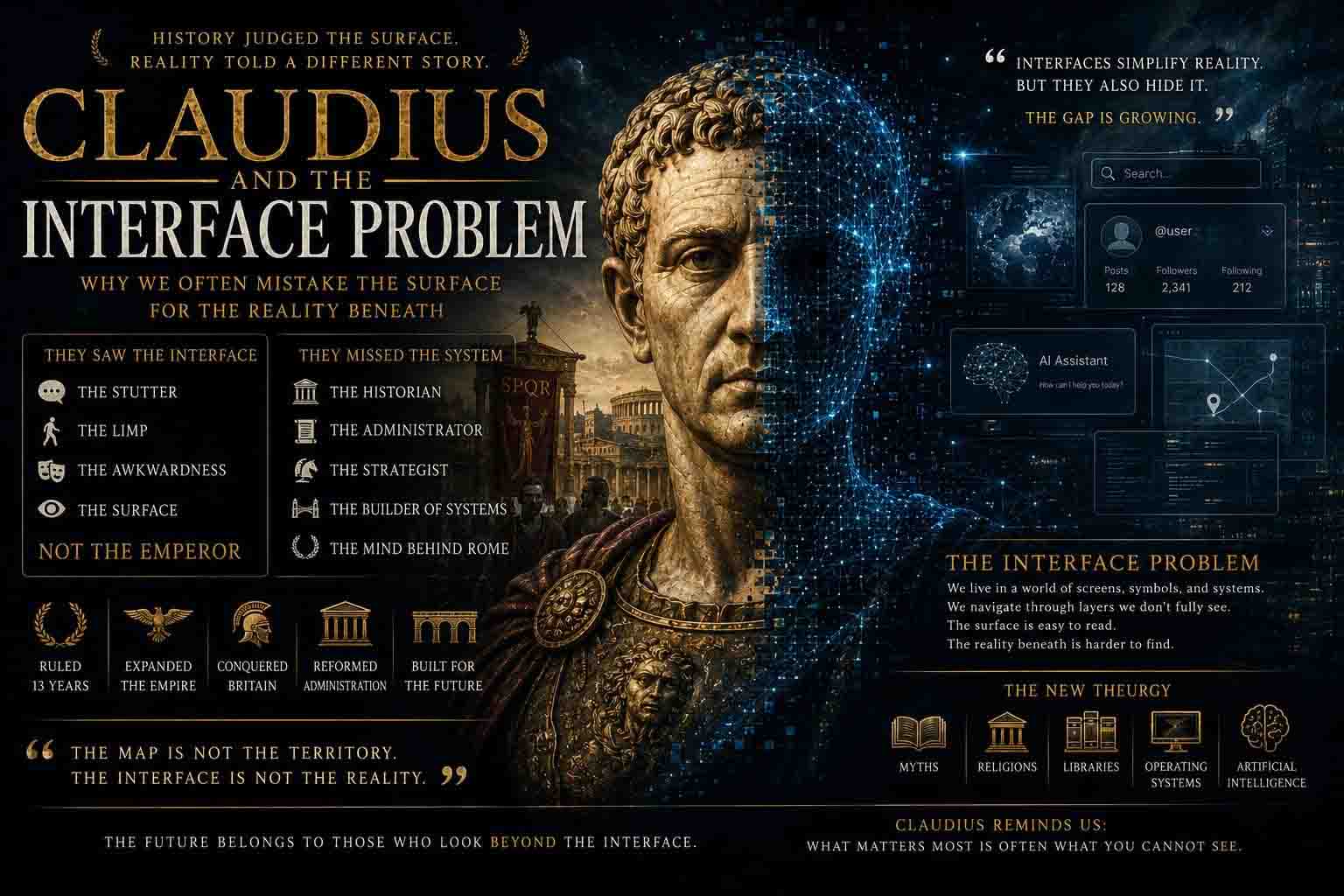
Claudius is especially useful because later cultural memory often begins with his supposed weakness.
Ancient writers emphasize physical mannerisms, family embarrassment, ridicule and the perception that he had been kept away from serious political life.
But the reign itself complicates the caricature.
Claudius governed for more than a decade. His administration expanded imperial bureaucracy, and his reign included the Roman invasion of Britain. Whatever his weaknesses, he was not merely an empty chair filled by administrative momentum.
That makes the story better, not worse.
A structure may elevate a person because they appear compatible with immediate continuity.
Once inside the office, the person can still alter the structure.
Institutional influence is reciprocal.
The throne changes the emperor.
The emperor changes the throne.
This prevents the essay from sliding into a mechanical theory in which systems act and individuals merely obey.
Structures constrain.
Individuals interpret those constraints.
Sometimes they exploit them.
Sometimes they reform them.
Sometimes they are destroyed by them.
The House Shapes the Person Holding the Keys
Think of an old house.
The new owner receives walls built for another generation.
Doors stand where earlier architects placed them.
Plumbing follows decisions made decades ago.
Some rooms encourage certain uses simply because of their shape.
The owner can renovate.
But renovation begins from something already there.
Institutions work similarly.
A new president inherits laws, agencies, alliances, budgets and crises.
A new CEO inherits contracts, employees, customers and technical systems.
A new pope inherits doctrine, history, bureaucracy and expectations older than any living participant.
Leadership therefore never begins from zero inside a mature structure.
The myth of the heroic ruler exaggerates the freedom of the individual at the top.
A leader may possess enormous discretion.
They also inherit enormous constraint.
Sometimes the structure does not choose the king.
It chooses the range of actions within which the king can remain king.
When the Structure Becomes Baal
There is a darker side.
Institutional continuity is valuable until survival becomes the institution’s highest value.
A university begins to exist for education, then gradually organizes itself around preserving departments whose original purposes have weakened.
A corporation begins with a useful product, then becomes an apparatus whose primary objective is protecting the apparatus.
A political institution created to solve one historical problem continues demanding resources long after the problem has changed.
At that point the caretaker principle can turn pathological.
Preservation becomes worship.
This is where our earlier metaphor of Baal becomes useful.
Humans build a structure.
The structure acquires procedures.
Procedures acquire beneficiaries.
Beneficiaries defend the procedures.
Eventually everyone begins speaking as if the structure existed independently of human choice.
“We have no alternative.”
“The system requires it.”
“This is simply how it works.”
The institution has not literally become a god.
Something more ordinary has happened.
Its human origins have become difficult to see.
Mature Institutions Can Also Become Old Institutions
There is therefore no simple progression from personality to institution in which the second stage is automatically better.
Personal rule can be arbitrary and fragile.
Institutions can be stable and fair.
But institutions can also preserve stupidity with extraordinary efficiency.
A bad ruler dies.
A bad procedure can survive three centuries.
This is one of bureaucracy’s strange powers.
Durability does not establish legitimacy.
The same mechanism that preserves a valuable institution can preserve an obsolete one.
The caretaker therefore cannot simply keep the machine running.
They must retain the capacity to ask whether the machine should still be running in its current form.
That is a more mature responsibility.
The builder asks whether something can exist.
The caretaker asks whether continued existence remains justified.
The Invisible Leader
History naturally remembers people who create discontinuities.
The conqueror.
The revolutionary.
The founder.
The ruler whose decisions visibly alter borders.
Caretakers often disappear because successful stewardship produces fewer spectacular events.
The currency remains stable.
The archive remains intact.
The institution survives a transition.
A crisis is prevented before the public realizes how close it came.
These are bad materials for heroic sculpture.
They are excellent materials for civilization.
The most consequential leader in a mature system may sometimes be the person who correctly understands when not to transform it.
This should not be romanticized either.
Conservatism can disguise cowardice.
Stability can protect injustice.
But innovation has its own vanity: the assumption that visible change is evidence of useful action.
A mature caretaker needs enough ego to act and enough restraint to understand that not every inherited structure is waiting for their signature.
Why This Matters in the Age of AI
AI may make this problem unusually visible.
An AI system can increasingly manage procedures, analyze records, route decisions and preserve institutional memory beyond the tenure of individual employees.
At first this looks like a triumph of continuity.
The institution becomes less vulnerable to staff turnover because knowledge no longer disappears whenever an experienced person leaves.
But another possibility appears.
What happens when AI begins preserving not only useful knowledge but also inherited assumptions?
A badly designed process could become extraordinarily durable because automation makes it frictionless.
A bias can stop looking like one person’s decision and become embedded in technical infrastructure.
At that point the system may appear objective precisely because the original human choice has disappeared from view.
This is why the future caretaker cannot merely preserve continuity.
They must preserve inspectability.
Who made this rule?
Why?
Under what conditions?
Does it still serve the purpose it once served?
AI could become civilization’s most powerful institutional memory.
It could also become the mechanism through which yesterday’s assumptions survive long after everyone has forgotten that alternatives existed.
Watch the Video
How to Read the World
Current Knowledge
Claudius became Roman emperor in AD 41 after the assassination of Caligula. Ancient literary accounts describe Praetorian soldiers finding him inside the imperial palace and acclaiming him emperor, although the dramatic details should be treated cautiously because surviving sources are literary narratives rather than neutral transcripts.
Claudius was not an anonymous or politically irrelevant figure. He belonged to the Julio-Claudian dynasty and possessed strong family connections to Augustus, Livia, Germanicus and the imperial household. Dynastic legitimacy, military support and the political situation following Caligula’s assassination all contributed to his accession.
The Senate did discuss Rome’s political future after Caligula’s death, but the idea that Rome simply stood on the verge of restoring the old Republic should not be overstated. By this point imperial institutions, military interests and expectations surrounding centralized rule had already developed substantial momentum.
Long-lived institutions generally reduce dependence on individual officeholders by formalizing roles, procedures and succession. This can increase stability, but institutional persistence is not automatically beneficial; systems can preserve obsolete incentives and practices as effectively as useful ones.
Open Questions
One major question is how much institutional continuity is desirable. Systems need enough stability to remain dependable, but excessive stability can protect outdated structures from correction.
Another concerns leadership selection. Institutions frequently reward traits that help individuals rise within the system, but those traits are not necessarily the same ones required to improve the system once power has been acquired.
AI introduces a further problem because institutional procedures can now be encoded into systems capable of reproducing decisions at enormous scale. This may improve continuity while making the historical origins of rules increasingly difficult to inspect.
The deepest question is whether mature institutions can preserve the ability to question their own necessity. A structure capable only of surviving may eventually confuse persistence with purpose.
Transhumation Interpretation
For Transhumation, When the Structure Chooses the King is really about the separation of person, role and system.
A role can survive replacement of the person.
A system can constrain the role.
And the person entering the role can still change the system.
Maturity begins when civilization understands all three levels instead of imagining either the heroic individual or the impersonal institution as completely sovereign.
The useful question is not simply who holds the keys?
It is:
Which parts of the house should still be standing when the keys change hands again?
FAQ
Why was Claudius an unusual emperor?
Because his accession followed the violent death of Caligula and was strongly connected to the Praetorian Guard rather than a simple planned succession. Ancient sources also portray him as an underestimated figure, although that portrait should be treated critically.
Did the Praetorian Guard really find Claudius hiding?
Ancient accounts describe such a scene, but the precise dramatic details cannot be verified independently. It is safer to treat it as a famous ancient narrative surrounding a real political crisis.
What does “the structure chooses the king” mean?
It means that mature institutions create constraints and incentives that make some kinds of leaders or succession outcomes easier than others. The phrase is metaphorical; institutions do not literally possess intentions.
Are institutions stronger than individuals?
Sometimes. Institutions can outlast individual officeholders and constrain their behavior, but individuals can also reform, damage or destroy institutions. Influence runs in both directions.
Why are caretakers important?
Because mature systems depend not only on creation but on maintenance, judgment and succession. A caretaker’s task is to preserve what remains valuable without treating everything inherited as sacred.
What is the deeper Transhumation question?
The deeper question is what happens when the structure no longer needs the founder in order to continue.
At first, this looks like the triumph of civilization.
The ruler dies; the state remains. The rector retires; the university opens the next morning. The founder disappears; the company still pays salaries. The office has become portable between human beings.
But success contains a danger.
Once the structure becomes better at surviving than the people inside it, survival itself can begin to look like justification.
Then the question changes.
Not Who should rule this system?
But Why does this system still deserve to be ruled in the same way?
Claudius matters because the throne survived the death of the man sitting on it.
The modern problem is harder.
We have built structures that can survive generations, founders, political parties and increasingly even the people who understand their original logic.
The next stage of civilization may therefore require something more sophisticated than succession.
It may require caretakers capable of inheriting the keys without inheriting the illusion that every locked door must remain locked forever.
Continue the Transhumation Series
- Forgotten Religion | Ancient Gods, Symbols and the Hidden Structures of Human Civilization
- The Last Religion | Death, Immortality and the Future of Humanity
- The New Theurgy | AI, Information and the Future of Human Civilization
- End of Branding: You Were Never Meant to Become a Product
- Baal vs Ishtar: Why Ancient Gods Never Disappeared