
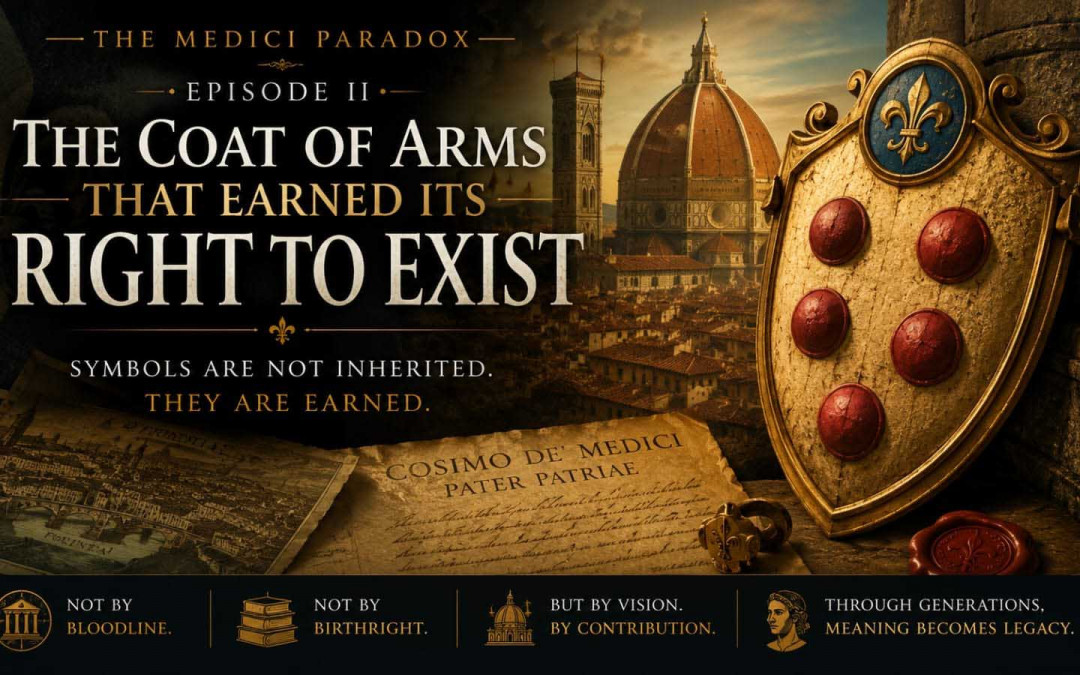
The Circles Heavier Than Gold
Florence is full of objects that no longer need introductions.
A dome appears above the roofs and an entire century seems to gather around it. A family name carved into stone can summon bankers, popes, artists, conspiracies and palaces before the visitor has read a single plaque. Then there are the circles.
The Medici palle are almost offensively simple. No intricate dragon coils around a sword. No eagle spreads imperial wings. The familiar emblem is built from round forms arranged upon a shield, a design simple enough that a child could reproduce its basic geometry in seconds.
Yet those circles are now heavy with history.
They are associated with money, Florence, political intelligence, patronage, Renaissance art, family ambition, churches, libraries, popes, dynastic marriage and the transformation of private wealth into public memory. The geometry itself contains none of these things. A circle has no opinion about Ficino, Michelangelo or banking.
Something happened to the symbol.
History kept returning to it.
That distinction may explain more about symbols than any theory of hidden meaning ever could.
What Do the Medici Balls Mean?
The honest answer is less satisfying than the legends.
We do not know with certainty why the Medici arms adopted the circular devices known as palle. Later explanations associated them with coins and banking, medicinal pills, or heroic dents left upon an ancestor’s shield. Some of these stories are attractive precisely because they seem to make the design inevitable after the fact.
That is usually when caution becomes useful.
A powerful symbol attracts origin stories.
Once a family becomes important, people want its emblem to contain an encoded prophecy of what the family later became. The bankers must have used coins. The name resembling medici must indicate medicine. The warrior family must have received the marks in battle.
History is rarely so neat.
The form of the Medici arms also changed over time. Heraldic devices were not always frozen corporate marks reproduced according to a twenty-first-century brand manual. Variations existed, and political prestige could alter how a coat of arms was displayed.
This uncertainty makes the emblem more interesting rather than less.
If the original circles did not contain one eternally fixed explanation, then their later power cannot be located inside the geometry.
It has to be located in the relationship between the geometry and everything that accumulated around it.
Are Symbols Empty Before History Fills Them?
Not completely.
A black circle and a golden crown do not produce identical perceptual responses. Shapes have visual properties. Colors acquire conventions. A heraldic sign existed inside a system whose users already understood that coats of arms identified families, offices and status.
But a symbol’s historical weight is different from its immediate appearance.
Consider the Nike swoosh without Nike.
It remains a curved graphic form.
The Apple mark without Apple is still an image of fruit modified into a logo.
Ferrari’s horse remains a horse.
What makes these signs commercially powerful is not hidden inside their geometry. Decades of products, victories, advertising, failures, celebrity, quality judgments and cultural repetition have attached themselves to the sign.
Recognition becomes compressed history.
The Medici emblem acquired power through a similar mechanism long before modern brand management existed. People encountered it on buildings, objects, commissions and spaces connected to the family. The sign repeatedly appeared near the consequences of Medici wealth and authority.
Eventually the emblem did not merely identify the family.
It activated the story of the family.
Were the Medici Always Great Nobles?
No, and that is crucial to the argument.
The Medici rose through the urban commercial and political world of Florence. Banking brought extraordinary wealth and international connections. Political networks converted wealth into influence. Patronage converted some of that influence into durable cultural visibility.
This was not the same route as possessing an ancient feudal title whose legitimacy supposedly disappeared into an immemorial past.
The Medici had to construct their position.
That does not mean the rise was a noble fairy tale of merit rewarded. Their history involved competition, factional politics, manipulation, dynastic strategy and eventually forms of princely rule that were far removed from the romantic picture of enlightened bankers quietly paying artists.
But precisely because their status was historically constructed, the emblem becomes instructive.
It did not begin as a visual proof that the family had always occupied the top of society.
The family’s ascent increased the significance of the mark.
Power accumulated.
The sign accumulated with it.
Meaning Through Repetition
Walk through enough Medici-associated spaces and the process becomes visible.
The emblem appears again.
Then again.
On architecture.
In churches.
On tombs.
In manuscripts.
On objects commissioned within the orbit of the family.
A visitor who initially knows nothing eventually learns the association before knowing the genealogy.
That is how repetition becomes cultural memory.
But repetition alone is not enough.
A meaningless mark repeated everywhere can become recognizable without becoming respected. Political propaganda proves this constantly. Commercial advertising does too.
The important mechanism is repetition plus consequence.
The sign appears where something happened.
A building was constructed.
A manuscript was collected.
A religious institution was supported.
An artist received patronage.
A political decision was imposed.
A rival was excluded.
A marriage rearranged alliances.
A scandal occurred.
Each event modifies the network of associations.
This is why enduring symbols are almost never morally simple.
They accumulate contradictions along with triumphs.
Cosimo and the Infrastructure of Reputation
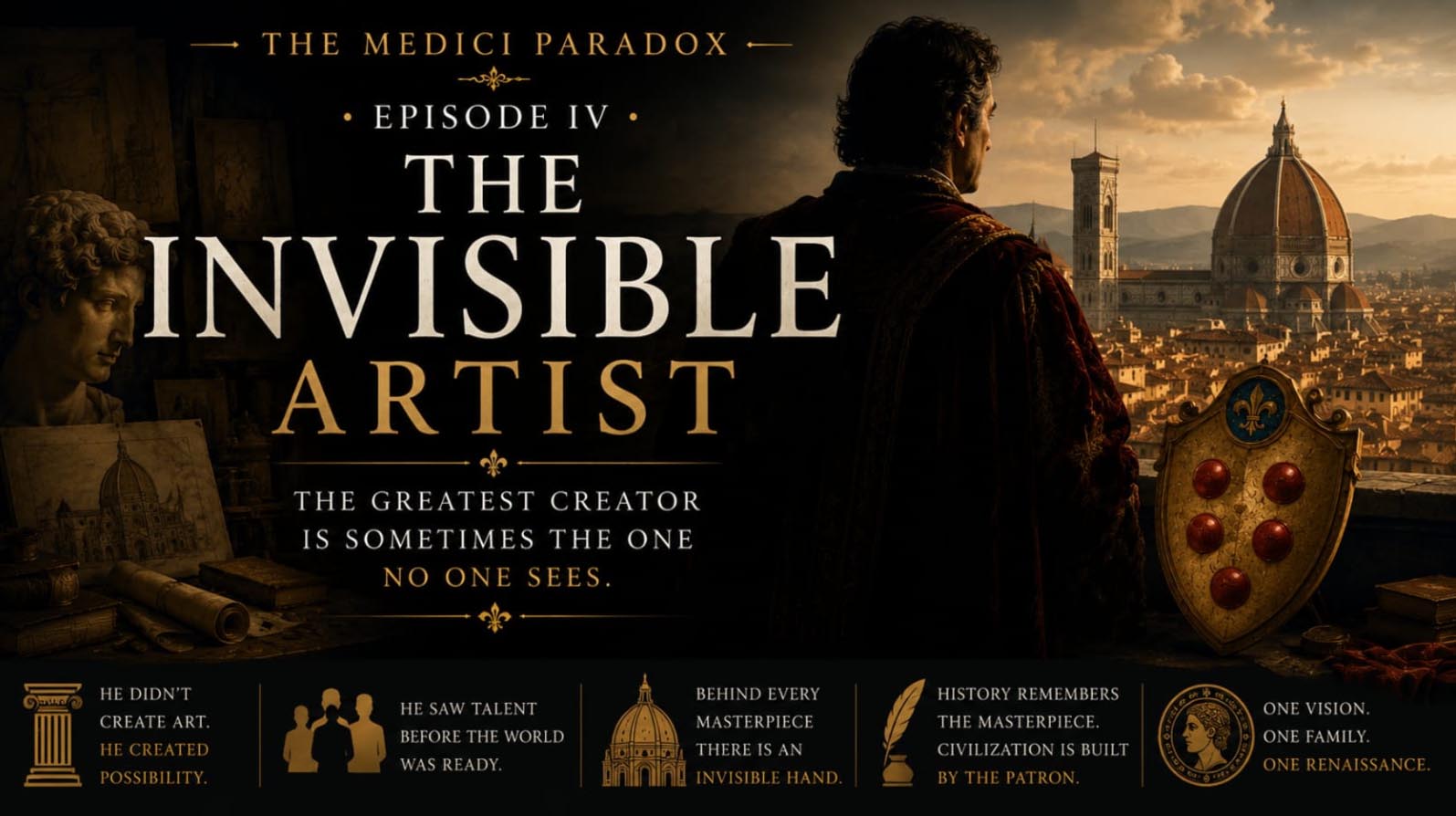
Cosimo de’ Medici is particularly useful here because his importance cannot be reduced to the sentimental category of “man who loved art.”
Patronage operated within religion, prestige, politics, family strategy and genuine intellectual interest. Wealth could create protected time, commission buildings, support scholars, sustain manuscript collections and place a family visibly inside Florence’s cultural landscape.
That does not mean money created the Renaissance.
The Renaissance was a much larger ecosystem involving artists, craftsmen, religious institutions, merchants, classical transmission, scholars, civic structures and connections extending well beyond one family.
But patronage can alter probability.
A talented person who receives time, materials and institutional protection can produce something that might otherwise never have existed in the same form.
A manuscript that is copied can survive.
A building that is funded can enter the city.
A scholar given support gains another stretch of working life.
The Medici emblem then appears beside the result.
Reputation grows not because the circles themselves contain culture, but because the circles repeatedly stand near structures that culture later decides to remember.
Reputation Is a Strange Form of Capital
Gold possesses useful physical properties.
Reputation does not.
You cannot lock it in a vault.
It exists through recognition distributed across other minds and institutions.
That makes reputation strangely fragile and strangely powerful at the same time.
A bank can collapse.
A palace can change owners.
A political office can disappear.
Yet the reputation attached to a name can continue reorganizing behavior centuries later. Tourists choose streets because of it. Museums arrange exhibitions around it. Publishers place the name on book covers. Historians continue arguing about it.
This is a form of persistence that biological inheritance alone cannot explain.
The Medici fortune did not survive intact.
The ruling dynasty did not continue indefinitely.
But “Medici” became an informational address.
Mention the name and a cluster of associations becomes available.
The family once owned property.
Civilization now carries the reference.
When Information Leaves Its Owner
This is the real threshold.
At first, a family can exert substantial control over its own sign.
It decides where the emblem appears.
It uses it to identify property, allegiance and prestige.
Then other people begin copying it.
Enemies discuss it.
Chroniclers record it.
Artists reproduce it.
Later historians reinterpret it.
Tourist shops print it.
Databases index it.
Students encounter it before visiting Florence.
At this stage the original owners are gone, but the symbol remains active.
Yet even here, we should be precise.
The information has not become immaterial.
It survives on stone, paper, photographs, screens, databases and human memory. Every version requires a carrier.
What has changed is dependence upon one particular carrier and one particular owner.
The emblem no longer requires a Medici hand to reproduce it.
That is informational continuity in the useful Transhumation sense:
carrier-independent enough to travel,
never carrier-free.
Is a Coat of Arms Like a Modern Logo?
Yes, at the right scale of comparison.
Both can compress complicated identity into a recognizable visual pattern. Both can accumulate associations through repeated exposure. Both can become valuable partly because a viewer no longer needs a full explanation whenever the sign appears.
But the differences matter.
Heraldry developed inside legal, social, dynastic and military systems very different from modern commercial trademark culture. A coat of arms could identify lineage, office or political status. A corporate logo primarily operates within commerce, communication and legal systems governing brands.
The analogy survives if we compare compression and recognition.
It breaks if we claim that medieval heraldry was simply advertising before advertising agencies existed.
That boundary matters because good analogies preserve difference.
The Ferrari horse and the Medici palle both summon large stories from small images.
They do not summon the same kind of story.
Caesar, Gucci and the Escape of Meaning
The Medici case belongs to a larger family of phenomena.
Caesar began as a Roman family name and became part of the vocabulary of imperial rulership. Eventually the sound travelled into political titles far outside the household of Julius Caesar.
Gucci became a luxury sign capable of functioning commercially even after control passed outside the founding family.
McDonald’s became one of the most recognizable names on Earth without remaining the restaurant business of the McDonald brothers.
In each case, a sign separated from its biological source.
But the mechanisms differ.
Caesar became political language.
Gucci became corporate property.
Medici became historical memory.
These should not be collapsed into one process.
What they share is narrower and more powerful:
recognition can survive the people who originally made recognition possible.
At that point the symbol has entered civilization.
Can a Symbol Outlive the Family That Created It?
Clearly.
But “outlive” should not be confused with immortality.
Symbols disappear constantly.
Scripts become unreadable.
Coats of arms are forgotten.
Brands collapse.
Names lose their associations.
A symbol survives only if something continues to reproduce or interpret it.
Stone helps.
Books help.
Museums help.
Institutions help.
Education helps.
Tourism helps.
Digitization helps.
Sometimes conquest helps.
Sometimes accidents help.
Survival is not necessarily evidence that the symbol was good, worthy or historically important in some objective sense.
This is why the title The Coat of Arms That Earned Its Right to Exist must remain metaphorical.
The Medici emblem did not pass a cosmic examination.
It accumulated enough associations, carriers and repetition to remain legible long after the ruling family disappeared.
It earned density.
History supplied survival.
A Symbol Does Not Contain Meaning
This distinction is especially important for Transhumation.
It is tempting to describe symbols as vessels filled gradually with meaning.
The image is elegant.
The mechanism is misleading.
A symbol does not contain the Renaissance in the way a bottle contains wine.
The Medici circles sitting alone on an unknown planet would not automatically communicate banking, Florence or patronage.
Meaning appears through a relationship among the pattern, historical context and interpreter.
That is why symbols can change.
The same emblem means something different to a fifteenth-century Florentine rival, a nineteenth-century historian and a twenty-first-century tourist.
No single interpretation exhausts it.
But neither can it mean absolutely anything.
History constrains interpretation.
This is the strange power of symbols.
They survive somewhere between fixed definition and total ambiguity.
Too fixed, and they become labels.
Too unconstrained, and they become noise.
When Recognition Becomes Inheritance
Biological inheritance moves through bodies.
Symbolic inheritance can move sideways.
A student with no genetic relationship to the Medici can preserve their historical significance more effectively than a forgotten descendant.
A conservator can protect the emblem.
A historian can reinterpret it.
A photographer can reproduce it.
A museum can place it inside a new explanatory frame.
This is where civilization departs radically from genealogy.
The biological family asks who descended from whom.
Culture can ask who is still capable of carrying the pattern.
That is why civilization can preserve structures after biological lines end.
The carrier changes.
The relationship continues.
But each transfer also modifies what is carried.
A symbol preserved by a museum is not functioning exactly as it did above a Renaissance palace.
It has survived by changing context.
Continuity contains transformation.
The Symbol and the Caretaker
This brings us back to the caretaker.
A symbol can survive generations, but somebody has to preserve the conditions under which it remains interpretable.
Restoring a fresco is not merely preserving pigment.
Cataloguing a document is not merely preserving paper.
Teaching the history of a coat of arms is not merely showing the image.
The caretaker preserves pathways between trace and context.
This is exactly what a good library does.
It does not worship every artifact.
It makes later encounter possible.
The Medici emblem today is powerful partly because Florence still supplies the surrounding world in which the sign can be read: buildings, churches, archives, collections, scholarship and stories.
Remove all of that and leave only six circles.
Much of the Medici disappears.
The mark survived because the ecosystem of interpretation survived with it.
Watch the Video
How to Read the World
Current Knowledge
The Medici coat of arms is most famously associated with circular devices known as palle. The precise original meaning of these forms is uncertain, and several popular explanations—including associations with coins, medicinal pills and legendary battle damage—should be treated cautiously rather than as established fact.
The Medici rose primarily through commerce, banking, political networking and later dynastic power rather than beginning as one of Europe’s archetypal ancient feudal houses. Their social and political status changed substantially across generations.
Heraldry historically performed functions including identification of individuals, families, institutions and offices. It should not be reduced simply to a medieval equivalent of modern corporate branding.
Symbols acquire cultural associations through repetition, historical context and interpretation. Recognition can remain stable while meaning changes across time and audiences.
The survival of a symbol depends upon carriers and institutions capable of preserving or reproducing it. Cultural information can migrate between stone, manuscript, print, photography and digital media, but it does not exist independently of physical implementation and interpreters.
Open Questions
One major question is how much continuity a symbol needs before it becomes effectively a new symbol wearing an old form. If meaning changes radically while the image remains stable, what exactly has survived?
Another concerns ownership. A family can control the use of an emblem during its lifetime, but once the sign enters historical memory, no descendant can fully determine what later societies will make it mean.
Modern branding creates a related problem. Corporations deliberately attempt to manage associations around logos, but public experience, scandal, politics and cultural reinterpretation constantly exceed that control.
The deepest question is whether symbols preserve history or compress it so aggressively that they eventually replace the complicated history they were supposed to represent.
Transhumation Interpretation
For Transhumation, the Medici emblem demonstrates how a pattern can cross generations without carrying one frozen meaning.
The image persists.
Carriers change.
Interpreters change.
Associations accumulate.
The symbol survives because recognition remains possible while interpretation remains flexible.
That makes the important question not:
What does the symbol mean forever?
But:
What must remain recognizable while meaning continues to change?
That is where heraldry becomes a problem of civilization rather than decoration.
FAQ
What are the balls on the Medici coat of arms?
They are heraldic circular forms traditionally known as palle. Their exact original significance is uncertain.
Were the Medici always an ancient noble dynasty?
No. Their rise was strongly associated with banking, commerce, political influence and later dynastic power.
Why did the Medici coat of arms become so famous?
Because it repeatedly appeared within the architectural, political and cultural environment shaped by Medici power, allowing generations of associations to accumulate around a simple visual pattern.
Is a coat of arms basically an old-fashioned logo?
Only partly. Both can compress identity into recognizable imagery, but heraldry belonged to a very different social, dynastic and legal system from modern corporate branding.
Can a symbol survive after its creators disappear?
Yes, if later carriers and interpreters continue reproducing it. Buildings, books, museums, education and digital archives can all carry a symbol beyond the people who first used it.
What is the deeper Transhumation question?
The deeper question is not why six circles survived.
It is why, after centuries, they are no longer merely six circles.
A child could reproduce the geometry.
The child could not reproduce the history.
That part required bankers, politicians, artists, enemies, patrons, churches, scandals, marriages, archives and generations of people who kept encountering the same form.
Eventually the symbol became larger than any one Medici.
Not because meaning floated free from matter, and not because the family discovered some immortal visual code. The opposite happened.
The symbol survived by entering more matter.
Stone.
Paper.
Paint.
Books.
Photographs.
Screens.
Memory.
Each carrier kept the pattern available long enough for another interpreter to meet it.
That may be the real achievement of an enduring symbol.
It does not defeat time.
It becomes good at finding another surface before the old one disappears.
And perhaps that is what the Medici coat of arms truly earned—not a right to exist forever, but the much rarer privilege of remaining recognizable after the people who once owned it could no longer explain what it was supposed to mean.
Continue the Transhumation Series
- Forgotten Religion | Ancient Gods, Symbols and the Hidden Structures of Human Civilization
- The Last Religion | Death, Immortality and the Future of Humanity
- The New Theurgy | AI, Information and the Future of Human Civilization
- End of Branding: You Were Never Meant to Become a Product
- Baal vs Ishtar: Why Ancient Gods Never Disappeared