
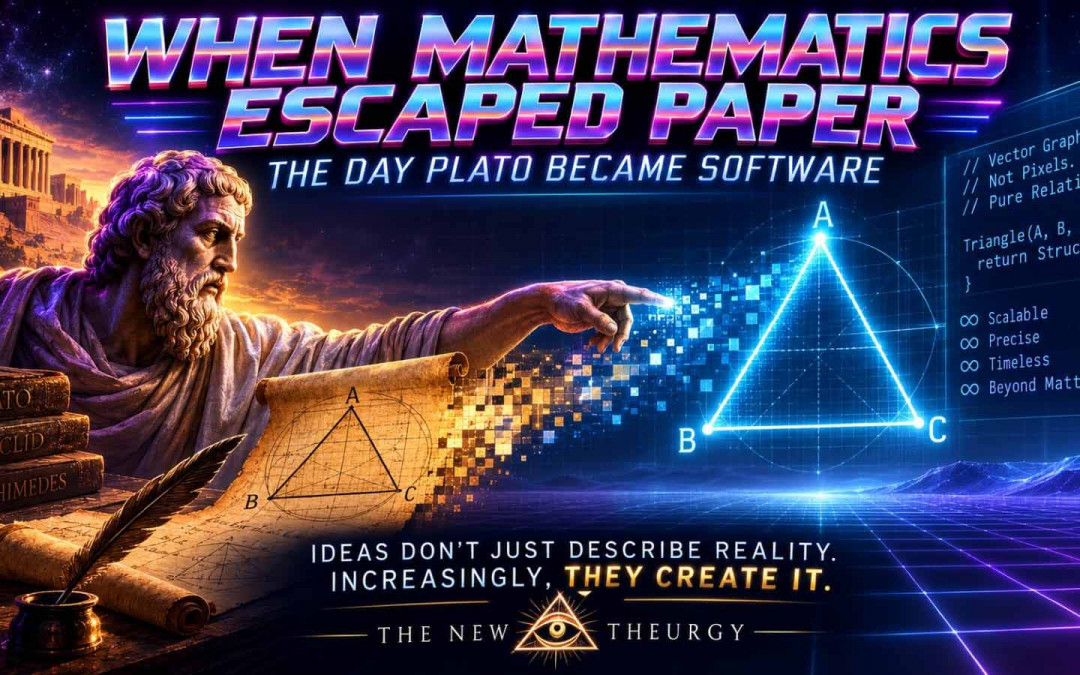
Mc Math – Please, Enter
For most of the history of writing, mathematics arrived before the reader in a strangely quiet condition. A triangle scratched into wax did nothing. An equation written in a manuscript remained motionless until a human mind recognized the symbols, understood the convention and performed the operation they described. The parchment could preserve Euclid, but it could not continue Euclid’s reasoning by itself. A geometrical construction survived because another person reconstructed the relation inside a new mind, perhaps centuries after the hand that drew it had disappeared.
This was already extraordinary. Mathematical relationships proved unusually capable of surviving changes of carrier. A theorem could move from papyrus to parchment, from Greek into Arabic or Latin, from manuscript to print, while remaining sufficiently stable for later readers to identify the same structure. The physical object was fragile; the relation could be copied. Libraries burned, alphabets changed, notation evolved, and yet mathematics repeatedly found another material form.
Then computation introduced a different kind of continuity. The symbols no longer needed to wait passively for a reader to decide what to do with them. A formal procedure could be embodied in a machine so that one state generated the next. Numbers could alter numbers. Coordinates could move coordinates. A mathematical description could become a process unfolding through time.
The distinction is easy to miss because computers have become ordinary. Yet it marks one of civilization’s profound conceptual shifts.
A page can preserve a rule.
A computer can be arranged to perform it.
The Triangle Waiting on the Page
Draw a triangle on paper and the familiar Platonic discomfort appears immediately. The lines have width. The corners are imperfect. Enlarge the drawing and the apparent precision dissolves into fibers, graphite and irregular edges. The physical triangle is never identical with the mathematical one used in a proof.
The reader supplies the missing precision.
We understand that the crude line is intended to represent something idealized: points without extension, straight lines, defined relationships among angles and lengths. The drawing functions less as the mathematical object itself than as an interface through which the reader reconstructs the mathematical relation.
For centuries this relationship was sufficient. A diagram could instruct another mind. The marks remained static, but the human being animated them through reasoning.
This should prevent us from romanticizing software too quickly. Mathematics was never merely decorative ink before computers arrived. Mathematical methods already transformed engineering, astronomy, navigation, architecture and mechanics. Tables of calculation guided ships. Equations predicted planetary motion. Geometry organized buildings. Mechanical devices embodied quantitative relationships long before electronic computing.
The genuinely new feature of modern computation is therefore not that mathematics suddenly acquired consequences.
It is that increasingly complex formal relationships could be executed automatically inside general-purpose machines, at enormous speed, with outputs continuously becoming new inputs.
The relationship entered a loop.
When the Drawing Became a Procedure
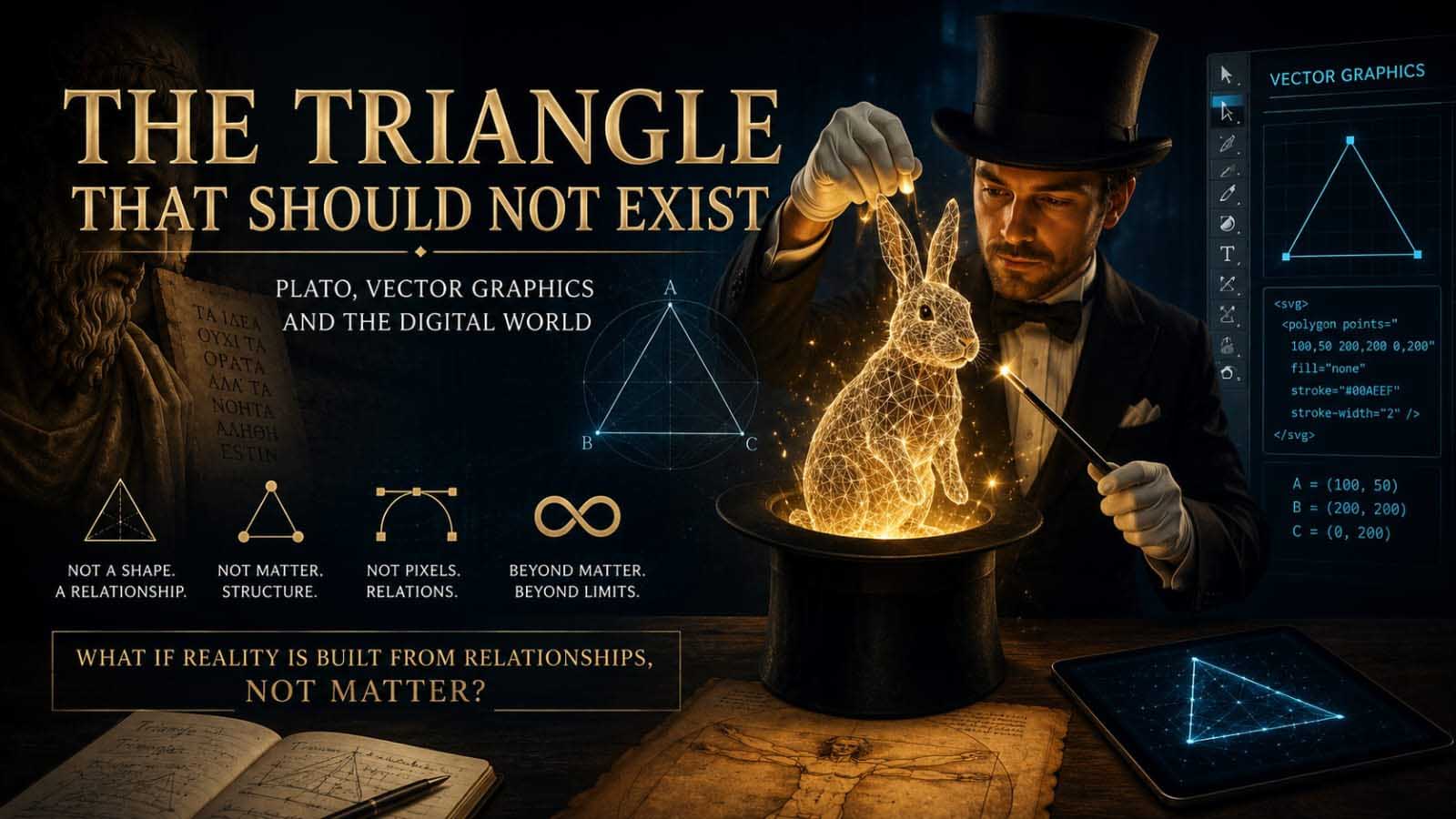
Vector graphics provide a clean illustration because they change what the computer needs to preserve.
A raster image begins from a finite array of sampled values. Enlarge it sufficiently and its dependence on that original resolution becomes visible. A vector object can instead be represented through mathematical parameters: coordinates, lines, curves, transformations and rules describing how the parts relate.
The visible triangle on the screen is therefore not necessarily a stored miniature painting waiting to be enlarged.
It can be generated.
Change the window and the triangle is rendered again. Rotate it and new pixel values appear. Alter the scale and another visible manifestation is calculated. Move it across the screen and almost none of the individual illuminated pixels need remain the same.
What persists is not one visible object.
It is a description capable of producing successive visible objects.
This is philosophically interesting because continuity has moved from the image toward the generative relation. The triangle does not survive because one physical arrangement remains untouched. It survives because another physical system can repeatedly instantiate enough of the same organization.
Of course, no computer contains infinite mathematical precision. Memory is finite, numerical representations are finite and every display ultimately has physical limits. A vector triangle enlarged without bound will eventually encounter implementation constraints.
But those engineering limits do not erase the conceptual difference.
The screen is temporary.
The rule tells the screen what to become next.
Plato Did Not Predict the Computer
Plato makes an irresistible appearance here because digital objects often seem to reverse the ordinary relation between thing and description. In the physical world, we encounter the object and then describe it. In software, a formal description may exist first within the computational process, and the visible object appears only when that description is rendered.
It sounds almost Platonic.
Structure first.
Appearance afterward.
The resemblance should not be pushed too far.
Plato’s theory of Forms belonged to a metaphysical project concerning knowledge, intelligibility, change and reality. He was not describing digital representation, and software provides no experimental confirmation of a separate realm of Forms. A computer’s abstract description is still physically implemented through electronic states, memory, processors and storage.
Yet computers give modern people an unusually intuitive way to feel the old Platonic question.
Suppose a digital circle appears on three different devices. The displays have different pixels. The processors contain different physical states. The rendering software may even differ. Yet we regard the circle as an instance of the same defined object because a recognizable relation survives those changes.
Which layer deserves to be called the thing?
The pixels?
The file?
The algorithm?
The mathematical relation?
Different philosophical theories will answer differently.
What technology demonstrates beyond dispute is narrower: a stable organization can generate many materially different appearances while remaining operationally recognizable across them.
That is enough to make Plato interesting again without pretending that Adobe Illustrator proved the Republic.
Mathematics Acquired an Environment
A page gives mathematics somewhere to be represented.
A computing system gives formal structures somewhere to unfold.
This becomes obvious in simulation. A book can contain equations describing orbital motion. A simulation repeatedly evaluates relationships among position, velocity and time, producing an evolving state. An architectural drawing can represent a building; digital models can estimate loads, light, airflow or heat under changing conditions. A meteorological equation can be printed in a textbook, but numerical weather prediction places mathematical models inside computational processes capable of generating possible future atmospheric states from measured initial conditions.
The equation itself has not become alive.
It has become operational.
This distinction matters because we often describe software using metaphors borrowed from living systems. Programs “run.” Processes “spawn.” Systems “respond.” Environments “evolve.” None of this establishes consciousness or biological life. The language reflects something simpler: unlike static inscriptions, computational structures can participate in chains of state transition.
One calculated result becomes the condition for the next calculation.
The pattern is no longer merely preserved.
It is allowed to have consequences within the machine.
That may be why software feels so different from previous media. A book can describe a game. Software can instantiate rules under which the game proceeds. A drawing shows a maze. Software can make the maze respond when the player turns left.
Representation becomes behavior.
A Small Universe Made of Rules
Video games make the transformation culturally visible because they contain worlds that do not need every event to be individually painted beforehand.
A designer establishes systems.
Objects have positions. Gravity may have a defined behavior. Surfaces have collision properties. Light changes according to algorithms. Characters operate through rule systems. Player actions alter variables. Thousands of visible events emerge from interactions among those rules.
The result resembles a miniature nature in one limited sense.
Nature does not need someone to paint tomorrow’s ocean wave in advance.
A simulated world does not necessarily need someone to store every frame a player will ever see.
Rules generate states.
This is one reason simulation matters far beyond entertainment. Researchers can construct simplified worlds in which models are allowed to interact and produce outcomes too complicated to predict intuitively. Engineers can test structures before manufacturing them. Economists can explore model behavior. Biologists can simulate selected processes. Pilots can rehearse situations without placing an aircraft in danger.
The value lies precisely in allowing structure to produce consequences before those consequences occur in the system we actually care about.
We built spaces in which equations can fail cheaply.
That may be one of computation’s greatest contributions to civilization.
The Equation Became an Actor — But Not an Agent
There is a linguistic trap here.
If mathematics can produce consequences inside software, we may be tempted to say that the equation has become an actor.
As metaphor, this works.
As ontology, it needs restraint.
The mathematical relation does not independently decide to calculate itself. A physical computing system implements operations according to architecture, software and available energy. Humans design objectives, create interfaces and decide which outputs matter. The process may become enormously complex and produce results its designers did not foresee, but complexity is not evidence that mathematics itself has acquired intention.
The distinction becomes especially important with artificial intelligence.
Modern AI systems can produce sentences, images, classifications, predictions, software and audio from mathematical transformations operating across learned representations. A generated face may depict no historical person. A sentence may never have existed before the model produced it. The output is genuinely new in one ordinary sense: that particular arrangement was generated rather than retrieved as a fixed stored artifact.
But saying that “mathematics created the image” compresses away almost everything important.
Training data mattered.
Architecture mattered.
Hardware mattered.
Optimization mattered.
Human objectives mattered.
Physical energy mattered.
The mathematical structure is indispensable, but it does not float above those carriers generating worlds by itself.
This is precisely the Carrier and the Pattern problem appearing again at another scale.
AI and Generative Structure
Artificial intelligence extends computation because the programmer no longer needs to specify every relationship that later determines the output.
Traditional software often follows rules deliberately encoded by programmers. Machine-learning systems can instead adjust enormous parameter sets through training, producing internal statistical organization that no human being wrote line by line.
Then the learned structure becomes executable.
A prompt enters.
Transformations occur.
A new visible or linguistic artifact appears.
This gives digital civilization another experience that can feel almost metaphysical: the observable object arrives after a vast invisible organization has acted.
But invisible does not mean immaterial.
The structure exists through physical states distributed across computing hardware. The generated image becomes visible only after additional physical computation. Nothing has escaped physics.
What has changed is our ordinary relationship with representation.
Increasingly, the picture is not the stored thing.
It is the temporary output of a process.
The same is true of an AI conversation. The system does not contain every future sentence hidden somewhere like pages in an enormous book. Outputs arise through execution.
The library has acquired machinery.
The Computer Does Not Need to See the Triangle
A person looking at a triangle experiences a unified shape. We may notice symmetry, tension, orientation or beauty. A designer sees composition. A mathematician may immediately think about angles or transformations.
The computer does not need any comparable subjective experience in order to perform operations involving the representation.
Coordinates can be transformed without anyone inside the processor “seeing” three corners.
This is an important boundary because modern technology increasingly separates competent manipulation of structure from demonstrated experience of that structure.
Software can rotate the triangle without recognizing it as elegant.
A rendering engine can produce a sunset without seeing light.
An AI model can generate a sentence about grief without that fact alone demonstrating grief.
This is where the old Platonic problem unexpectedly meets the modern consciousness problem.
Structure can clearly produce behavior.
Whether structure alone produces experience remains unresolved.
Those questions should not be collapsed merely because both involve patterns.
From Symbol to Procedure
The history can now be described more carefully.
Human beings first encountered regularities.
They developed symbols to represent some of them.
Symbols became organized into increasingly formal mathematical systems.
Formal operations were embodied in mechanical and later electronic devices.
General-purpose computation allowed enormous families of those operations to become executable procedures.
Software then allowed procedures to interact, respond and generate environments.
Artificial intelligence added systems whose internal parameters could be shaped through learning rather than specified entirely in advance.
At each stage, the pattern became capable of participating in a more complicated chain of consequences.
That is more interesting than saying mathematics simply escaped paper.
The paper was never a prison.
It was one carrier in a succession of carriers.
The real transformation was that civilization learned to build carriers that did not merely preserve relationships.
They iterated them.
Watch the Video
How to Read the World
Current Knowledge
Mathematical notation has long allowed abstract relationships to be recorded independently of any particular physical example, although every inscription or computation still requires a physical carrier. Mathematics was operational long before electronic computers through human calculation, mechanical devices, navigation, engineering and other applications.
Modern computers execute formal operations through physical hardware. Software therefore does not make mathematics independent of matter; it allows mathematical and logical relationships to be implemented as repeatable processes whose outputs can become inputs to later operations.
Vector graphics represent shapes through mathematical parameters such as points, curves and transformations rather than only through a fixed raster of pixels. This allows shapes to be rendered across many sizes and devices, although real implementations remain constrained by finite precision and hardware.
Computer simulations use mathematical models to generate changing states over time. Their usefulness depends upon how well the selected model represents the aspects of the target system relevant to the question being studied.
Modern artificial intelligence uses mathematical and statistical models implemented through physical computing systems. AI can generate novel outputs, but this does not establish conscious experience or independent agency in the human sense.
Open Questions
The oldest unresolved question remains whether mathematics is best understood as discovered structure, human construction or some combination that makes the distinction itself too simple. Computation demonstrates the extraordinary operational power of mathematical relationships without settling their metaphysical status.
There is also a question about simulation. When a sufficiently detailed mathematical model reproduces the behavior of a physical system, which properties of the original have actually been preserved? A simulated hurricane can reproduce selected dynamics without becoming wet, cold or dangerous in the way an atmospheric storm is.
This becomes much harder when the object modeled is a mind. If a computational system reproduced all behavior associated with human cognition, would functional equivalence imply subjective experience, or could the structure operate without an observer inside it? No current experiment settles that question.
Artificial intelligence creates another challenge. As learned systems become less transparent to their designers, civilization may increasingly rely on executable structures whose outputs can be tested more easily than their internal reasoning can be explained. We may know that the machine works before we know exactly what kind of understanding, if any, its internal organization deserves.
Transhumation Interpretation
When Mathematics Escaped Paper belongs naturally beside The Triangle That Should Not Exist and The Carrier and the Pattern, but it adds one crucial step.
The triangle showed that a recognizable relation can survive changes of representation.
The carrier-and-pattern distinction showed that continuity does not require preservation of one original material object.
Software introduces something new:
the pattern can become a process.
A text can cross carriers.
A program can cross carriers and then act according to its organization once instantiated again.
This is an important difference.
Suppose a mathematical model of a pendulum is printed in a book. The relations are available, but nothing happens unless a reader performs the mathematics. Encode the same relationships inside software and connect them to a computational loop, and the state can update repeatedly without a person calculating each intermediate position.
The mathematical description has acquired an environment in which consequence follows consequence.
This does not mean the pattern has become independent.
It has become executable.
That distinction may eventually matter enormously for how Transhumation thinks about identity.
A preserved memory is one thing.
A dynamic system capable of updating memory in response to new experience is another.
A portrait preserves appearance.
A model capable of generating new expressions in response to conversation is different again.
A biography describes a personality.
An executable reconstruction might behave as though that personality had continued into circumstances the original person never encountered.
At some point, civilization will almost certainly be tempted to call that continuation.
The history of software tells us why the temptation will be powerful.
A static pattern becoming an active process feels like a categorical transformation.
Yet the Julian Experiment supplies the warning. Even if the pattern becomes dynamically indistinguishable from the original person, we still have to ask whether the observer crossed the transition or whether a new process merely inherited enough structure to claim the same past.
The triangle does not care.
Copy the vector description, instantiate it elsewhere and the question of personal continuity never arises.
Consciousness may be different.
This is where the phrase Plato became software earns its ambiguity. Plato himself did not become software, and neither did the Forms. What became technologically ordinary was something Plato would have found philosophically provocative: structures could be specified independently of one visible instance, transferred between physical carriers and made generative within new environments.
The screen became a theater in which relation precedes appearance.
But software also teaches the opposite lesson from simplistic digital mysticism.
The abstract structure never literally leaves the physical world.
Every execution requires a machine.
Every process consumes energy.
Every digital object exists through material states.
The relationship survives because civilization has become exceptionally good at building new matter capable of carrying it.
Perhaps that is the deeper story.
Mathematics did not escape matter.
It escaped stillness.
The theorem became algorithm.
The diagram became simulation.
The model became environment.
The relationship became capable of generating another state before any human being had to draw it.
Paper allowed civilization to remember structures.
Software allowed civilization to watch some of those structures unfold.
And artificial intelligence now confronts us with the next question: what happens when the executable pattern becomes complicated enough to produce behavior that looks less like calculation and more like interpretation?
That question is still open.
Which is exactly where Transhumation should leave it.
FAQ
What does “mathematics escaped paper” mean?
It is a metaphor for the transition from mathematics represented statically in writing to formal relationships implemented as processes that computers can repeatedly execute.
Did computers make mathematics operational for the first time?
No. Humans used mathematics operationally in engineering, astronomy, navigation and mechanical devices long before electronic computing. Computers radically expanded the speed, scale and automation of executable mathematics.
Why are vector graphics philosophically interesting?
Because the visible image can be generated repeatedly from mathematical relationships rather than preserved only as one fixed arrangement of pixels. They make the distinction between representation and structure unusually easy to see.
Does software prove Plato was right?
No. Software provides an interesting modern analogy to the distinction between intelligible structure and visible manifestation, but it does not prove Plato’s metaphysics.
Is software independent of matter?
No. Every program requires physical implementation when stored or executed. What can become relatively independent is the dependence on one particular physical carrier.
Does executable structure bring us closer to digital consciousness?
It makes the question more precise, not easier. We know structures can become dynamic processes. We do not know whether reproducing the relevant processes of a human mind would preserve the same first-person observer.
The important transition was therefore not from matter to something immaterial.
It was from the written relationship to the running relationship.
The page could tell us what the triangle was.
The machine could make it move.
Continue the Transhumation Series
- Forgotten Religion | Ancient Gods, Symbols and the Hidden Structures of Human Civilization
- The Last Religion | Death, Immortality and the Future of Humanity
- The New Theurgy | AI, Information and the Future of Human Civilization
- End of Branding: You Were Never Meant to Become a Product
- Baal vs Ishtar: Why Ancient Gods Never Disappeared