
The King is Naked
Before we learn what things are for, we briefly remember that they might become something else.
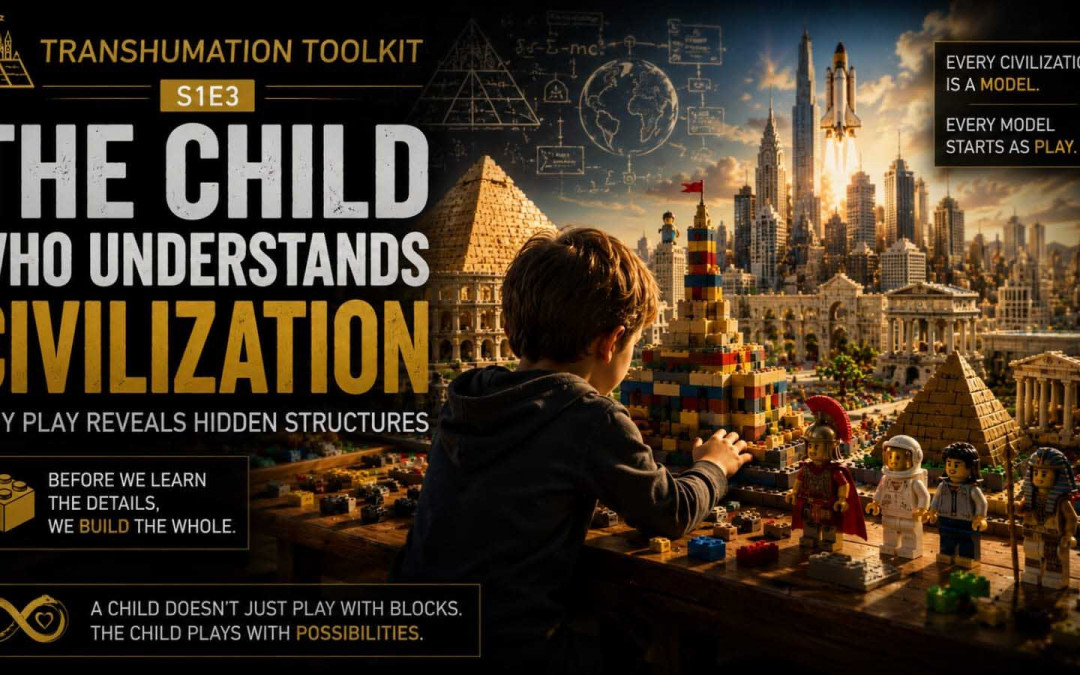
Give a child an empty cardboard box and an adult will usually see packaging. The object has completed its commercial purpose; perhaps it should now be flattened and recycled. A child may look at the same rectangle of corrugated paper and discover a spacecraft before lunch, a castle after lunch and an animal hospital by evening. The cardboard has not changed its chemistry. Its dimensions remain almost exactly what they were when it contained a television or a pair of shoes. What changed was the network of relationships surrounding it: where the opening is imagined, what another object placed beside it now represents, which rule governs entry, who is allowed inside and what story makes the arrangement coherent.
This is normally called play, a word adults often use affectionately to describe the period before serious life begins. Yet the operation underneath it is remarkably close to some of the operations on which serious life depends. Engineers recombine known principles into structures that did not previously exist. Scientists place familiar variables into unfamiliar experimental relationships. Artists take inherited forms and make them behave differently. Entrepreneurs notice that a technology built for one purpose can serve another. Political systems are redesigned by people willing to imagine institutions arranged differently from the ones they inherited.
The child does not possess the engineer’s mathematics, the historian’s archive or the philosopher’s vocabulary. What the child possesses, temporarily and often intensely, is freedom from the assumption that the present arrangement is the only legitimate one.
That is not wisdom.
But civilization would be impossible without it.
Before the Object Acquires a Job
Adults are exceptionally good at seeing functions.
A chair is for sitting. A school is for teaching. A road carries traffic. A telephone makes calls. A book is read from beginning to end. The ability is useful because civilization would become exhausting if every encounter required us to rediscover what ordinary objects are for.
Children inhabit an earlier stage of classification. A chair can become a mountain because its function has not yet fully imprisoned its form. A spoon can become a catapult. A blanket becomes geography. Three cushions establish a border whose authority is taken with complete seriousness for twenty minutes.
Development does not consist simply of replacing this looseness with correct knowledge. It also involves learning which constraints are real.
The cardboard box can become a submarine in the symbolic world of play, but it cannot carry a child to the bottom of the Atlantic. A bridge built from wooden blocks may look plausible and still collapse because the center of mass is wrong. Stack enough pieces badly and gravity ends the argument.
This is why play is more interesting than unrestricted fantasy.
Reality participates.
The child proposes a structure; the world answers.
Sometimes the answer is no.
A tower falls. A wheel refuses to turn. Two pieces will not connect. Another child rejects the rules of the game. The builder modifies the model and tries again.
Long before anyone explains engineering or experimental method, the child encounters a primitive but profound principle: imagination creates possibilities; constraints decide which possibilities survive.
The Castle Comes Before the Vocabulary
Specialization reverses the order.
A structural engineer learns names for forces a child encounters only as the mysterious reason one tower stands and another falls. A historian distinguishes institutions that a child would collapse into the word “king.” A chemist can explain why materials behave differently. An economist can formalize incentives that children discover by fighting over who controls the desirable toy.
Civilization depends on this increasing precision.
There is no serious argument for replacing expertise with childish intuition. Airliners should not be designed by people who merely possess an inspiring sense that wings are possible.
Yet specialization creates its own blindness.
The more precisely we understand a component, the easier it becomes to mistake mastery of the component for mastery of the system containing it. The engineer can know the material perfectly and misunderstand the city the bridge will alter. The economist can model an incentive and overlook a cultural norm that makes people respond differently. The historian can know every surviving document concerning an institution and still struggle to explain why the institution felt legitimate to the people living inside it.
The child often commits the opposite error.
The whole appears before the pieces are understood.
The castle exists immediately. Only later comes the knowledge of load, geometry, materials and historical fortification.
Neither direction is sufficient.
Civilization requires the ability to move from whole to component and back again.
The expert learns what the brick can bear.
The builder remembers that the brick was never the destination.
The Intelligence of the Construction Set
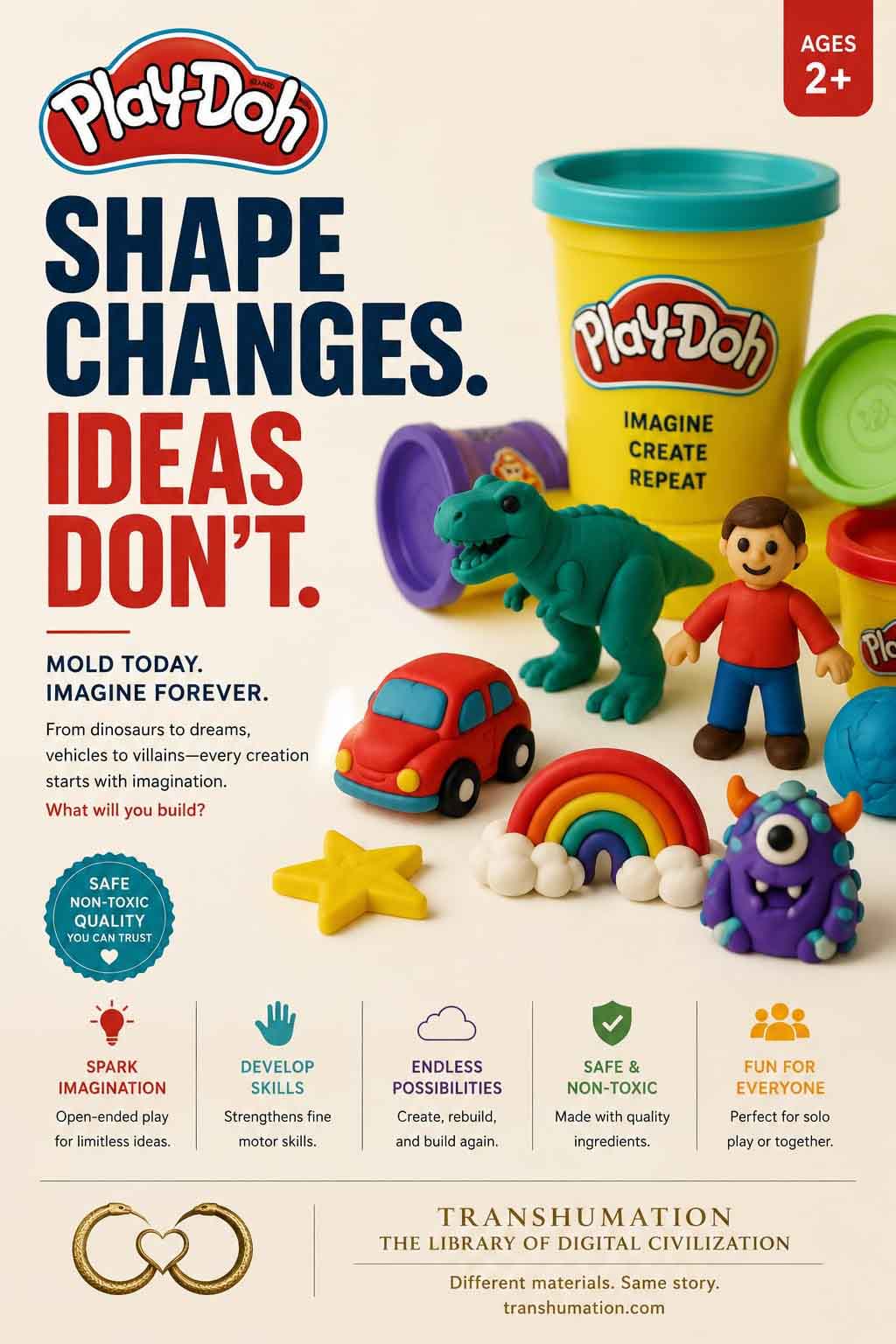
This is what makes LEGO a better metaphor than it first appears.
The individual brick is intentionally incomplete. Its genius lies in having a stable interface that permits repeated connection. The same piece can participate in structures that share almost nothing at the level of meaning: a medieval tower, a lunar rover, a flower, an animal, a machine.
The brick does not contain those objects.
It contains possibilities constrained by connection.
That distinction appears everywhere in civilization. A limited alphabet produces libraries. A relatively limited set of musical intervals participates in traditions of astonishing variety. Legal concepts are rearranged into different constitutions. Standardized components permit machines to become more complicated than any single component could suggest. Digital logic builds immense computational systems from simple operations repeated at enormous scale.
Complexity often comes not from inventing fundamentally new matter but from reorganizing available elements.
That is why certain technologies matter disproportionately. The alphabet was powerful partly because a small reusable set could generate an open-ended number of expressions. Standardized mechanical parts made repair and manufacturing easier because components could migrate among larger systems. Software libraries allow new applications to inherit structures programmers do not have to recreate from zero.
Civilization is full of intellectual studs and sockets.
The important question is not merely which pieces exist.
It is which pieces can connect.
The Block Is Not the Castle
This principle has a philosophical consequence.
An object can participate in a larger identity without containing that identity inside itself.
No single LEGO brick is the castle.
Remove one ordinary piece and the castle may remain recognizable. Replace several pieces with equivalent ones and the structure may still survive. Rearrange the same material and the castle disappears even though every brick remains on the table.
Something about identity therefore resides in organization.
This is where Plato becomes tempting.
Platonic philosophy famously distinguishes changing particulars from more stable intelligible structures, although the theory of Forms is much richer than the children’s-book formula of perfect objects existing somewhere outside the physical world. The playroom does not prove Plato correct.
It does, however, recreate the intuition that made his problem durable.
The castle is not reducible, for every useful purpose, to an inventory of plastic pieces. The inventory can remain constant while the castle becomes a bridge.
Matter constrains what can happen.
Arrangement determines what has happened.
This distinction has become increasingly important to Transhumation because it appears in language, software, institutions, biology and information. But the LEGO Principle also supplies the necessary warning: not every structure can migrate without loss, and a carrier is never simply irrelevant.
The brick has dimensions.
The body has biology.
The medium pushes back.
Form is possibility negotiated with constraint.
Stories Are Also Made From Reusable Parts
Children do not construct only physical objects. They construct worlds from narrative components.
Someone leaves home.
There is a forbidden place.
A companion joins.
A rule is violated.
Something valuable is lost.
The character returns changed.
These patterns recur across mythology, folktale, novels, cinema and games, but recurrence does not prove that all stories descend from one secret original narrative. Human beings share enough recurring problems—separation, danger, status, family, death, betrayal, cooperation—that comparable narrative structures can emerge repeatedly.
The interesting thing is that stories behave like construction sets.
A narrative element can survive radical changes of costume. The dangerous forest becomes outer space. The king becomes a corporation. The monster becomes an artificial intelligence. The journey becomes psychological rather than geographic.
Yet the structure cannot be compressed indefinitely. If every conflict becomes “a battle between order and chaos,” eventually all stories become identical because the model has discarded the information that made them different.
Children understand this intuitively as well.
Change enough rules and it is no longer the same game.
The freedom of play is therefore not limitless. Meaning survives inside a negotiated boundary between repetition and variation.
Civilization works in much the same way.
Play Is a Laboratory With Cheap Failure
Perhaps the most serious feature of play is that collapse is inexpensive.
A tower falls and nobody calls an inquiry. The bridge fails and the child builds another one. A game becomes unfair, so the players renegotiate the rules. A strategy fails; another is attempted.
Real civilization cannot always afford such freedom.
A failed bridge can kill people. A badly designed institution can damage a generation. A financial experiment can destroy savings. A technological platform can reach hundreds of millions before its unintended incentives are understood.
Play creates a smaller universe in which consequences are real enough to teach but usually limited enough to permit repetition.
This is one reason simulation becomes increasingly important in mature technological societies. Engineers test prototypes. Pilots train in simulators. Militaries conduct exercises. Scientists construct models. Policy analysts attempt scenarios. Games themselves have become tools for exploring systems that are too dangerous, expensive or slow to manipulate directly.
The common principle is not childishness.
It is reversible consequence.
A civilization becomes more intelligent when it can discover why something fails before committing the whole world to the experiment.
AI and the Infinite Construction Set
Artificial intelligence makes the metaphor tempting because contemporary models can identify relationships across enormous quantities of text, images and other data and generate combinations that no individual person explicitly specified.
In that limited sense, AI possesses an enormous construction set.
But the comparison with a playing child should remain carefully bounded.
A child encounters the world through a body. Frustration has a felt character. A tower collapsing can surprise, annoy or delight. Play occurs within relationships with parents, siblings and other children, and its meaning is inseparable from development, emotion and embodiment.
Current AI systems can manipulate representations and generate novel combinations without giving us sufficient reason to assume that they experience those combinations as play.
The important similarity lies elsewhere.
Both reveal that intelligence cannot be reduced to storage.
A warehouse containing every LEGO brick ever manufactured has more pieces than a child.
It has built nothing.
Likewise, an archive containing every book is not automatically understanding. Something must identify relationships, propose configurations, compare alternatives and test whether the construction survives.
AI may become extraordinarily useful in that process.
But the human task remains deciding whether the castle is worth building.
The Future Begins as Misuse
Many inventions begin by violating the expected use of something.
A technology designed for one context becomes valuable somewhere else. A scientific instrument intended to measure one phenomenon reveals another. An artistic form created for entertainment becomes a political language. Existing components are rearranged until a new function appears.
The word misuse is therefore interesting.
Sometimes misuse breaks the machine.
Sometimes it invents the next machine.
Children inhabit that ambiguity naturally because purpose has not yet hardened completely around the object. Adults gain efficiency by learning conventional function, but invention periodically requires recovering the ability to suspend it.
What else could this do?
What happens if these two things are connected?
Why does this rule exist?
What if we reverse it?
The important qualification is that novelty is not automatically progress. Most rearrangements are useless. Many are worse than what they replace. Creativity without testing produces novelty, not civilization.
Civilization advances when imaginative recombination meets selection.
The child proposes.
Reality edits.
Watch the Video
How to Read the World

Current Knowledge
Developmental psychology and education research broadly support the importance of play in children’s cognitive, social, emotional and physical development. Construction and spatial play can provide opportunities to explore balance, geometry, planning, causation and problem-solving, while social play can involve negotiation, cooperation and rule formation. The strength and character of these effects vary by age, context and type of activity, and “play” covers many different behaviors rather than one universal learning mechanism.
Research does not support a simple opposition in which unstructured play is always superior to instruction. Guided play, direct teaching and free exploration can serve different purposes. Expertise remains essential for developing reliable knowledge, while exploratory activity can support curiosity and flexible problem-solving.
Human innovation frequently involves recombination of existing technologies, concepts and practices rather than creation from entirely new components. At the same time, material constraints, institutional conditions and accumulated technical knowledge strongly shape which combinations are actually possible.
Modern AI systems can generate novel combinations by learning statistical regularities in large datasets, but this should not be equated automatically with human play, imagination or subjective understanding.
Open Questions
One unresolved question is how much childhood cognitive flexibility is actually lost with age and how much simply becomes disciplined by useful knowledge. Expertise can create functional fixedness, but it can also reveal possibilities invisible to novices because experts understand deeper constraints.
There is also the educational problem of balance. Too little structure can leave exploration shallow; too much instruction can make learners dependent on known solutions. We still have good reason to ask how environments can preserve experimentation while transmitting the accumulated knowledge civilization cannot afford to rediscover from scratch.
Artificial intelligence introduces another version of the same problem. A system capable of generating millions of possible combinations still requires criteria for determining which combinations matter. Is creativity primarily generation, selection, understanding of consequence, or the relationship among all three?
And perhaps the larger civilizational question is whether modern societies have enough safe spaces for genuine experimentation. As technologies become more powerful and interconnected, mistakes can propagate farther. The ability to model possible worlds before building them may become increasingly important.
Transhumation Interpretation
The child in this article is not a prophet and not a miniature philosopher who secretly understands civilization better than civilization understands itself.
The child illustrates one operation civilization cannot outgrow:
the ability to see a component before its current arrangement becomes inevitable.
This belongs naturally to The New Theurgy because an interface is always a set of permitted relationships. A LEGO brick has studs. A language has grammar. Software exposes commands. Institutions contain roles and procedures. Symbols carry enough structure to be recognized while remaining open to reinterpretation.
Civilization advances partly by discovering new pieces.
It also advances by discovering new grammars for pieces it already possesses.
Fire existed before cooking.
Electricity before telecommunications.
Silicon before microprocessors.
Language before philosophy.
The relevant material did not suddenly arrive at the moment of invention. A new arrangement made another world possible.
But Transhumation should resist turning this into a metaphysics in which everything is merely interchangeable structure. The material matters because the possibilities are constrained by the carrier. Wood, silicon, biological tissue and language do not permit identical transformations. A human body is not simply a neutral brick waiting for an arbitrary new function.
The child teaches the opposite lesson if we watch carefully.
Some constructions stand.
Others fall.
The intelligence of play lies not only in imagining alternatives but in discovering which relationships reality will tolerate.
This may also be the safest way to approach recurring symbols. A gate, guardian, journey or transformation can reappear across cultures because the underlying problems recur. But the reusable block is not the complete building. Historical context determines what the structure becomes in each construction.
The same piece can belong to radically different worlds.
That is precisely why it is useful.
And perhaps this offers a better description of cultural inheritance. We do not receive a finished civilization. We inherit a box containing languages, institutions, stories, technologies, biological constraints, habits, laws and symbols assembled by people who arrived earlier.
Some pieces are damaged.
Some are dangerous.
Some have been mistaken for permanent parts of the model simply because nobody remembers the moment they were attached.
Others appear trivial until someone removes them and discovers that they were carrying weight.
Every generation therefore performs two contradictory tasks.
Preserve enough of the previous construction that the floor remains beneath us.
Remain free enough to ask what else the pieces could become.
That tension is not a childhood phase civilization eventually outgrows.
It may be civilization itself.
The expert tells us why the tower is standing.
The child asks whether the tower has to be there.
Neither question is sufficient alone.
Put them together and something new becomes possible: imagination disciplined by reality, and knowledge that has not forgotten how to move.
Perhaps that is the real gift of play.
Not escape from the world.
Practice in rebuilding it.
FAQ
What does “The Child Who Understands Civilization” mean?
It refers to the child’s tendency to explore relationships and possible uses before objects become fixed by conventional function. It is a metaphor for one aspect of innovation, not a claim that children possess greater knowledge than experts.
Why is LEGO such a useful example?
Because a small set of standardized components can generate radically different structures. The complexity lies less in the individual brick than in the relationships among bricks.
Is play really important for learning?
Yes, although different forms of play support different kinds of development, and play does not replace instruction or expertise. Exploration and teaching can complement each other.
Are children more creative than adults?
Not in every meaningful sense. Children may be less constrained by conventional uses, while adults possess knowledge that enables far more sophisticated invention. Creativity often requires both flexibility and expertise.
How does AI resemble a construction set?
AI can recombine learned patterns into new configurations, but that computational ability should not automatically be equated with embodied human imagination or the felt experience of play.
What is the deeper Transhumation idea?
Civilization does not progress only when it discovers new components. It also progresses when it discovers new relationships among components already available.
But the child teaches one more thing.
The future is not whatever we can imagine.
It is whatever remains standing after imagination meets the world.
Continue the Transhumation Series
- Forgotten Religion | Ancient Gods, Symbols and the Hidden Structures of Human Civilization
- The Last Religion | Death, Immortality and the Future of Humanity
- The New Theurgy | AI, Information and the Future of Human Civilization
- End of Branding: You Were Never Meant to Become a Product
- Baal vs Ishtar: Why Ancient Gods Never Disappeared