
Places Where Reality Can Say No
In Monaco, the lights are perfect.
The cars outside may cost more than houses. The audience arrives dressed for ceremony. Royalty, performers, impresarios and guests take their places beneath a roof built for spectacle. Music rises, costumes glitter, and for a few minutes the entire machinery of prestige does exactly what civilization has always done well: it creates an atmosphere in which the world appears more elegant than it usually is.
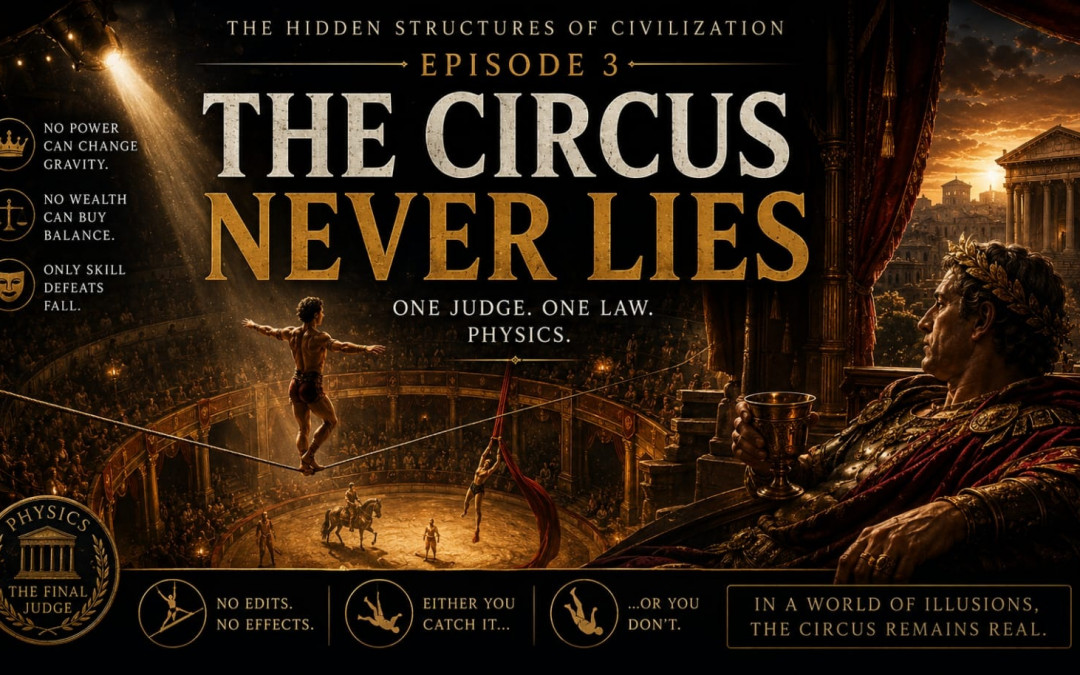
Then an acrobat leaves the platform.
At that moment, wealth becomes irrelevant.
The prince in the box cannot help. The applause cannot help. Reputation cannot help. The performer may have trained for twenty years, may be adored by the audience and may have performed the same sequence a thousand times, but none of those facts can renegotiate the next half-second.
The body has velocity.
The bar has a position.
Gravity has not read the program.
This is why the circus remains strangely powerful in an age capable of manufacturing almost any image. Its deepest attraction is not simply danger, nostalgia or virtuosity. It is the experience of watching a human being enter a situation in which reality retains the right to refuse.
That right may be more important to civilization than we usually admit.
Why Does the Circus Feel More Real Than Cinema?
Cinema can show us almost anything.
A man can fly.
A city can collapse.
An actor who died decades ago can appear young again. A creature that never existed can occupy a physically convincing room. Editing can remove the failed attempt, visual effects can replace impossible environments, and sound design can make a movement feel more powerful than it was.
None of this makes cinema dishonest.
Cinema is an art of construction.
The circus is also constructed. Music, lighting, choreography, costume and audience expectation all shape what the spectator experiences. Safety systems may be present. Apparatus can be engineered carefully. Performers know how to direct attention.
But one layer remains stubbornly literal.
The body must still perform.
A trapeze artist may appear to float, but something measurable is happening. Momentum must be managed. Timing must be precise. A hand must reach another hand within a small window that no metaphor can enlarge.
The distinction is therefore not between illusion and truth.
It is between representation and execution.
Cinema can represent an impossible leap.
The circus must execute a possible one.
That difference is small enough to fit inside one second and large enough to contain an entire philosophy.
Nero Could Not Change Gravity
Imagine Nero watching an acrobat.
The scene is hypothetical. We do not need to pretend that one specific performance occurred exactly this way.
What matters is the structure.
The emperor commands armies. A gesture can change a man’s legal status, wealth or survival. People around him adjust language, posture and truth according to power. Political reality bends.
Then the acrobat climbs.
Nero can order the performance.
He can reward success.
He can punish failure.
He can rewrite the account afterward.
What he cannot do is change the mechanical relationship between mass, momentum, balance and height while the act is occurring.
For a brief instant, imperial power encounters something outside its jurisdiction.
The emperor may control the story.
He does not control the fall.
This is one of the great humbling properties of physical reality. It does not recognize status.
A billionaire and a beggar fall with the same gravitational acceleration under the same conditions. A dictator cannot order a broken bridge to carry twice its designed load merely because the consequences of refusal are politically inconvenient.
Reality can be manipulated.
It can be engineered.
It can be understood more accurately.
It cannot be persuaded by prestige.

Can Physics Be Negotiated?
Of course humans negotiate with physical constraints constantly.
Aircraft do not abolish gravity, but they exploit aerodynamic forces.
A tightrope walker does not defeat balance; they become exceptionally skilled at operating within it.
A pole vault does not suspend the laws of mechanics. It uses them.
This distinction is crucial.
Technology often looks like victory over nature when it is actually improved cooperation with constraint.
The wheel works because friction exists.
The wing works because air has properties.
A bridge stands because materials behave within ranges engineers learn to model.
A circus performer appears superhuman precisely because the audience understands, at least intuitively, that the rules have not been removed.
If the trapeze artist were secretly levitating through unknown technology, much of the achievement would disappear.
The beauty lies in the constraint.
A triple rotation matters because four may not be safely available.
The wire matters because the ground remains below it.
The act is meaningful partly because reality can say no.
This is something digital culture sometimes allows us to forget.
The Most Honest Stage
A live circus performance is not perfectly honest.
That would be an unnecessary myth.
Performers can conceal effort. Apparatus can be designed to make one feat easier than another. Stagecraft shapes perception. Some performances deliberately imitate greater risk than is actually present.
But the crucial distinction remains that the physical system cannot be edited after the fact.
If the act depends on catching the bar, there is a moment when the bar either enters the hand or does not.
If balance must be maintained, the performer’s body must continuously correct deviation.
The stage can influence interpretation.
It cannot retroactively repair biomechanics.
This gives live physical performance a particular kind of authority.
Not moral authority.
Not metaphysical truth.
Constraint authority.
The audience witnesses a system in which the performer is answerable to something outside opinion.
This is increasingly rare in cultural environments where almost every representation can be revised before anyone sees it.
A photograph can be retouched.
A voice can be cloned.
A speech can be rewritten.
A model can generate a plausible answer.
But the physical act still contains a boundary where plausibility is insufficient.
The body either made it.
Or it did not.
What Is Reality’s Veto?
Reality’s veto is the point at which an elegant description fails because the world refuses to behave accordingly.
A scientific theory meets the veto in experiment.
An engineer meets it when a structure is loaded.
A physician meets it when treatment encounters the body.
A pilot meets it in weather.
An investor eventually meets it when narrative encounters cash flow.
A circus performer meets it immediately.
This is why the circus is a useful metaphor far beyond entertainment.
Civilization becomes dangerous when its models become too insulated from veto.
An ideology that interprets every failure as proof of itself cannot learn.
A conspiracy theory that absorbs every contradiction becomes unfalsifiable.
An AI system that produces fluent answers without a path back to evidence can appear correct long after it has left reality behind.
A simulation can be beautiful and wrong.
The world must retain permission to interrupt the story.
That is one of the central disciplines of knowledge.
Why Live Performance Feels Different
The audience knows something about live performance even before consciously formulating it.
The event is not fully recoverable.
If something extraordinary happens, it happened in that room, at that time, between those bodies.
Recording can preserve traces.
It cannot recreate the original uncertainty.
Watching a replay of a dangerous act is psychologically different because the very existence of the replay often tells us that the event reached some completed form.
Live performance contains a future that has not yet happened.
That produces tension.
For several seconds, nobody knows.
Not the audience.
Not the performer with absolute certainty.
Not the organizer.
This is where live performance approaches ritual.
People gather around an outcome that remains open.
The moment becomes valuable because it could still fail.
Much of modern media removes this uncertainty before we encounter it.
The circus puts uncertainty back in the room.
Why Monaco Celebrates the Circus
Monaco is an especially elegant place for this contradiction.
The principality is associated with wealth, luxury, controlled surfaces, ceremonial polish and carefully maintained spectacle. The International Circus Festival of Monte-Carlo has become one of the best-known stages for elite circus performance.
That combination is more interesting than it first appears.
Luxury usually promises insulation from inconvenience.
Better hotels hide logistics.
Better cars hide mechanical roughness.
Better interfaces hide complexity.
The more refined the environment becomes, the less often the user sees the work underneath it.
Circus reverses the relationship.
The setting may be luxurious, but the performance exposes effort.
The polished surface surrounds a body doing something that cannot be outsourced to etiquette.
This may be why high prestige and circus fit together so well.
The wealth of the room makes the indifference of physics more visible.
A prince can award the prize.
He cannot award balance.
The Circus and the Body
Circus also preserves something increasingly unusual: the body as evidence.
Not the body as image.
The body as instrument.
Modern culture often encounters bodies through photographs, filters, fitness metrics, avatars and screens. The body becomes represented constantly.
Circus returns attention to capability.
Can this body rotate?
Can it hold?
Can it coordinate with another body moving at speed?
Can fear be managed long enough for precision to remain?
This does not mean circus reveals some pure or natural human truth. The trained circus body is highly artificial in one sense: shaped by years of discipline, coaching, apparatus and repetition.
But that artificiality makes the point stronger.
Culture does not disappear when physics enters.
Culture trains the body to exploit physics more effectively.
Human excellence often emerges not from escaping constraint but from learning where constraint bends without breaking.
The Limits We Choose
Some of the most interesting human activities impose constraints voluntarily.
A pianist agrees to the keyboard.
A chess player accepts the board.
A poet accepts meter.
A climber chooses the mountain.
A circus performer enters the apparatus.
Constraint creates form.
Without rules, many achievements become meaningless.
If a tightrope walker could quietly switch off gravity, balance would lose its significance.
If a chess player could move any piece anywhere, strategic brilliance would dissolve.
If every musical note were equally available at every moment without structure, composition would become harder to distinguish from noise.
Limits do not automatically produce meaning, but they make certain forms of achievement legible.
This may explain why technologically advanced societies continue inventing difficult games long after survival no longer requires them.
We voluntarily create rooms in which reality can defeat us.
Then we try again.
The Digital World and the Return of the Impossible
Digital systems alter this relationship because they allow environments in which physical constraints can be rewritten.
A video-game character can jump thirty meters.
A virtual object can pass through walls.
Gravity can be reduced.
Time can run backward.
This freedom is enormously creative.
But it also creates a new distinction between possible inside the model and possible outside it.
The two can feel increasingly similar.
A photorealistic video can display an event that never occurred.
A generated photograph can contain a person who never stood before a camera.
A voice can speak words its apparent owner never said.
The sensory evidence remains convincing while the causal history disappears.
The circus therefore acquires a new symbolic value.
It reminds us that there are still domains where provenance is built into the event.
Someone really had to be there.
The body really had to move.
The uncertainty really existed before the outcome.
In a culture of increasingly synthetic representation, that may become luxurious in its own right.
Can AI Create a World Without Physical Limits?
No.
It can create representations in which physical limits are ignored.
That is not the same thing.
AI can describe a perpetual-motion machine.
It cannot make one work.
It can generate a beautiful bridge.
The image cannot carry traffic.
It can produce a plausible medical explanation.
The patient’s body still gets the final vote.
This distinction may become one of the most important forms of literacy in an AI-rich civilization.
Generative systems are extraordinarily good at producing worlds that are internally persuasive.
Reality does not grade for persuasiveness.
The model can be coherent and false.
The simulation can be elegant and incomplete.
The answer can sound certain while depending on a fabricated premise.
AI therefore increases the value of environments in which external constraint remains visible.
The future may need more circuses, metaphorically speaking.
More laboratories.
More prototypes.
More field tests.
More ways for the world to say:
No. That does not work.
The Circus as a Model of Knowledge
A good circus act contains something science values deeply.
A claim is made.
The claim is exposed to failure.
The result is visible.
The performer says, in effect:
I can do this.
Then reality is invited to disagree.
This is very different from a system in which every outcome can be reinterpreted as success.
The distinction matters because intelligence is not merely the ability to generate explanations.
It is the ability to survive correction.
The scientist, engineer and acrobat share a strange dignity.
They enter domains in which confidence has limited value unless performance follows.
The circus does not prove philosophical truth.
But it dramatizes epistemic humility beautifully.
There is no argument with the wire.
Watch the Video
How to Read the World
Current Knowledge
Modern circus as a recognizable institution is much younger than ancient civilization, although acrobatics, juggling, animal performance and other forms of physical spectacle have deep historical roots. It is therefore more accurate to distinguish the long history of physical performance from the specific history of the modern circus.
Live circus acts are carefully trained and often engineered for safety. They may use hidden supports, specialized equipment, choreography and stagecraft. The claim that circus “never lies” should therefore be treated as a metaphor rather than a literal description.
Physical performance remains constrained by biomechanics and the laws of physics regardless of how the performance is framed. Training can improve what humans can achieve within those constraints but does not suspend them.
Digital media and generative AI can produce highly convincing representations of events that never occurred. This increases the importance of provenance and of distinguishing representation from physically executed events.
Scientific and engineering knowledge depends upon external constraint because models gain reliability only when reality can contradict them. A theory that cannot lose contact with evidence is weaker than one exposed to genuine tests.
Open Questions
One important question is whether increasingly synthetic media will increase cultural demand for authenticated live experience. As digital representation becomes easier to manufacture, physical presence and verifiable provenance may become more valuable.
Another concerns AI. If people increasingly encounter the world through systems that summarize, generate and interpret information, how can interfaces preserve the user’s ability to reach the evidence underneath the representation?
There is also a broader cultural question about constraint. Technologies give people greater ability to customize environments, remove inconvenience and alter experience, but many forms of mastery depend precisely on accepting limits rather than eliminating them.
The deepest question is epistemic: how do we preserve institutions and practices in which reality is still allowed to defeat our preferred explanations?
Transhumation Interpretation
For Transhumation, the circus matters because it makes reality’s veto visible.
The performance can be styled.
The audience can be persuaded.
The story can be magnificent.
But at some point the body still meets the bar, the wire or the ground.
That is the same boundary every serious idea eventually needs.
A pattern that survives only while protected from contradiction is not strong.
A model becomes useful when reality is allowed to say no.
The circus simply makes that moment impossible to miss.
FAQ
Why does the circus feel more “real” than cinema?
Because crucial parts of the performance must be physically executed in real time. Cinema can represent an impossible feat convincingly; circus performers must operate within actual physical constraints.
Does the circus really “never lie”?
Not literally. Circus uses stagecraft, choreography and carefully engineered conditions. The title refers to the fact that the underlying physical act cannot be negotiated away by narrative.
Why use Nero in the article?
Nero functions as a thought experiment about the limits of political power. Even an emperor capable of controlling people and stories could not command gravity to suspend itself for an acrobat.
Why is Monaco important to the argument?
Monaco’s prestigious circus tradition creates a striking contrast between social luxury and physical constraint. Status can shape the ceremony, but it cannot perform the act for the performer.
What does this have to do with AI?
AI can generate extremely persuasive representations, but plausibility is not the same as physical or factual truth. The more synthetic our information becomes, the more important external verification becomes.
What is the deeper Transhumation question?
The deeper question is not whether the circus is more honest than cinema.
It is whether civilization still preserves enough places where its stories can fail.
An emperor can control the official account.
A corporation can control an interface.
An algorithm can control what appears first.
A model can generate an answer so elegant that nobody wants to question it.
But the bridge still has to carry the load.
The medicine still has to work in the patient.
The aircraft still has to remain in the air.
The acrobat still has to catch the bar.
Civilization becomes powerful when it learns to model reality.
It becomes wise when it leaves reality the right to reject the model.
That may be the real reason the circus endures.
For one suspended second, beneath the lights and music and all the machinery of spectacle, there is no argument left.
Only the performer.
The distance.
And a world that cannot be bribed.
Continue the Transhumation Series
- Forgotten Religion | Ancient Gods, Symbols and the Hidden Structures of Human Civilization
- The Last Religion | Death, Immortality and the Future of Humanity
- The New Theurgy | AI, Information and the Future of Human Civilization
- End of Branding: You Were Never Meant to Become a Product
- Baal vs Ishtar: Why Ancient Gods Never Disappeared