
God’s Mysterious Ways
Human beings repeatedly describe themselves as though they were finished objects.
We speak of human nature, authentic identity and the discovery of a final self. Religions imagine the redeemed person. Political systems imagine the ideal citizen. Philosophies imagine enlightenment. Technological movements imagine a perfected human being freed from disease, aging and biological limitation.
The stories differ, but the structure remains familiar: humanity is incomplete now, yet history is travelling toward a final condition in which its deepest contradictions will be resolved.
But what if there is no final condition?
What if the human being is unfinished not because perfection has not yet been reached, but because every transformation changes the meaning of perfection itself?
This is the starting point of Transhumation.
Humanity does not merely solve problems. It creates new positions from which previously impossible questions become real.
Every destination becomes another crossroads.
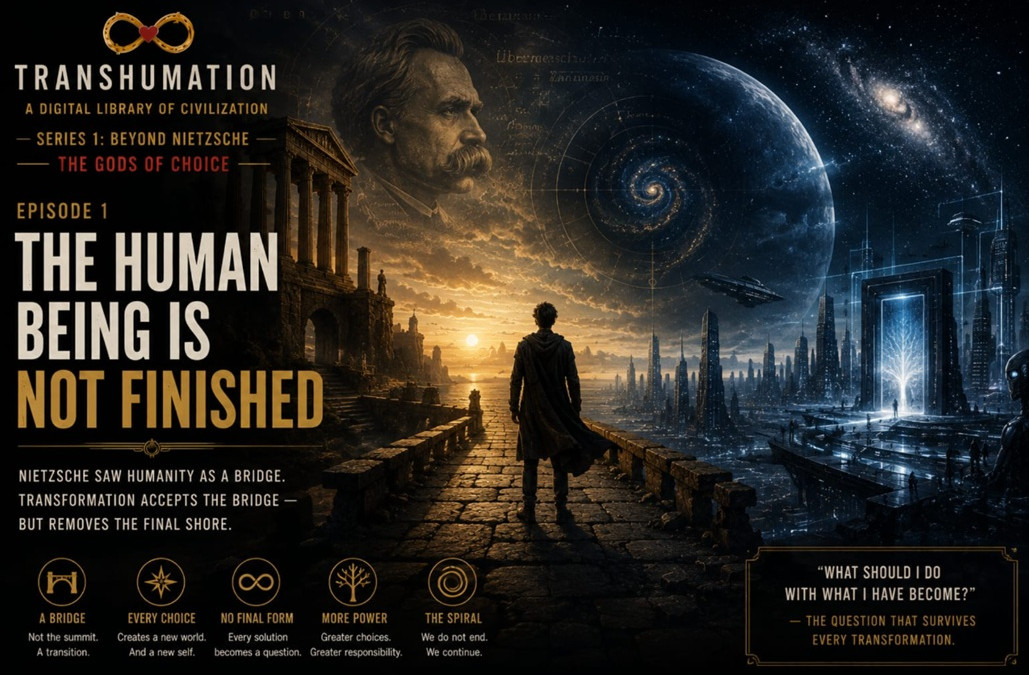
Nietzsche’s Bridge
Friedrich Nietzsche described the human being not as the summit of creation but as something to be overcome—a bridge between the animal and the Übermensch.
This remains one of the most radical ruptures in modern philosophy. Humanity was no longer a stable essence established once and for all. Its inherited values could be questioned, replaced and created anew.
The Übermensch is often misunderstood as a biological superior, political tyrant or comic-book superhuman. More carefully understood, the figure represents self-overcoming: the ability to move beyond inherited values and accept responsibility for creating meaning.
Nietzsche made the decisive first move.
He showed that the human being did not have to remain the final measure of what humanity could become.
But another question immediately follows:
What happens after the Übermensch arrives?
Would this new being stop changing? Would its values remain adequate forever? Would it have no conflicts, limitations or unrealized possibilities?
The answer can only be no.
The Übermensch would also face choices. Its greater power would not end becoming. It would enlarge the territory in which becoming occurs.
Nietzsche gave us the bridge.
Transhumation removes the final shore.
Technology Does Not End Choice
Imagine that humanity eliminates disease, stops biological aging and learns to preserve or transfer parts of consciousness. Energy becomes abundant. Human settlements spread beyond Earth. Memory can be enhanced and personality modified.
Would history be complete?
It would become more complicated.
A copied mind would raise the question of whether memory is enough to preserve identity. An immortal person would face moral questions about resources, reproduction and the accumulation of power. A parent capable of modifying a child’s traits would no longer choose only an education or environment, but aspects of the future person’s body and mind.
Technology does not abolish choice.
It increases its scale.
Today, a writer may decide whether to create a novel. A future intelligence may decide whether to create an artificial world populated by conscious beings.
Today, a person may choose whether to forgive a painful memory. Tomorrow, someone may be able to delete it.
Greater capability does not automatically produce greater wisdom. Every new power creates a new category of responsibility.
Technology can transform the body, extend memory and multiply intelligence. It cannot decide what transformation is for.
History Is a Spiral
Many religions, ideologies and technological visions imagine history as a line.
An imperfect condition produces conflict. Conflict leads to salvation, revolution, enlightenment or invention. Eventually, humanity reaches the final order.
Transhumation proposes another image: the spiral.
A person encounters a choice. The decision changes the person’s position. From that new position, further possibilities become visible. Similar questions return—power, love, security, freedom, identity—but they are faced by someone already altered by earlier decisions.
Communication shows this clearly.
Writing allowed knowledge to survive the speaker. Printing multiplied access to texts. The internet connected much of the world. Artificial intelligence can now search, organize and generate information at enormous speed.
Each development solved genuine problems.
Each created new ones.
Writing weakened dependence on oral memory. Printing expanded propaganda. The internet produced surveillance, misinformation and competition for attention. AI raises new questions about authorship, labour, responsibility and the boundary between personal and external thought.
Development does not remove history.
It opens the next version of it.
We do not return to exactly the same point.
We return to the same structure of choice from somewhere new.
Choice Reveals and Creates the Person
People often say that crisis reveals a person’s true character.
There is some truth in this. Pressure strips away comfortable declarations. When not everything can be saved, a person must decide which value matters most.
But no single decision reveals a permanent and complete essence.
It reveals who the person has become up to that moment.
A cowardly decision does not make future courage impossible. A noble act does not protect someone permanently from betrayal. Each choice carries the weight of previous habits, loyalties, fears and experiences—but it also helps construct the person who will face the next choice.
Small decisions participate in this process too.
Someone decides to stop drinking coffee, then orders one after a sleepless night. The action does not establish their entire moral worth. It reveals a temporary structure: exhaustion and habit overcame an earlier intention.
That information can become resignation—“I simply have no willpower”—or knowledge: “My decisions collapse under predictable conditions.”
The failed choice can strengthen repetition or improve self-understanding.
Human beings are not revealed through one final test.
They emerge through a sequence of decisions that both expose and alter them.
Not Every Possibility Is Yours
Freedom is often described as though every person stands before an unlimited field of options.
Real choice is more concrete.
A person in a restaurant may imagine what they would do if they controlled nuclear weapons. But they do not actually possess that decision. They lack the authority, information and responsibility that would make it real.
For a president, the same possibility belongs to the architecture of lived power.
Choice therefore reveals not only character but position.
Every life has its own crossroads.
For one person, leaving home may be decisive. For another, it may be refusing an order, closing a factory, signing a treaty or beginning a war. The historical scale differs, but each decision reorganizes the future available to the person making it.
Transhumation does not claim that anyone can become anything.
Its claim is more demanding:
You can respond to the possibilities that have genuinely opened before you—and your response changes which possibilities may open next.
Every New Human Becomes an Old Human
Every revolutionary technology eventually becomes infrastructure.
Every rebel risks becoming the founder of an institution. Every new value becomes an inheritance received by people who did not participate in creating it. Every higher human form eventually becomes the ordinary human of an older world.
This is why the series is called Beyond Nietzsche — The Gods of Choice.
Nietzsche placed self-overcoming at the center of human development. Transhumation accepts that motion but rejects the possibility that one final act of overcoming could complete it.
The future human will also become outdated.
The enhanced mind will inherit new blind spots. The immortal body will produce new fears. The civilization that conquers one limitation will discover another at a scale it could not previously imagine.
The destination becomes an environment.
The environment produces another transformation.
Watch the Video
How to Read the World
Current Knowledge
Nietzsche’s concept of the Übermensch is philosophical and symbolic rather than a scientific prediction of a future biological species. It is connected to self-overcoming, value creation and the rejection of inherited moral certainty.
Human identity is already influenced by biological change, memory, social relationships, technology and institutions. However, no current technology can upload consciousness, establish digital personal continuity or remove the ethical problems surrounding radical human modification.
Technological development does not reliably produce moral improvement. Increased capabilities can expand freedom and well-being, but they can also strengthen surveillance, inequality, violence and control.
Open Questions
Would a digitally copied consciousness continue the original person or create a new being possessing the same past? Could immortality preserve meaning, or would meaning itself change without death?
Who should determine which traits count as illness, weakness or improvement? Can emotional suffering be removed without also altering empathy, creativity or love?
And if every new form of humanity eventually becomes the inherited limitation of another generation, can progress have a destination—or only a direction?
Transhumation Interpretation
The human being is not unfinished because humanity has failed.
The human being is unfinished because no achievement can remove the next question.
Nietzsche understood that humanity was a bridge. Transhumation accepts the bridge but argues that there is no final shore waiting at the other end.
Every transformation creates another chooser.
Every solution creates another field of responsibility.
Every new form of intelligence must eventually ask:
What should I do with what I have become?
That question survives biological evolution, technological enhancement and even imagined perfection.
Humanity is not a completed answer moving slowly toward fulfilment.
Humanity is the structure through which new questions become possible.
And that is why history continues.
FAQ
What does “the human being is not finished” mean?
It means humanity has no permanent final form. Choices, technologies, institutions and environments continually change what people can become.
How does this relate to Nietzsche?
Nietzsche described the human being as a transitional form that must overcome inherited values. Transhumation accepts this starting point but rejects a final completed human type.
What is the Übermensch?
The Übermensch is Nietzsche’s symbolic figure of self-overcoming and value creation. It is not a biological race, superhero or authoritarian ruler.
Why is this philosophy post-Nietzschean?
It continues Nietzsche’s idea of self-overcoming while arguing that even the Übermensch would eventually face new limitations and transformations.
Does technology make humanity better?
Not automatically. Technology expands capability, but the same power may support freedom, domination, creation or destruction.
Why is transformation represented by a spiral?
A spiral returns to a familiar structure from a changed position. Humanity repeatedly confronts questions of power, identity and freedom, but never under identical conditions.
Do ordinary decisions matter?
Yes. Small choices create habits and environments that influence how larger decisions are later made, although no single ordinary decision defines the whole person.
Would immortality complete human development?
No. It would create new questions involving identity, memory, resources, relationships, power and the meaning of time.
Is progress inevitable?
No. Transformation can produce growth, stagnation or decline. Greater power does not guarantee greater wisdom.
What is the central idea?
Humanity is not unfinished because it has not yet reached perfection. It is unfinished because every achieved form—including perfection—would still have to decide what to become next.
Continue the Transhumation Series
- Forgotten Religion | Ancient Gods, Symbols and the Hidden Structures of Human Civilization
- The Last Religion | Death, Immortality and the Future of Humanity
- The New Theurgy | AI, Information and the Future of Human Civilization
- End of Branding: You Were Never Meant to Become a Product
- Baal vs Ishtar: Why Ancient Gods Never Disappeared