
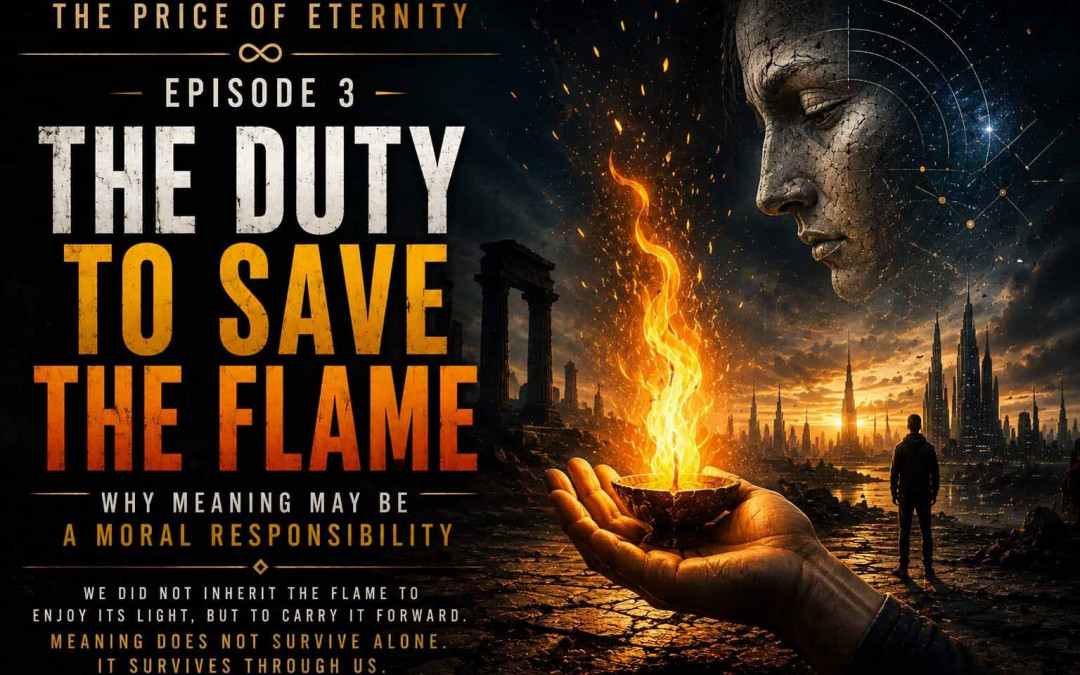
The Fire of Vesta
Imagine a future in which humanity has solved most of the problems that once defined ordinary life.
Disease is largely controlled. Extreme poverty is rare. Artificial intelligence performs much of the repetitive labour. Human beings live longer, safer and more comfortable lives than any previous generation could have imagined.
For centuries, this was the dream.
Yet when survival is no longer the central struggle, another question becomes harder to avoid:
What are we surviving for?
For most of history, people did not need to construct an answer every morning. Life demanded participation. Food had to be produced. Children had to be protected. Homes, communities and institutions had to be maintained. Meaning was embedded in necessity.
Modern civilization is gradually weakening that relationship.
As technology removes obligations, reduces friction and expands comfort, purpose becomes less inherited and more consciously chosen.
That may sound like liberation.
It is also a responsibility.
If meaning is not guaranteed by survival, religion, family or tradition, then someone must keep creating the conditions in which meaning remains possible.
Someone must save the flame.
The Fire That Built Civilization
Every civilization began around a physical fire.
It provided warmth, protection, food and light. But human beings soon surrounded fire with stories. It became a meeting place, ritual center and symbol of continuity.
The flame came to represent something more than survival.
Curiosity.
Memory.
Presence.
The refusal to allow darkness to become the final condition.
Many of humanity’s greatest achievements cannot be explained by immediate biological necessity. Pyramids did not feed the people who built them. Cathedrals were not efficient shelters. Libraries, observatories and works of art required enormous resources that could have been spent on more practical needs.
Yet civilizations repeatedly invested in them.
Why?
Because human beings do not merely maintain life.
They try to place life inside a larger structure.
We build things that will outlive us because survival alone does not satisfy the imagination. We want our existence to participate in something extending beyond one body, one family or one generation.
The flame is this movement beyond immediate utility.
The Invisible Inheritance
Most people inherit far more than money, property or genetic traits.
They inherit language.
Stories.
Questions.
Moral intuitions.
Artistic forms.
Scientific knowledge.
Every generation enters a world partly constructed by people who are no longer alive.
A child learns words created before their birth. A scientist begins with discoveries made by strangers across centuries. An artist works inside forms shaped by forgotten cultures. Even rebellion depends on an inherited structure against which to rebel.
Civilization is therefore an invisible transfer between the dead and the unborn.
But the transfer is not automatic.
A library can burn. A language can disappear. A tradition can become empty repetition. Knowledge can survive physically while losing the people capable of interpreting it.
Preservation does not mean freezing everything exactly as it was. Some inherited ideas deserve rejection. Some institutions preserve injustice rather than wisdom.
Saving the flame means something more demanding:
preserving the capacity to receive, question, transform and pass meaning forward.
The flame is not one doctrine.
It is the possibility of continuing the conversation.

Comfort Does Not Produce Purpose
Modern civilization has made extraordinary progress in reducing suffering.
That achievement should not be romanticized away. Hunger, disease, violence and premature death do not become spiritually valuable merely because previous generations endured them.
But the reduction of necessity creates a new problem.
When life no longer tells a person what must be done, the person must decide what is worth doing.
The old question was:
How can I remain alive?
The new question becomes:
Why should I use this life in one way rather than another?
Comfort can provide time, safety and freedom. It cannot determine what deserves attention.
A person may possess every entertainment, convenience and technological assistance while experiencing life as empty repetition. The absence of pain is not the same as the presence of purpose.
This is where modern systems often fail.
Governments can create stability. Markets can distribute products. Algorithms can predict preferences. None of them can guarantee that the resulting life feels worth inhabiting.
Meaning cannot be delivered like electricity.
It requires participation.
The Flame and the Machine
Artificial intelligence intensifies the problem.
Machines can already create images, write text, compose music, summarize knowledge and perform tasks once treated as distinctly human. Future systems may become capable of producing work that exceeds human skill across many domains.
The immediate response is often to ask what human beings will still be better at.
That may be the wrong question.
The human role may not depend on maintaining superiority.
Perhaps what matters is responsibility.
A machine can generate a story.
It cannot automatically decide why that story should exist, whose life it should serve or whether its effect is worth preserving.
An AI can propose thousands of futures.
It cannot remove humanity’s responsibility for choosing among them.
Technology expands the range of available actions. It does not provide a final account of what actions are good.
The more the machine can do, the more important the human question becomes:
What should be done?
The flame is not productivity.
It is the obligation to care about the direction in which power is used.
The Guardians of Meaning
Every civilization has created people and institutions that preserve what cannot be measured easily.
Teachers.
Artists.
Parents.
Librarians.
Priests.
Scientists.
Storytellers.
Their roles differ, and none deserves automatic moral authority. Yet structurally they perform a similar task: they connect the present to meanings that do not originate entirely within it.
They remind a society that value cannot be reduced to immediate profit, popularity or efficiency.
This function is easy to underestimate because its results are difficult to count. A teacher may preserve a question that changes a student twenty years later. A book may remain unread for decades before becoming essential to another generation. A parent may transmit a story whose original source has been forgotten.
The flame often survives through small acts.
Explaining something carefully.
Protecting a difficult work from disappearance.
Teaching a child to ask why.
Refusing to reduce every activity to its market value.
Preserving wonder is not sentimental decoration.
It is civilizational maintenance.
Meaning Cannot Be Outsourced
It may become possible to outsource almost every practical task.
AI can recommend a career, plan a journey, select entertainment, organize communication and eventually perhaps manage health, finance and education.
But there is a limit.
A system can tell us what people like us usually choose.
It cannot decide what our lives should mean without quietly replacing our agency.
Meaning produced entirely from outside becomes instruction.
Meaning requires some form of authorship.
This does not mean each person must invent a philosophy alone. Human meaning is almost always shared. It grows from relationships, traditions, commitments and participation in structures larger than the individual.
But receiving meaning is not passive.
A person must decide what to protect, what to reject and what to continue.
No machine can carry that responsibility without transforming humanity into spectators of its own existence.
The Price of Eternity
Immortality is often imagined as the ultimate victory.
But endless duration is not the same as meaningful life.
Without direction, eternity could become repetition. Without memory, it could dissolve identity. Without responsibility, it could magnify boredom, inequality and power.
The longer humanity lives, the more important the question of meaning becomes.
A short life can be filled by urgent necessity. An extremely long life would eventually exhaust many inherited goals. Careers, possessions and conventional milestones might lose their organizing power.
What remains after the hundredth achievement?
After the thousandth year?
The central challenge of immortality may not be preserving the body.
It may be preserving the ability to care.
A civilization capable of defeating death but unable to renew meaning would not have solved the human problem.
It would have extended it indefinitely.
Watch the Video
How to Read the World
Current Knowledge
Psychological research generally links well-being not only with pleasure and comfort but also with purpose, relationships, agency and participation in meaningful activity. However, there is no universally accepted scientific definition of meaning in life.
Technological progress can reduce suffering and increase opportunity, but it does not automatically produce purpose, wisdom or moral agreement. These depend on social structures, individual commitments and cultural interpretation.
Cultural knowledge is fragile. Languages, traditions and interpretive skills can disappear even when physical records remain. Preservation therefore requires active transmission rather than storage alone.
Open Questions
Can a society protect shared meaning without imposing one compulsory worldview? Who should decide which traditions deserve preservation and which should be abandoned?
Could artificial intelligence become a genuine participant in meaning rather than merely a generator of symbolic material? Would an immortal civilization develop deeper purpose, or would extreme longevity weaken commitment?
And if future generations inherit almost unlimited technological capability, what cultural structures will teach them why some possibilities should remain unused?
Transhumation Interpretation
The flame is not a supernatural object hidden inside the human body.
It is a relationship maintained across time.
A person receives language, memory, hope and unfinished questions from those who came before. Through choices, these inheritances are changed. Some are rejected. Others are protected and passed forward.
The soul, in this interpretation, is not merely something one possesses.
It is something one helps keep alive.
This changes the meaning of responsibility.
We are not responsible only for surviving.
We are responsible for preserving the conditions under which survival can still become a life.
Technology may protect bodies.
Archives may protect information.
Artificial intelligence may protect access to knowledge.
But only a civilization capable of caring can decide why any of it should continue.
The duty to save the flame is therefore not a command to preserve one religion, one culture or one answer.
It is the duty to keep wonder, interpretation and purpose possible for people we will never meet.
The flame was handed to us.
We do not own it.
We decide whether it reaches the next shore.
FAQ
What does “save the flame” mean?
It means preserving humanity’s capacity for meaning, hope, curiosity, creativity and participation in something larger than immediate survival.
Why is meaning a responsibility?
If meaning is fragile and depends on active transmission, then protecting the conditions that allow it to survive becomes a moral responsibility.
Can technology create meaning?
Technology can support meaningful activity and generate symbolic material, but it cannot automatically determine what deserves value or direction.
What does the flame symbolize?
The flame represents wonder, purpose, memory, creativity and the continuity of meaning across generations.
Does comfort destroy meaning?
Not necessarily. Comfort can create freedom and opportunity, but it does not automatically provide a reason for using them.
Who are the guardians of meaning?
They may include teachers, parents, artists, librarians, scientists, religious figures and anyone who preserves and transmits valuable questions, knowledge or cultural memory.
How does this connect with immortality?
Longer life would not guarantee deeper purpose. The longer existence continues, the more important it may become to preserve the capacity to care, choose and renew meaning.
Is the article arguing for one shared religion?
No. It argues for preserving the ability to create, question and transmit meaning without requiring one compulsory doctrine.
Can artificial intelligence become a guardian of meaning?
AI may help preserve and interpret knowledge, but whether it can genuinely care about meaning—or only model human expressions of care—remains an open question.
What is the central Transhumation idea?
Civilization’s task is not merely to preserve life and information. It must also preserve the human ability to transform existence into something worth continuing.
Continue the Transhumation Series
- Forgotten Religion | Ancient Gods, Symbols and the Hidden Structures of Human Civilization
- The Last Religion | Death, Immortality and the Future of Humanity
- The New Theurgy | AI, Information and the Future of Human Civilization
- End of Branding: You Were Never Meant to Become a Product
- Baal vs Ishtar: Why Ancient Gods Never Disappeared