The Crossroads of Meaning
Human beings possess a strange ability: we can imagine lives we are not yet living. We can see ourselves in another city, another profession, another relationship, another future. We can picture the conversation we have avoided, the project we have not begun, the door we have not opened.
But imagination does not move us.
A person can think about leaving a job for five years and still return to the same desk every morning. Someone can understand an addiction perfectly and continue repeating it. Another person can dream about leaving a city, ending a relationship or beginning a company without ever crossing the distance between possibility and reality.
That distance has a name.
It is choice.
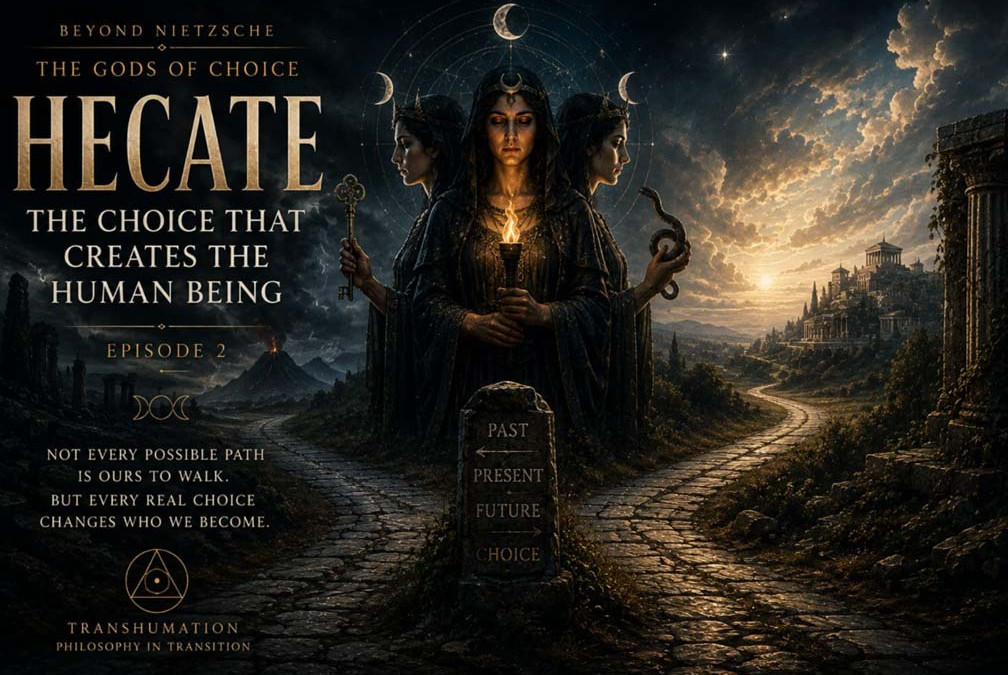
Within Transhumation, Hecate becomes one of the clearest symbols of that threshold.
The Crossroads Is Not Destiny
In Greek religion, Hecate was associated with crossroads, thresholds, night and transitions between different domains. Later traditions also connected her with magic, spirits and theurgy. She often appears as a figure who stands where one world becomes another.
That symbolism can easily be misunderstood as fatalism. A goddess stands at the crossroads, therefore perhaps she already knows which road will be taken. The human being becomes a passenger inside a destiny arranged elsewhere.
The Transhumation interpretation reverses that.
Hecate does not choose the road.
She represents the fact that there is a road to choose.
The distinction matters because freedom becomes visible only when several possibilities are genuinely available. Before the crossroads, movement may be automatic. At the crossroads, imagination becomes consequential. One path is taken, others remain unrealised, and the world after the decision is no longer identical to the world before it.
This is why choice is more than preference.
A preference can remain private forever. A choice enters reality.
Marriage reorganises time, loyalty, money and future planning. Moving abroad changes language, social networks and opportunity. Starting a company creates freedoms that did not previously exist while introducing responsibilities that did not exist either. Even reversible decisions leave traces, because the person who returns is not exactly the person who left.
Every real choice changes the chooser.
The Choice Reveals a Hierarchy
People often claim that several values are equally important: family, truth, loyalty, freedom, law, security. As long as those values cooperate, the declaration costs almost nothing.
The real crossroads appears when they collide.
What happens when truth threatens loyalty? When family conflicts with law? When freedom produces insecurity? When order requires cruelty? A person may not know what they value most until preserving one thing requires sacrificing another.
This is why decisions made under pressure can be so revealing. They do not necessarily expose an eternal face hidden beneath every social mask. They reveal the current hierarchy of forces inside the person: fear, obligation, desire, loyalty, ambition, shame.
Augustus offers a striking example. He spent much of his political life trying to secure dynastic continuity while simultaneously constructing a public ideology centred on Roman morality, marriage and legitimacy. When those two structures collided, the choice revealed which one carried greater weight.
The point is not to reduce Augustus to a single moral judgement. It is that his decision showed something ordinary declarations could not. The political order he had built had become more powerful than one biological interest within it.
The creator was now accountable to his own creation.
That is what a crossroads does. It converts abstract values into hierarchy.
Not Every Road Is Ours
Modern ideas of freedom often imply an unlimited catalogue of options, as if every imaginable future belongs equally to everyone.
Reality is narrower.
A person sitting in a restaurant may wonder whether they would launch a nuclear strike if they were president, but this is not their actual crossroads. They do not possess the office, information or responsibility that makes the possibility real. For someone who genuinely holds such authority, the same question belongs to lived reality.
Choice therefore reveals not only character but position.
Every person inhabits a different field of possible action. Wealth expands some possibilities. Poverty removes others. Law, social status, health, knowledge and historical circumstance all alter which doors actually exist.
Freedom cannot mean the absence of conditions.
It means movement within conditions.
For one person, the defining decision may be leaving the family home. For another, it may be signing a treaty, exposing corruption, refusing an order or closing a factory. A choice does not need to affect millions of people to matter. Its weight also depends on what it costs the person who must make it.
Transhumation does not claim that everyone can choose everything.
It makes a harder claim: we are responsible for how we respond to the possibilities that genuinely become ours.
Small Decisions Build the Next Chooser
The crossroads does not appear only in wars, dynasties and historical crises. It appears constantly in ordinary life.
A person decides to stop drinking coffee. Two days later, exhausted and distracted, they walk into a restaurant and order one. That decision does not define their entire character, but it reveals something specific: in that situation, fatigue, habit or pleasure outweighed the previous resolution.
The choice becomes information.
A person can turn it into identity—“I have no discipline”—or into inquiry: under what conditions does my decision fail? Perhaps lack of sleep is the real trigger. Perhaps the environment makes relapse too easy. Perhaps the original commitment relied on willpower while ignoring structure.
Then failure becomes a map.
This is one of the central ideas of the series: choice does not merely expose who we are. It changes who will make the next choice.
A person who starts a company gains not just a company but a new field of worries, skills, obligations and dependencies. Someone who marries does not simply add a relationship to an existing life; their future decisions are now made from a different position. Someone who publishes an idea no longer controls its meaning completely because other minds begin interacting with it.
Choice is therefore cumulative.
Life is not a collection of independent decisions.
It is a path in which each movement changes the architecture of the next crossroads.
Inaction Is Also a Road
This is why doing nothing cannot always be treated as neutrality.
Not answering a message changes a relationship. Ignoring a deadline gives time permission to decide. Leaving default settings untouched allows a system to choose on our behalf. Refusing to challenge an institution may preserve the existing structure.
Sometimes inaction is wise. A person may lack information, power or safety. Waiting can itself be a deliberate strategy.
But even deliberate waiting has consequences.
At the crossroads, remaining where one stands is still one of the available paths because the world continues to move around the person who refuses to move.
Technology makes this especially visible. Choosing a smartphone may appear trivial, but the decision can pull a person into an ecosystem of apps, payments, cloud storage, social expectations and data collection. The original purchase seems small while the architecture that follows it becomes large.
We choose the tool.
Then the tool begins organising later choices.
This is one reason freedom is not achieved once and permanently. Even a successful rebellion can become a new structure of dependence. An alternative platform becomes a standard. A new institution develops its own rules. The road that once represented escape becomes another system with walls.
Hecate represents passage, not guaranteed liberation.
Three Roads, Not Two
Hecate’s triple form becomes especially interesting here.
A binary choice is simple: yes or no, stay or leave, accept or refuse.
A third possibility changes the structure.
Now the mind must compare several futures rather than merely react to an opposition. One path may be safe, another ambitious, another unknown. The person begins constructing counterfactual worlds before any of them exists.
This is where the symbolism becomes unexpectedly modern.
Choice depends on imagined realities.
Human beings do not live only inside what happened. We carry worlds that might have happened: the career we abandoned, the person we did not marry, the city we never moved to. These unrealised paths produce regret, nostalgia and sometimes wisdom.
They also make planning possible.
By imagining several futures before acting, the mind begins to stand above the immediate road and model the crossroads itself.
The metaphysical power of Hecate may not require literal magic.
It may begin with the human capacity to stand inside one reality while seeing others that do not yet exist.
Watch the Video
How to Read the World
Current Knowledge
Hecate was an ancient Greek deity associated with crossroads, boundaries, night, transitions and later magical and theurgical traditions. Her triple representations became especially prominent in later iconography.
Modern psychology supports the idea that decisions are shaped by previous experience, habits, context, incentives and available options rather than by unlimited abstract freedom. Choices can also change later behaviour by creating commitments, habits and new environments.
Human decision-making is influenced by social position, resources and circumstance. People do not encounter identical sets of meaningful possibilities, which makes simplistic ideas of universal freedom difficult to sustain.
Rituals and symbolic acts can also strengthen commitment and mark transitions, although their effects do not require supernatural explanation.
Open Questions
How much of identity is revealed by choice, and how much is produced by the choice afterward?
Can a person ever know their true hierarchy of values before those values genuinely collide?
When does hesitation become wisdom, and when does it become disguised surrender of agency?
How much freedom remains when technological systems increasingly shape the options presented to us?
And if every choice changes the person who will choose next, can any identity ever be considered final?
Transhumation Interpretation
Hecate does not represent the correct road.
She represents the moment when several possible worlds become one lived world.
This makes her more than a symbol of decision. She becomes a symbol of transformation itself.
The human being imagines.
The crossroads appears.
One possibility receives action.
The world changes.
The chooser changes with it.
Then another crossroads appears.
This is why choice does not simply reveal a hidden, permanent self. There may be no final version waiting beneath all circumstances. A decision reveals the person as they exist now, but the consequences of that decision help construct the person who will stand at the next threshold.
Hecate therefore belongs naturally beside Nietzsche, but she pushes the idea of self-overcoming in another direction. Nietzsche asks how the human being can move beyond inherited forms. Hecate asks how that movement actually enters reality.
Not through imagination alone.
Not through belief.
Through crossing.
A person does not become different because they can imagine another life.
They become different when one imagined possibility acquires consequence.
Hecate does not promise that the choice will be wise.
She does not promise that freedom is unlimited.
She does not promise that the road will remain open.
She marks something more fundamental:
the point where possibility becomes history.
And because every choice changes the position from which the next one will be made, the human being is never created once.
We create ourselves again at every crossroads.
FAQ
Who is Hecate?
Hecate is an ancient Greek goddess associated with crossroads, thresholds, boundaries, night and transitions. Later traditions also connected her with magic and theurgy.
Why does Hecate represent choice?
The crossroads provides a natural symbol for competing possibilities. Hecate represents the threshold at which one possible path becomes an actual one.
Does Hecate choose a person’s destiny?
Not in the Transhumation interpretation. She represents the structure of choice rather than a supernatural force deciding for the individual.
How does choice create the human being?
Every decision changes experience, habits, relationships and available possibilities. The next decision is therefore made by someone already altered by previous choices.
Does crisis reveal true character?
It can reveal a person’s current hierarchy of values and fears, but it does not necessarily expose a permanent essence that can never change.
Why do small choices matter?
Repeated ordinary decisions create habits and environments that influence later, more serious decisions.
Is inaction also a choice?
Often, yes. Refusing to act can still allow time, institutions or other people to determine what happens next.
Does everyone possess the same freedom?
No. Meaningful choice depends on resources, safety, knowledge, social position and power.
How does technology relate to Hecate?
Technology creates and restructures crossroads. Choosing one system can shape later options, habits and dependencies.
What is the role of theurgy here?
Theurgy can be interpreted structurally as the use of symbols and rituals to give form to transitions. A ritual does not replace choice, but it can make the crossing visible and durable.
Why is Hecate often shown in triple form?
The triple form fits the idea of multiple directions. Three paths create a richer structure than a simple binary opposition and force comparison among possible futures.
What is the central Transhumation idea?
Choice is the passage between possibility and reality. It reveals the current person, alters the world, and creates the person who will face the next crossroads.
Continue the Transhumation Series
- Forgotten Religion | Ancient Gods, Symbols and the Hidden Structures of Human Civilization
- The Last Religion | Death, Immortality and the Future of Humanity
- The New Theurgy | AI, Information and the Future of Human Civilization
- End of Branding: You Were Never Meant to Become a Product
- Baal vs Ishtar: Why Ancient Gods Never Disappeared