
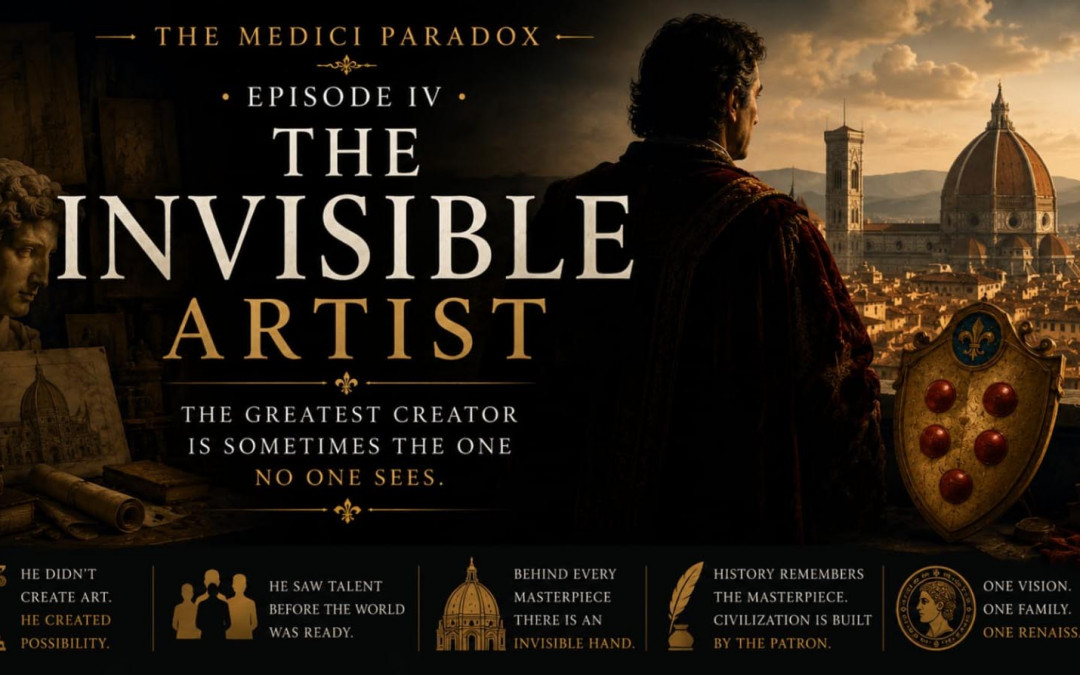
The Art and the Observer
There is a peculiar way to look at Florence that changes the city almost immediately.
Stand before Michelangelo’s David and the obvious question is who made it. The answer is easy. Walk beneath Brunelleschi’s dome and ask the same thing; again, history gives us a name. Museums are designed around this kind of attribution. The artist stands in front of the work like a signature attached to civilization.
But now remove the artist from the question.
Ask instead who bought the marble, who maintained the workshop, who paid for the commission, who preserved the ancient text that inspired the scholar, who introduced the architect to the patron, who gave a young person enough time to become unusually good at something before anybody knew whether the investment would make sense.
The city begins to look different.
The visible masterpiece remains exactly where it was. What changes is the network behind it.
And suddenly Florence is full of invisible artists.
The Masterpiece Before the Masterpiece
We tend to imagine creation beginning at the moment somebody touches the material. A painter lifts a brush. A sculptor approaches marble. A writer places the first sentence on a page. That is the part history photographs because it gives us a clean author and a clean object.
Yet almost every serious work begins earlier.
The marble had to arrive. The workshop had to exist. Someone had to teach the apprentice. Manuscripts had to survive long enough to be rediscovered. A scholar required food, light, paper and time. An architect needed a client sufficiently ambitious to commission something that had not yet been proved possible.
None of these people becomes the artist in the conventional sense. Paying Donatello does not make the patron the sculptor. Preserving a manuscript does not make the librarian its author. The distinction matters because enabling creation is not the same thing as creating the final work.
But neither is it nothing.
A masterpiece has an ecology.
Remove enough of that ecology and the work may never appear.
This is where Cosimo de’ Medici becomes interesting again. His importance cannot be reduced to a romantic story in which one banker single-handedly invents the Renaissance. Florence was a dense system of guilds, churches, merchants, workshops, political rivalries and civic institutions long before Cosimo became its dominant political figure. Other patrons spent money. Other families competed for prestige. Artists did not wait passively for the Medici to teach them how to create.
What Cosimo understood unusually well was how many different conditions could reinforce one another.
Money could protect scholarship.
Scholarship could strengthen prestige.
Architecture could make political power visible.
Libraries could preserve ideas longer than any individual life.
A patron did not have to produce the masterpiece personally to influence the environment in which masterpieces became more likely.
That is a subtler kind of authorship.
The Man Who Created the Room
There is a type of creativity that does not produce an object. It produces a room in which objects can appear.
A good editor does not write the novel, but may recognize the novel inside a manuscript that is not yet working. A teacher does not become the student’s discovery, yet may recognize a mind before that mind has learned to recognize itself. A producer may not act, direct or write, but can bring people together in a combination from which something emerges that none of them could have produced alone.
The medium is not paint.
It is configuration.
Cosimo worked in this medium instinctively. His influence moved through banking, politics, architecture, religious patronage, manuscript collecting and intellectual networks. He could not predict every consequence, and later Medici mythology tends to make the family look more coherent than any real dynasty ever was. But the larger structure is difficult to miss.
Some people create things.
Others create conditions.
The difference becomes particularly important because conditions are usually invisible after success. Once the building exists, we look at the architect. Once the book becomes famous, we look at the author. Once the scientific discovery enters textbooks, the institution that tolerated ten years of uncertain work becomes background.
Success deletes part of its own history.
The better the invisible artist performs, the easier it becomes to forget that he was there.

Florence Did Not Suddenly Produce Better Humans
This may be the most useful way to think about the Renaissance.
Tuscany did not suddenly undergo a biological event that produced more genius per square mile. Human brains did not improve dramatically between one generation and the next. What changed were the circumstances in which certain forms of ability could become visible, trainable and valuable.
Workshops accumulated technical knowledge. Wealth created commissions. Cities competed through architecture and art. Humanist scholarship intensified the search for texts and ideas. Political prestige became connected to cultural patronage. An ambitious young person could enter a system capable of refining talent rather than merely discovering it accidentally.
That does not diminish genius.
It gives genius somewhere to happen.
The romantic version of history loves the isolated individual because the story is cleaner. Michelangelo appears, Leonardo appears, Brunelleschi appears, and civilization moves forward through an almost miraculous sequence of exceptional minds.
The radical realist has to ask the less glamorous question: how many exceptional minds existed elsewhere and disappeared because the surrounding structure failed to notice them?
We cannot know.
That unknowable population may be one of history’s largest invisible archives.
Every civilization preserves the geniuses somebody recognized.
It also buries the ones nobody did.
The Dangerous Power of Recognition
This is where the metaphor of the Invisible Artist stops being flattering.
A patron is not merely a benevolent person opening doors. A patron is also a filter.
To give one person time is to deny time to another. To fund one building is to postpone another. To preserve one manuscript is to leave another vulnerable. A network capable of amplifying brilliance can amplify fashion, loyalty, ideology or mediocre taste just as efficiently.
The gardener does not merely help things grow.
He decides what receives water.
This makes patronage one of civilization’s most consequential forms of power precisely because it can remain difficult to see. The artist’s hand is visible in the finished object; the patron’s selection often disappears into the assumption that this was simply the work history was always going to produce.
But history contains no such guarantee.
The Renaissance we know is partly the Renaissance that survived its filters.
That includes extraordinary works.
It also includes everything that was never commissioned, never preserved, never translated, never taught and never protected.
Cosimo’s creative power therefore had a shadow. Supporting possibility also means influencing which possibilities become real.
The Invisible Artist can create a future.
He can also narrow it.
The Artist Who Never Signs
Modern civilization is filled with people occupying this position.
A research director protects a strange project long enough for it to become useful. An editor sees something in an unknown writer before the market does. An investor funds an idea that looks ridiculous until suddenly it looks inevitable. A librarian preserves a document nobody has requested for fifty years, only for the fifty-first year to make it indispensable. An engineer builds a tool used by people whose names become far more famous than his own.
The pattern is so common that we barely notice it.
Visible achievement tends to gather attention around the final carrier.
The book.
The company.
The painting.
The discovery.
But civilization often begins one step earlier, with a judgment made before certainty exists.
That is the difficult part.
Recognizing something after consensus requires taste.
Recognizing it before consensus requires imagination.
This may be why the Invisible Artist belongs inside the Medici Paradox. Cosimo’s most interesting talent was not that he possessed better aesthetic judgment than every artist around him, nor that he personally created the Renaissance. It was that he understood something about the conversion of resources into possibility.
Money could buy objects.
Used differently, it could buy time.
And time is one of the rarest materials from which culture is made.
The Shadow Behind the Masterpiece
Go back to David.
Nothing about this argument transfers Michelangelo’s authorship to anybody else. The sculpture remains his. The hand matters. The eye matters. The decisions carved into the marble belong to the person who made them.
But the sculpture no longer looks completely alone.
Behind it appears a workshop, a commission, a quarry, a city, a political climate, a history of sculpture, people who taught people who taught other people, patrons who failed, patrons who succeeded, institutions that preserved knowledge and accidents that happened at exactly the right moment.
The masterpiece casts a shadow much larger than itself.
Perhaps this is the real work of the Invisible Artist.
Not to become the visible creator.
To make the visible creator possible.
History likes signatures because they give us somewhere to point.
Civilization is usually built by networks.
And somewhere inside almost every great work is a person whose name never appeared on the frame, but without whom the frame might have remained empty.
Watch the Video
How to Read the World
Current Knowledge
Cosimo de’ Medici was an important Florentine banker, political figure and patron whose influence extended into architecture, religious institutions, manuscript collecting and humanist scholarship. His role should not be exaggerated into the claim that he alone created the Renaissance, which emerged from a much larger network of civic institutions, guilds, merchants, churches, scholars, workshops and competing patrons.
Renaissance artistic production frequently depended on commissions, workshops, apprenticeships and patronage. Artists retained authorship of their works; financial or institutional support did not make patrons the creators of those works in the conventional artistic sense.
Modern scholarship increasingly studies creativity and innovation as products not only of individuals but also of networks, institutions, education, access to resources and environments that allow talent to develop.
Open Questions
How much creative achievement belongs to the individual who produces the final work, and how much to the environment that allowed the work to become possible?
Can recognizing talent before consensus itself be considered a creative act? How many potentially transformative artists, scientists or inventors disappear because nobody recognizes them at the right moment?
There is also a more uncomfortable question: if patrons and institutions determine which possibilities receive time, money and protection, how much of cultural history reflects excellence, and how much reflects the preferences of those who controlled access?
Transhumation Interpretation
Transhumation treats the Invisible Artist as a recurring civilizational function rather than a hidden author.
The structure is:
potential → recognition → protection → resources → development → creation → inheritance
The visible creator occupies one essential position in that chain, but not the only one.
This complicates the mythology of genius. Civilizations need people capable of producing extraordinary things, but they also need systems capable of recognizing potential before its value becomes obvious.
That function can migrate between carriers.
Patron.
Teacher.
Editor.
Librarian.
Investor.
Institution.
Recommendation system.
Perhaps even certain forms of artificial intelligence.
Each faces a version of the same problem:
Among thousands of possibilities, what deserves attention before the world has decided that it matters?
Attention becomes time.
Time becomes possibility.
Possibility becomes history.
The Invisible Artist does not create the masterpiece.
He creates the conditions in which the masterpiece gets the chance to exist.
FAQ
Who is the Invisible Artist?
The Invisible Artist is someone who shapes creation without becoming the visible author of the final work: a patron, mentor, teacher, editor, librarian, investor or institution that recognizes and protects potential.
Why is Cosimo de’ Medici called an Invisible Artist?
The phrase is metaphorical. Cosimo did not create the artworks he supported, but his patronage and political influence helped create environments in which artists, scholars and architects could work.
Is supporting art the same as creating art?
No. Authorship remains with the creator. The article argues that enabling creation is a separate civilizational function with its own consequences.
Why is recognition so important?
Talent requires more than ability. It also requires time, opportunity, training, resources and often someone willing to support it before success becomes obvious.
Can an Invisible Artist have too much power?
Yes. The person or institution allocating resources also determines which possibilities remain unfunded or invisible. Patronage can amplify originality, but it can also amplify bias and conformity.
Why is this idea relevant today?
Modern science, technology, publishing and culture still depend heavily on people and institutions whose contribution lies in creating conditions for others to succeed.
What is the central Transhumation idea?
Civilization is not built only by visible creators. It is also built by systems that recognize, connect and protect potential before history knows what that potential will become.
Continue the Transhumation Series
- Forgotten Religion | Ancient Gods, Symbols and the Hidden Structures of Human Civilization
- The Last Religion | Death, Immortality and the Future of Humanity
- The New Theurgy | AI, Information and the Future of Human Civilization
- End of Branding: You Were Never Meant to Become a Product
- Baal vs Ishtar: Why Ancient Gods Never Disappeared