
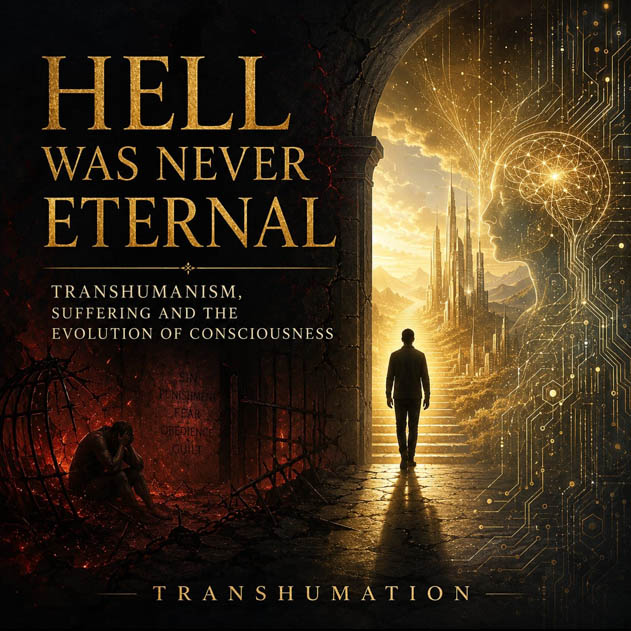
Hell Was Never Eternal
Transhumanism, Suffering and the Evolution of Consciousness
For thousands of years, humanity imagined hell as a place.
A place of punishment.
A place of fire.
A place where consciousness remains trapped forever.
Religions gave hell different names and forms, but the central fear remained similar: suffering without escape.
Yet what if hell was never a place at all?
What if hell was a condition of existence?
A condition created by pain, fear, biological limitation and the fragile structure of human life.
Perhaps the idea of eternal punishment did not emerge only from theology. Perhaps it emerged from the reality human beings already knew.
Suffering Was the Original Human Condition
For most of history, suffering was not an unusual interruption.
It was part of ordinary life.
Disease could appear without explanation. A minor infection could become fatal. Childbirth was dangerous. Hunger returned regularly. Violence was common. Memory disappeared with age. Death could arrive suddenly and remove a person from the world without warning.
Human beings lived inside bodies they could not repair and a reality they could barely control.
In such a world, hell was not difficult to imagine.
People already understood pain.
They understood helplessness.
They understood what it meant to lose someone and have no way to bring them back.
Religious images of punishment transformed these experiences into metaphysical language. Hell became the final symbol of suffering that could never end.
The fear was not merely that pain existed.
The fear was that there might be no exit.
Hell as a Structure
A prison does not need flames to become hell.
It only needs suffering, awareness and the impossibility of change.
A person trapped inside chronic pain may experience time differently. A mind trapped inside fear can turn every ordinary event into a threat. Memory loss can slowly remove the continuity of identity. Isolation can make the world feel empty even when other people remain physically present.
Hell can therefore be understood as a structure.
Consciousness exists.
It suffers.
And it cannot transform the conditions producing that suffering.
This interpretation changes the question.
Instead of asking where hell is located, we can ask what conditions create it.
Pain without relief.
Fear without understanding.
Memory without healing.
Existence without agency.
Consciousness without an exit.
If those conditions can be changed, then perhaps hell is not eternal.
Intelligence Begins to Redesign Existence
Humanity may now be entering a radically different phase of its history.
For the first time, intelligence is beginning to redesign some of the conditions that once appeared unavoidable.
Medicine can replace damaged organs, suppress pain and treat diseases that previously meant certain death.
Neuroscience is beginning to reveal how memory, identity and perception emerge from the brain.
Biotechnology may allow future generations to repair genetic damage, slow biological decline and prevent illnesses before symptoms appear.
Artificial intelligence can accelerate research, identify hidden patterns and help human beings understand systems too complex for a single mind.
These technologies do not eliminate suffering today.
They also create new risks.
But they change the meaning of limitation.
A problem once accepted as destiny can become a technical question.
A disease once interpreted as punishment can become a biological mechanism.
A failure of memory can become something to study, prevent or perhaps one day repair.
The boundary between fate and design begins to move.

The End of Biological Fatalism
Human beings have always adapted to reality.
Transhumanism asks whether reality can now be adapted to human consciousness.
This is a profound reversal.
For most of evolution, the body determined the limits of experience. Human beings could improve their environment, but they could not fundamentally redesign aging, memory or death.
Now those limits are being questioned.
What if aging is not a sacred law but an accumulation of biological failures?
What if cognitive decline can be delayed?
What if pain can be understood more precisely?
What if consciousness can remain continuous through forms that do not depend entirely on one fragile biological structure?
None of these questions guarantees an answer.
But asking them already changes civilization.
Suffering is no longer automatically treated as permanent.
Death is no longer only a theological mystery.
Biology is no longer viewed as an untouchable destiny.
Salvation From Within Reality
For millennia, salvation was imagined as an escape.
The soul would leave the body.
Divine intervention would break the laws of the material world.
A better existence would begin somewhere beyond ordinary reality.
But another possibility is emerging.
Salvation may not arrive from outside the universe.
It may emerge from intelligence operating within it.
This does not mean technology becomes God.
It means that intelligence may gradually acquire the ability to solve problems that religion once placed beyond human reach.
Disease.
Aging.
Memory loss.
Isolation.
Perhaps even the interruption of consciousness itself.
The result would not be a magical paradise.
Every technological solution creates new questions. Longer life may create inequality. Digital continuity may preserve information without preserving the original person. Artificial intelligence may expand human understanding while also creating systems of control.
The future will not automatically become heaven.
But it may reduce the number of conditions that once made earthly life resemble hell.
Transhumation as a Threshold
Transhumation explores this threshold.
It is not simply the replacement of the human body with machines.
It is the passage from biological fatalism to conscious participation in evolution.
Humanity begins by treating suffering as destiny.
Then it understands suffering as a process.
Finally, it attempts to redesign the conditions that produce it.
This does not require denying the reality of pain.
It requires refusing to treat pain as sacred merely because it is ancient.
There is nothing noble about a disease remaining incurable.
There is nothing spiritually necessary about memory disappearing.
There is nothing morally valuable about suffering that could have been prevented.
The task of intelligence may not be to explain why suffering must exist.
It may be to reduce the amount of suffering existence requires.
Hell Was Temporary
Perhaps ancient humanity correctly recognized the structure of hell but misunderstood its duration.
Hell was the condition of conscious beings trapped inside limits they could not change.
It existed in disease.
In helplessness.
In the loss of memory.
In the certainty of death.
In the inability to repair the body or understand the mind.
But conditions can change.
The history of civilization is already a history of reducing certain forms of suffering. Clean water, vaccines, anesthesia, surgery, communication and social cooperation have transformed experiences once accepted as unavoidable.
The process is incomplete.
It may never remove every form of pain.
But it reveals something important.
Suffering can have a history.
And what has a history does not necessarily have to last forever.
Perhaps hell was never an eternal destination waiting beyond death.
Perhaps it was a stage in the evolution of conscious life.
A stage defined by fragility, ignorance and powerlessness.
Humanity may not yet have escaped it.
But for the first time, it may be learning how.
Hell was real.
But it was temporary.
Read more

FAQ
What is the main idea of “Hell Was Never Eternal”?
The article explores hell as a condition created by suffering, fear and biological limitation rather than only as a supernatural place of punishment.
Does the article claim that religious hell does not exist?
No. It presents a philosophical interpretation and does not attempt to prove or disprove religious beliefs about the afterlife.
Why did ancient societies imagine eternal punishment?
Experiences such as disease, violence, helplessness and death may have influenced religious images of suffering without escape.
How can hell be understood as a structure?
Hell can describe a condition in which consciousness suffers but has no ability to change, escape or understand the source of that suffering.
How could technology reduce these conditions?
Medicine, biotechnology, neuroscience and artificial intelligence may help prevent disease, reduce pain, preserve cognitive function and extend healthy life.
Does transhumanism promise the end of suffering?
No. Technology cannot guarantee a world without suffering and may create new risks. Transhumanism asks whether some limits previously treated as unavoidable can be reduced or redesigned.
Is technology presented as a replacement for God?
No. The article treats technology as an extension of human intelligence, not as a divine being or a substitute for religious faith.
What does salvation from within reality mean?
It means that some forms of suffering may be overcome through knowledge, medicine and conscious intervention rather than only through escape into a supernatural world.
Why is biological fatalism being questioned?
Scientific progress increasingly treats aging, disease and cognitive decline as processes that can be studied and potentially modified rather than fixed laws that must always be accepted.
Why does the article say hell was temporary?
Because many conditions that once caused unavoidable suffering have already been reduced through civilization and technology. The article suggests that further progress may continue this process.
Continue the Transhumation Series
Explore the full journey:
- End of Reality — Where Do You Really Exist?
- End of Physics — Are the Laws of Reality Real?
- End of the Real World — Reality Is No Longer Required
- End of Consciousness — Beyond the Human Mind
- End of Death — When Human Limits Disappear
- End of Religion — When Technology Replaces Faith