
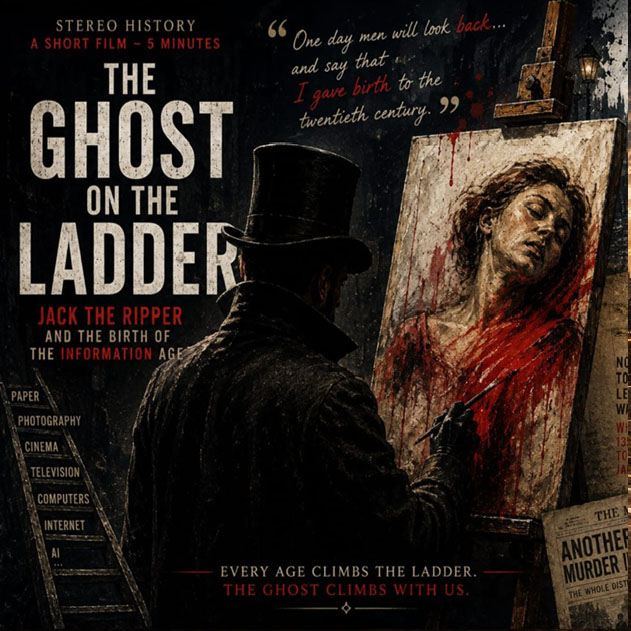
Jack Escaped 1888
Jack the Ripper may have escaped in 1888.
Not necessarily the man.
The identity.
That distinction matters because the biological killer, whoever he was, almost certainly died long ago. The persona did not. It survived newspapers, police archives, photography, film, television, psychological profiling, DNA speculation, internet forums and now artificial intelligence. Each generation has approached the same absence with a new machine and the same confidence: perhaps now we will finally see him clearly.
We do not do this with Leonardo da Vinci.
Nobody waits for the newest facial-recognition model to prove that Leonardo painted like Leonardo. Nobody expects a genetic database to explain why Michelangelo was Michelangelo. Their identities feel complete enough.
Jack does not.
He remains an empty center surrounded by information.
And perhaps that is why he belongs less to the history of murder than to the history of modern media.
The First Internet Without the Internet
Whitechapel in 1888 contained the basic structure of something we now recognize immediately.
A murder became a headline. The headline created fear. Fear produced rumours. Rumours generated witnesses. Letters created more headlines. Police statements fed the newspapers. Newspapers returned those statements to the streets.
Then the cycle began again.
Murder → press → fear → rumour → police → letter → press.
Information circulated through London, changing as it moved. No central authority controlled the entire system. The police could issue statements, journalists could exaggerate, witnesses could remember incorrectly, letter writers could imitate the killer, and readers could fill gaps with imagination.
The network did not need the real Jack to remain active.
It only needed the idea of Jack.
That is where the case becomes strangely modern. A name began operating independently of the person who may or may not have chosen it. “Jack the Ripper” became a portable identity: reproducible, theatrical, recognizable and larger than any single body.
In other words, Jack may have become viral before civilization had a word for virality.
The Name Was Better Than the Man
This may be the most important fact in the entire case.
The name is almost too perfect.
“Jack” is ordinary. “The Ripper” is theatrical. Together they create something both anonymous and unforgettable.
A biological killer can only stand in one alley at a time.
A name can stand everywhere.
It can appear in newspapers, conversations, police reports, fiction, advertisements and nightmares. It can be spoken by people who never saw the crimes. It can survive contradictory descriptions because a persona does not need biological consistency.
One witness remembers a moustache.
Another remembers a clean-shaven man.
One letter sounds educated.
Another sounds barely literate.
One theory imagines a butcher.
Another a doctor.
Another an aristocrat.
Another a sailor.
The contradictions should weaken the identity.
Instead, they strengthen it.
Jack becomes whatever the current age needs him to be.
That is what information ghosts do.

Death Changed Clothes
For centuries, European art gave death a recognizable body.
A skeleton.
A hood.
A scythe.
Death did not need personality because it was universal. Kings and beggars were harvested by the same figure.
The modern city changed the costume.
The scythe became a knife.
The hood became a respectable coat.
The skeleton became a man standing under a gas lamp.
This was more frightening because modern death no longer announced itself. It could look ordinary. A gentleman, a worker, a doctor, a stranger passing in the street.
The monster had entered anonymity.
That may be one reason Jack endured so powerfully. He was not only a murderer. He was the fear that the modern city had become too complex to read.
The killer could be anyone.
The information could be everywhere.
And certainty could disappear even while evidence multiplied.
That last part is crucial.
Modernity did not simply give us more information.
It gave us more ways to become uncertain.
The Empty Man
The Jack the Ripper case contains almost everything modern civilization considers evidence.
Victims. Streets. Witness statements. Police files. Maps. Handwriting. Clothing descriptions. Newspaper reports. Alleged letters. Medical analysis.
And yet the center remains empty.
This is what makes Jack more interesting than many solved historical criminals. We are attempting to reconstruct an absent author from traces whose authorship is itself uncertain.
It is like trying to identify a painter from five unsigned paintings while knowing that two of them may have been produced by imitators, one may have been altered by a journalist and another may never have belonged to the original set.
First came the crimes.
Then repetition was perceived.
Repetition suggested intention.
Intention demanded an author.
And the author received a name.
Perhaps the name was the final act of creation.
Not the killer creating Jack.
Civilization creating Jack.
The Immortality Nobody Would Choose
There is another uncomfortable side to this story.
Most people spend their lives hoping not to disappear completely. They want to be remembered by family, by an audience, perhaps by history.
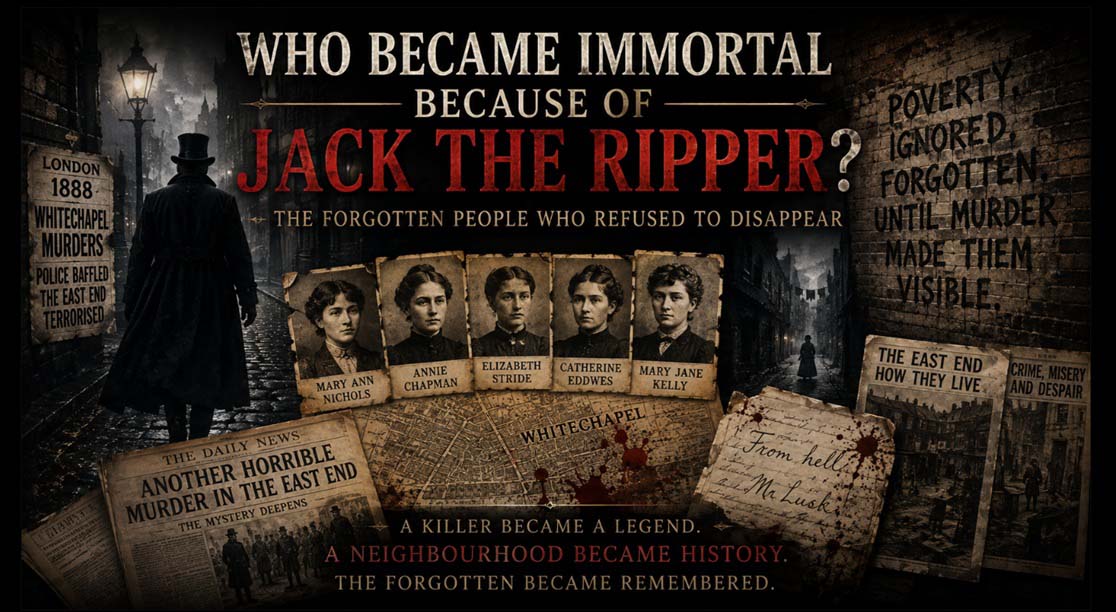
The women of Whitechapel received a different kind of permanence.
Had Mary Jane Kelly lived an ordinary life, most of us would never know her name. Today people reconstruct her room, clothing, relationships and final days with extraordinary attention.
This is immortality by catastrophe.
It is morally disturbing precisely because the killer becomes the gateway through which the victims survive historically.
Jack brings the audience to Whitechapel.
But once we arrive, something larger appears behind him: poverty, housing, clothing, migration, sex work, policing, newspapers, rent, class and the texture of ordinary Victorian life.
A button can sometimes tell us more about 1888 than another suspect theory.
This is where Stereo History should resist true crime’s usual temptation. The point is not simply to keep staring at the murderer.
The murderer is the door.
The lost world is behind it.

Every New Machine Tries to Catch Him
Then something extraordinary happened.
Jack did not remain Victorian.
He migrated.
Early forensic medicine tried to reconstruct him.
Handwriting analysis tried to reconstruct him.
Psychological profiling tried to reconstruct him.
Databases tried to reconstruct him.
DNA tried to reconstruct him.
Internet communities tried to reconstruct him.
Now AI can generate his face, compare suspects, analyze texts and build new probabilistic versions of the same absent man.
Every technological age climbs one rung higher and looks back down at Whitechapel.
Each says: perhaps now.
That is why Jack is the ghost on the ladder.
The ladder is not moral progress. Being higher does not mean being wiser. It only means possessing a different view.
Photography can see what paper cannot.
Databases can compare what individual memory cannot.
AI can detect patterns across volumes of material that no single researcher could process manually.
But greater perspective does not guarantee truth.
Sometimes it only generates a more sophisticated ghost.
Why Leonardo Stays Dead
This is where the comparison with Leonardo becomes useful.
Leonardo is also reconstructed endlessly. Scholars debate attribution, biography and intention. But nobody expects every new technology to fundamentally reveal who Leonardo “really was.”
His identity is already stabilized by works, documents and cultural consensus.
Jack is different because absence is his defining feature.
He has no authenticated portrait.
No uncontested confession.
No universally accepted handwriting.
No final biography.
His identity is structurally incomplete.
And incomplete identities invite technology.
Every new method promises to fill the missing space.
This may be why the mystery survives even when individual suspect theories collapse.
Jack is not sustained by one answer.
He is sustained by the possibility that the next tool might produce one.
The First Viral Legend
Perhaps this is the strongest reason to think of Whitechapel as an early information-age event.
Jack became famous through a feedback loop between violence, media, police, public imagination and imitation.
The persona exceeded the person.
The name exceeded the body.
The information exceeded the event.
That is an extremely modern structure.
Today we live inside identities that can become larger than their creators within hours. A phrase, image, scandal or pseudonym can detach from its origin and circulate globally. It can be copied, altered and reinterpreted until authorship becomes almost irrelevant.
Jack did this in 1888.
Or rather, civilization did it to Jack.
The real man may have wanted secrecy.
The information system gave him immortality.
How to Read the World

Current Knowledge
The Whitechapel murders of 1888 remain unsolved, and historians continue to debate the number of victims attributable to a single killer. Many letters claiming to come from “Jack the Ripper” are considered dubious or likely hoaxes, and the famous name itself may have been popularized through correspondence rather than chosen by the murderer.
Victorian newspapers played a major role in shaping public perception of the case. Rapid circulation, sensational reporting and intense competition among papers helped transform the murders into a major media event.
Modern forensic, historical and genetic approaches have produced numerous suspect theories, but no identification has achieved broad scholarly consensus.
The comparison with digital networks is therefore interpretive rather than literal. Whitechapel did not possess an internet, but information did circulate through interacting institutions and audiences in ways that created feedback, amplification and distortion.
Open Questions
Did the media merely report Jack the Ripper, or did it help create the identity we now call Jack?
How much of the persona depended on genuine actions by the killer, and how much came from journalists, hoaxers and public imagination?
Why does every new technology revive confidence that the case can finally be solved?
Can increasing quantities of information make historical identity less certain rather than more certain?
And if a persona can survive for centuries without its biological author, at what point does the information become historically more important than the person who produced it?
Transhumation Interpretation
Jack the Ripper may not matter because he was uniquely mysterious.
He may matter because he shows what happens when a human being becomes information before civilization knows how to control the process.
The biological man disappeared.
The pattern survived.
It moved from paper to photography, from photography to cinema, from cinema to television, from television to computers, from computers to the internet, and now into AI.
Each medium reconstructs him again.
Not because Jack is immortal in any biological sense.
Because the structure is.
That may be the real escape from 1888.
Jack did not outrun the police.
He outran his own body.
The person vanished while the identity continued climbing.
And perhaps this is why the case still feels unfinished. We keep asking the same question as if somewhere inside the next technology there is finally a man waiting to be recovered.
Who was Jack the Ripper?
But Stereo History suggests another question.
How much of a human being can survive when the human being disappears?
Jack may never answer the first.
The second is already happening all around us.
FAQ
Why does the article say Jack “escaped 1888”?
It refers to the survival of the Jack the Ripper identity beyond the historical period in which the murders occurred. The biological person disappeared, but the persona continued through media and technology.
Was Jack the Ripper an early viral identity?
Not literally in the digital sense, but the name spread rapidly through newspapers, rumours, letters and public discussion in a way structurally similar to later viral media phenomena.
Did Jack the Ripper write the famous letters?
The authenticity of many letters attributed to him is disputed, and numerous letters were probably hoaxes.
Why compare Jack with Leonardo da Vinci?
Leonardo’s identity is relatively stable despite continuing research. Jack remains structurally incomplete, so every new technology seems to promise a final reconstruction.
What does “the first internet without the internet” mean?
It describes a feedback network involving newspapers, police, rumours, witnesses and the public in which information circulated and changed as it moved.
What is “The Ghost on the Ladder”?
It is the idea that every new level of information technology gives civilization another way to reconstruct Jack, while the central identity continues to remain absent.
Is the article primarily true crime?
No. The murders are the starting point for examining media, information, historical memory and the construction of identity.
Why are the victims important to this interpretation?
The case preserves unusually detailed traces of lives that might otherwise have disappeared from the historical record, showing how tragedy can produce a disturbing form of informational immortality.
Does AI have a realistic chance of solving the case?
AI may help analyze existing data and identify patterns, but it cannot compensate for missing, unreliable or contaminated historical evidence.
What is the central Transhumation idea?
A human identity can outlive the biological individual when information becomes sufficiently reproducible. Jack the Ripper may be one of the clearest early examples of a persona becoming larger and more durable than the person behind it.
The Core Questions of Transhumation
Explore the full journey:
- End of Reality — Where Do You Really Exist?
- End of Physics — Are the Laws of Reality Real?
- End of the Real World — Reality Is No Longer Required
- End of Consciousness — Beyond the Human Mind
- End of Death — When Human Limits Disappear
- End of Religion — When Technology Replaces Faith