
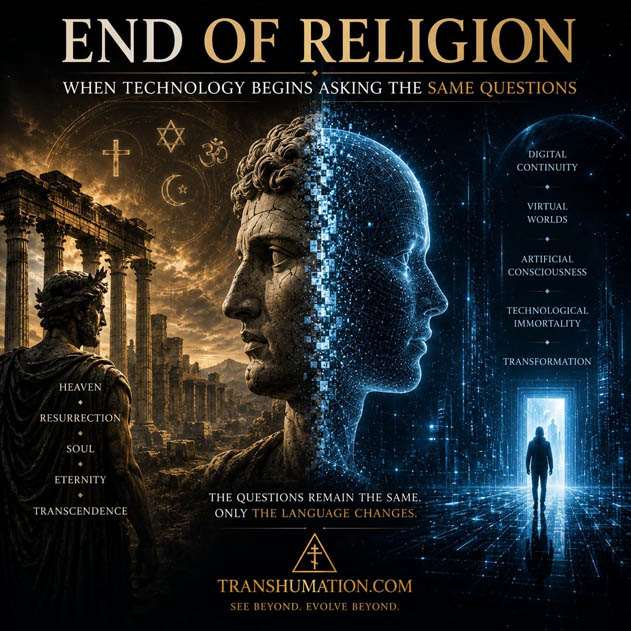
Religion Was Humanity’s First Operating System
For thousands of years, religion served as humanity’s primary framework for understanding reality. Long before modern science emerged, civilizations turned to myths, sacred texts, and philosophy to answer the deepest questions imaginable. What happens after death? What is consciousness? Why does the universe exist? Is there something beyond the material world?
Every great civilization developed its own answers. Heaven, reincarnation, resurrection, enlightenment, and the immortal soul all represented different attempts to explain the same mystery: how human existence fits into a reality far larger than everyday experience. Religion did more than provide comfort. It created an intellectual structure that allowed people to navigate life, morality, suffering, and the unknown.
Technology Has Started Asking the Same Questions
Today, something remarkable is happening. For the first time in history, many questions once reserved for religion are becoming subjects of scientific investigation. Artificial intelligence explores intelligence itself. Neuroscience studies consciousness. Brain-computer interfaces examine the relationship between mind and machine. Digital technologies raise entirely new questions about identity and memory.
The language has changed, but the questions have not. Modern civilization is no longer asking only how machines can become more intelligent. It is increasingly asking what intelligence actually is. It is no longer asking only how to preserve life, but whether consciousness itself can continue beyond biological limitations.
Immortality Is Becoming a Technological Problem
For centuries, religions promised continuity after death. Whether through heaven, resurrection, or reincarnation, the central idea remained the same: the human self could survive the destruction of the body.
Transhumanism approaches the same challenge from an entirely different direction. Instead of relying on supernatural explanations, it asks whether consciousness could one day be preserved through information, advanced computing, artificial intelligence, or entirely new technological substrates. The question is no longer simply whether the soul survives. The question becomes whether continuity can be engineered.
This represents one of the most profound shifts in human history. Immortality is slowly moving from theology toward technology.

Heaven May Become Something Humanity Builds
The traditional image of heaven described a perfect realm beyond the physical universe—a place free from suffering, decay, and death. While this idea belonged to religion, modern technology introduces an unexpected parallel.
Advances in virtual reality, artificial intelligence, and simulated environments have inspired the possibility that future civilizations might create digital worlds capable of sustaining conscious experience. In such a future, heaven would no longer be understood only as a supernatural destination. It could become an engineered environment designed to preserve consciousness indefinitely.
The ancient promise remains recognizable. Only the mechanism changes.
History Has Seen This Before
Civilizations have experienced dramatic shifts in worldview before. During the fourth century, the Roman emperor Julian the Apostate attempted to preserve the traditional religions of Greece and Rome while Christianity rapidly spread across the empire. Julian believed that the ancient gods represented philosophy, culture, and an entire vision of reality worth preserving.
History, however, moved in another direction. Christianity did not eliminate humanity’s deepest questions. It reorganized them into a new intellectual framework that shaped Western civilization for more than a thousand years.
Today, humanity may once again be standing at the beginning of a similar transformation—not from one religion to another, but from theological explanations toward technological ones.
The Questions Never Changed
It is tempting to believe that technology replaces religion. A more interesting possibility is that technology simply inherits its oldest questions.
Artificial intelligence asks what intelligence is. Neuroscience asks what consciousness is. Digital identity asks what makes a person the same individual over time. Space exploration forces humanity to reconsider its place in the cosmos. Every technological breakthrough seems to push civilization back toward philosophical territory once occupied almost exclusively by religion.
Perhaps humanity has not abandoned its spiritual questions at all. It has simply found new tools with which to investigate them.
The End of Religion—or the Beginning of Something New?
The phrase End of Religion does not necessarily mean that belief disappears. It may instead describe the end of an era in which religion alone carried humanity’s deepest existential questions.
Science, engineering, and artificial intelligence are increasingly entering the same intellectual territory. They do not erase ancient questions—they reinterpret them.
Perhaps the future will not witness the disappearance of religion, but its transformation. The next great search for transcendence may begin not in temples, but in laboratories. Not through revelation alone, but through discovery.
And history may one day remember this moment as the beginning of a new chapter in humanity’s oldest conversation.
FAQ
What does „End of Religion” mean?
It does not mean religion will disappear. It suggests that technology is beginning to investigate many of the same fundamental questions that religion has explored for thousands of years.
Is technology replacing religion?
Not necessarily. The article argues that technology may be translating ancient religious questions into the language of science, engineering, and information rather than replacing belief itself.
Why is artificial intelligence connected to religion?
AI raises questions about intelligence, consciousness, creation, free will, and identity—topics that have traditionally belonged to philosophy and theology.
Who was Julian the Apostate?
Julian was a Roman emperor who tried to restore the traditional Greco-Roman religions during Christianity’s rise. His reign illustrates how civilizations can transition between fundamentally different worldviews.
Could heaven become a technological reality?
Some futurists speculate that advanced virtual worlds or digital environments could eventually support conscious experience, creating a technological interpretation of paradise. This remains speculative rather than established science.
What is the relationship between transhumanism and religion?
Both explore humanity’s desire to overcome biological limitations. Religion generally offers spiritual continuity, while transhumanism investigates technological possibilities for extending or preserving consciousness.
Why are ancient religious questions becoming important again?
Because advances in AI, neuroscience, and brain-computer interfaces increasingly force humanity to confront questions about consciousness, identity, and the future of the human mind.
What is the central message of this article?
The deepest human questions have remained remarkably consistent throughout history. While the language has evolved from mythology and theology to science and technology, humanity is still searching for the same answers about consciousness, existence, and transcendence.
Continue the Transhumation Series
Explore the full journey:
- End of Reality — Where Do You Really Exist?
- End of Physics — Are the Laws of Reality Real?
- End of the Real World — Reality Is No Longer Required
- End of Consciousness — Beyond the Human Mind
- End of Death — When Human Limits Disappear
- End of Religion — When Technology Replaces Faith