
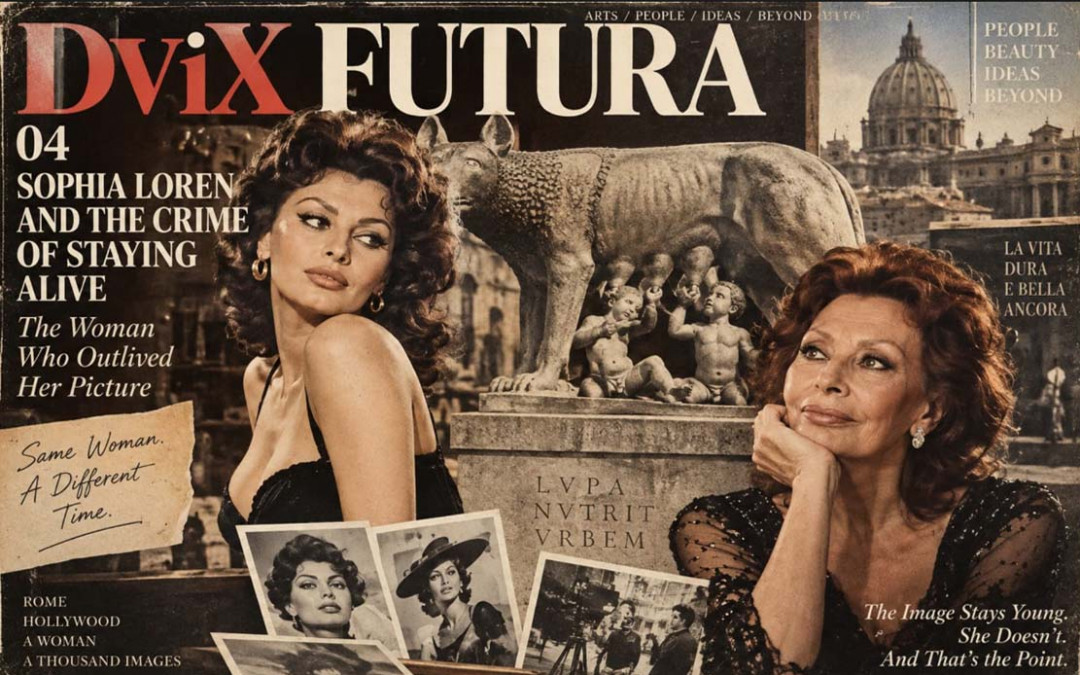
The Woman Who Outlive Her Picture
Imagine meeting Sophia Loren at twenty-five and taking her photograph.
If you are good enough, or merely lucky enough, you might get everything right at once: the mouth, the dark eyes, the impossible confidence of the face, the light falling exactly where it should. Then the shutter closes and you have performed a small miracle. You have made Sophia Loren stop.
Nothing further can happen to the woman in that photograph. She will not become a mother. She will not lose anyone. She will never discover what eighty feels like, never watch her children become adults, never find herself standing before a camera directed by one of them. Tomorrow she will still be twenty-five, and sixty years from now she will have obeyed you perfectly.
The real Sophia Loren had no such discipline.
She had to keep living.
That is what interests me about her. We usually speak of photography as a technology that preserves people, and in the obvious sense it does. But Loren suggests a less comfortable possibility: an image can preserve someone so successfully that eventually we begin comparing the changing original with the immaculate copy.
At some point Sophia Loren had to compete with Sophia Loren.
Two Sophias
There is a peculiar difficulty in being the son of Sophia Loren. Edoardo Ponti has described the division between the woman he knew privately as his mother and the public figure other people seemed to possess. At home was a mother who had stepped back from filmmaking in part because she wanted to be present for her family; outside it was an image that had escaped into cinema, magazines and collective memory.
Most children eventually discover that their parents existed before them. Ponti had to make the discovery in cinemas. Millions of strangers could remember versions of his mother he had never met, including the young woman whose face had become one of the twentieth century’s most durable definitions of Italian glamour.
Photography made the division permanent. The woman could continue changing, but her earlier states remained available for inspection. There was always another Sophia waiting in the archive: younger, smoother, frozen before whatever happened next.
The photograph was not lying.
That would have made the problem easier.
It was telling the truth about a woman who no longer existed in precisely that form.
The Photograph Does Not Turn Seventy
The photograph has one enormous advantage over the person it depicts: it never has to discover another use for itself.
A successful portrait can remain successful indefinitely. The light does not deteriorate with age. The mouth does not acquire grief. The eyes never become tired after a bad night. If Sophia Loren was beautiful at twenty-five on Tuesday, she will still be beautiful at twenty-five in that photograph when everybody who stood in the room on Tuesday is dead.
A human being survives by almost the opposite method. We change position. We acquire relationships, obligations, injuries, losses, memories and capacities that could not have existed in the younger person because the events required to produce them had not happened yet. Continuity in a living person is therefore not immobility. It is the strange ability to remain oneself while ceasing to be what one was.
This becomes particularly cruel when somebody becomes an icon early. At seventy, the woman is not compared with another seventy-year-old. She can be compared with herself at thirty, and her opponent has spent forty years performing the considerably easier task of doing absolutely nothing.
We call what happens to the woman aging.
From the photograph’s point of view, it probably looks like incompetence.
Before the Oscar, There Was the Picture
There is a respectable way of telling Loren’s career that I distrust. First came beauty; later came proof that she was more than beautiful. Desire becomes the shallow opening chapter, while serious acting arrives to rescue the woman from the inconvenience of having been looked at.
The chronology refuses to cooperate.
Loren’s international image and her serious work developed alongside each other. In Two Women, directed by Vittorio De Sica, she played Cesira, a mother attempting to protect her daughter during wartime Italy. The performance won her the Academy Award for Best Actress at the 1962 ceremony; the Academy records Loren as the first performer in a foreign-language film to win in an acting category.
The beautiful woman did not disappear so that the actress could arrive. Nor did serious acting need to purify her of glamour before she became legitimate.
Both things occupied the same person.
Perhaps the contradiction was never hers.
Beauty After Geometry
If beauty is principally geometry, age is a losing proposition.
Skin changes. Proportions soften. Hair changes colour. The tiny asymmetries that photography can once make erotic become something advertising teaches us to correct. Under that definition, every birthday is subtraction, and the old photograph becomes evidence for the prosecution.
Loren presents a difficulty because the beautiful object continued to be a person. She married, became a mother, reduced her film work, lost her husband, watched her sons become men and accumulated the ordinary and extraordinary debris of decades. None of this makes the photograph of young Sophia Loren more beautiful. It does something the photograph cannot do at all: it adds history to the woman.
This is where beauty becomes more difficult than geometry. A face is not encountered in isolation like a specimen under laboratory glass. Voice matters. Gesture matters. Recognition matters. What we know about someone enters the act of looking, as does what that person knows about us. A beautiful face seen for the first time and the same face seen after thirty years of shared life are optically related objects but humanly different events.
The photograph can preserve the arrangement.
It cannot preserve the relationship.
The Son Behind the Camera
In 2020, Edoardo Ponti put a camera in front of his mother for The Life Ahead. Loren was eighty-six, and the role he offered her was almost perversely uninterested in returning the public to the woman it remembered.
Madame Rosa is elderly, a Holocaust survivor and former prostitute who cares for children and develops a relationship with Momo, a Senegalese boy. Ponti had known Romain Gary’s novel since his youth; decades later he found in it a role for which his mother could bring something that could not have been manufactured by costume or makeup. Loren herself said Rosa’s humor and fragility reminded her strongly of her own mother.
Ponti then asked Loren to perform partly in Neapolitan. Something happened to her voice. He described it dropping and becoming grittier, until the woman speaking in front of him began to remind him of his grandmother.
Think about the arrangement for a moment.
A son is directing his mother. The mother is playing an old woman who makes her think of her own mother. The son’s ear hears his grandmother returning through his mother’s voice.
No photograph of Sophia Loren at twenty-five could contain that.
Not because the young woman was deficient. She simply had not lived long enough to possess it.
The Position Only She Could Occupy
Sophia Loren could never defeat young Sophia Loren at being young. Nobody can, and the attempt would have been particularly absurd in her case because the opponent had been professionally photographed by some of the most efficient machines of cultural memory ever invented.
There was another possibility. She could arrive somewhere the younger woman had never been.
Madame Rosa required an old face not merely because the screenplay specified an age. She required accumulated time. The role asked the audience to believe that things had happened to this woman before we met her. A young performer can imitate fatigue, alter posture and wear excellent makeup, but there is a form of information that only duration produces.
That does not make age synonymous with wisdom. Stupidity also survives birthdays extremely well. Nor does suffering become valuable merely because someone survives it. Pain can destroy without teaching, and it would be obscene to pretend otherwise.
The proposition is smaller than that, and I think more useful.
You do not yet know what will become useful.
At twenty-five Loren could not know that one day a director would need something she did not yet possess: decades. She could not know that the director would be her son, that a fictional old woman would remind her of her mother, or that her Neapolitan voice would allow her son to hear his grandmother.
Looking backward makes the sequence feel suspiciously well arranged. Biography does this to us. Once we know the destination, accidents begin masquerading as clues.
I do not know whether we discover those patterns or manufacture them.
I only know they were invisible from the beginning.

Rome Before Rome
There is an old Italian image I cannot get away from once Madame Rosa enters the story.
Two infants lie beneath a female wolf.
They are not founders yet. There is no Senate, no empire, no legion and no triumph. Romulus cannot build Rome because Romulus cannot yet keep himself alive. Before the city acquires roads, law, armies and marble, its future is represented by two hungry bodies that need somebody else’s milk.
Plutarch preserves the familiar account of Romulus and Remus being nourished by a she-wolf before entering human care. The historical origins of the legend are another question; the image itself has survived precisely because it can hold several things at once.
The animal above the children is not harmless.
She has teeth.
That is what makes the image better.
A creature capable of killing the children is also the creature keeping them alive. Predator and nurse occupy one body without cancelling each other.
Rome, in this picture, cannot yet walk.
Someone has to feed it first.
The Saint and the Whore
Then the language itself becomes troublesome.
Latin lupa could mean a she-wolf, but it was also used of a sexually disreputable woman. Plutarch knew the ambiguity and recorded an alternative tradition in which the supposed wolf was Acca Larentia, wife of the shepherd Faustulus, described in that version as a woman of loose character. He also records traditions concerning another Larentia, a courtesan who nevertheless received Roman religious honours. The accounts are messy, and they should remain messy; they do not establish that Rome’s wolf was “really a prostitute.”
What interests me is that the language permitted the collision.
Cultures have always been unusually talented at dividing women into categories that women themselves fail to respect. There is the woman men desire and the woman children depend upon. The body and the mother. The profane woman and the sacred one. The whore and the saint.
Madame Rosa makes that division particularly difficult to maintain. She is explicitly a former prostitute and a caretaker of children. Loren, meanwhile, arrives at the role carrying a completely different cultural history: she had been one of cinema’s great objects of desire. The comparison is not biographical—Sophia Loren is not Madame Rosa, much less Acca Larentia. What interests me is the structure that suddenly appears when these images are placed beside each other.
The young woman did not have to become less profane in order for the old woman to acquire something sacred.
Sexuality did not require an apology before care could become possible.
The problem may have been the or.
Teeth and Milk
The wolf does not lose its teeth when it produces milk.
That may be the simplest way of putting it.
There is a polite insult hidden in the way we sometimes praise aging beautiful women. We congratulate them for having become more than their beauty, as though beauty had been an embarrassing apprenticeship. Desire becomes the primitive phase. Motherhood, experience, seriousness and age become the respectable destination.
But why should one function invalidate another?
Ancient Mesopotamia gives us a useful flash of a world that did not always arrange these categories as we do. Ishtar could encompass sexual attraction and war; the British Museum describes her precisely through that apparently uncomfortable combination, while Inanna was later identified with Ishtar.
I am not proposing Sophia Loren as Ishtar. That would be a very efficient way of ruining both Sophia Loren and Ishtar.
I only want the brief disturbance the comparison creates.
Sex and war in one goddess. Teeth and milk in one wolf. Desire and motherhood in one woman. Beauty and age in one life.
Perhaps the problem was never the contradiction of the woman.
Perhaps the problem was our categories.
The Woman Who Walked Out of the Photograph
Now return to the picture of Sophia Loren at twenty-five.
Nothing is wrong with it. I would not ask the photographer to make her less beautiful, nor pretend that our fascination with the young woman was merely cultural stupidity. Desire is real. Beauty matters. A face can stop a room before anyone has had the opportunity to discover the mind behind it.
The mistake begins later, when preservation becomes expectation.
The photograph shows us one successful state and quietly teaches us to treat continuity as remaining there. The woman commits the crime of leaving. She becomes a wife, a mother and a widow. Her children grow older. Her face acquires information the photograph cannot record because the photograph has already completed its work.
Then one of those children becomes a director.
He puts the camera in front of his mother again.
This time he does not need the woman who once stopped the room. He needs Madame Rosa. He needs age, memory, danger, tenderness, survival, an old woman’s voice and a face capable of making the audience believe that something happened before the film began.
The photograph of young Sophia Loren was never false.
It was merely incapable of knowing what Sophia Loren would later be for.
Somewhere that photograph still exists. Her face remains extraordinary. The light remains exactly where the photographer left it. Tomorrow she will still be twenty-five.
The photograph completed its task beautifully. It preserved the woman the world wanted.
Sophia Loren had somewhere else to go.
Watch the Video
How to Read the World

Current Knowledge
Sophia Loren won the Academy Award for Best Actress for Vittorio De Sica’s Two Women at the 34th Academy Awards in 1962. The Academy identifies her as the first performer in a foreign-language film to win an acting Oscar; its historical database records the performance as Italian-language.
In 2020 Loren starred in The Life Ahead, directed by her son Edoardo Ponti. Loren described Madame Rosa as reminding her strongly of her own mother, while Ponti explained that he asked Loren to perform partly in Neapolitan and found that her changed vocal quality reminded him of his grandmother. Loren also discussed having reduced her film work after becoming a mother in order to spend more time with her family.
The Roman material in this essay comes from ancient literary traditions rather than a demonstrated historical explanation of Rome’s origins. Plutarch records both the she-wolf story and the ancient observation that Latin lupa could refer both to a female wolf and to a sexually disreputable woman. He preserves traditions concerning Acca Larentia, but those traditions vary and should not be collapsed into the claim that the she-wolf “was actually a prostitute.”
The comparison with Ishtar is similarly limited. British Museum material associates Ishtar with sexual attraction, love and war and identifies the Sumerian Inanna with the later Ishtar. This essay uses that combination to question modern categorical divisions; it does not claim any historical or religious connection between Loren and the Mesopotamian goddess.
Open Questions
When we look backward at a life and discover an elegant trajectory, what have we actually found? Later events can make earlier experiences appear preparatory even when nobody living through them could have known what was coming. We may be discovering a structure that genuinely emerged across time, or imposing one because the completed biography gives us a privileged position from which to arrange the pieces.
There is another unresolved question about representation. When does a preserved image cease to serve the living person and begin competing with them? Photography allows one human state to survive alongside all the states that follow it. For a public figure, millions of observers may therefore retain an earlier version long after the person herself has changed.
The cultural division between the desired woman and the maternal or sacred woman raises a different problem. Are these genuinely incompatible human roles, or categories that become convenient precisely because they simplify people? The Roman lupa, Madame Rosa and the much older figure of Ishtar cannot answer that question for us, but each makes the boundary less comfortable.
And perhaps the most personal question is the simplest: which parts of a life appear to have lost their usefulness only because their next use has not arrived yet?
Transhumation Interpretation
A photograph and a living person preserve identity by almost opposite methods.
The photograph survives by refusing new information. Once the shutter closes, the state becomes fixed. Sophia Loren remains young because nothing else is permitted to happen to that particular version of her.
The living woman survives by remaining open.
Marriage, motherhood, grief, age, work, withdrawal and memory alter the state without necessarily destroying the continuity of the person. Identity therefore need not mean preserving the same configuration. It can also mean retaining enough structure to remain recognisable while passing through configurations that did not previously exist.
The she-wolf adds another possibility. A structure can contain capacities whose importance depends upon circumstances. Teeth and milk are present in the same animal, but the abandoned child makes one of them suddenly decisive. What appears contradictory from the perspective of a category may be perfectly coherent from the perspective of a living system.
This is why Transhumation does not read Loren’s biography as evidence that everything happens for a reason. That would replace uncertainty with a comforting story. The narrower proposition is enough: we do not know all the future uses of what we are becoming while we are becoming it.
The same problem exists far beyond a human biography. Technologies acquire purposes their inventors did not anticipate. Symbols survive religions and enter new ones. Objects lose their original function and become carriers of memory. Information produced for one environment may become valuable only after that environment has disappeared.
The photograph preserves a state.
The woman preserves the possibility of another state.
Both are forms of continuity.
Only one can discover what comes next.
FAQ
Why is Sophia Loren important to this DViX FUTURA argument?
Because her career spans an unusually long period of modern image culture. The same person exists in beauty-contest photographs, classic cinema, television-era celebrity, digital archives and a major late-life performance directed by her own son. That makes Loren a particularly clear example of the difference between a preserved image and a continuing life.
What Oscar did Sophia Loren win for Two Women?
She won Best Actress for Two Women. The Academy identifies Loren’s performance as the first foreign-language performance to win an Academy Award.
Who directed Sophia Loren in The Life Ahead?
Her son, Edoardo Ponti, directed the 2020 film. Loren played Madame Rosa, an elderly Holocaust survivor who develops a relationship with a troubled child.
Can AI preserve a person rather than merely their appearance?
Current systems can reproduce or synthesize aspects of human representation—such as appearance, language or voice—but that is not evidence that subjective consciousness or personal continuity has been transferred. The difference between reproducing a recognizable pattern and preserving the person who originally produced it remains one of the central open questions behind Transhumation.
Continue the Transhumation Series
- Forgotten Religion | Ancient Gods, Symbols and the Hidden Structures of Human Civilization
- The Last Religion | Death, Immortality and the Future of Humanity
- The New Theurgy | AI, Information and the Future of Human Civilization
- End of Branding: You Were Never Meant to Become a Product
- Baal vs Ishtar: Why Ancient Gods Never Disappeared