
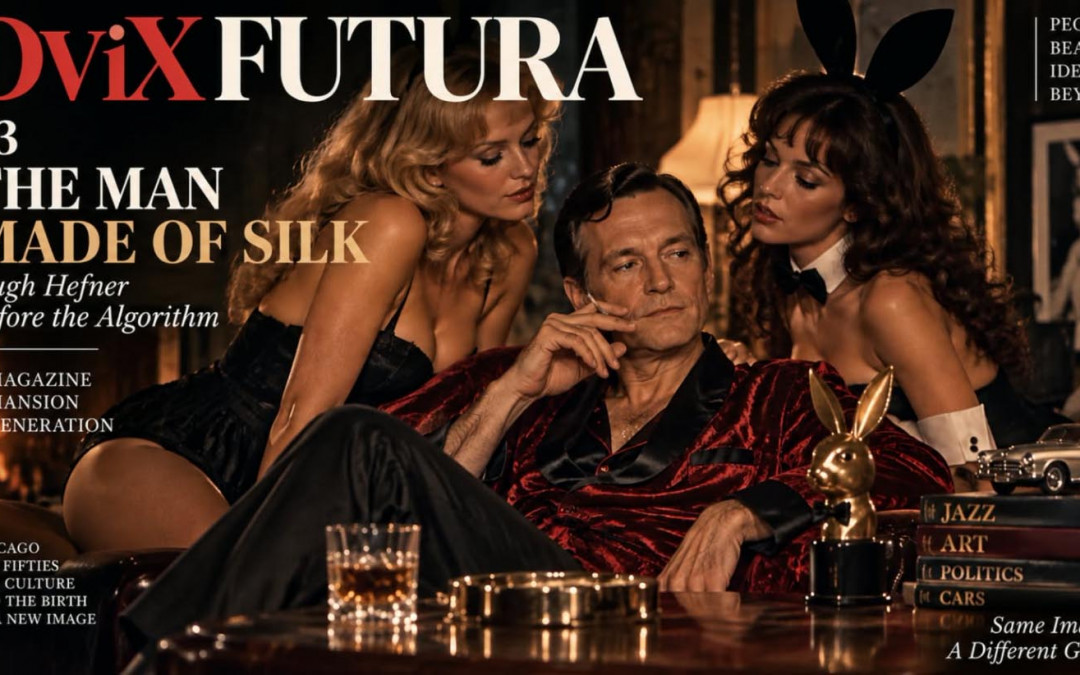
The Last Man in Hefner’s Pajamas
In The Last Man on Earth, Phil Miller inherits almost everything. Civilization has collapsed, ownership has become meaningless, and the surviving treasures of America are available to whoever can carry them home. He drinks absurdly expensive wine with cheap food, collects things that once required money or status, and at one point announces that he is wearing Hugh Hefner’s actual pajamas. Then, almost apologetically, he adds that he washed them.
It is a perfect joke because the pajamas have survived while the world that made them meaningful has disappeared. Without the Mansion, the women, the photographers, the parties and the millions of people who knew what Hugh Hefner represented, silk returns to being cloth. Phil has acquired the relic and lost the religion.
I would begin there, because ordinary objects are often most revealing after their instructions disappear. A chair is only a chair until a civilization decides what kind of man should sit in it. A pair of pajamas is only sleepwear until one man wears it so consistently that it becomes a uniform. A rabbit is only an animal until two ears and a bow tie become sufficient to summon an entire erotic world.
Hugh Hefner’s great invention was not simply a magazine. He learned how to make objects agree with one another until they became a world.
When the Artist Stopped Sculpting the Woman
The first issue of Playboy appeared in 1953 with Marilyn Monroe on the cover and nude photographs made years earlier, before the magazine existed. Monroe had not posed for Hefner. He acquired rights to material that had already entered commercial circulation. The beginning is therefore almost embarrassingly simple: take an existing image of a desirable woman and place it inside a new frame.
But the frame kept growing. The woman was soon surrounded by furniture, jazz, liquor, cars, fiction, interviews, architecture and an increasingly specific idea of masculine sophistication. The reader was not merely shown what to desire. He was shown the room in which that desire was supposed to make sense.
This may be the moment when the artist stopped sculpting the woman and began sculpting the room. Once the room existed, the next step followed naturally: sculpt the man who belonged inside it. He should recognize the record, know the drink, understand the joke, own the chair and possess enough leisure to make pleasure look effortless. Playboy was no longer merely presenting objects. It was arranging them into a habitat.
The most sophisticated media eventually do something similar. They stop selling individual pieces of content and begin offering a world in which those pieces confirm one another. The article, photograph, chair and bottle become doors into the same room. The product is no longer the object. The product is the coherence.

The Man Made of Silk
Then something stranger happened. Hefner entered the room.
His silk pajamas, smoking jacket, pipe, Mansion and carefully repeated public routines gradually made the publisher inseparable from the publication. A man who had built an image of the Playboy lifestyle became its most recognizable exhibit. Silk was particularly useful because it reversed an ordinary social signal. Pajamas usually mean that a man has withdrawn from public life. On Hefner they meant that public life had been reorganized around him. He did not need to dress for the office because, symbolically at least, the office had become his bedroom.
This is why The Man Made of Silk belongs beside Woman Made of Paper and Woman Made of Silicone. Paper asks what happens when representation begins designing the woman. Silicone asks what happens when the image crosses into living tissue. Silk turns the camera around. What happens to the man producing the image when he begins designing himself to fit the world he created?
At first the persona increases freedom. It gives the creator authority, recognition and a language that millions can read. Eventually the same success can become a constraint. If Hugh Hefner wakes up and no longer wants to be Hugh Hefner, what exactly is he allowed to become without damaging the world built around his name?
This is a peculiar prison because the door need not be locked. Leaving simply means becoming someone else. Modern societies contain many softer versions of the same mechanism. Nobody has to order us into the correct apartment, career, body, holiday or lifestyle. A sufficiently persuasive culture can do something more efficient: construct the destination so convincingly that walking toward it feels like spontaneous desire. The command disappears inside the wish.
The Rabbit Without the Rabbits
The Playboy rabbit is a miniature version of the same operation. Art director Art Paul created the familiar rabbit-head logo, and Hefner explicitly spoke of the animal’s playful sexual associations. Yet the success of the symbol eventually exceeded any explanation. Ears, bow tie and tail became enough. The animal disappeared behind the code.
There is a quiet irony in the choice. Rabbits are proverbial for reproduction, while Playboy built its fantasy primarily around desire detached from the ordinary consequences and responsibilities of reproduction. The rabbit survived; the babies disappeared. That is not a moral verdict on sex without children. It is an example of culture separating a signal from the larger biological structure from which part of its meaning arose.
Once that separation works at scale, almost anything can become erotic. A pair of costume ears does not contain sexuality as a physical property. Millions of people learn to read it there. Hefner did not have to put sex inside a rabbit. Culture learned to put the rabbit inside sex.

The Room That Sculpted Its Sculptor
World-building becomes most interesting when causality begins to run in both directions. Hefner shaped Playboy, but Playboy increasingly specified what Hefner had to look like. The Mansion validated the man; the man validated the Mansion. The pajamas meant Hefner because Hefner wore them, and Hefner wore them because they had come to mean Hefner. Each element authenticated the others.
This is more than branding. A brand can be attached to a person. A world can absorb one. The creator becomes an interface through which the audience enters the creation, until the distinction between private person and public artifact becomes difficult to locate. The sculptor has stepped onto the pedestal.
That is why the lonely survivor in Hefner’s pajamas is such a useful experiment. Remove the audience and the symbolic circuit breaks. The silk remains materially identical, but its power collapses. Meaning was never stored entirely in the fabric. It lived in the relationship among object, person, audience and story.
Marilyn at the Other End
There is an uncomfortable symmetry at the end. Marilyn Monroe helped make the first issue instantly legible, although she had never posed for Playboy and never became part of Hefner’s world in the way the cover can make it seem. Decades later Hefner bought the crypt beside Monroe’s at Westwood Village Memorial Park. After his death in 2017, he was buried there.
The gesture is almost too neat for fiction. Playboy began by placing Marilyn inside Hefner’s frame. Hefner ended by arranging for himself to be placed beside Marilyn. Between those two points grew a magazine, clubs, a Mansion, a rabbit, a wardrobe and one of the most recognizable male personas of the twentieth century.
None of this requires a final verdict on Hefner. The structure is interesting enough. A man selected an image, built a room around it, expanded the room into a world and finally turned himself into one of the world’s recurring objects. The artist stopped sculpting the woman. He sculpted the room. Then the room began sculpting him.
In the end, perhaps that is the danger hidden inside every successful world. If you make it coherent enough, other people may want to enter it. If you live inside it long enough, you may discover that leaving requires abandoning the person the world taught everyone to see.
Watch the Video
How to Read the World

by
Current Knowledge
Hugh Hefner launched Playboy in 1953. Marilyn Monroe appeared on the first cover, while nude photographs of her used inside had been made in 1949 and were not commissioned by Playboy. The magazine developed a broader lifestyle identity around sex, design, consumption, fiction, interviews and urban sophistication rather than functioning only as a collection of nude photographs.
The Playboy rabbit logo was created by art director Art Paul and appeared from the magazine’s early issues; Hefner later described the rabbit in explicitly playful and sexual terms. Hefner also became strongly associated with silk pajamas and robes, turning private clothing into part of a highly public persona.
In the television comedy The Last Man on Earth, Phil Miller says he is wearing Hugh Hefner’s actual pajamas and adds that he washed them. The joke is fictional, but it provides a useful thought experiment about the dependence of symbolic objects on social context.
Hefner purchased the crypt beside Marilyn Monroe’s in 1992 and was buried there after his death in 2017. Hefner and Monroe did not have a personal relationship comparable to the symbolic connection later created by Playboy’s history.
Open Questions
When does a public persona stop expressing a person and begin constraining that person? Celebrity makes the problem unusually visible, but the mechanism may be more general. Careers, brands, social groups and digital profiles can reward consistency until changing one’s mind or lifestyle begins to carry a social cost.
A second question concerns symbols. How much of a symbol’s meaning remains attached to its original object once a culture has learned the code? The Playboy Bunny demonstrates how a simple animal form can acquire meanings that no individual rabbit possesses.
The deeper question concerns worlds. If a coherent environment can shape desire without issuing explicit commands, where should we draw the line between influence and choice? The existence of influence does not eliminate agency, but agency does not require influence to be absent.
Transhumation Interpretation
The Man Made of Silk is not primarily about pornography, algorithms or Hugh Hefner’s private morality. It is about a transition in scale. First an image is selected. Then an environment is designed around the image. Then the environment becomes a world. Finally the creator enters that world as one of its symbols.
The result is a feedback loop: the creator gives meaning to the objects, the objects give coherence to the persona, and the audience confirms both by recognizing the code. Nothing needs to be physically false. The illusion, if there is one, lies in forgetting how much construction was required to make the arrangement feel natural.
The artist stopped sculpting the woman and began sculpting the room. Then he stepped inside. The final question is not whether the room was real. It plainly was. The question is whether, after enough years, its most famous inhabitant could still tell where the room ended and Hugh Hefner began.
FAQ
Why call the article “The Man Made of Silk”?
Hefner’s silk pajamas became part of his public identity. The title also mirrors Transhumation’s Woman Made of Paper and Woman Made of Silicone: this time the question is what happens when the producer of an image turns himself into an image.
Did Marilyn Monroe pose for Playboy?
No. The nude photographs used in the first issue had been made years earlier. Playboy later acquired publication rights through the existing commercial chain; Monroe did not pose specifically for the magazine.
Why did Playboy use a rabbit?
The rabbit-head logo was created by art director Art Paul. Hefner described the rabbit as playful and sexually suggestive. Over time the Bunny became a cultural code whose meaning extended far beyond the animal itself.
Was Hugh Hefner really buried next to Marilyn Monroe?
Yes. Hefner bought the adjacent crypt in 1992 and was buried beside Monroe after his death in 2017.
What does the “invisible prison” mean here?
It describes a role that does not require physical coercion to become restrictive. A successful persona can reward a person for remaining recognizable until changing course begins to threaten the identity on which the surrounding world depends.
What is the deeper Transhumation question?
When we build coherent worlds from images, objects and stories, do those worlds merely express our desires, or do they eventually begin teaching us what to desire and who to become?
Continue the Transhumation Series
- Forgotten Religion | Ancient Gods, Symbols and the Hidden Structures of Human Civilization
- The Last Religion | Death, Immortality and the Future of Humanity
- The New Theurgy | AI, Information and the Future of Human Civilization
- End of Branding: You Were Never Meant to Become a Product
- Baal vs Ishtar: Why Ancient Gods Never Disappeared