
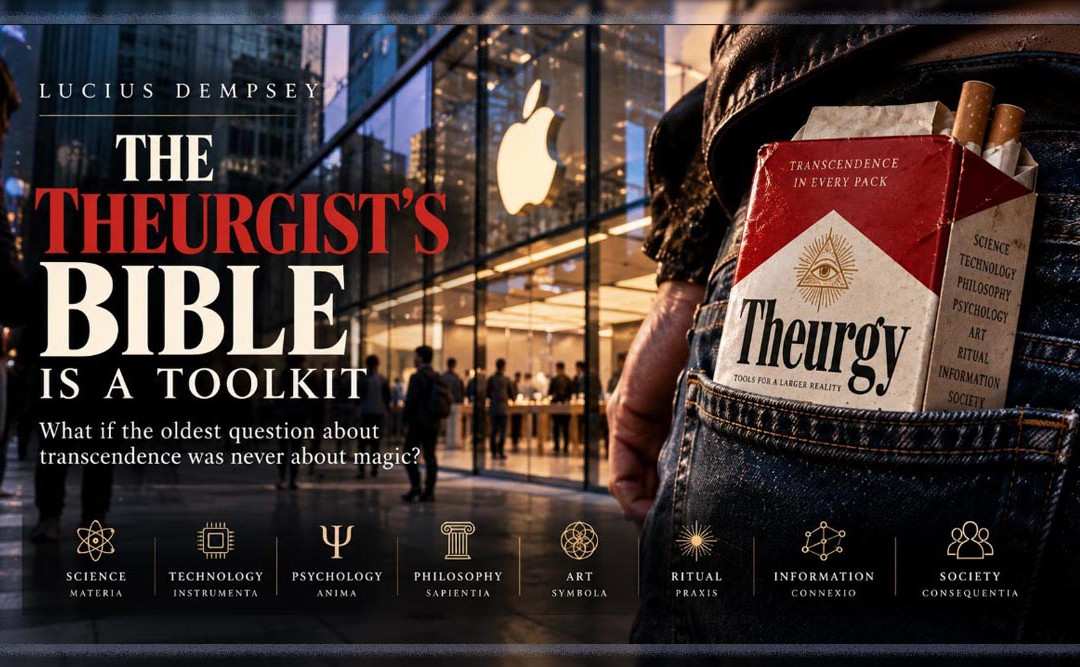
The Theology`s Evil Cusin
There is a recording of a man who has been dead for almost a century. Put it through the right machine and air begins to move. A membrane vibrates, the vibrations reach your ear, and a voice enters the room. The man himself is not there, of course, and almost nobody hearing the recording would mistake the event for resurrection. Yet something that once seemed inseparable from a living body — its voice — has survived the body, crossed generations and become available on demand. The achievement is so familiar that its strangeness has almost completely disappeared.
This is what technology sometimes does to miracles. It does not necessarily make the remarkable less remarkable; it makes it reliable. A device smaller than a book can show us a street on another continent, locate us from objects orbiting thousands of kilometres above the Earth, retrieve more writing than an ancient library could contain and answer a question phrased in ordinary language. We rarely describe any of this as supernatural because we know, at least approximately, that there is machinery behind it. But explaining an effect and abolishing an effect are different things. The recorded voice remains a voice after we learn how recording works.
Perhaps the final stage of a miracle is boredom.
The Missing Bit
Imagine reducing several familiar technologies to the claims they would have made before anyone knew how to build them. A voice will survive the death of its speaker. A library will exist without books. A person will cross an ocean through the air without growing wings. One element will be transformed into another. A piece of manufactured matter will receive questions expressed in human language and produce relevant answers. Detached from their mechanisms, these propositions have a suspicious resemblance to the kinds of claims modern people are trained to distrust.
We can now attach mechanisms to all of them. The voice becomes a recording; the library becomes digital storage; flight becomes aeronautics; elemental transformation becomes nuclear physics; the answering object becomes a computer running a language model. Giving each phenomenon a mechanism changes its intellectual status. What was impossible becomes engineering, and engineering eventually becomes merchandise.
Now consider one more proposition: a human mind survives the biological system that produced it.
Here the comfortable sequence stops. We can preserve a voice, photographs, writing, medical data, preferences and increasingly elaborate traces of behaviour. None of this establishes that consciousness can be transferred between substrates, and still less does it tell us what a soul is or whether the word identifies anything that could be transferred. The responsible answer is therefore neither yes nor no. We have reached a blank whose contents reality has not yet supplied.
[ ]
That is the missing bit.
Its importance lies precisely in our inability to fill it. The previous examples do not prove that consciousness is portable. They do, however, warn us against a particular mistake: treating the absence of a present mechanism as evidence of a permanent prohibition. Before deciding that something cannot happen, we need to know what sort of impossibility we are dealing with.
The Alchemist’s Mistake
Alchemy offers an unusually good example because its most notorious ambition seems to have received history’s verdict long ago. For centuries, turning base materials into gold became shorthand for the hopeless project: greed fortified by bad chemistry and magical thinking. Heating lead, purifying it or combining it with a secret powder will not rearrange its nucleus into gold. On the mechanism that mattered, the alchemists were profoundly wrong.
The twentieth century complicated the joke. Elements can be transmuted through nuclear processes, and gold can in principle be produced from other elements. This does not vindicate an alchemical laboratory. The required mechanisms have almost nothing to do with traditional alchemical theory, and manufacturing gold this way is so impractical that it defeats the economic purpose of making it. Anyone attempting to become rich through nuclear transmutation would be better advised to buy gold.
Yet the episode leaves behind an interesting distinction. The alchemist was wrong about how the transformation could occur and catastrophically wrong about whether it would be useful, but nature had not forbidden the transformation itself. “Impossible” had bundled several different propositions together: we cannot do it, we do not know how to do it, it cannot be done, and it cannot be done profitably. History separated them.
Technology has performed this separation often enough that we should be suspicious whenever the categories are casually reunited. Some impossibilities really are consequences of physical constraints. Others are temporary descriptions of our ignorance. The difficulty is that, from inside the present, the two can look remarkably similar.
This is where alchemy begins to lead somewhere unexpected.
Theology, Alchemy, Theurgy
Late antiquity gives us another word that has aged even less gracefully than alchemy. Theurgy now sounds like something belonging to occult shops, fantasy novels or forgotten religious ceremonies. In the Neoplatonic tradition associated particularly with Iamblichus, however, it occupied a serious philosophical position. Intellectual contemplation alone was not enough. Theurgy involved practices through which the human soul could participate in, or become receptive to, an order beyond its ordinary condition.
There is no good historical reason to turn Iamblichus into a prophet of artificial intelligence. He did not anticipate computers, telecommunications or neural interfaces, and translating ancient gods directly into modern information systems would tell us more about ourselves than about late antiquity. But it is possible to preserve a question without preserving the answer originally given to it. Once the cosmology and ritual vocabulary are temporarily set aside, theurgy leaves behind a peculiar structural problem: can a human being acquire access to a mode of action that does not naturally belong to the unaided human organism?
That question has aged surprisingly well.
The distinction from alchemy now becomes useful. The alchemist wants to transform one thing into another. The theurgist seeks participation in, or access to, a higher order of capability. Modern flight provides a deliberately mundane analogy. We solved the ancient problem of human flight without solving the biological problem of turning humans into birds. We did not acquire feathers, hollow bones or wings. We constructed an interface between a human body and a set of physical laws that were already there.
The person remained human. What changed was the range of actions available to the person.
In that limited structural sense, alchemy is a project. Theurgy is a direction.
A Bible With a Hammer Inside
Suppose, then, that a New Theurgy needed a sacred book. A conventional scripture might begin with a cosmology. It could explain where reality came from, what invisible entities inhabit it, what human beings are supposed to do and what happens at the end. Its authority would reside partly in the preservation of its answers.
The Theurgist’s Bible would be a rather disappointing purchase. Open the box and instead of answers you find a small hammer, a brush and a shovel. It resembles one of those archaeology kits given to children, except that the fossil has not been hidden inside the plaster in advance.
The distinction matters because a scripture and a toolkit preserve different things. Destroy every surviving copy of a particular sacred text and there is no experimental procedure by which a future civilisation must reconstruct its sentences in precisely the same order. Now destroy the numeral 5. Destroy the Roman V and every other sign ever used to represent that quantity. Five stones can still be placed on a table. Another civilisation can invent another mark for the relationship because the notation is not what makes the relationship exist.
Reality is older than its notation.
This is the sense in which reality is older than fiction. Fiction here does not mean falsehood. It means the representation: the word, diagram, category, equation, symbol or interface through which a mind handles something. Representations are extraordinarily powerful, but they are also disposable. The map may disappear without inconveniencing the territory.
A toolkit therefore preserves something different from doctrine. It preserves a capacity for discovery. Give someone the correct answer and the answer can be remembered. Give them the means of testing an answer and they may discover something that the maker of the toolkit never knew.
How Much Can Be Removed?
Digital compression provides an unexpectedly useful metaphor for this problem. We normally think of compression as making files smaller, but the deeper question is what can be removed while preserving the structure required for reconstruction. An MP3 is not the acoustic event that occurred in a recording studio. A photograph is not the person it depicts. A map is not the landscape. Nevertheless, each can retain enough structure to perform a function after enormous amounts of the original situation have disappeared.
The same question can be applied to knowledge. Traditional instruction often attempts to preserve the answer. Socratic instruction improves on this by using questions to make the learner participate in reaching it. But there is a third possibility: compress the problem until only the minimum structure necessary to reconstruct it remains, and then refuse to perform the final operation for the student.
A manual and a toolkit reveal the difference. A manual can tell you how to replace a pipe under conditions anticipated by its author. The actual pipe may be forty years old, corroded, inaccessible from the expected angle and connected with a fitting the author never encountered. At that moment the manual begins to fail, while the toolkit becomes useful. It was never supposed to contain the solution to this particular pipe.
Reality supplies the missing information. An elegant theory can survive pages of argument and still produce an aircraft that refuses to fly. No amount of agreement changes the result. This is why the New Theurgy cannot merely collect fascinating analogies between ancient ideas and modern technologies. Eventually it must expose them to something capable of saying no.
The question is not simply: Does it fit?
It is also: Does it work?
Credo Quia Probabile
Tertullian is associated with one of Christianity’s most famous paradoxes, although the familiar credo quia impossibile is not his literal formulation. In De Carne Christi, discussing Christ’s death and resurrection, he uses the phrase certum est, quia impossibile: it is certain because it is impossible.
The New Theurgy requires an inversion: Credo quia probabile.
“I believe because it is probable” should not be mistaken for “I know that it will happen.” Probability is not prophecy, and technological history is littered with plausible futures that never arrived. The phrase instead describes a discipline of withholding one particular conclusion. A boundary observed today should not automatically be promoted into a boundary of reality.
Flight crossed such a boundary. Recorded voices crossed another. Nuclear transmutation crossed one while making the original economic dream ridiculous. Conversational machines have crossed a boundary that remained comfortably fictional within living memory. In each case, the interesting transition was not simply from impossible to possible. It was from impossible to possible, then perhaps to impractical, expensive, useful, affordable and finally so ordinary that the original impossibility became difficult to feel.
The miracle did not vanish. We learned where the switch was.
This is why the surviving fragments of the Chaldean Oracles offer such an appropriate emblem for the New Theurgy. Historically, their fragmentary condition is a loss; missing texts cannot responsibly be reconstructed and attributed to their authors simply because a modern interpretation seems attractive. But as an intellectual exercise, fragments force a useful discipline. We cannot possess the complete system. We have to distinguish what survives from what we are adding ourselves.
The resulting toolkit can be very small. Find a boundary. Determine what kind of boundary it is. Remove assumptions that belong only to the current representation. Construct a way of testing what remains. Then allow reality to ruin the idea if necessary.
That last step is what prevents the toolkit from becoming another scripture.
Watch the Video
How to Read the World
by Lucius Dempsey
Current Knowledge
Human capabilities are demonstrably not limited to the unaided biological capacities of the human body. We fly without wings, communicate across planetary distances without shouting, preserve memories outside the nervous system, observe wavelengths our eyes cannot detect and perform calculations at scales unavailable to unaided cognition. Information can also survive radical changes of carrier: a voice can move from an acoustic event to a physical recording, then to an electrical signal, a digital encoding and a network transmission while preserving enough structure to remain recognisable as that voice. None of this demonstrates that consciousness is independent of its biological substrate. It does not establish that a person can be transferred, copied or reconstructed from information, and it certainly does not demonstrate the existence of a transferable soul. Those propositions belong beyond the present evidence.
Open Questions
The difficult question is therefore not whether technology can preserve information about a person; it plainly can. The problem is determining what would have to be preserved for the person rather than merely the record to survive. We do not yet know whether consciousness depends on a particular biological process or whether the relevant organisation could exist in another substrate. Nor do we possess a reliable method for distinguishing every temporary technological limitation from a fundamental physical one.
The historical problem is equally important. Ancient language about divine powers, symbols, spirits and participation cannot simply be translated into the vocabulary of computation because the comparison is attractive. Somewhere between refusing all comparison and declaring an ancient daimon to be artificial intelligence lies a more difficult task: preserving the structure of a question without pretending that its original answer was ours.
Transhumation Interpretation
The New Theurgy does not require us to believe that the ancients predicted artificial intelligence. Its proposition is both smaller and more troublesome: human beings repeatedly encounter boundaries through a particular vocabulary, and the vocabulary can disappear before the underlying problem does.
A voice was once inseparable from the body speaking it. Then it became a groove in matter. The groove became an electrical signal; the signal became numbers; the numbers became something that could cross a network and reconstruct the voice somewhere else. At every stage the carrier changed, while something recognisable survived the translation. That history gives us no licence to assume that every human property can undergo the same process. It does give us a reason to ask exactly where the process stops.
Perhaps that is all a Theurgist’s Bible should contain. Not a description of how reality must be, but a method for discovering how much of our description reality actually requires. Not commandments, but instruments. Not the fossil, but the brush.
We know that a voice can survive its speaker. We know that a library can survive its books. We know that human beings can fly without becoming birds and that matter can be made to perform operations no unaided human mind could complete.
Can a soul survive its original carrier?
[ ]
The last bit is yours.
FAQ
What is theurgy?
Theurgy was a religious and philosophical practice that became particularly important in later Neoplatonism. In thinkers such as Iamblichus, intellectual understanding alone was not considered sufficient; theurgy involved practices through which the human soul could participate in, or become receptive to, a divine order beyond its ordinary condition. The New Theurgy does not attempt to revive those ancient practices. It asks whether the underlying problem—how human beings gain access to capacities beyond their unaided condition—can still produce useful questions today.
What is the difference between theology, alchemy and theurgy?
The distinction is easiest to see by looking at what each one tries to accomplish. Theology seeks to understand or describe a divine order, while alchemy attempts transformation: one substance or state becoming another. Theurgy is concerned instead with participation or access. A human being who wants to fly, for example, does not have to transform into a bird; an aircraft allows the person to acquire the function without acquiring the bird’s biology. This is the distinction condensed in the article as: alchemy is a project; theurgy is a direction.
Why is the Theurgist’s Bible a toolkit?
A scripture normally preserves answers: a cosmology, commandments, explanations of the world and perhaps an account of what ultimately happens to us. A toolkit preserves something different—the ability to investigate a problem that its maker may never have encountered. That is why the imaginary Theurgist’s Bible contains an archaeologist’s hammer, brush and shovel rather than a finished fossil. Its purpose is not to tell the reader what reality must be, but to provide a method for discovering what reality permits.
What does “Reality is older than fiction” mean?
Here, fiction does not simply mean an invented story or something false. It means the representations through which human beings describe reality: words, symbols, models, categories and interfaces. We could destroy the numeral 5, the Roman V and every other symbol used to represent that quantity, but five stones could still lie on a table. The notation can disappear because the relationship it describes does not depend upon our notation. In this sense, reality is older than the languages we invent to describe it.
Does the New Theurgy claim that ancient philosophers predicted AI?
No. The article explicitly rejects the idea that Iamblichus anticipated computers, artificial intelligence or telecommunications. The more interesting possibility is that an old question can survive even when its original vocabulary, cosmology and proposed answers become obsolete. Instead of asking whether AI “is” theurgy, the New Theurgy asks whether a modern phenomenon fits the structure of an older problem—and then subjects that comparison to a second, harder question: does it work?
What is the Missing Bit?
The Missing Bit is the point at which a sequence of demonstrated achievements reaches something we cannot yet answer. Human beings have learned to preserve voices and images, externalise memory, fly without wings, transform elements and construct machines that respond to questions. None of those achievements proves that consciousness—or what an older vocabulary might call the soul—can survive a change of carrier. The blank space is therefore deliberate. It marks the boundary between what preceding examples make imaginable and what reality has actually demonstrated.
Can consciousness be transferred to another carrier?
We do not know. Information can clearly survive changes of carrier: a voice can pass from an acoustic event to a physical recording, an electrical representation, digital storage and network transmission while remaining recognisable. Consciousness presents a much harder problem because we do not yet know what minimum physical or organisational structure would have to be preserved for a person, rather than merely information about that person, to survive. The article therefore treats substrate-independent consciousness as an open question, not a technological prediction.
What does “Credo quia probabile” mean?
Credo quia probabile means “I believe because it is probable.” The phrase is presented as a deliberate inversion of the paradox traditionally associated with Tertullian. It does not mean that everything imaginable will eventually become possible, nor that technological progress is inevitable. Instead, it expresses a refusal to confuse a present limitation with a permanent law of reality. The history of flight, recording, nuclear transmutation and computing gives us good reason to preserve that distinction.
Is the New Theurgy a religion?
Not in the conventional sense developed in this article. It provides no required supernatural belief, revealed cosmology or predetermined answer to the questions it raises. Its “Bible” is deliberately paradoxical because it behaves more like an experimental toolkit than scripture: find a boundary, determine what kind of boundary it is, construct a way of testing it and allow reality to reject the idea if necessary. The unanswered space at the end matters precisely because the reader is not told what must be written inside it.
What is the method of the New Theurgy?
Its method is to separate the structure of a problem from the vocabulary historically used to describe it. Once that structure has been isolated, the question is not whether a modern phenomenon can be given an impressive ancient name, but whether the comparison survives examination. Does it fit? Does it work? Where does it fail? The purpose of the toolkit is not to protect an idea from falsification. It is to carry the idea far enough that reality gets the opportunity to say no.
Continue the Transhumation Series
- Forgotten Religion | Ancient Gods, Symbols and the Hidden Structures of Human Civilization
- The Last Religion | Death, Immortality and the Future of Humanity
- The New Theurgy | AI, Information and the Future of Human Civilization
- End of Branding: You Were Never Meant to Become a Product
- Baal vs Ishtar: Why Ancient Gods Never Disappeared