
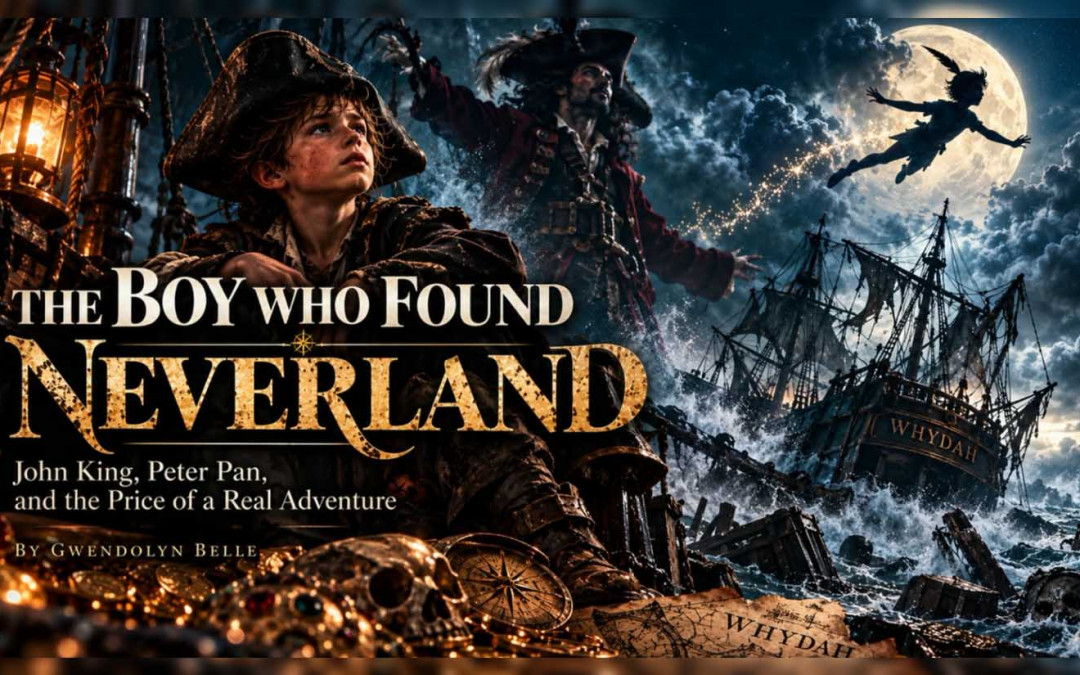
The Boy Who Found Neverland
In 1716, somewhere on the Atlantic, a mother and her young son found themselves looking at the same pirate.
His name was Samuel Bellamy. He was young, successful and sufficiently good at piracy to acquire the name by which history remembers him: Black Sam. His men had captured the ship on which the boy, John King, was travelling with his mother, and by any reasonable adult calculation the situation was appalling. Armed strangers had appeared at sea, taken control of a vessel and placed a woman and her child at their mercy. The mother apparently wanted nothing more complicated than to get her son away from them.
John wanted to join them.
He was about eleven years old.
There are many ways to explain what happened next. We can discuss childhood impulsiveness, the romance surrounding piracy, Bellamy’s reputation among his men, or the reliability of the surviving accounts. All of these questions matter. Yet they can obscure the strangest part of the story, which is also the simplest.
The mother and the boy were looking at exactly the same thing.
She saw criminals.
He saw pirates.
Both were right.
Two People Looking at the Same World
There is an age at which a pirate is not yet an economic category or a maritime criminal. He is a pirate. The distinction matters more than it sounds.
An adult looking at Bellamy might reasonably have noticed weapons, violence, uncertain discipline and the rather serious possibility of dying at sea. A child could look at the same man and see the thing that adults had previously placed in stories. Here was the hat, the ship, the weapons, the crew, the horizon. Here, most astonishingly, was proof that the world contained places his mother had not shown him.
We should be careful not to romanticise the situation retrospectively. We do not know what John thought in anything like the detail a novelist would require, and an eleven-year-old joining a pirate company in the early eighteenth century was entering a genuinely dangerous environment. But the reports that he wanted to remain with Bellamy’s men are enough to expose something more interesting than a sentimental story about childhood.
John and his mother did not merely disagree about the pirates. They appear to have inhabited different versions of the same event.
Children do this all the time. A ruined building can be a castle until an adult explains property law. A dark wood can contain monsters until somebody identifies the birds making the noise. A cardboard box can remain a spaceship for several hours, provided nobody particularly tiresome points out that it once contained a refrigerator.
We normally describe this by saying that children possess imagination. Perhaps that is not quite precise enough. Imagination does not necessarily replace reality. Sometimes it changes which properties of reality matter.
Bellamy really was a pirate.
For once, the child did not need to imagine anything.
The Real Captain Hook
Samuel Bellamy would have been almost indecently useful to a children’s author. He was young, charismatic, successful and theatrical enough to survive three centuries of retelling. His career was also brief, which is helpful to legends. Middle age has ruined many promising mythologies.
By the time John encountered Bellamy’s world, the pirate captain had accumulated an extraordinary reputation and considerable wealth. In 1717 Bellamy captured the Whydah Gally, originally constructed as a slave ship, and made it his flagship. The ship would later become one of the most important archaeological discoveries associated with the Golden Age of piracy.
John joined Bellamy’s company during this astonishingly compressed period.
That timing is essential.
Had he remained among pirates for five or ten years, the story might have become less perfect. He would have had time to discover repetition. He might have learned that pirates became ill, quarrelled, smelled unpleasant, made poor decisions and occasionally spent long periods doing nothing picturesque whatsoever. Bellamy might gradually have ceased to be Black Sam and become Sam, a man John knew rather too well.
John might, in other words, have grown up inside the adventure.
That is what usually happens to Neverland.

The Machinery Beneath the Pirates
Disneyland provides a surprisingly good demonstration, although not because adults necessarily cease to enjoy it. Many do not, and there is nothing particularly profound about disliking a theme park after one’s fortieth birthday.
Something more interesting happens.
A child and a parent can sit beside each other on the same Pirates of the Caribbean ride and encounter different objects. The child sees a town attacked by pirates, cannon fire, treasure, skeletons and men behaving badly with considerable enthusiasm. The parent may enjoy exactly the same scene, but the parent can also see the construction. There are tracks or guidance systems, speakers, programmed figures, emergency procedures and employees somewhere behind the walls who know what to do if the magic stops moving.
Neither experience is necessarily superior. The adult has gained information and lost a certain kind of innocence; the child has less information and therefore possesses freedoms of interpretation that the adult can only imitate.
The genius of Disneyland is not that it restores childhood. It allows these two modes of seeing to occupy the same physical space.
A mother can sit beside her child while the pirates attack.
And then they both get off.
This is the crucial difference between Disneyland and John King’s adventure. Disneyland has solved the problem technologically. It can provide the child’s world while secretly retaining the mother’s world underneath it. The cannon can fire without killing anyone. The pirate can threaten without possessing genuine power. The ship can appear to enter danger while engineers maintain the machinery.
John King encountered the version before the safety system was invented.
He saw the pirates.
His mother saw the machinery.
Except the machinery was the Atlantic.
The Boy Before Peter Pan
Almost two centuries later, J. M. Barrie created a boy for whom the child’s version of reality could become permanent.
Peter Pan does not merely visit a world of pirates. He belongs there. Captain Hook is real, the crocodile is real, the Lost Boys are real, and adulthood has lost its jurisdiction. Peter possesses the one power John King never had the opportunity to test: he can remain a child indefinitely.
It is easy to turn this into a pleasant story about preserving imagination. Barrie makes that reading much harder.
Death sits remarkably close to childhood in his imaginative world. In Peter Pan in Kensington Gardens, children who are lost occupy an uneasy territory between ordinary domestic life and something darker. Barrie’s mythology includes the famous explanation of babies and children being lost when nurses are inattentive, and Peter himself becomes associated with children who die, including the unsettling idea of accompanying them part of the way so that they will not be frightened.
The biographical background makes the theme harder to dismiss as accidental. Barrie’s older brother David died after an accident when he was thirteen. Their mother was devastated, and the dead boy remained fixed in family memory at the age he had reached. Barrie grew up in the presence of a brother who, in the most terrible literal sense, would never grow old.
We should not flatten this into a convenient equation in which David simply “became” Peter Pan. Literature rarely submits so politely to biography. Nor should the Lost Boys simply be labelled dead children and the case declared solved.
But Barrie understood something that the cheerful phrase never grow up tends to conceal.
There is more than one way never to grow up.
The Lost Boys
Barrie’s Lost Boys are usually remembered as one of the pleasures of Neverland: a tribe liberated from parents, school and the tedious administrative machinery of childhood. Their origin, however, is wonderfully disturbing. They are children who have fallen out of their perambulators when their nurses were looking the other way; if they are not claimed after a period, they are sent away to Neverland.
It is funny because Barrie makes it funny. It is also the nightmare of every parent compressed into a joke.
The parent looks away.
The child disappears.
That tiny movement — an adult turning her head — separates the nursery from Neverland.
And suddenly John King’s mother returns to the story.
She did not look away. She saw the danger. She wanted the child back. Yet John appears to have looked toward the very world from which the mother wanted to retrieve him and decided that it was where he belonged.
Barrie would later invent children who are lost because adults fail to watch them.
John King may be stranger still.
He appears to have wanted to be lost.
The Pirate Who Could Not Lose
On 26 April 1717, the Whydah encountered a violent storm off Cape Cod. The ship was driven onto a sandbar and wrecked. Bellamy died, together with most of those aboard.
John King died too.
There is an obvious moral available here, and it should probably be resisted. His mother was right about the danger, but history becomes very dull if every dead child is recruited to prove that mothers know best. The more interesting fact is that John did not live long enough for his perception of Bellamy’s world to undergo the ordinary correction of adulthood.
We do not know what he thought while the Whydah was being destroyed, and it would be indecent to manufacture heroic last thoughts for a child who left us none. Yet his story makes one question almost impossible not to ask.
At what moment does an eleven-year-old discover that Black Sam Bellamy can lose?
His mother had known from the beginning that pirates could lose. The Atlantic knew it too. Bellamy himself, whatever his reputation, presumably understood the possibility better than the boy who had fought to join him.
John had been aboard long enough to discover that pirates were real.
Perhaps he had not been aboard long enough to discover that they obeyed the ordinary rules of the world.
The Boy Who Never Saw the Tracks
This is what makes John King different from the millions of children who have subsequently entered imaginary pirate worlds.
We come back.
We grow.
Eventually we see the tracks beneath the ride.
A child may return to Disneyland twenty years later and notice that the castle is smaller than remembered, that the pirate’s movement repeats, that the darkness conceals machinery. This need not destroy the pleasure. Sometimes adulthood produces another kind of pleasure: the pleasure of understanding how extraordinarily difficult it is to manufacture magic reliably every eight minutes.
John never received that second visit.
Had he lived to thirty, perhaps Bellamy would have become an embarrassment from his childhood. Perhaps John would have become a sailor and told increasingly improbable stories in taverns. Perhaps he would have regretted leaving his mother. Perhaps he would have insisted until old age that joining the pirates was the best decision he ever made.
We cannot know.
But he would have acquired something he never possessed aboard the Whydah: another point of view.
He would have been able to look back at the pirate through adult eyes.
John King never saw the tracks beneath the ride.
Neverland Before Neverland
There is no evidence that Barrie created Peter Pan from the story of John King, and there is no reason to invent such a connection. The absence of a connection is actually what makes the resemblance interesting.
History produced the structure first.
A child leaves the mother’s world. He enters the world of pirates. What appears terrifying from the adult side appears irresistible from the child’s. Before he has time to become an adult and reinterpret what happened, he dies.
Nearly two hundred years later, literature constructs a similar machine deliberately.
A boy leaves the ordinary world. He lives among pirates. He refuses the authority of adulthood. And the mechanism that keeps the fantasy intact is brutally simple.
Peter never grows up.
This does not make John King the historical Peter Pan. It makes him something more useful to us: a real event in which several ideas that would later become culturally familiar briefly occupied the same place before anyone had names for them.
The future has a long past.
Sometimes we can find the places where its lines crossed.
John King’s pirate ship may be one of them.
What Disney Changed
Disney eventually inherited Peter Pan and the pirate world and performed another transformation. It removed the thing John’s mother feared.
Consequences.
Neverland could now be entered safely. Pirates could be encountered without surrendering the child to them. Parents could accompany their children into the fantasy, and the adult world would remain invisibly present behind every painted wall.
This is why Disneyland belongs in John King’s story, but not as a complaint about commercialisation or lost childhood. It is interesting because it solves structurally the problem presented by the encounter between John, his mother and Bellamy.
John sees the pirate.
His mother sees the danger.
Disney builds a pirate both can accept.
The child is allowed to believe in him. The mother is allowed to know that he cannot hurt the child.
And at the end there is an EXIT sign.
Perhaps that sign is one of the most important inventions in Neverland.
The Price of Eternity
Peter Pan appears to have solved John’s problem differently.
There is no need for an exit if the child never changes.
This is where the charming promise of eternal childhood acquires its darker edge. A child who remains permanently a child does not merely retain wonder. He loses the ability to acquire the mother’s point of view.
Peter can never look back at Neverland and understand why Wendy left. He cannot become the adult who remembers the boy who once believed in pirates. He possesses the experience but is denied the reinterpretation.
John King suffered the real version of this.
Death fixed his perspective.
That does not mean he died happily believing himself inside a magnificent adventure. We do not know whether his final minutes contained wonder, terror, regret or nothing coherent at all. The distinction matters, because there is a temptation to make his death beautiful simply because his story has acquired the shape of a myth.
It was not beautiful.
An eleven-year-old boy drowned.
But history sometimes creates patterns without intending them, and John’s pattern is almost unbearably precise. He entered a world that looked remarkably like the world children would later be invited to enter in stories and amusement parks, and he died before acquiring the one thing every surviving child eventually receives.
Distance.
The Mother and the Boy
I keep returning to the mother because she is the person our stories usually leave on shore.
The pirate gets the legend. The boy gets the adventure. The wreck gets the museum. The treasure gets the glass case.
The mother gets to be sensible.
Yet she may be the most important person in the entire story because she shows us that Neverland was never a geographical location. It existed in the distance between two people looking at Samuel Bellamy.
She saw what John would perhaps have seen at twenty.
John saw what she could no longer see.
Neither required the other to be mistaken.
This may be why adults sometimes experience such a peculiar sensation when watching children enter imaginary worlds. We know the sword is plastic. We know who is wearing the costume. We know where the emergency exit is. Yet we also remember, imperfectly, what it was like when none of those facts had jurisdiction over the experience.
For most of us, the two perspectives eventually coexist.
We see the pirate and the actor.
The castle and the concrete.
The magic and the machinery.
Perhaps growing up is not replacing one world with another. Perhaps it is acquiring the uncomfortable ability to see both.
John King never got that far.
The Boy Who Found Neverland
That is why his story deserves to survive separately from the much larger history of Bellamy and the Whydah.
Bellamy was a remarkable pirate. The wreck is a remarkable archaeological site. The recovery of its artefacts has given historians unusual access to the material reality of piracy.
But John King gives us something else.
For a few weeks in 1716 and 1717, a child appears to have stepped through a border that is normally impermeable. The world adults had placed in stories turned out to exist. There really was a pirate captain. There really was treasure. There really was a ship travelling beyond the horizon.
And then the other half of the stories turned out to be real as well.
The storm.
The wreck.
The death.
John found Neverland before Barrie gave it a name, but history denied him the ending Barrie would later deny Peter Pan.
He never became the man who remembered being the boy.
Perhaps that is the true price of eternal youth. Not that childhood continues for too long, but that the next point of view never arrives.
Peter Pan cannot grow up.
John King did not get the chance.
And somewhere between those two boys lies the reason Neverland needs an exit.
Watch the Video
How to Read the World
By Gwendolyn Belle
Current Knowledge
John King was a young boy associated with the pirate company of Samuel “Black Sam” Bellamy. Contemporary legal testimony and later historical research connect him with a vessel captured by Bellamy’s pirates while King was travelling with his mother and indicate that the boy wanted to join the pirate company. The surviving evidence supports the remarkable outline of the story much more securely than it can reveal John’s private thoughts or motivations.
Bellamy captured the Whydah Gally, a vessel originally built for the transatlantic slave trade, in 1717 and converted it into his flagship. On 26 April 1717 the Whydah was wrecked in a severe storm off Cape Cod, killing Bellamy and almost everyone aboard. John King is believed to have died in the wreck. The ship was rediscovered in the twentieth century and has become the first widely authenticated Golden Age pirate shipwreck discovered in North America.
M. Barrie’s Peter Pan developed almost two centuries after King. Barrie’s writings connect Peter’s imaginative world with lost children, mortality and the refusal or inability to grow older. Barrie’s brother David died at thirteen, an event that profoundly affected his family and has long been considered relevant to discussions of Barrie’s recurring fascination with childhood and arrested ageing. These connections should not be simplified into a claim that David “was Peter Pan,” nor is there established evidence that Barrie based Peter Pan on John King.
The comparison among John King, Peter Pan and later Disney versions of Neverland is therefore interpretive rather than genealogical. It identifies a recurring structure rather than claiming direct historical influence.
Open Questions
We cannot know how John King actually perceived Samuel Bellamy. The surviving evidence that he wanted to join the pirates gives us an extraordinary fact, but not access to the mental world of an eleven-year-old living three centuries ago. How much of our picture of his enthusiasm reflects John’s experience, and how much has accumulated through later retelling?
Barrie’s relationship between childhood and death is similarly resistant to a single explanation. How much did the death of his brother shape Peter Pan? To what extent should the Lost Boys be read through mortality rather than abandonment, imagination or Edwardian ideas of childhood? The material supports the questions more securely than any single answer.
The largest question may be one we cannot test at all. What would John King have thought about Bellamy at thirty, fifty or seventy? Would adulthood have destroyed the adventure, complicated it, or made it more precious? His death makes the question impossible to answer — and precisely for that reason makes it impossible to ignore.
Transhumation Interpretation
The future rarely announces itself when it first appears.
Its components emerge separately, sometimes centuries apart, and only retrospectively do we notice the moments when they briefly touched. Transhumation is interested in those intersections: places where a later structure existed before anyone standing inside it could have understood what it would become.
John King offers one of those moments.
In one encounter we find a child, a mother and a pirate occupying the same physical reality while apparently experiencing different worlds. Nearly two centuries later, Barrie would turn the separation between childhood and adulthood into Neverland and give it a boy who could not grow old. Later still, Disney and the modern theme park would engineer a controlled version of the same crossing, allowing children to encounter pirates while adults remain protected by the machinery behind the illusion.
None caused the next.
That is precisely the point.
History does not always proceed through direct inheritance. Sometimes the same structure appears repeatedly because the underlying human problem remains.
How can a child enter the dangerous, impossible world without being destroyed by it?
John King entered it before we had an answer.
Barrie gave it a name.
Disney gave it an exit.
And perhaps that is why a small boy aboard a pirate ship in 1717 still matters.
The future has a long past.
Sometimes, if we are fortunate, history shows us the place where two of its lines first crossed.
FAQ
Was John King a real pirate?
Yes. John King appears in contemporary testimony concerning Samuel Bellamy’s pirates. He was a child travelling with his mother aboard the Bonetta when Bellamy’s company captured the vessel in November 1716. According to Captain Abijah Savage’s later testimony, King actively demanded to join the pirates.
How old was John King?
His exact age is unknown. Evidence generally places him at approximately eight to eleven years old, making him exceptionally young even within the unusual social world of early eighteenth-century piracy.
Did John King sail aboard the Whydah?
King is associated with Bellamy’s company and is generally believed to have died when the Whydah Gally wrecked off Cape Cod in April 1717. Archaeological finds from the wreck include child-sized remains and clothing that researchers have associated with him, although the identification is not absolutely certain.
Was John King the inspiration for Peter Pan?
There is no known evidence that J. M. Barrie knew John King’s story. This article does not claim a historical connection between them. The significance lies in the parallel: long before Barrie created the Lost Boys and their world of pirates, a real child chose to leave his mother and enter a pirate world from which he never returned.
Who were the Lost Boys in Peter Pan?
In Barrie’s story, the Lost Boys are children who became separated from the ordinary adult world and ended up in Neverland. They live with Peter Pan, encounter pirates and remain outside the conventional process of growing up.
Did John King choose to become a pirate?
Contemporary testimony indicates that he did. Captain Abijah Savage reported that King strongly resisted efforts to prevent him from joining Bellamy’s pirates. What King understood piracy to mean, however, cannot be recovered from the surviving evidence.
Did John King become rich?
King joined Bellamy during an extraordinarily successful period of his piratical career and ultimately became associated with the treasure-laden Whydah. It is therefore reasonable to say that he entered a remarkably wealthy pirate company. We cannot establish what personal share of that wealth King regarded as his own.
What happened to John King?
He is believed to have died when the Whydah was wrecked during a storm off Cape Cod in April 1717. Because he died as a child, King never had the opportunity to tell us how he later understood the extraordinary decision he had made.
Why is Great Ormond Street Hospital connected to Peter Pan?
- M. Barrie gave his rights in Peter Pan to Great Ormond Street Hospital in 1929. UK legislation later created a special continuing right for the hospital to receive royalties from certain uses of the work even after ordinary copyright protection expired.
What does John King have to do with Disney?
There is no historical connection between John King and Disney. The article uses Disney’s later transformation of pirate adventure into safe entertainment as a contrast. A modern child can enter an imaginary world of pirates and then return home. John King entered the real one.
Continue the Transhumation Series
- Forgotten Religion | Ancient Gods, Symbols and the Hidden Structures of Human Civilization
- The Last Religion | Death, Immortality and the Future of Humanity
- The New Theurgy | AI, Information and the Future of Human Civilization
- End of Branding: You Were Never Meant to Become a Product
- Baal vs Ishtar: Why Ancient Gods Never Disappeared