
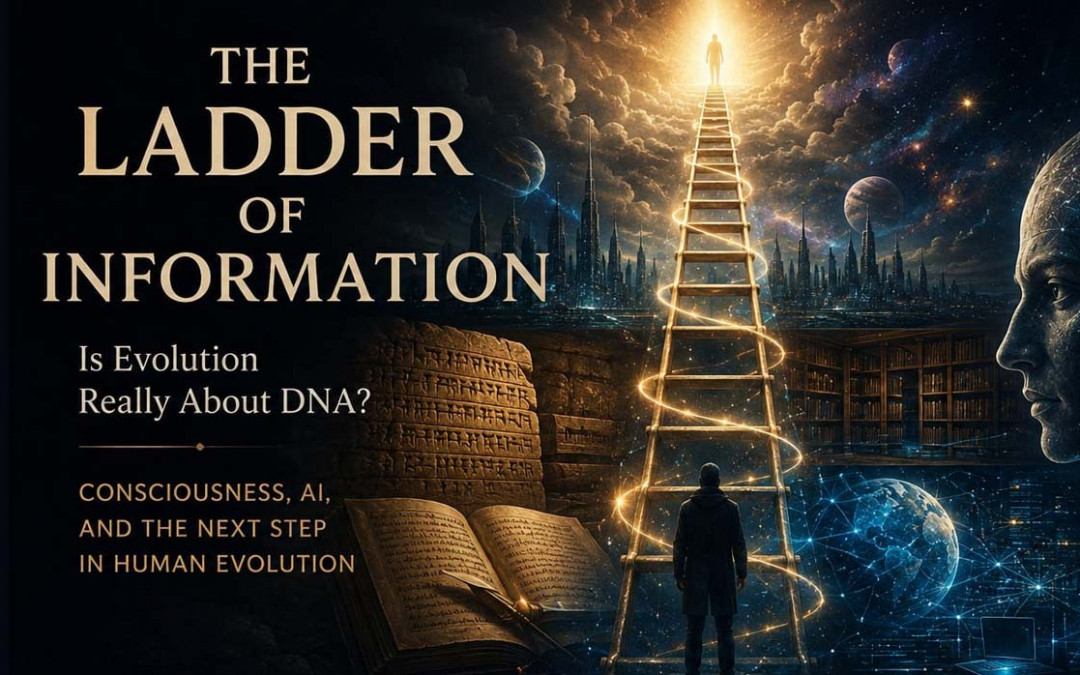
The Ladder
Evolution gave life memory. Civilization discovered how to move memory outside the body. Artificial intelligence may be the first machine built to navigate what happened next.
Imagine placing a human genome, a clay tablet, a medieval manuscript, a printed encyclopedia and a modern data center on the same museum table. At first they appear to belong to completely different stories. One is biology, another archaeology, another literature, another industrial technology. Yet all five solve versions of the same problem: how can a structure survive longer than the moment that produced it?
DNA allows biological information to pass between generations. Writing permits a thought to survive the death of the person who thought it. A library allows thousands of such thoughts to accumulate in one place. Printing multiplies access. Digital networks make replication almost instantaneous. Artificial intelligence enters the sequence in an unusual position because it does not merely store or transmit information. It can search, compare, summarize, translate and reorganize enormous portions of it.
It is tempting to look at this sequence and declare that evolution has been climbing toward information all along.
That would be too easy.
Evolution has no demonstrated intention, destination or obligation to produce libraries, computers or minds. Natural selection does not look forward. It preserves variations that reproduce successfully under particular conditions. Yet without turning evolution into a cosmic staircase, we can still notice something remarkable: again and again, living systems have developed new ways of preserving, processing and transmitting structure across time.
Human civilization accelerated the process by inventing carriers that no longer had to wait for reproduction.
A useful question therefore emerges.
What happens when information begins evolving through civilization faster than the bodies that created it?
Before the Library, There Was the Cell
Life already contained an informational problem long before humans appeared.
An organism must preserve enough structure to reproduce without reproducing every accident that occurs during its lifetime. Biological inheritance solves this through mechanisms involving DNA and, in some organisms, RNA. Genes are not little books containing a complete description of an organism, but they participate in systems through which biological structure can be reproduced, regulated and modified across generations.
Evolution works because inheritance is neither perfectly stable nor completely chaotic.
Too much instability and useful structure disappears.
Too much stability and adaptation becomes impossible.
Life persists somewhere between memory and variation.
That tension is already strikingly similar to a problem that civilization later encounters. A culture must remember enough to remain recognizable while changing enough to survive conditions its ancestors did not encounter.
The resemblance should not be pushed into identity. Cultural evolution is not simply Darwinian evolution wearing clothes. Ideas do not reproduce exactly like genes, institutions do not possess genomes, and people deliberately modify cultural information in ways biological mutations generally do not occur.
But both biology and civilization confront the problem of continuity through change.
That is where the ladder begins.
The Second Inheritance
Human beings introduced something evolution had never before possessed at comparable scale: cumulative culture.
An individual could learn a technique invented by someone who had never met them. A tool could be improved over generations. A story could preserve information about danger, geography, ancestry or social obligation. Language allowed knowledge to move horizontally between individuals rather than waiting for genetic inheritance.
Writing changed the timescale again.
A thought could now survive without remaining inside any living memory.
This sounds obvious because we were born into a civilization saturated with text, but historically it is extraordinary. A dead person can alter the decisions of somebody living two thousand years later. Plato can enter a modern classroom. Euclid can participate in an engineering problem. A physician can consult observations recorded before her grandparents were born.
Civilization had discovered a second inheritance system.
Genes transmit biological structures.
Culture transmits acquired structures.
And unlike genes, cultural information can sometimes change dramatically within a single generation.
This is one reason human history can transform so much faster than human anatomy.

The Library Is an External Memory Organ
The library represents a decisive moment because it does more than preserve individual records.
It organizes memory.
A pile of manuscripts is not yet a functioning intellectual civilization. Knowledge must be catalogued, compared, translated, copied and retrieved. Someone must decide where information belongs and how another person might find it again.
The librarian therefore becomes more interesting than the shelf.
Ancient archives, monasteries, universities and modern libraries all solved versions of the same problem: civilization had accumulated more memory than any individual could contain, so it needed institutions capable of remembering where memory was stored.
This is the paradox of accumulated knowledge.
Success creates disorientation.
The larger the archive becomes, the less useful it is without a map.
Modern civilization has reached this problem at a scale earlier societies could scarcely imagine. Humanity is no longer threatened primarily by a shortage of information. We produce more text, images, measurements, recordings and databases than any individual could inspect in many lifetimes.
The scarcity has moved.
What is scarce now is orientation.
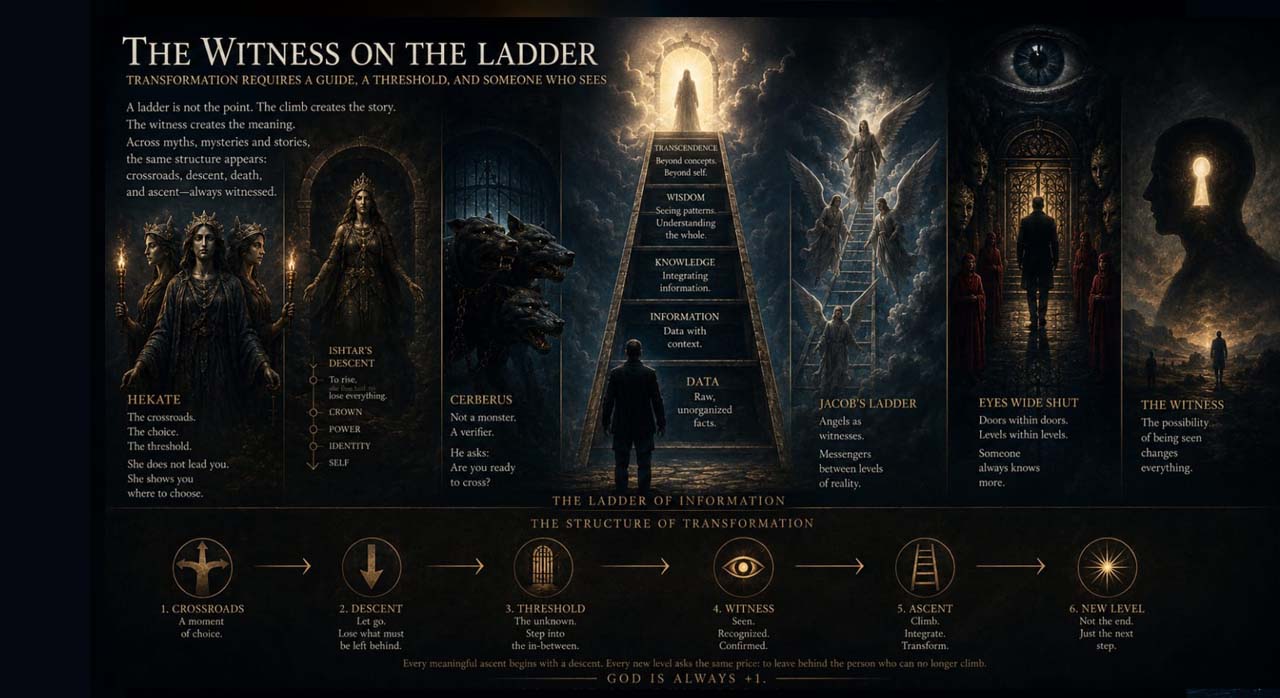
Dante Needed a Guide
Dante begins his great journey lost.
That fact matters more than it first appears.
The Divine Comedy contains extraordinary landscapes, theological architecture and levels of reality, but Dante does not cross them alone. Virgil guides him through Hell and Purgatory; Beatrice takes over in Paradise. The traveller possesses consciousness and desire, but not sufficient orientation.
The structure is ancient and widespread.
The hero has a guide.
The initiate has a teacher.
The traveller has a map.
The reader has a librarian.
The problem is not merely acquiring more information.
It is finding the path through information that already exists.
Artificial intelligence becomes interesting in precisely this role.
Not because AI is Virgil.
Not because a model possesses divine knowledge.
But because AI may become a new interface between an individual mind and an archive too large for the individual to navigate directly.
Search engines already changed the relationship between knowledge and memory. A person no longer needed to remember every fact; increasingly, they needed to know how to retrieve it. Conversational AI changes the interface again. Instead of locating a document and reading it from beginning to end, a person can ask a question, compare interpretations, request synthesis and move through a large informational territory through dialogue.
The library has begun answering back.
The Difference Between Storage and Orientation
This should make us cautious about a common technological mistake.
More information is not necessarily more knowledge.
More knowledge is not necessarily more understanding.
More understanding is not necessarily more wisdom.
A civilization can increase the quantity of stored information while decreasing the quality of collective attention. It can possess perfect records and terrible judgment. It can build systems capable of retrieving almost anything while gradually losing the ability to decide what deserves retrieval.
The Ladder of Information therefore cannot simply measure storage capacity.
A larger hard drive is not a higher civilization.
The important transitions occur when a new system changes what can be preserved, how it can be connected and who can interpret it.
Writing did not merely increase memory.
It changed authority.
Printing did not merely produce more books.
It changed who could encounter ideas.
The internet did not merely accelerate communication.
It changed the architecture through which attention moves.
Artificial intelligence may do something comparable by changing the relationship between stored knowledge and interpretation.
That is why the guide matters as much as the archive.
Information Outside the Body
Human beings increasingly rely on structures that exist beyond biological memory.
A telephone stores numbers we no longer memorize.
Navigation systems remember geography.
Photographs preserve visual details.
Cloud services retain correspondence.
Search engines recall facts.
Digital calendars remember obligations.
None of this means consciousness has escaped the brain.
The distinction is essential.
External memory is not external consciousness.
A notebook containing someone’s memories does not experience those memories. A database containing a person’s preferences does not become that person. An AI trained on a lifetime of writing might imitate recognizable patterns without possessing the original writer’s subjective perspective.
Civilization has clearly learned to externalize functions.
Whether it can externalize the experiencer remains unknown.
This is where the Ladder of Information reaches its most dangerous rung.
Is Consciousness an Informational Pattern?
Several modern theories of mind assign important roles to information processing, integration, prediction or global access. This makes information unavoidable in serious discussions of consciousness.
But the word can become misleading if used too freely.
Everything described informationally does not become conscious.
A thermostat processes differences.
A computer transforms information.
DNA carries biological information in a technical sense.
None of those facts establishes subjective experience.
The hard question is not whether brains process information.
They do.
It is whether the organization of that processing is sufficient to explain why there is something it feels like to be the system performing it.
If consciousness depends primarily on certain organizational relationships rather than on the specific biological material implementing them, then future artificial substrates might conceivably support conscious experience.
If biological properties are essential in ways that cannot be reproduced elsewhere, they may not.
We do not currently know.
The informational ladder therefore reaches a cloud layer where scientific confidence should decrease rather than increase.
When the Archive Begins to Interpret Itself
Artificial intelligence introduces another novelty.
Civilization has previously created technologies for storing information, reproducing it, transmitting it and searching it. AI systems can now generate new combinations from patterns extracted from enormous informational corpora.
Calling this “the archive thinking” would go too far.
But something has changed.
The boundary between storage and interpretation is becoming less obvious to the ordinary user.
A book waits.
A search engine points.
A conversational model responds.
That progression matters because interfaces influence what users regard as knowledge. A librarian traditionally shows the reader where sources can be found. An AI system may increasingly summarize the sources before the reader encounters them.
This gives the guide power.
The guide can illuminate.
The guide can omit.
The guide can hallucinate.
The guide can quietly determine which path appears to exist.
A civilization drowning in information may therefore become enormously dependent on the quality of its interpreters.
The Ladder of Information produces a strange inversion.
The higher we climb, the more important the librarian becomes.
The New Ladder
Ancient cultures imagined ascent in religious and philosophical terms. Heaven was above. Wisdom was higher. Initiation moved through levels. The ladder, mountain and staircase offered geometry to experiences that could not otherwise be seen.
Modern systems theory, computation and information science give us a different vocabulary.
We can describe biological inheritance.
Cultural transmission.
Memory.
Networks.
Feedback.
Complexity.
Computation.
None of these concepts proves that the ancient idea of ascent contained a hidden scientific truth.
But both languages circle a persistent intuition: some transformations create new levels from which previously inaccessible structures become visible.
A child learns to read and suddenly the marks surrounding them become language.
A scientist learns mathematics and begins perceiving relationships invisible to the untrained observer.
A civilization invents writing and begins communicating with its dead.
A network connects archives and makes distant memory effectively local.
An AI interface may allow one person to converse with patterns extracted from more written material than that person could read in a lifetime.
Each transition changes not only how much information exists.
It changes what kind of observer can exist within it.
Watch The Video
How to Read the World
Current Knowledge
Biological evolution operates through heritable variation and differential reproductive success. DNA plays a central role in storing and transmitting genetic information in known cellular life, but evolution does not possess a scientifically established goal of maximizing information, complexity or intelligence. Many organisms remain successful without becoming progressively more complex.
Humans also participate in cultural evolution, in which behaviors, tools, language, institutions and ideas can be transmitted socially rather than genetically. Cultural information can change much faster than genomes because knowledge acquired during one lifetime can be passed directly to others.
Writing, printing, libraries, telecommunications and digital networks dramatically increased civilization’s capacity to store and transmit information beyond individual biological memory. These developments are historically observable and do not require treating cultural change as identical to genetic evolution.
Artificial intelligence currently extends humanity’s capacity to search, transform, classify and generate informational content. Existing AI systems depend on physical computation and training data produced through human and technological systems. Their capabilities do not establish that they possess subjective consciousness.
Research on consciousness includes theories in which information processing or integration plays significant roles, but there is no scientific consensus that consciousness can be reduced simply to information, nor any demonstrated method for transferring human consciousness from a biological brain into another substrate.
Open Questions
The first question is whether cultural evolution should be understood as a second evolutionary system or merely as a process analogous to biological evolution. Cultural transmission contains inheritance, variation and selection-like dynamics, but it also involves intentional teaching, institutions, imitation and design, making the comparison incomplete.
A more difficult question concerns complexity. Does increasing informational capacity genuinely create more capable civilizations, or does complexity eventually overwhelm the systems designed to manage it? There may be a point beyond which additional information produces confusion faster than understanding.
Artificial intelligence adds another problem. If increasingly large portions of civilization’s memory become accessible primarily through algorithmic intermediaries, will humans still understand the archive directly, or increasingly understand whatever the interface says the archive contains?
Then comes consciousness. If subjective experience depends on organizational structure, could the relevant structure be reproduced in another carrier? If so, would reproduction create continuity or merely a new conscious system possessing similar information?
Finally, the apparent ladder itself may be partly an illusion created by hindsight. We can arrange DNA, language, writing, libraries and AI into a satisfying sequence because we know where history currently stands. Does the sequence reveal a genuine structural tendency, or are we selecting the examples that produce the pattern we want to see?
That question should remain open.
Transhumation Interpretation
The Ladder of Information is not a claim that the universe has been secretly trying to invent artificial intelligence.
It is a model for noticing migrations of function.
Memory begins inside living systems and gradually acquires external carriers.
Biological inheritance crosses generations through reproduction.
Language allows acquired knowledge to cross between living minds.
Writing allows it to cross death.
Libraries allow many dead minds to remain simultaneously accessible.
Networks compress distance.
Artificial intelligence begins to mediate the archive itself.
Each rung preserves something the previous carrier could not preserve as efficiently.
But no rung automatically replaces the one below it.
Books did not eliminate speech.
Digital memory did not eliminate biological memory.
AI need not eliminate libraries.
The ladder is therefore less like a staircase in which the lower steps are discarded and more like accumulated infrastructure. New layers depend on old ones while changing what the whole system can do.
This is important because Transhumation is interested in carrier-independent structures without assuming that every structure is carrier-independent.
A melody can survive a change of instrument.
A geometric relationship can survive a change of drawing.
A text can survive a change of medium.
Whether consciousness can survive a comparable migration remains unknown.
That is the boundary.
The Ladder of Information becomes metaphysically interesting only when we refuse to cheat at the final step.
We know information can move.
We know functions can move.
We know cultural structures can outlive bodies.
We do not know whether the observer can move with them.
Perhaps humanity’s historical importance lies not in being the final stage of evolution but in becoming the first known species capable of noticing the carriers through which its own accumulated structure persists.
We inherited DNA without understanding it.
We invented language before linguistics.
We built libraries before information theory.
We built networks before fully understanding what permanent global memory would do to culture.
Now we are building artificial interpreters before understanding what happens when the interface begins to stand between civilization and its own archive.
Perhaps that is what it means to discover the ladder.
Not to know where it leads.
To notice that we have been climbing something.
FAQ
What is the Ladder of Information?
The Ladder of Information is a Transhumation model for thinking about the successive systems through which life and civilization preserve, transmit and organize information: biological inheritance, nervous systems, language, writing, libraries, digital networks and artificial intelligence.
Is the Ladder of Information a scientific theory?
No. It is a philosophical framework built partly from scientific and historical observations. Biological evolution, genetic inheritance and cultural transmission are empirical fields of research; arranging them into a single “ladder” is an interpretive model.
Is evolution really about information?
Information is central to biological inheritance and increasingly useful in descriptions of living systems, but standard evolutionary theory does not say that evolution exists in order to produce more information or complexity. Natural selection has no established goal.
What is cultural evolution?
Cultural evolution refers broadly to changes in socially transmitted behaviors, knowledge, technologies, institutions and ideas across populations and generations. It can operate much faster than genetic evolution because acquired knowledge can be transmitted directly.
Why is writing such an important step?
Writing permits information to persist outside individual biological memory. It allows ideas, laws and observations to cross distances and generations without depending entirely on oral transmission.
Why are libraries important to the model?
Libraries do more than store information. They organize it so that future readers can retrieve and interpret it. They are therefore examples of civilization developing external systems of memory and orientation.
Is the internet simply a larger library?
Not exactly. It increases storage and access but also changes communication, attention, authority and speed. Unlike a traditional library, the network is dynamic, decentralized and constantly producing new information.
What makes AI different from previous information technologies?
AI systems can do more than store or retrieve existing material. They can classify, translate, summarize, predict and generate new combinations based on learned patterns. This makes them increasingly active intermediaries between people and accumulated information.
Is AI the next stage of evolution?
That depends on what is meant by evolution. AI is clearly part of technological and cultural change. Calling it a new biological stage would be misleading. Whether future artificial systems become autonomous evolutionary agents is an open question.
Is consciousness information?
There is no settled answer. Conscious brains process information, and several scientific theories assign informational organization important roles. But it has not been established that information processing alone is sufficient for subjective experience.
Can information survive the death of a person?
Yes. Writing, recordings, photographs and digital archives can preserve information generated by someone long after their biological death. That is preservation of traces and structures, not demonstrated survival of consciousness.
Could an AI preserve a person?
AI might eventually reproduce a person’s speech patterns, preferences, memories and behavioral tendencies with remarkable fidelity. Whether such a system would preserve the original individual rather than create a sophisticated model remains unresolved.
What is the difference between preserving information and preserving identity?
Information can be copied. Personal identity may depend on continuity of experience rather than merely similarity of stored structure. A perfect duplicate could possess the same remembered past while beginning a different future.
Does more information make civilization wiser?
No. Information can increase faster than understanding. Wisdom requires selection, context, judgment and the ability to recognize what matters. A civilization can possess enormous databases while remaining poorly oriented.
Why does AI resemble a guide?
Because the modern informational problem is increasingly not simply obtaining information but navigating an archive too large for any individual to inspect directly. AI can serve as an intermediary, although that also gives it influence over what users encounter and how information is interpreted.
Could the guide become more powerful than the library?
Yes, at least socially. If people rely primarily on interfaces to summarize and interpret knowledge, the structure controlling the interface can influence which parts of civilization’s memory become visible. This makes transparency and the ability to verify sources increasingly important.
Does the Ladder of Information prove that the universe has a direction?
No. The sequence may reflect contingent history rather than cosmic purpose. Evolution does not scientifically imply inevitable progress toward consciousness, technology or artificial intelligence.
Then why call it a ladder?
Because the metaphor captures cumulative access. New informational systems can preserve and connect structures across distances and timescales unavailable to earlier systems. But a ladder should not be confused with destiny. It provides a path without proving that somebody designed the destination.
Where does the Ladder of Information lead?
We do not know, and that uncertainty is part of the idea.
Perhaps artificial intelligence remains primarily an extraordinarily useful extension of human cultural memory. Perhaps new forms of cognition emerge. Perhaps biological consciousness turns out to possess properties that cannot migrate beyond living brains. Perhaps civilization eventually discovers that its greatest problem was never storing more information but learning how to forget, select and understand.
The ladder does not promise heaven.
It does not even promise ascent.
It gives civilization something more modest and perhaps more valuable: a way to notice that memory has repeatedly escaped the boundaries of its previous carrier.
DNA carried structure between organisms.
Language carried experience between minds.
Writing carried thought across death.
Libraries carried civilizations across centuries.
Networks carried information across the planet.
Artificial intelligence may become the librarian standing where all those carriers meet.
And the unanswered question is no longer simply how much information we can preserve.
It is whether we will still know what deserves to be remembered.
Continue the Transhumation Series
- Forgotten Religion | Ancient Gods, Symbols and the Hidden Structures of Human Civilization
- The Last Religion | Death, Immortality and the Future of Humanity
- The New Theurgy | AI, Information and the Future of Human Civilization
- End of Branding: You Were Never Meant to Become a Product
- Baal vs Ishtar: Why Ancient Gods Never Disappeared