
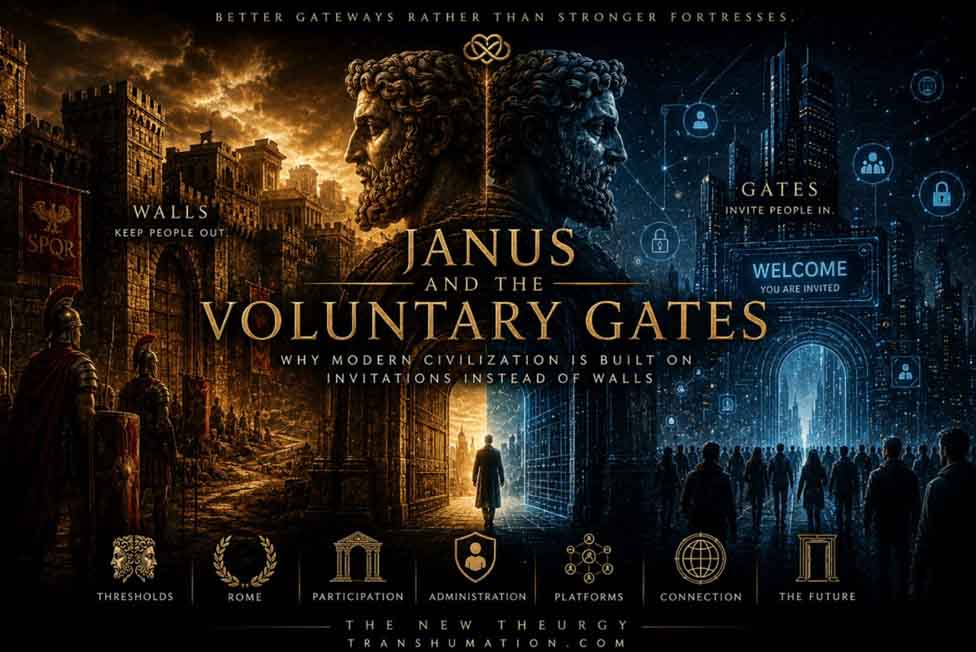
Janus and the Voluntary Gates
Civilizations are shaped not only by the walls they defend, but by the thresholds through which outsiders become participants.
A wall is one of the oldest political technologies.
It marks territory. It slows an army. It separates the protected from the exposed and converts geography into a visible statement: beyond this line, the rules change.
Ancient cities understood this perfectly. Walls could mean survival. Gates could be closed at night, defended during siege and monitored during peace. A city without boundaries was vulnerable precisely because it could not control entry.
But a wall creates a paradox.
The same structure that protects a civilization can also prevent it from growing.
A city needs merchants, workers, allies, soldiers, marriages, ideas, taxes and people willing to identify their future with the future of the system. Protection requires exclusion. Expansion requires admission.
Between those two demands sits the gate.
That is where Janus becomes more interesting than the wall itself.
The Roman god of beginnings, doorways and transitions does not symbolize simply openness. A doorway can be locked. A gate can admit one person and reject another. The threshold is powerful because it is where distinction becomes decision.
Who may cross?
Under what conditions?
What changes after they do?
Civilizations have been answering those questions for thousands of years.
Janus Does Not Abolish the Wall
Janus is often represented with two faces, conventionally associated with looking toward different directions or moments. He is linked with doors, passages, beginnings and transitions, and his name became deeply embedded in the Roman imagination of entry and departure.
The temptation is to turn him into a cheerful god of openness.
That would miss the point.
A threshold exists because there is a boundary. Without the wall, the gate has no meaning. Without an outside, entry is impossible.
Janus therefore belongs less to inclusion itself than to the management of transition.
This distinction matters because modern civilization increasingly speaks as though openness were the absence of control. Digital systems demonstrate the opposite. The apparently open platform may contain elaborate rules for authentication, membership, ranking, moderation and removal.
Access is not the disappearance of power. Access is power organized around a crossing. The gate does not destroy hierarchy. It decides how hierarchy begins.
Rome Was Both Fortress and Invitation
Rome offers an unusually rich example because it combined brutal coercion with extraordinary capacities for incorporation.
The empire conquered territory through military force. Revolts could be suppressed with extreme violence. Slavery was central to Roman society. Legal rights were unequal, and citizenship did not mean democratic equality in the modern sense.
Yet Roman political history also shows that membership could expand.
Citizenship was gradually extended far beyond the original population of Rome. Local elites could become integrated into Roman institutions. Military service, manumission, municipal status and political negotiation could create routes into different forms of Roman belonging. In 212 CE, the Constitutio Antoniniana dramatically extended Roman citizenship to most free inhabitants of the empire.
None of this turns conquest into voluntary association.
But it reveals an important principle of durable systems.
Rome did not depend exclusively on keeping outsiders permanently outside.
It repeatedly created mechanisms through which conquered, peripheral or previously excluded populations could acquire recognizable positions inside Roman order.
The wall protected Rome.
The gate reproduced Romanness.

Membership Is a Technology
Citizenship is easy to treat as an abstract legal concept. It is also an interface. It tells a person what relationship they have with the system.
Which protections apply?
Which taxes are owed?
Which institutions can be used?
Which obligations follow?
What status can be inherited?
Who counts as an insider?
Modern civilization is filled with comparable interfaces, although their stakes differ radically.
A passport.
A university admission letter.
A professional license.
A subscription.
A company account.
A security clearance.
A verified profile.
An invitation code.
Each creates a small political event. Before crossing, the person stands outside a particular structure. After crossing, new permissions become available.
Modern technological culture has multiplied these thresholds because participation itself has become modular. We enter and leave systems constantly. Sometimes we barely notice the crossing.
The Soft Power of the Login Screen
A login screen is one of the least dramatic objects in modern civilization. It is also one of the most revealing. Enter an email address. Create a password. Agree to terms. Continue.
The ritual appears neutral because it is familiar.
Yet the act establishes a relationship between person and system. The user receives access. The system receives data, attention, compliance with rules and often some degree of dependence.
No guard raises a spear. No official reads a proclamation. The gate has become almost frictionless. This changes how authority feels. A wall announces resistance. A digital gate usually advertises convenience.
Join now.
Create your account.
Start free.
The modern system often grows not by forcing people through the threshold but by making the threshold attractive enough that people cross voluntarily. That does not make the relationship free of power. It makes power compatible with desire.
Why Platforms Look Open
Successful digital platforms often create an impression of radical openness. Anyone can join. Anyone can post. Anyone can build an audience. Anyone can participate.
The experience at the surface can be remarkably horizontal. But the architecture beneath it is not.
Owners establish the system.
Developers alter its environment.
Administrators possess special permissions.
Moderators enforce rules.
Algorithms distribute visibility.
Payment systems create different levels of access.
Recommendation systems decide which participants are likely to encounter one another.
The platform is therefore neither a wall nor an open field.
It is a city of gates. Some are visible. Others are hidden inside code.
The user’s most important encounter with authority may happen before they even notice authority exists.
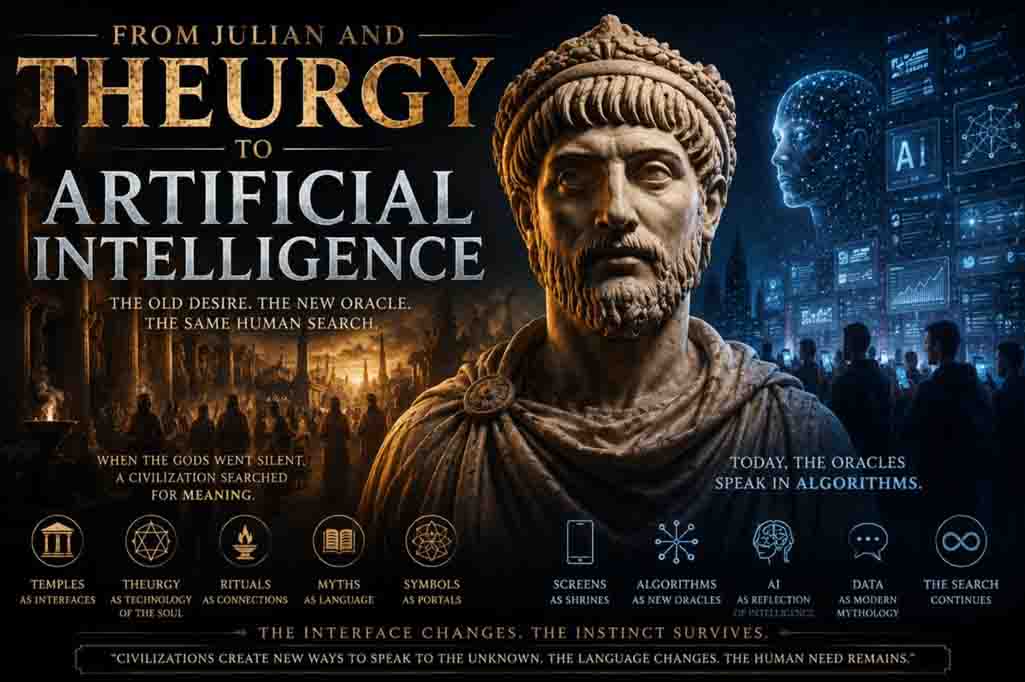
The Gate Can Become More Powerful Than the Wall
A wall answers a simple question:
Who must remain outside?
A sophisticated gate answers a more powerful one: Who may enter, in what role, with which privileges and under which conditions? The second system can shape behavior far more precisely.
A university does not merely admit or reject. It creates categories of applicant, student, graduate and faculty member. A professional body certifies competence. A digital service distinguishes free users from premium users, verified users from ordinary accounts, administrators from participants.
Modern power frequently operates through permissions. And permissions are attractive because they can be earned, purchased, granted or unlocked. The hierarchy becomes aspirational.
The participant does not merely experience the higher level as domination. They may want access to it. This is one reason gated systems can be extraordinarily stable.
A barrier produces resentment.
A ladder attached to the barrier can produce ambition.
Voluntary Does Not Mean Free
This is where the phrase voluntary gate becomes dangerous if taken too literally.
Modern systems frequently offer genuine choice.
They also create dependencies.
A person may technically be free not to use a dominant professional network while discovering that employers expect participation. A business may be free to leave a large marketplace while losing much of its customer access. A citizen may formally accept terms for essential digital services without possessing realistic bargaining power over those terms.
Voluntary entry therefore exists on a spectrum. The interesting question is not simply whether the person clicked Agree.
It is what alternatives were realistically available before the click. The most sophisticated modern gate may preserve the appearance of free entry while becoming increasingly difficult to refuse. This is why Janus belongs to politics as much as mythology. Thresholds organize freedom.
The Administrator at the Door
Traditional power often presented itself through status. Modern power increasingly presents itself through maintenance. The administrator does not need a crown. The administrator needs permissions.
The role appears functional: verify access, enforce standards, protect the system, remove abuse, restore service. Often these functions are genuinely necessary.
Every gate needs somebody—or something—to determine whether the conditions of entry have been met.
But as more of civilization becomes digital, administrators are increasingly joined by automated gatekeepers.
Fraud detection systems.
Identity verification.
Credit models.
Ranking systems.
Automated moderation.
AI-assisted hiring tools.
The guardian at the threshold may no longer be a recognizable person. This creates a new political problem.
If the gate refuses entry, who made the decision?
Watch The Video
How to Read the World

Current Knowledge
Janus was a Roman deity associated with beginnings, doorways, gates and transitions. His symbolic relevance to modern systems of access is an interpretive analogy rather than evidence that Roman religion anticipated contemporary digital architecture.
Ancient Rome combined military conquest, legal inequality and slavery with mechanisms of incorporation that expanded Roman citizenship and political integration over time. Roman citizenship eventually extended far beyond the population of the city itself, culminating in the broad grant of citizenship to most free inhabitants of the empire under Caracalla in 212 CE.
Modern digital platforms commonly use layered systems of access, permissions, moderation and membership. Although users may enter voluntarily, ownership and decision-making power remain unequal within those systems.
Research across political science, sociology and institutional design has long shown that legitimacy depends on more than coercive power alone. Perceptions of fairness, participation, procedural clarity and access can influence whether people accept institutions and their rules.
Voluntary participation should not automatically be equated with equal bargaining power. Network effects, economic dependence and lack of realistic alternatives can make nominally optional systems practically difficult to avoid.
Open Questions
The first question concerns the relationship between access and legitimacy. Do people trust a system more because entry is genuinely open, or because the interface makes the gate feel open even when important forms of power remain hidden?
A second question concerns exclusion. Every gate that admits also possesses the ability to reject. As more important social, professional and economic activities move through privately controlled digital systems, who should have authority to determine the conditions of entry?
Artificial intelligence sharpens the problem. If future systems increasingly decide who receives credit, employment, insurance, visibility or access, the gatekeeper may become computational. How can a person challenge a threshold whose reasoning they cannot inspect?
There is also a civilizational question. Can systems remain attractive enough to invite participation while preserving enough boundaries to maintain identity, trust and function? Complete closure produces stagnation, but complete openness can dissolve the conditions that make membership valuable.
Transhumation Interpretation
The Janus Principle is not that gates are morally superior to walls.
It is that a civilization reveals itself most clearly at the threshold. The wall tells us what it fears. The gate tells us what it is willing to become.
That distinction matters increasingly in technological society because modern systems compete not only through defense or coercion but through attraction.
Join the platform.
Study at the university.
Move to the city.
Enter the profession.
Adopt the standard.
Use the network.
Participate.
The strongest modern systems often expand because outsiders begin reorganizing their behavior in order to gain entry. That is a subtler form of power than command. The system does not have to chase everyone outside its walls. It can make them approach the gate.
Janus therefore becomes useful to The New Theurgy as the figure of controlled transition.
Not openness.
Not closure.
The threshold between them.
Every interface contains such a threshold. A button looks trivial, but behind it sits a question of permission. Every account contains a boundary between anonymous outsider and recognized participant. Every membership system defines what must be given before something else becomes available.
The future may indeed belong less to civilizations that can build the highest walls than to systems capable of designing the most compelling gates.
But a beautiful gate can lead into a prison.
An open gate can still record everyone who enters.
A voluntary gate can become unavoidable once enough of society moves behind it.
The mature Janus Principle must therefore ask two questions at the same time:
Why would anyone want to enter?
And:
What power does the system acquire once they do?
That is the real politics of the threshold.
FAQ
Who was Janus?
Janus was the Roman god associated with beginnings, doors, gates and transitions. His two-faced imagery became strongly connected with looking across boundaries and moments of passage.
What is a voluntary gate?
It is a Transhumation metaphor for a system people enter because participation offers perceived value: citizenship, membership, professional admission, accounts or digital platforms.
Why are gates different from walls?
A wall primarily excludes. A gate manages movement across the boundary. It can admit, reject, classify and determine the conditions under which participation begins.
Did Rome really grow through inclusion?
Partly. Rome remained an imperial and often violently coercive system, but it also expanded citizenship and created pathways by which different populations could become integrated into Roman institutions.
How do digital platforms function as gates?
Accounts, subscriptions, verification systems and permissions determine who can participate and what they can do after entry.
Does voluntary participation eliminate hierarchy?
No. A system may be entered voluntarily while still containing strong inequalities of ownership, visibility, control and authority.
What is the Janus Principle?
The Janus Principle asks us to study systems through their thresholds: who can enter, what they must do to enter, what changes after entry and who controls the gate.
What is the deeper Transhumation question?
Perhaps modern civilization is moving from the politics of the wall toward the politics of the interface.
Power no longer needs to appear only as exclusion.
It can appear as invitation.
And that may make the threshold more important than ever.
The wall says:
You cannot enter.
The modern gate says:
Come in.
The important question begins after we accept.
Continue the Transhumation Series
- Forgotten Religion | Ancient Gods, Symbols and the Hidden Structures of Human Civilization
- The Last Religion | Death, Immortality and the Future of Humanity
- The New Theurgy | AI, Information and the Future of Human Civilization
- End of Branding: You Were Never Meant to Become a Product
- Baal vs Ishtar: Why Ancient Gods Never Disappeared