
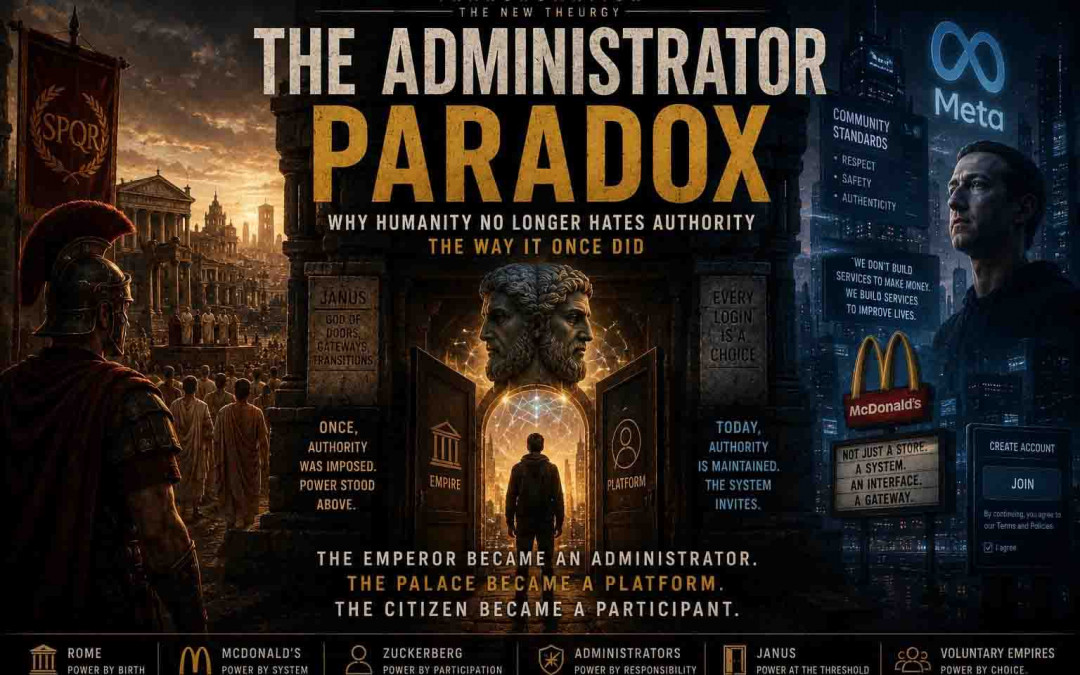
King or Admin?
The king stood above the gate. The administrator disappears inside it.
There is a peculiar moment that occurs billions of times every day. A person opens a device, touches an icon and enters a world governed by rules written by people they will probably never meet. Certain things may be said there, others may be removed. An identity can be verified, restricted or suspended. Visibility can increase or disappear according to systems the participant only partly understands.
And yet almost nobody experiences pressing “Log in” as crossing a national border.
There is no guard, no passport booth, no portrait of the sovereign above the entrance. Nobody bows. No trumpet announces the arrival of authority. The transition is so ordinary that it barely feels like a transition at all.
That may be precisely what makes it interesting.
For much of history, power tried to make itself visible. The crown, palace, uniform, procession, temple and throne were not merely decoration. They told you where authority was located. Modern digital civilization has begun producing another kind of environment, one in which extraordinary authority can exist without looking very much like authority.
The king stood above the gate.
The administrator may be somewhere inside the software.
The Kingdom You Can Leave
At first, the distinction seems obvious. A Roman subject could not simply decide on Tuesday afternoon that the Roman Empire was no longer relevant to him. Territory made authority difficult to escape. Laws followed bodies because bodies occupied land.
A digital platform appears fundamentally different. You usually enter by choice. You accept conditions, create an account and receive access to something useful: communication, entertainment, customers, information, storage, status or community. If the exchange no longer appeals to you, there is usually a button somewhere that promises you can leave.
That difference matters.
But it does not settle the question.
Imagine that nearly everyone you know has moved into a magnificent hotel. The restaurants are there, the conversations happen there, business is conducted in its lobby and invitations arrive through its reception desk. Technically, nobody forces you to stay. You remain perfectly free to sleep in a tent across the road.
At what point does voluntary participation begin acquiring some of the characteristics of dependence?
This is where the administrator becomes more interesting than the king. The king could say: obey because I rule this place. The successful administrator rarely needs to say anything comparable.
The environment says it for him.
Rome Had Already Discovered the Problem
The Romans would not have recognized a social-media account, but they knew that naked force was an expensive way to govern.
Roman authority was never based on one simple principle. Republican traditions emphasized offices, law, status, citizenship, institutions and elite competition; imperial government preserved many older forms while concentrating extraordinary power around the emperor. Across centuries, Rome learned that durable authority required more than somebody powerful enough to issue commands.
It required a functioning world.
Roads had to remain usable. Grain had to arrive. Taxes had to be collected. Disputes required institutions. Provinces needed administration. Water had to reach cities. The enormous territory had to become sufficiently predictable that people could conduct ordinary lives inside it.
This suggests a distinction that survives Rome.
Power can make people obey.
A system must also make continued participation possible.
The emperor therefore becomes less interesting if we look only at the throne. Behind him appears an administrative machine, and behind that machine appears something more durable than any particular ruler: the expectation that the structure will continue working tomorrow.
A throne can command.
Infrastructure creates habits.

The Man Behind the Hamburger
There is an unexpectedly good place to see this transformation, and it does not contain a marble bust.
It contains French fries.
Ray Kroc did not invent the hamburger, and the McDonald brothers were already operating their restaurant before his involvement. What became remarkable about McDonald’s was not simply the object being sold. America already possessed hamburgers. The achievement was increasingly the system surrounding the hamburger: replication, procedures, recognizable architecture, standardized preparation and an experience designed to become predictable across locations.
A traveler could enter an unfamiliar town and recognize the golden arches.
That recognition did something important. It reduced uncertainty.
You knew roughly how the system worked before crossing the door.
This is one of civilization’s most underestimated powers. A successful system does not need to persuade us from the beginning every time we encounter it. Eventually we learn its interface. We understand where to stand, what to ask for, what will happen next and approximately what the exchange will cost.
The golden arches become a kind of gate.
Not because McDonald’s is an empire in any serious political sense, but because it demonstrates something political theory can easily overlook: people often surrender small degrees of freedom gladly when structure gives them something they value in return.
We accept the menu because the menu makes the experience legible.
And suddenly Janus is standing nearby.
The God at the Login Screen
Janus was the Roman god associated with beginnings, doorways, transitions and passages. His two faces made him an unusually elegant symbol for thresholds: one direction behind us, another ahead.
The modern world is crowded with thresholds, although we have stripped most of them of ceremony.
Create account.
Accept.
Continue.
Join.
Subscribe.
Enter password.
Each looks trivial. Yet each can mark passage from one rule environment into another. Once inside, different permissions become possible. You acquire an identity recognized by the system. Actions are recorded. Some doors open. Others remain closed.
The comparison should not be pushed too literally. Facebook is not a Roman temple, a login is not an initiation rite, and Janus did not somehow predict the Internet.
The recurring structure is what matters.
There is an outside.
There is an inside.
There is a threshold between them.
And someone or something determines the conditions under which the threshold can be crossed.
In an ancient city, that function might have been represented by a physical gate and its keeper. In software, much of the gatekeeping has migrated into code.
Authority did not necessarily disappear.
Some of it became interface.
When the Gatekeeper Disappears
This creates the real Administrator Paradox.
A traditional ruler becomes conspicuous when exercising power. Soldiers arrive. A law is announced. A tax collector knocks. A judge issues a sentence. Authority reveals itself through intervention.
A digital system can exercise influence without producing an equivalent moment.
A ranking changes.
A recommendation disappears.
A default setting moves.
A piece of content receives less distribution.
An account encounters an automated restriction.
Nothing resembling an emperor has entered the room, yet the field of possible action has changed.
This is why calling technology executives “new kings” is both tempting and insufficient. They can possess enormous power, but the architecture of that power differs from territorial sovereignty. A platform does not normally command a population in the same comprehensive way a state can. States possess legal and coercive powers that companies do not.
At the same time, describing platform authority as mere administration is too innocent.
An administrator does not simply maintain the game.
Administrators can help determine its rules.
The more important a system becomes, the more consequential those rules become. If leaving means losing customers, professional relationships, an audience, years of accumulated data or access to a community, the sentence you can always leave begins to resemble the hotel guest being reminded that the tent across the road remains available.
Formally true.
Structurally incomplete.
The Empire Nobody Conquered
This may be one of the strangest inventions of the information age: environments capable of reaching enormous populations without acquiring territory in the traditional sense.
A platform can cross borders without annexing them. Its users may live under hundreds of governments while simultaneously inhabiting the same digital rule system. They bring their conversations, photographs, businesses, friendships and disputes with them. The environment becomes more valuable as more people enter it, which can make departure increasingly costly even while departure remains legally possible.
Nothing here requires a secret conspiracy or a hidden emperor.
The mechanism is more interesting than that.
Utility produces participation.
Participation produces scale.
Scale produces dependence.
Dependence produces power.
And power creates the need for governance.
At some point the person maintaining the infrastructure is no longer merely maintaining infrastructure. Decisions about access, visibility, identity, acceptable behavior and dispute resolution begin affecting the lives of millions or billions of participants.
The administrator has crossed an invisible threshold.
He has become a governor without necessarily acquiring the title.
The New Theurgy
This is where the Administrator Paradox enters Transhumation.
Perhaps civilization is not simply replacing old rulers with nicer ones. Something more structural may be happening. Authority may be migrating between carriers.
Once it wore a crown.
Then it occupied an office.
Sometimes it became a bureaucracy.
Now parts of it can reside in protocols, permissions, interfaces, algorithms and defaults.
The underlying function survives: somebody or something still determines what the system permits, remembers, rewards, rejects and makes difficult.
This also gives us a useful way to resist the simplistic story that technological progress automatically decentralizes power. Sometimes it does. At other times it merely makes power less theatrical.
A king needs a throne because people must know where the king is.
An administrator may become most powerful when we stop looking for him.
Perhaps the great political question of the information age will therefore not be whether humanity has finally escaped hierarchy. It clearly has not. The more interesting question is whether we can still recognize authority after authority stops dressing like authority.
The emperor was easy to find.
He was the man on the coin.
The administrator may be harder.
He may be the reason the button is there.
Watch The Video
How to Read the World
Current Knowledge
Modern states, corporations and digital platforms exercise importantly different kinds of authority. States possess forms of legal sovereignty and coercive power that private platforms generally do not. Digital platforms nevertheless establish rules governing participation in their services and can moderate content, suspend accounts, design recommendation systems and determine technical conditions of access.
Roman political authority also changed substantially across the Republic and Empire and cannot accurately be reduced to a simple transition from hereditary elites to functional administrators. Roman government combined law, social status, citizenship, patronage, military power, political institutions and administrative practices in changing configurations.
Likewise, Ray Kroc did not create McDonald’s alone or invent its original restaurant system. Richard and Maurice McDonald developed the early streamlined restaurant model; Kroc later played a central role in expanding it through franchising and large-scale standardization.
Open Questions
When does voluntary participation become practical dependence? How meaningful is the ability to leave a system when leaving carries significant social or economic costs? At what scale does moderation become governance?
There is also a deeper problem. If rules are increasingly enforced automatically through software, where exactly should responsibility reside—with the designer, owner, administrator, algorithm, institution or person who chose to participate?
And perhaps the most difficult question is the simplest:
Can authority become harder to challenge precisely because it no longer looks like authority?
Transhumation Interpretation
Transhumation does not interpret the administrator as simply a modern emperor. The more interesting possibility is that the function of authority has migrated to a new carrier.
The throne, bureaucracy, platform and algorithm are not equivalent. Their powers and historical circumstances differ enormously. Yet each can perform part of the same durable civilizational function: defining the boundaries within which other people act.
Seen this way, the important transformation is not king → Zuckerberg.
It is:
command → rules → infrastructure → interface.
Power has not vanished from the gate.
The gate itself has learned how to exercise power.
FAQ
What is the Administrator Paradox?
The Administrator Paradox describes a form of authority that can become extremely influential while appearing less like traditional power. Instead of issuing visible commands, administrators can shape the environments, rules and interfaces through which people participate.
Is a platform administrator the same as a king?
No. A king or state exercises territorial and legal powers that a private digital platform generally does not possess. The comparison is useful only for examining how some functions of authority can appear in different institutional forms.
Why do people voluntarily accept rules on digital platforms?
Because participation provides something they value, such as communication, information, entertainment, customers or access to communities. Rules become part of the exchange required to use the system.
Is participation in social media truly voluntary?
Formally, it usually is. Practically, the situation can become more complicated when a platform is important for employment, business, relationships or public communication. The cost of leaving therefore matters when evaluating how meaningful voluntary participation really is.
Why does the article discuss Ancient Rome?
Rome demonstrates that durable authority requires more than visible command. Infrastructure, administration, law and predictable institutions can become essential components of political power.
What does McDonald’s have to do with authority?
McDonald’s illustrates the power of standardized systems. People willingly accept limited options and procedures because predictability makes an environment easy to understand and use. It provides a simple example of how structure can encourage voluntary participation.
What does Janus represent in the article?
Janus represents the structure of the threshold: an outside, an inside and a passage between them. The article uses this ancient motif to examine modern thresholds such as accounts, permissions and login screens.
Is the article claiming that Janus predicted digital technology?
No. Janus is used as a structural analogy, not as evidence of ancient technological foresight. The recurring element is the function of the gateway, even though its material form has changed.
How can an interface exercise power?
Interfaces determine which possibilities are visible, easy, difficult or unavailable. Defaults, permissions, rankings and access controls can therefore influence behavior without issuing direct commands.
Why aren’t technology executives simply “new kings”?
Because corporate and territorial sovereignty are fundamentally different. Technology companies generally cannot exercise the full legal and coercive authority of states. Their influence often comes instead from controlling important systems people choose—or increasingly need—to use.
What is an “invisible empire”?
It is a metaphor for a system capable of coordinating enormous populations without conquering physical territory. Its expansion occurs through participation rather than territorial annexation.
When does administration become governance?
The boundary becomes interesting when decisions about maintaining a system begin substantially determining access, visibility, identity, behavior and opportunities for large populations.
Does technology eliminate hierarchy?
No. Technology can decentralize some forms of power while creating or strengthening others. Hierarchy may survive even when its visible symbols disappear.
What does Transhumation mean by authority changing carriers?
It means that a durable function can persist while the structure carrying it changes. Authority once expressed primarily through rulers and physical institutions can partly migrate into bureaucracy, software, protocols, interfaces and automated systems.
What is the main argument of the article?
The article argues that modern civilization may not be eliminating authority so much as changing its form. The most important power of the future may not always command people directly. It may design the environment in which their choices are made.
Continue the Transhumation Series
- Forgotten Religion | Ancient Gods, Symbols and the Hidden Structures of Human Civilization
- The Last Religion | Death, Immortality and the Future of Humanity
- The New Theurgy | AI, Information and the Future of Human Civilization
- End of Branding: You Were Never Meant to Become a Product
- Baal vs Ishtar: Why Ancient Gods Never Disappeared