
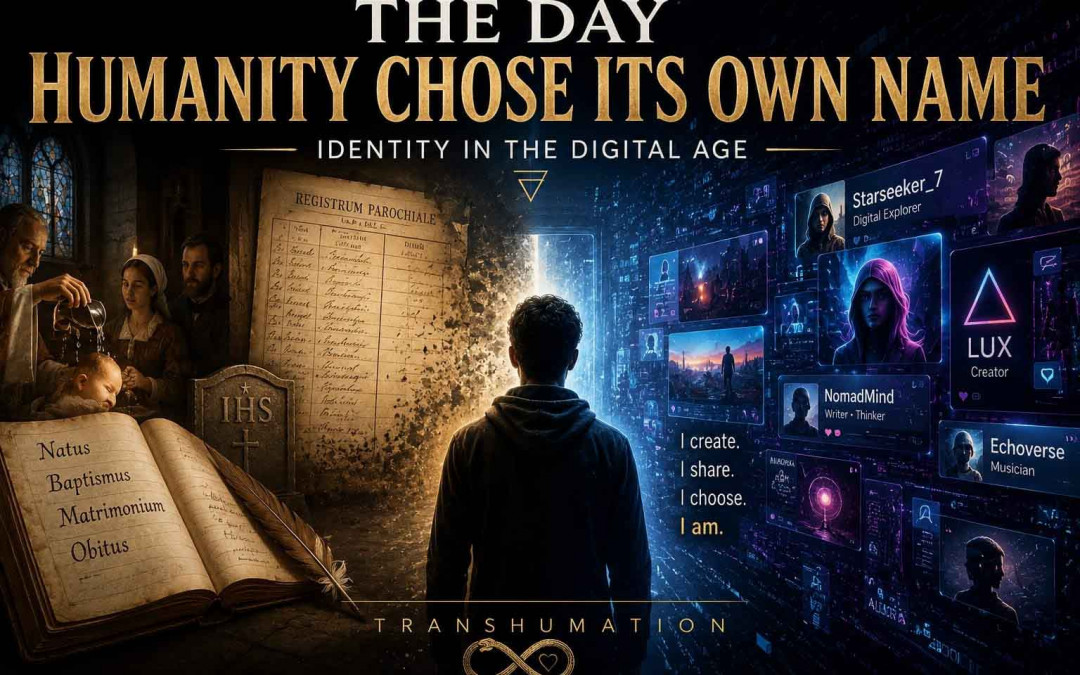
For most of human history, identity was inherited.
You were born into a family.
Into a language.
Into a religion.
Into a nation.
Into a profession that was often chosen long before you could choose it yourself.
Even your name usually came from someone else.
Identity was something received.
Not something created.
A Name Is More Than a Label
A name has always carried information.
It connects a person to history, family, memory, and society.
Throughout history, changing one's name was uncommon and often marked a profound transformation.
Kings adopted royal titles.
Monks received new names.
Popes chose a new name at the beginning of a new mission.
A new name symbolized a new identity.
The privilege belonged to very few.
Then the Internet Changed Everything
Without realizing it, humanity crossed a remarkable threshold.
For the first time in history, billions of people could publicly choose who they wished to become.
A username.
A pseudonym.
A creator's identity.
A project.
A digital persona.
Not because governments ordered it.
Not because religions approved it.
But because technology made it possible.
A teenager can create an identity recognized by millions without changing a single official document.
That has never happened before.
Identity Became Voluntary
The digital world introduced something civilization had rarely experienced:
voluntary identity.
You may still possess a legal name.
A passport.
A tax number.
But these describe only your administrative existence.
The world increasingly knows people by the identities they intentionally create.
Scientists.
Artists.
Writers.
Developers.
Creators.
Entire communities gather around chosen identities rather than inherited ones.
More Than Social Media
Many people believe social media merely distract humanity.
Perhaps they also reveal something deeper.
For centuries, institutions preserved that a person existed.
Today, individuals preserve how they experienced existence.
Photos.
Podcasts.
Videos.
Ideas.
Books.
Conversations.
Projects.
The digital world does not simply record names.
It records perspectives.
Why This Matters for Artificial Intelligence
Artificial intelligence introduces a fascinating question.
If identity becomes information...
Can information survive independently from its original biological carrier?
Human civilization has already separated names from bodies.
Ideas from authors.
Books from generations.
Could identity itself become increasingly independent from biology?
Perhaps this is the first step toward understanding what consciousness truly is.
The Last Religion
Ancient civilizations inherited identity.
Modern civilization increasingly creates it.
This is not merely a technological revolution.
It is a philosophical one.
For the first time, humanity is beginning to participate consciously in designing its own public identity.
The question is no longer:
Who gave you your name?
The question becomes:
Who did you choose to become?
Perhaps the greatest freedom civilization has ever created was not freedom of movement.
Nor freedom of speech.
But the freedom to consciously define the story by which the world remembers you.
Want to Explore More..?
Watch The Video Below
Continue reading...
The Mirror of Mind
FAQ
What does "The Day Humanity Chose Its Own Name" mean?
It refers to the historical shift from inherited identities toward identities that individuals consciously create through digital platforms, creative work, and voluntary communities.
Is this article about social media?
Not primarily. Social media serves as an example of a broader transformation in how identity is created, expressed, and preserved.
Did people never change their names before the Internet?
They did, but it was relatively rare and often connected with religious life, monarchy, artistic careers, or exceptional personal circumstances. The Internet made self-chosen public identities accessible to billions.
What does this have to do with AI?
Artificial intelligence raises questions about identity as information rather than merely biology. If identity can increasingly exist through information, it changes how civilization thinks about memory, continuity, and personhood.
Is this part of The Last Religion?
Yes. This article continues the The Last Religion and The New Theurgy themes by exploring identity as an informational structure that evolves alongside civilization rather than remaining fixed by birth.
Continue the Transhumation Series
Explore the full journey:
- End of Reality — Where Do You Really Exist?
- End of Physics — Are the Laws of Reality Real?
- End of the Real World — Reality Is No Longer Required
- End of Consciousness — Beyond the Human Mind
- End of Death — When Human Limits Disappear
- End of Religion — When Technology Replaces Faith