
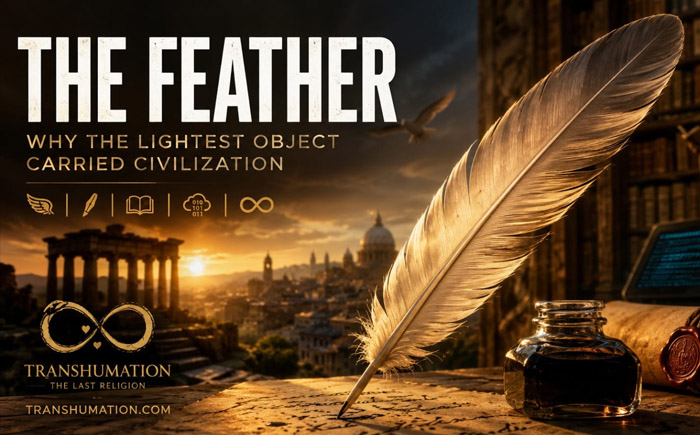
The Feather
There is something almost comically inadequate about a feather. Hold one between two fingers and it weighs almost nothing. It cannot support a roof, cut stone, cultivate a field or defend a city. Place it beside the obvious instruments of civilization—the hammer, the sword, the plough, the wheel—and it looks decorative, an object that nature designed for another purpose entirely. Its original achievement belonged to the bird. It helped create lift, controlled air and allowed a living body to occupy a region of the world inaccessible to most terrestrial animals.
Then humans removed the feather from the wing, cut its shaft, dipped it in ink and asked it to perform a completely different kind of flight.
For centuries, the quill became one of the characteristic instruments of European writing. Laws passed through it. Accounts were kept with it. Letters crossed borders because of marks it left behind. Poems, contracts, theological arguments, scientific observations, love letters and death sentences all passed through the same improbable device: a hollow keratin tube that evolution had produced for feathers, converted by human hands into a controlled channel for ink. The bird no longer left the ground. The sentence did.
It would be romantic but historically wrong to say that civilization began writing with feathers. Human beings had been recording language for millennia before quill pens became common: clay tablets, reeds, brushes, papyrus, parchment and carved inscriptions already belonged to sophisticated writing cultures. The feather entered a civilization that had long ago discovered the larger trick.
That trick was not writing with a particular object.
It was learning how to leave a thought behind.
The Feather Came Late
Writing is so fundamental to modern life that we tend to imagine it as one invention, followed by increasingly convenient writing tools. The real history is much more complicated. Different writing systems developed in different places and under different material conditions. Scribes pressed marks into wet clay. Reed pens carried ink onto papyrus. Brushes became instruments of extraordinary precision. Stone and metal were inscribed when permanence mattered more than speed.
The quill therefore deserves no mythical place as the first instrument that liberated memory.
Its significance lies elsewhere.
For a long period of European history it became an extraordinarily intimate interface between thought and inscription. A writer sharpened the feather by hand. The angle of the cut mattered. Ink flow depended upon material properties the writer could feel directly. The pen had to be repaired and recut. Writing was not an abstract act performed upon an invisible system; the resistance of the page, the movement of the wrist and the condition of the nib remained part of the event.
A letter written with a quill therefore preserves something a modern digital text easily hides. The words carry small physical traces of the moment in which they were made. Pressure changes. Ink accumulates. The hand becomes tired. A correction enters the line. The writing instrument stands directly between biological movement and cultural memory.
This is why the feather can become a Transhumation object without becoming a historical fantasy.
It sits exactly at the threshold between an event inside one body and a structure capable of leaving that body behind.
From Wing to Word
The symbolic transformation is almost too elegant.
A feather first belongs to flight.
Then it belongs to writing.
Human cultures have associated wings with ascent, speed, divine messengers, freedom and movement between separated realms in many different traditions. Those meanings should not be collapsed into one universal code; an Egyptian winged symbol, a Greek winged figure and a Christian angel belong to different historical and theological worlds. Yet the physical function beneath the symbolism is obvious enough: wings carry bodies across a boundary ordinary human bodies cannot cross unaided.
The quill performs another version of transportation.
Not because writing is supernatural, and not because the feather secretly connects heaven and earth, but because writing allows an organized fragment of human thought to cross a boundary its author cannot.
Time.
A spoken sentence normally disappears into the air unless another memory receives it. A written sentence can wait. It can remain unread for a week, a century or, under exceptional conditions, thousands of years. Its author may be dead before the reader is born. The two nervous systems never coexist, yet one arrangement of symbols can still alter the other.
That is an astonishing physical achievement disguised as an ordinary cultural habit.
The feather did not make thought immaterial. Ink remained material. Parchment remained material. The written mark still required a carrier. What writing achieved was more subtle: the pattern ceased to depend exclusively upon the biological carrier in which it originated.
The author’s mind could no longer be preserved.
But something the mind had organized could.
Shakespeare’s Hand
The funerary monument to Shakespeare at Holy Trinity Church in Stratford-upon-Avon presents him not as a warrior, nobleman or statesman but as a writer. The familiar monument places the literary act itself at the center of his identity: Shakespeare is represented with writing materials, his hand connected symbolically to the work through which later generations know him.
Imagine altering the object in his hand.
Give him a sword and the entire biography begins tilting toward another kind of man. Give him scales and we expect a merchant. Place a piece of fruit before him and the monument becomes opaque until someone explains the joke.
Writing implements work because they perform compression.
They cannot tell us who Shakespeare was. They do not contain his consciousness. They say almost nothing about the private man who worried, desired, became ill, quarreled, invested money or walked through Stratford. Yet one object can preserve the relationship upon which his historical continuity largely depends.
He wrote.
The instrument becomes an interface between the vanished person and the surviving pattern.
This is why symbols matter without becoming magical. A symbol can remove enormous quantities of information while retaining one relation powerful enough to orient the observer. The quill does not preserve Shakespeare.
It tells us where to look for what survived him.
The War Against Forgetting
Every civilization fights forgetting, although not every civilization fights it in the same way and not everything deserves to be preserved.
Oral cultures developed sophisticated methods of transmitting stories, law, genealogy and ritual knowledge without writing. Written cultures developed archives, libraries, bureaucracies and copying traditions. Monuments preserved selected public memories. Families preserved private ones. Printing multiplied texts until survival could depend less on the fate of one manuscript. Photography and recording added image and voice. Digital technology has now created personal archives of a scale almost unimaginable to earlier generations.
The materials keep changing.
The underlying problem does not.
A human nervous system has a limited lifetime.
Civilization does not.
For civilization to accumulate, something learned by one generation must become available to another. That transfer may happen through imitation, teaching, ritual, oral transmission, writing, images, institutions or digital networks. The mechanism is less important than the structure: memory must continually find another carrier.
This is where the feather belongs in a much larger genealogy.
Clay.
Papyrus.
Parchment.
Paper.
Magnetic tape.
Silicon.
Server.
None defeated forgetting permanently. Every medium created new vulnerabilities. Manuscripts burned. Ink faded. Books were censored. Magnetic media degraded. Websites disappeared. File formats became obsolete. Passwords were lost.
Civilization did not invent permanent memory.
It invented repeated rescue.
The Lightest Technology
Heavy technologies are easy to respect. A bridge demonstrates engineering through mass. A cathedral announces accumulated labor through stone. A battleship has no difficulty persuading the observer that technology can change history.
Writing instruments are quieter.
Yet the political history of Europe, the transmission of scientific knowledge and much of the surviving record of private life depended upon objects physically trivial enough to blow away in the wind. The quill could not defend a kingdom, but instructions written with it could move an army. It could not feed a population, but accounts written with it could organize taxation and grain. It could not create a scientific discovery, but it could allow an observation made by one person to become the starting point of another person’s work decades later.
The cliché that the pen is mightier than the sword survives because it points toward two radically different forms of power.
The sword acts locally and immediately.
Writing can act remotely and late.
A person can defeat an enemy who is standing in front of them. A text can alter a reader whose great-grandparents have not yet been born.
That delayed causality is one of civilization’s strangest powers.
The feather became important not because it was strong enough to resist history.
It was useful because what it carried could be copied when the feather itself disappeared.
The Feather and the Soul
This is where the metaphor becomes dangerous.
It is tempting to move from writing to immortality in one step. The body dies, the words survive; therefore something essential about the person survived. Add enough letters, photographs and memories, and perhaps the soul becomes an informational archive.
We do not know that.
Religious traditions use the word soul in multiple and often incompatible ways, involving moral identity, life, personhood, divine relation, consciousness or a non-material principle. None of those meanings can simply be replaced with the modern word information without losing much of what the traditions actually claimed.
Nor does writing preserve the observer.
A surviving letter does not know that it survived. Shakespeare does not experience a performance of Hamlet. A diary can preserve an account of grief without preserving the consciousness that once felt it.
Yet the distinction should not make the archive seem trivial.
Writing preserves traces of perspective.
A dead person can no longer answer us, but the way they once arranged language can still place constraints on what we believe they thought. Their argument can survive. Their joke can still work. Their question can still become ours.
That is not personal immortality.
It is continuity of participation.
And for most of human history, that was already an astonishing achievement.
When the Feather Disappears
Almost nobody now needs a quill to write. Even the fountain pen occupies a smaller cultural territory than it once did. Fingers strike glass. Voices become transcripts. Text appears without visible ink. Artificial intelligence can generate paragraphs without any hand performing the traditional motion of writing at all.
The feather survives mostly as an icon.
That does not make it obsolete as a symbol.
It may make its meaning clearer.
Once the practical technology disappears, we can see what civilization had attached to it: authorship, record, testimony, responsibility, law and the ability to leave language behind.
The feather therefore joins the floppy-disk save icon in a strange category of cultural object: a material technology whose image may survive the technology itself because the function migrated elsewhere.
This is another carrier-and-pattern problem.
The quill disappeared.
Writing did not.
The hand may eventually become less important to writing as well.
The pattern continues looking for carriers.
Watch The Video
How to Read the World

Current Knowledge
Quill pens were important writing instruments in Europe for many centuries, particularly before the widespread adoption of metal nibs in the nineteenth century. They were commonly made from the flight feathers of birds such as geese and were cut and maintained by users to control the flow of ink.
They were not humanity’s first writing tools. Writing systems existed thousands of years earlier and used technologies including styluses pressed into clay, reed pens, brushes and carved inscriptions. The history of writing also developed differently across regions, so there is no single universal sequence from speech to feather to printing.
Writing allows linguistic information to persist beyond the moment of speech and, when copied successfully, beyond the lifetime of the original physical inscription. This does not make information independent of matter: every inscription, book or digital record requires a physical carrier.
The surviving writings of deceased individuals can preserve aspects of their language, beliefs and perspective, but they do not establish survival of subjective consciousness.
Artificial intelligence adds another layer to cultural transmission by making large archives searchable, interpretable and increasingly conversational. It remains important to distinguish original source material from later reconstruction or generated interpretation.
Open Questions
One question concerns what civilization should preserve. Digital technology increasingly makes it possible to retain enormous quantities of ordinary human communication, but an archive containing everything may become almost as inaccessible as an archive containing nothing. Preservation eventually becomes a problem of selection and retrieval.
Another question concerns authorship. When writing becomes increasingly mediated by predictive systems and AI, what exactly does it mean to leave one’s own intellectual trace? A quill visibly followed the movements of one hand; future texts may emerge from far more complicated relationships between person, model and archive.
There is also the problem of continuity. Written work can clearly preserve ideas beyond the death of an author, but we do not know how much of a human identity can be represented informationally before the difference between a rich reconstruction and the original observer becomes philosophically decisive.
And perhaps the oldest question remains the simplest: why do human beings care so intensely about leaving traces at all? Is it fear of disappearance, responsibility toward descendants, desire for recognition, participation in culture—or several of these at once?
Transhumation Interpretation
The feather is useful to Transhumation because it demonstrates how little physical material can be required to begin a very long chain of continuity.
A bird grows a feather.
A human cuts it.
Ink crosses paper.
The paper disappears.
A copy survives.
The copy becomes print.
Print becomes digital text.
A reader encounters the sentence centuries later.
Nothing supernatural has occurred.
And yet the original biological event has propagated far beyond the lifespan of the organism that initiated it.
This is carrier independence in its most defensible form.
Not independence from matter.
Independence from one particular piece of matter.
The thought no longer depends on the original nervous system. The text no longer depends on the original sheet. The sentence can enter another body, another century and another technology.
That is why the feather belongs naturally beside the library, the triangle and the carrier-and-pattern problem.
Each teaches the same lesson at a different scale: some organized structures can survive radical changes in the material used to carry them.
But the feather also provides the warning.
A text surviving its author is not the same thing as the author surviving.
That difference may eventually become one of the most important philosophical boundaries technological civilization has to defend.
Future systems may preserve voices, gestures, correspondence, creative work and patterns of speech with extraordinary fidelity. AI may make those archives conversational. A descendant may one day ask a reconstruction of an ancestor a question and receive an answer assembled from decades of surviving material.
The experience could feel far more intimate than opening an old letter.
But the feather already teaches us how to distinguish the layers.
There was once a writer.
There is now a trace.
The trace can generate new consequences.
We should not automatically call the trace the writer.
This does not diminish what civilization achieved. It makes the achievement precise.
Humanity did not defeat death when it learned to write.
It discovered that death does not have to erase every consequence of having lived.
A person can disappear while a sentence remains capable of changing someone.
A hand can stop moving while an argument continues.
A biological observer can vanish while a question continues crossing generations, looking for another mind willing to carry it farther.
The feather is therefore not a primitive form of immortality.
It is something more believable and, perhaps, more beautiful.
It is evidence that continuity does not always require the original carrier.
The bird lost a feather.
The writer lost a lifetime.
The sentence found another reader.
FAQ
Why were feathers used for writing?
Large flight feathers have hollow shafts that can be cut into effective nibs capable of holding and controlling ink. Quills became important writing tools in Europe for many centuries.
Was the quill humanity’s first writing technology?
No. Writing predates quill pens by thousands of years. Earlier cultures used clay tablets, reed styluses, brushes, papyrus and many other materials.
Why is the feather such a strong symbol?
Because an object originally associated with physical flight became a tool for another kind of transmission: carrying words beyond the immediate presence of the person who wrote them.
Does writing preserve a part of the human mind?
It can preserve language, arguments, memories and traces of perspective produced by a mind. That is not the same as preserving the complete mind or its subjective consciousness.
What does AI change?
AI can help organize and interpret enormous human archives, potentially making surviving traces much easier to explore. It also makes it increasingly important to separate authentic records from reconstruction.
What is the deeper Transhumation idea?
The feather shows that a pattern can leave its original carrier without becoming immaterial.
The author dies. The original page may disappear. The writing can continue moving.
Perhaps civilization’s victory over oblivion was never that it learned how to preserve a human being forever.
It learned something smaller first:
how to make sure that when the hand disappeared, not everything it had touched disappeared with it.
Continue the Transhumation Series
- Forgotten Religion | Ancient Gods, Symbols and the Hidden Structures of Human Civilization
- The Last Religion | Death, Immortality and the Future of Humanity
- The New Theurgy | AI, Information and the Future of Human Civilization
- End of Branding: You Were Never Meant to Become a Product
- Baal vs Ishtar: Why Ancient Gods Never Disappeared