
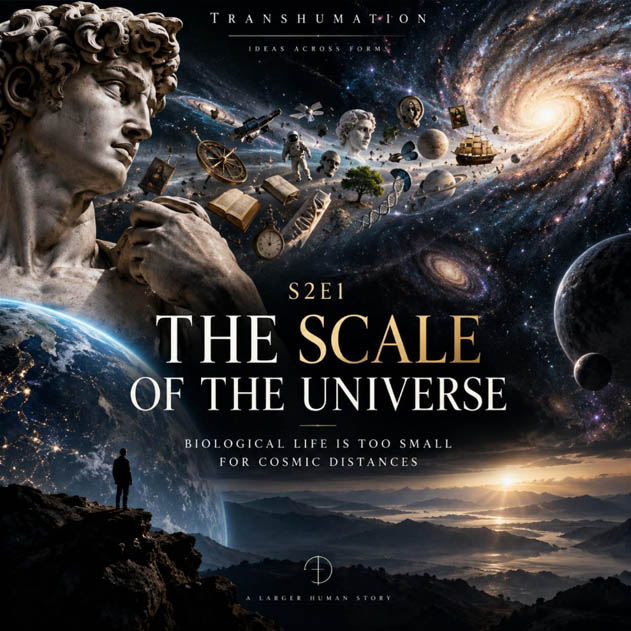
THE SCALE OF THE UNIVERSE
We were built for weather, faces, hunger and a single planet. Then consciousness discovered a universe measured in light-years. Perhaps civilization is the long attempt to make a local creature capable of participating in a reality that is not local at all.
Human beings were made for weather.
Not literally made, of course. Evolution has no architect sitting behind the clouds with a specification sheet. But the scale at which our bodies and instincts became useful is unmistakably terrestrial. We recognize a face across a room, notice a storm approaching, estimate whether a branch will hold our weight, hear anger in a voice and remember a path through familiar ground. Hunger arrives in hours. Childhood lasts years. A life usually fits inside the memory of a few overlapping generations. Even our grandest emotions tend to be organized around things close enough to touch: another person, a home, a landscape, a body that can be lost.
Then, absurdly, this local animal looked upward and discovered that almost nothing about the wider universe shares its scale.
The stars were not lights arranged conveniently above the village. They were suns. The pale band crossing the night sky was not decoration but a galaxy containing more stars than any human being could meaningfully imagine one by one. The faint smudges beyond it became other galaxies, and the distances between them became so large that ordinary language began to fail. We invented light-years because miles had become embarrassing.
The discovery did more than enlarge the map.
It created a mismatch between the scale of the organism and the scale of the reality the organism had learned to perceive.
That mismatch may be one of the defining problems of civilization.
Why Does the Universe Feel Larger Than Human Life Can Contain?
A human lifetime can feel enormous from inside. Eighty years contains childhood, boredom, desire, grief, careers, accidents, illnesses, marriages, departures and enough ordinary Tuesdays to create the illusion of permanence. Against astronomical time, however, a lifetime becomes almost indecently brief. Light itself, travelling at the fastest speed permitted by known physics, takes years to reach nearby stars and tens of thousands of years to cross the Milky Way. Entire human civilizations could rise, divide, forget their founding myths and disappear while a signal crossed only a portion of our own galaxy.
The problem is not simply that space is far away. Distance becomes time. Once that happens, almost every familiar human assumption begins to weaken. A traveller may not return. A message may reach its recipient after the sender is dead. A mission may require people to begin something whose completion belongs to descendants they will never meet. Political systems built around election cycles, companies built around quarterly results and individuals built around biological lifetimes all begin to look strangely short-term when placed against interstellar distance.
This is why the usual image of space exploration as primarily an engineering problem may be incomplete. Propulsion matters, obviously. Energy matters. Radiation matters. But even a perfect engine would not automatically solve the deeper problem of continuity. A civilization operating on cosmic scales would have to discover how intention survives its author, how memory survives generations, how identity survives replacement and how a project remains meaningful when no participant can experience its entire duration.
The universe is large enough to turn philosophy into logistics.
Did Human Beings Become Cosmic Before Their Technology Did?
Long before astronomy revealed the physical scale of the cosmos, human cultures were already psychologically unwilling to remain entirely local. They watched celestial cycles, named constellations, aligned monuments with the sky, calculated calendars and placed gods, ancestors and final destinies beyond ordinary terrestrial experience. The details differed radically among cultures, and it would be careless to pretend that ancient religion contained hidden astrophysics waiting to be translated by modern science.
It did not.
What ancient religion reveals is something else.
Human symbolic imagination routinely exceeded immediate survival.
A farmer needs to know when the rains come. He does not strictly need a theory of eternity. A village must remember its dead. It does not strictly need a cosmology explaining where the dead belong in the structure of existence. Yet again and again, cultures built frameworks that connected ordinary life to realities vastly larger than the individual.
Perhaps this is because consciousness encounters scale differently from the body. The body is trapped within its operating range, but imagination is remarkably promiscuous. It can stand beside a fire and think about the beginning of everything. It can live for seventy years and invent eternity. It can occupy one valley and imagine worlds beyond the stars.
Religion did not make humans physically cosmic.
It made cosmic participation psychologically imaginable.
That distinction becomes interesting now because technology is beginning, however primitively, to follow imagination into territory once occupied almost entirely by myth.
Is Technology a History of Biological Compensation?
One way of reading civilization is as a sequence of extensions.
Not improvements in some moral sense, and certainly not an inevitable march toward perfection. Extensions.
A wheel allows a body to move weight farther than muscle alone permits. Writing allows memory to remain after the remembering nervous system has disappeared. A ship enlarges reachable geography. A telescope gives the eye access to distances it could never resolve unaided. Radio allows voice to cross spaces no human throat can fill. Networks allow information to move without the body that produced it making the journey.
Seen this way, technology repeatedly takes a function constrained by biology and relocates part of that function into another carrier.
This should not be exaggerated. A book does not literally possess a human memory. A photograph does not preserve a person. Artificial intelligence is not simply a detachable human mind. But the structural pattern remains useful: civilization externalizes capabilities that would otherwise die at the boundary of the organism.
This is why interstellar distance makes some forms of transhumanist speculation more interesting than they appear when framed merely as fantasies of enhancement. If the problem were simply that humans wished to be cleverer, prettier or harder to kill, much of the subject could reasonably be dismissed as technological vanity. But if intelligence wants to operate in environments whose scale is radically different from the environment that produced human biology, enhancement starts looking less like ornament and more like adaptation.
A diving suit does not insult the human body.
It acknowledges that the ocean was not designed around lungs.
The universe was not designed around human lifespans either.
Does Cosmic Scale Make Non-Biological Continuity Inevitable?
This is where enthusiasm has to slow down.
The fact that cosmic distances exceed human biological scale does not prove that minds must be uploaded, that artificial intelligence will replace humanity or that consciousness can be transferred between substrates. At present, we do not know how to upload a person, and we do not know whether a sufficiently accurate digital reconstruction of someone’s memories and cognitive patterns would preserve the original observer or merely create a new system resembling them.
Structural continuity and personal continuity are not the same claim.
A civilization can solve many scale problems without abandoning biological humanity. Institutions already survive their founders. Scientific traditions pass through generations. Languages remain recognizable despite continuous replacement of speakers. Archives allow information to persist beyond individual memory. Future societies might extend these methods dramatically without requiring anyone to become software.
But cosmic scale does apply pressure.
If you want a project to survive for a thousand years, memory must become more durable than one brain. If you want decisions to operate across enormous distances, communication systems must tolerate delays that make normal conversation impossible. If you want an expedition to preserve its purpose after every original participant is dead, identity must exist at more than one level.
These pressures do not dictate a particular solution.
They tell us which kinds of things will have to become scalable.
Memory.
Coordination.
Meaning.
Possibly identity.
Perhaps consciousness itself.
The mistake would be assuming that because the pressure exists, we already know what form the adaptation will take.
We do not.
Why Does a Larger Civilization Need More Than Better Machines?
There is another danger hidden inside the language of scale.
A civilization can become larger without becoming wiser.
We already know this on a much smaller level. Modern humans can communicate across continents instantly, access libraries larger than ancient empires could have imagined and inhabit technological environments that would have looked miraculous to people living only a few centuries ago. None of this automatically produces psychological stability, moral maturity or a coherent sense of belonging.
Capability scales more easily than meaning.
That may become an even greater problem if civilization expands beyond planetary life.
The farther we move from the conditions in which human psychology evolved, the more important it becomes to distinguish technical survival from meaningful continuity. A population could remain biologically alive while losing the cultural structures that made its survival recognizable as a continuation of anything we would presently call human. Conversely, a culture could preserve enormous archives while no longer understanding why they mattered.
This is where the old religious vocabulary becomes strangely relevant again, not because religion predicted spacecraft, but because religion spent thousands of years working on a different scale problem.
How does a temporary person participate in something larger than a temporary person?
How does one life acquire meaning inside an order that exceeds it?
What can survive death?
What is worth preserving?
Those questions were once expressed through souls, heavens, ancestors, divine judgment and eternity. Future civilizations may ask some of them through archives, synthetic cognition, longevity, interstellar travel and continuity of information.
The language changes.
The pressure does not entirely disappear.
What Would Have to Survive If the Journey Lasted a Thousand Years?
Imagine a spacecraft beginning a journey whose destination lies a thousand years away.
Assume, for the sake of the thought experiment, that the engineering works.
Now ask the more difficult question.
What must arrive?
The hull obviously does not need to be original. Components can be replaced. The passengers may be descendants of descendants. Languages may evolve. Political institutions may change. The mission itself may be reinterpreted several times.
At what point does the arriving civilization cease to be the civilization that departed?
This resembles the Ship of Theseus, except the ship now contains people who are also being replaced.
Perhaps genetic continuity matters.
Perhaps memory matters more.
Perhaps the preservation of a shared project is sufficient.
Perhaps none of these individually is enough.
The question becomes even sharper with digital forms of continuity. Suppose the travellers carry extremely detailed simulations or reconstructions of people who died centuries earlier. Those systems might preserve voices, habits, memories and styles of reasoning. They could become extraordinary carriers of cultural information.
But something of a person surviving is not automatically the same as the person surviving.
That distinction matters because cosmic ambition can easily turn continuity into a slogan.
The universe is large enough to make us desperate for persistence.
Desperation does not settle ontology.
Why Did Immortality Appear Before Spaceflight?
It is tempting to explain humanity’s fascination with immortality entirely through fear of death.
Fear obviously matters.
But there may be another layer.
Human consciousness is capable of conceiving structures much larger than the period for which one consciousness remains available to experience them. We can understand that civilizations last longer than citizens, that stars outlive nations and that the consequences of actions can extend beyond the actor’s death.
That creates a peculiar tension.
The mind can see farther than the organism can travel.
Religion often answered by placing the observer inside a structure larger than biological life. An immortal soul, resurrection, reincarnation or participation in an eternal order all solve the scale mismatch in different symbolic ways. The finite life becomes locally brief but cosmically connected.
Science does not confirm those theological claims.
But science dramatically enlarges the scale mismatch that made such claims psychologically powerful.
We now know with far greater precision just how little of cosmic time one human life occupies.
Technology then arrives with another set of promises: longevity, external memory, artificial agents, increasingly persistent digital traces and, in speculative form, mind uploading.
These should not be confused with religious immortality.
But it is difficult not to notice that civilization repeatedly returns to the same wound.
The mind understands continuation.
The body stops.
Can Consciousness Become Large Enough Without Losing Its Human Scale?
Perhaps this is the real danger.
Not that human beings remain too small for the universe.
That they succeed in becoming larger and lose the scale on which meaning originally worked.
Human life is not meaningful because it contains the maximum possible amount of information. Much of its value arises from local things: one face rather than every face, one child rather than humanity in the abstract, one room, one voice, one person’s absence. Scale can expand capability while weakening intimacy.
A civilization capable of preserving memory for ten thousand years would still need to know why any particular memory matters.
A distributed intelligence spanning planets would still face some version of the problem of attention.
An immortal consciousness, if such a thing were possible, would eventually confront questions that mortality currently answers for us by force: what deserves time when time is no longer scarce?
This is why becoming technologically compatible with cosmic scale cannot simply mean becoming more cosmic.
Something local must remain.
Not necessarily the present biological body in every detail.
But some capacity for attachment, distinction, curiosity, care and finite significance.
Otherwise the civilization may finally become large enough for the universe and discover that it no longer knows why it wanted to enter it.
The Universe Was Never Human-Sized
Perhaps the most difficult thing astronomy taught us was not that Earth is small.
It was that reality has no obligation to match the scale at which human intuition works comfortably.
We emerged locally.
We think beyond locality.
Civilization exists somewhere between those two facts.
Every telescope, archive, spacecraft and communications network extends the radius within which human intention can operate. Artificial intelligence may eventually become another such extension. Longevity technologies may add others. Perhaps one day forms of continuity we cannot yet describe will emerge.
But the goal cannot simply be expansion.
Transhumation becomes interesting precisely where ordinary transhumanism can become shallow: at the point where increased capability stops answering the question.
Suppose consciousness becomes faster.
Suppose memory becomes enormous.
Suppose bodies become optional.
Suppose distance becomes negotiable.
Then what?
The universe offers no guarantee that greater scale produces greater significance.
Meaning remains something intelligence has to build.
Perhaps that is why an animal evolved for weather keeps looking at the stars.
Not because the stars were waiting for us.
Because consciousness discovered a reality larger than itself and, ever since, has been trying to decide whether becoming large enough to enter it would still leave something worth calling human.
Want to Know More?
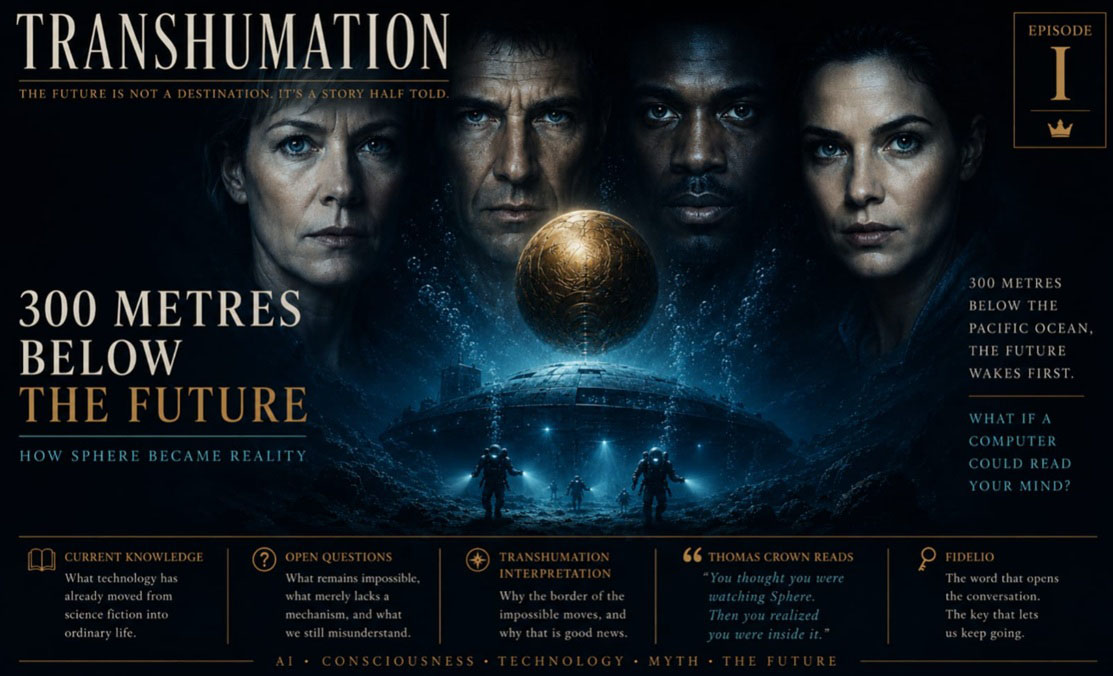
Current Knowledge
The observable universe operates across spatial and temporal scales far beyond ordinary biological experience. Even the nearest stars are separated from Earth by several light-years, while the Milky Way spans roughly one hundred thousand light-years. Under known physics, these distances impose severe constraints on travel, communication and coordination, regardless of future engineering improvements.
Human civilization already uses external systems to extend functions that would otherwise remain limited by individual biology. Writing and digital storage preserve information beyond a single lifetime; telecommunications allow communication without physical proximity; computation performs some forms of information processing at scales inaccessible to unaided human cognition. These are genuine extensions of function, although they should not be confused with extensions of subjective consciousness itself.
There is currently no demonstrated technology for transferring personal consciousness to a non-biological substrate, nor is there scientific agreement that reproducing the informational structure of a mind would preserve the original individual’s subjective identity. Artificial intelligence can extend or automate particular cognitive tasks without establishing that human consciousness has migrated into the system.
The scientific case is therefore modest but significant. Human biology evolved under terrestrial conditions, while human knowledge now encompasses physical scales radically larger than those conditions. Technology can compensate for some biological limitations, but we do not yet know whether genuinely interstellar civilization would require fundamental changes to human consciousness, social organization or identity.
Open Questions
The first question is whether biological limitation truly becomes incompatible with cosmic participation. Human beings may never need to cross the galaxy personally; robotic systems, long-lived institutions or multigenerational communities could potentially extend civilization without requiring radical alteration of human consciousness. Cosmic scale creates pressure, but pressure does not determine one solution.
A second problem concerns continuity. If a civilization persists while its members, languages, technologies and institutions are repeatedly replaced, what exactly makes it the same civilization? Similar questions apply at the personal level to hypothetical digital copies or reconstructions. Preserved information may establish continuity of pattern without establishing continuity of the observer.
There is also the psychological question. Human meaning appears deeply tied to relationships, embodiment, limited attention and finite time. It is unclear how those structures would change in radically extended lives or distributed forms of cognition. More memory, more time and greater intelligence may create possibilities while also removing constraints that currently organize human value.
The deepest question may therefore be whether intelligence can adapt to cosmic scale while retaining a meaningful local scale. A civilization large enough to cross the stars would still need reasons to care about something smaller than the stars.
Transhumation Interpretation
Transhumation does not assume that biology is a mistake waiting to be corrected. Biology is the carrier that produced the observer capable of discovering the scale problem in the first place.
But carriers have limits.
Human civilization already survives partly by moving memory, knowledge and structure beyond individual bodies. Cosmic distance may eventually require this tendency to go further.
The test is not whether humanity can become more powerful.
It is whether continuity can expand without becoming empty.
Perhaps the future asks us to become large enough for the universe while preserving the capacity to care about one small thing inside it.
FAQ
Why is biological life poorly suited to cosmic distances?
Human lifespans and bodies operate on planetary scales, while interstellar distances involve years, centuries or longer periods of travel and communication.
Does cosmic scale prove humans must become non-biological?
No. It establishes a problem of scale, not one inevitable solution. Biological humans, artificial systems, institutions and multigenerational communities could address different parts of the problem.
Is AI already an extension of human consciousness?
No. AI can extend certain cognitive capabilities, but that is different from demonstrating that human subjective consciousness exists inside an artificial system.
Did ancient religions anticipate modern space science?
There is no evidence that ancient religions contained hidden modern astrophysics. What they did provide were symbolic frameworks connecting finite human lives to realities imagined as larger than the individual.
Could mind uploading make interstellar travel easier?
In principle, non-biological information systems might tolerate long journeys differently from human bodies, but mind uploading remains hypothetical, and the identity problem would remain even if accurate cognitive copying became possible.
What is Author’s deeper question here?
If the universe forces intelligence to operate at scales larger than the human organism, can consciousness expand its duration, memory and reach without losing the small-scale attachments that originally made existence meaningful?
Continue the Transhumation Series
- Forgotten Religion | Ancient Gods, Symbols and the Hidden Structures of Human Civilization
- The Last Religion | Death, Immortality and the Future of Humanity
- The New Theurgy | AI, Information and the Future of Human Civilization
- End of Branding: You Were Never Meant to Become a Product
- Baal vs Ishtar: Why Ancient Gods Never Disappeared