
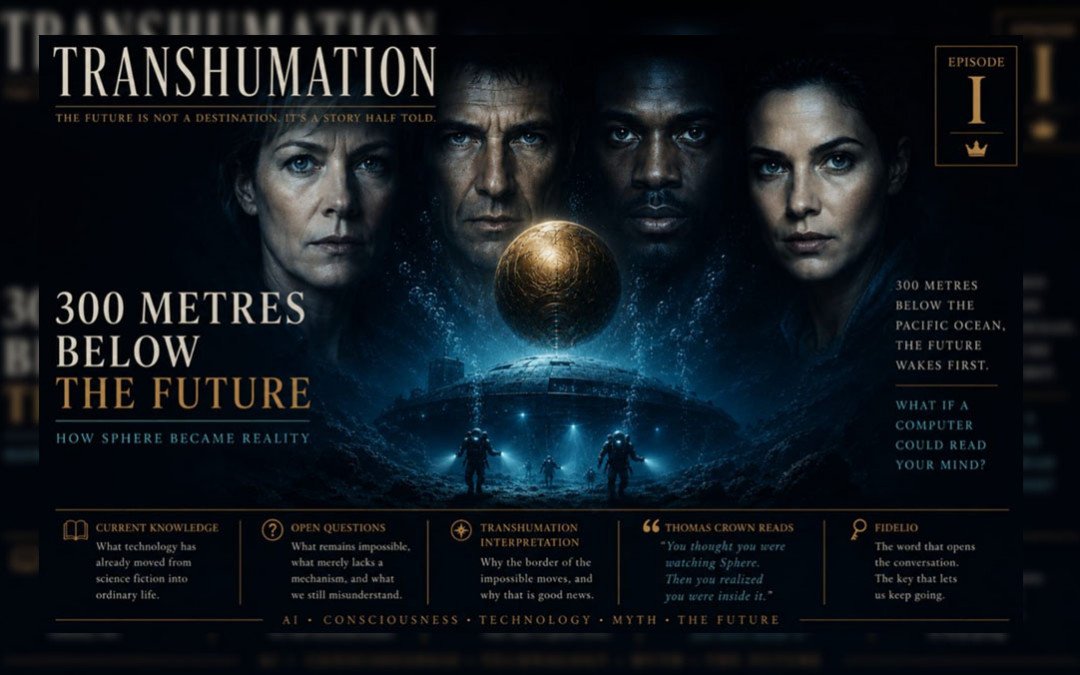
300 Metres Below the Future
Imagine waking three hundred metres beneath the Pacific Ocean. There is no horizon here, no sunrise and almost nothing in the environment that acknowledges the fact that human beings were ever supposed to visit. Beyond the windows lies pressure capable of crushing an unprotected body, darkness interrupted by artificial light and, resting improbably on the seabed, a spacecraft that seems to have arrived from the future. Somewhere inside it, behind corridors built by people who may not yet have been born, a scientific team discovers a perfectly smooth golden sphere. It has no visible controls, no instruction manual and no obvious entrance. It looks less like a machine than an object that has somehow escaped from mythology.
Fortunately, you are not actually there. You are sitting in a cinema in 1998 watching Barry Levinson’s adaptation of Michael Crichton’s Sphere. The distinction matters because everything still belongs comfortably on the correct side of the border. A spacecraft from the future is science fiction. A mysterious object apparently capable of interacting with the human mind is science fiction. A group of frightened scientists staring at technology they cannot understand is exactly where the audience expects to find them. Then something happens that once fitted naturally among all those impossibilities: words appear on a computer screen, and something begins answering the humans.
The characters call it Jerry. They wonder whether it understands them, whether it has emotions, whether it might become angry and whether the personality emerging through the monitor belongs to something genuinely conscious or merely appears to. The scene once carried the atmosphere of first contact.
Twenty-eight years later, it may be the most ordinary part of the film.
That is when Sphere becomes strange again.
The Miracle That Became an Office Tool
Technological progress has a talent for destroying its own mythology. A successful miracle rarely remains a miracle for long. The first time a touchscreen responds directly to a finger, the gesture feels like evidence that the future has arrived ahead of schedule. A few years later, the same gesture dismisses an advertisement. Satellite navigation once belonged to military infrastructure and expensive machinery; now people become irritated when it takes three seconds to find a restaurant. A device capable of filming in high resolution, recognizing a face, translating languages and connecting instantly to another continent spends much of its life being blamed for interrupting dinner.
The extraordinary does not disappear. It becomes habitual.
This may be why old science-fiction films sometimes recover their power in unexpected ways. We normally expect them to age by becoming less convincing. Buttons look too large, displays too primitive, spacecraft too obviously designed according to the decade in which the film was made. Forbidden Planet can still be magnificent while carrying an unmistakable archaeological layer of 1950s assumptions about what advanced technology would look like. The future often ages faster than the story.
Sphere does something more peculiar. Much of its technology still feels close enough to our own visual language that the film has not become an antique. The underwater habitat, screens, communications equipment and remote observation do not demand much imaginative charity. But the real surprise lies in the psychological distance. Dustin Hoffman can look at a sentence generated by an unknown intelligence with the expression appropriate to a miracle, while the modern viewer may be watching him on one screen and conversing naturally with an AI system on another.
The technology has not merely caught up with part of the scene.
It has made the astonishment look historical.
And perhaps that is the part worth preserving, because familiarity is extremely bad at remembering what wonder felt like before it became compulsory software at work.
The Spell Inside the Sphere
Then Sphere gives us something even better than a prediction. It gives us a piece of magic that can be inspected.
The numerical messages appearing in the story are not merely random digits placed on a monitor to suggest mathematical complexity. They are intended to follow a defined system in which letters correspond to positions derived from a keyboard imagined across a spherical arrangement. What initially looks like an incomprehensible wall of numbers therefore contains an actual mechanism. Someone designed a key. The spell has grammar.
That detail changes the pleasure of watching the film today. In 1998, most viewers had little practical reason to stop the scene and reconstruct the cipher unless they already possessed the relevant curiosity and technical ability. The scientist on screen discovered the pattern; the audience followed him through the door. Numbers functioned partly as theatrical authority. They told us that something complicated was happening somewhere behind the story.
Today the distance between noticing something suspicious and testing it can collapse almost instantly. A viewer can freeze the frame, photograph the numerical sequence, show it to an AI system, explain the spherical-keyboard premise and ask whether the mapping is internally consistent. The machine may be wrong and still require checking, but the important change has already occurred: the mechanism is available for interrogation.
That becomes particularly interesting when the film moves from Jerry to Harry. Norman eventually realizes that the name the team has decoded may have been wrong. Dramatically, the revelation works beautifully. Structurally, however, the cipher becomes less obedient. If a numerical relationship has been decoded incorrectly, changing that relationship should affect other places where the same symbols occur. A rule cannot conveniently mean one thing when spelling HELLO and another when the plot needs HARRY without requiring further explanation.
For years, the sequence could remain inside the protected category of movie mathematics. Scientists see a pattern, numbers rearrange themselves, revelation follows.
Now the viewer can knock on the mechanism.
Sometimes it sounds hollow.
That is a very modern kind of magic. The computer inside Sphere helped create the illusion. A computer outside Sphere can help dismantle it.
Where Does the Fiction Actually Begin?
Once that happens, a much better question appears than whether Crichton “predicted ChatGPT.” Prediction hunting is usually superficial. Fiction contains thousands of speculative objects, and eventually some of them will resemble later technologies. A videophone appearing in an old film is interesting, but resemblance alone tells us little about the deeper structure of change.
The more useful experiment is to ask: how far into Sphere can we travel before we finally reach something that still requires science fiction?
The deep ocean itself is no longer enough. Humans operate at extraordinary depths using specialized vessels, remotely operated systems and sophisticated sensing equipment. A convincing perceptual descent into inaccessible environments can be simulated with virtual reality. Digital systems coordinate cameras, environmental data and communications in ways that would have appeared remarkable to earlier audiences. Natural-language conversation with a computer has moved beyond laboratory demonstration into consumer technology, and arguments over whether such systems understand, intend, simulate or experience anything are no longer confined to philosophers or screenwriters.
None of this gives us the golden sphere. There is no known object capable of turning unconscious fears into independent physical events, and nothing about modern AI provides evidence that matter will someday obey imagination in the way Crichton’s story requires. The spacecraft from humanity’s own future remains fiction as well. The crucial point is therefore not that Sphere has come true.
It is that the border between reality and Sphere no longer sits conveniently outside the film.
It passes through it.
Some scenes remain impossible. Some have become ordinary. Others occupy the far more interesting territory in between, where the function has arrived but the form is different. We did not find a golden sphere containing an intelligence at the bottom of the Pacific. We built screens through which we can address artificial systems using ordinary language and receive answers convincing enough to provoke many of the same questions the characters ask Jerry.
The mythology migrated.
The carrier changed.
Why Halfway May Be Better Than Arrival
There is a temptation to treat this as a countdown. If conversational AI moved from science fiction to ordinary life in a few decades, perhaps consciousness, radical life extension, mind uploading and everything else will simply follow. That is precisely the conclusion Transhumation should resist.
History is not a screenplay, and technology does not advance by completing a list of imaginative promises in order. Many ideas once described as inevitable never arrived. Others appeared in forms so different from prediction that we barely recognize the ancestry. Physical limits matter. Economics matters. Regulation, culture, accidents and human desire matter. The existence of the first half tells us very little with certainty about the ending.
But it does tell us something about certainty itself.
The statement “that is science fiction” is weaker than it sounds.
Science fiction is not evidence that something will happen, but neither is belonging to science fiction evidence that it cannot. The category describes our present relationship to an idea, not necessarily the idea’s permanent relationship to reality. Once that distinction becomes visible, our position becomes much more interesting than either optimism or skepticism.
We have enough fulfilled impossibility behind us to know how provincial certainty can become. We have enough impossible territory ahead to remain cautious.
That is exactly the middle of a good adventure.
The coastline on the old map begins matching the land beneath our feet. A few landmarks are unmistakable. Beyond them, the drawing becomes speculative, then blank. We can no longer pretend the entire map was fantasy, but we would be equally foolish to assume the blank space contains exactly what the illustrator imagined.
The most beautiful part is that we still have somewhere to go.
You Wanted to See It Again for the First Time
There is a particular sadness attached to favourite films. After enough years, you know the corridors. You know which door will open. You know when the music changes and what the characters are about to discover. People sometimes express the impossible wish to erase a story from memory simply so they could experience its uncertainty again.
Sphere offers a strange exception.
The film can remain unchanged while the world around it moves far enough that the story becomes unfamiliar for a second time.
A viewer in 1998 encounters a group of scientists speaking to a mysterious intelligence through a computer. The scene belongs beside an impossible spacecraft and a golden object hidden beneath the ocean. A viewer in 2026 can stop that same scene, photograph the code, give it to an artificial intelligence, discuss the logic of the decoding and return to the film with information unavailable to the original audience.
The film did not become more futuristic.
The observer moved toward it.
This is the part of Sphere that matters most to Transhumation. Not that Crichton somehow knew our future, but that an object of fiction can survive long enough for reality to approach it from the other side. The distance between audience and story changes, and suddenly scenes we thought we understood acquire a second meaning.
The golden sphere still waits at the bottom.
We have not entered it.
We do not know what would be on the other side if we ever could.
But the strange machine through which humans address an intelligence, receive answers, doubt those answers and ask what exactly is speaking back no longer belongs exclusively to the adventure.
Perhaps that is why the old film has not ended.
You only thought you had seen the second half.
Look at the screen beside you.
We are already halfway through the film.
Watch the Video
How to Read the World
Current Knowledge
Michael Crichton published Sphere in 1987, and Barry Levinson’s film adaptation was released in 1998. The story combines deep-ocean exploration with a spacecraft apparently originating in the future, a mysterious golden sphere and computer-mediated communication with an intelligence that the characters initially misunderstand. Conversational computing itself predates the novel: systems such as ELIZA demonstrated limited text dialogue decades earlier, although current large language models operate at a vastly different scale and level of linguistic flexibility.
Modern underwater technology includes crewed submersibles, remotely operated vehicles, sophisticated sensing and communications systems. Consumer virtual reality can also simulate forms of environmental immersion that once required specialized cinematic or laboratory settings. Contemporary AI systems allow broad natural-language interaction and multimodal analysis, but there is no evidence that they possess the fictional sphere’s ability to transform unconscious mental content into physical reality.
The numerical code portrayed in Sphere uses an intended decoding structure rather than functioning solely as meaningless visual decoration. Its implementation contains inconsistencies, particularly when later plot revelations require parts of the earlier interpretation to change. This makes the cipher useful as an example of a fictional mechanism that can now be inspected rather than merely accepted as cinematic complexity.
Open Questions
How much of what a civilization calls impossible reflects genuine physical limitation, and how much reflects the absence of a known mechanism? History alone cannot answer this, because it contains both astonishing technical successes and confident predictions that failed completely.
AI introduces another uncertainty. Tools that dramatically lower the cost of investigating technical questions may empower non-specialists to detect inconsistencies they previously could not test. The same tools can also generate persuasive errors. Does easier access to explanation create a better-informed observer, or simply a more confident one?
And if part of Sphere moved from speculative atmosphere into ordinary experience within a few decades, which features of our own technological world will appear equally primitive to someone watching it forty years from now?
Transhumation Interpretation
Transhumation does not claim that the golden sphere is inevitable or that the remaining science fiction in Sphere constitutes a forecast.
The more durable pattern is the migration of a function between carriers.
What once required the visual language of an alien encounter—a human addressing an unknown intelligence through a machine—can now occur through an ordinary consumer interface. The form is radically different. The underlying question survived: what exactly is on the other side of the conversation?
This is one reason Transhumation treats the present not as the beginning or conclusion of technological transformation, but as a point inside it. Successful impossibilities tend to disappear into normality. Once they work reliably, civilization stops seeing them as evidence of how far the boundary moved.
A miracle becomes a product.
A product becomes a habit.
The habit makes the next miracle look impossible again.
Perhaps the task is therefore not to predict the ending.
It is to remember where the film began.
FAQ
Did Sphere predict ChatGPT?
Not literally. Conversational software existed before Crichton wrote the novel, and modern language models operate very differently from the intelligence portrayed in Sphere. The interesting change is cultural: sustained natural-language conversation with a computer has moved from a science-fiction atmosphere into ordinary consumer technology.
Is the code in Sphere real or just random numbers?
The film uses an intended numerical mapping rather than completely random decoration. The code can be partially reconstructed according to the fictional system, although the displayed sequences contain inconsistencies.
Is the Jerry/Harry revelation mathematically consistent?
Not completely. The plot twist works dramatically, but applying a consistent substitution or mapping rule creates problems elsewhere in the decoded messages. The cinematic mechanism is stronger than the cryptographic one.
Could modern technology create the golden sphere?
No known technology can reproduce the sphere’s central fictional ability to manifest unconscious mental content physically. AI, virtual reality and neural-interface research resemble limited pieces of the broader interface structure, not the sphere itself.
Why is Sphere important to Transhumation?
Because it allows us to observe the movement of the boundary between fiction and normality. The film contains both functions that now have ordinary real-world counterparts and mysteries that remain untouched, placing the contemporary viewer in an unusually revealing halfway position.
Continue the Transhumation Series
- Forgotten Religion | Ancient Gods, Symbols and the Hidden Structures of Human Civilization
- The Last Religion | Death, Immortality and the Future of Humanity
- The New Theurgy | AI, Information and the Future of Human Civilization
- End of Branding: You Were Never Meant to Become a Product
- Baal vs Ishtar: Why Ancient Gods Never Disappeared