
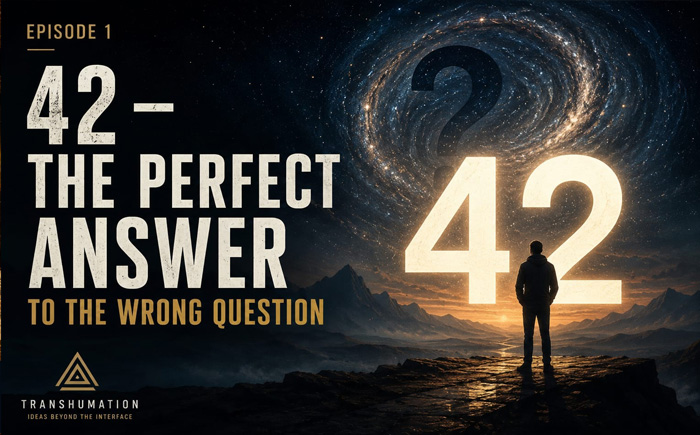
42 — The Answer That Arrived Too Early
Douglas Adams made the universe answer humanity’s greatest question. The joke was that humanity was not ready to understand the reply.
Imagine that after several thousand years of religion, mathematics, philosophy and science, humanity finally succeeds. Somewhere inside a laboratory, perhaps beneath an ordinary office building, a machine finishes the calculation for which generations have been waiting. The screens go dark. The technicians stop talking. A printer begins to move, and from it comes a single sheet of paper containing the answer to the oldest question we know how to ask: the meaning of life, the universe and everything.
The number printed on the page is 42.
There would probably be a few seconds of silence before someone asked the obvious question: What does that mean? Douglas Adams built one of the great jokes of modern literature around precisely this failure. In The Hitchhiker’s Guide to the Galaxy, the supercomputer Deep Thought spends millions of years calculating the Answer to the Ultimate Question of Life, the Universe, and Everything, only to announce that the answer is forty-two. The difficulty, Deep Thought explains, is not the answer. The difficulty is that nobody actually understands the question.
The comedy survives because the situation is absurd. But beneath it sits a surprisingly serious possibility. Perhaps the most important truths would not necessarily look important when first encountered. Perhaps an answer could be perfectly correct and almost completely useless because the civilization receiving it lacked the structure required to understand what had just been said.
The Answer Is Not the Understanding
Modern civilization has become extraordinarily efficient at obtaining answers. A person who once needed access to a university library can now retrieve papers while sitting on a train. Search engines locate obscure facts in seconds. Databases store more material than anyone could read in several lifetimes, and artificial intelligence can compare, summarize and reorganize enormous bodies of knowledge before a human researcher has finished making coffee. We have built machines of unprecedented informational abundance.
Yet information and understanding have never been the same thing. Knowing that the Earth travels around the Sun is easy today; arriving at a civilization in which that statement can be understood is not. The sentence occupies a few words, but behind it stand centuries of observation, geometry, astronomy, improved instruments, abandoned cosmologies and intellectual battles. What looks simple at the end of an inquiry may contain an immense amount of compressed history.
This is one reason sophisticated knowledge can become deceptive when presented without its path. A person can memorize an equation without understanding the physical world described by it. A tourist can stand before a cathedral and see stone where an architect sees load, proportion, ritual, politics, money and engineering. A child learning music hears notes individually; a trained musician begins to hear relationships between them. The sensory information may be nearly identical. What changes is the structure receiving it.
The answer has not become richer. The observer has.
Simple Things Can Contain Long Journeys
We tend to associate profundity with difficulty. Serious ideas, we imagine, should arrive wrapped in technical vocabulary and pages of explanation. But mature understanding often travels in the opposite direction. Once a pattern has been understood deeply enough, complexity can sometimes be expressed with startling economy. A scientific principle may be summarized in a few lines. A mathematical relationship may fit into a small equation. A proverb may preserve generations of social experience in one sentence.
Simplicity, then, is not necessarily the opposite of depth. It can be the result of depth. Compression is only possible after someone has discovered what can safely be removed.
The distinction matters because compressed knowledge can look trivial to anyone who does not possess the context needed to unpack it. A short piece of notation on a blackboard may represent years of study. A chess position that appears almost empty to a beginner may tell a grandmaster that the game is essentially over. A single archaeological fragment may be meaningless to a passer-by and revolutionary to someone who knows precisely where it was found and what should have been there instead.
The difficulty is not always discovering more information. Sometimes it is learning to see more inside less.
The Sentence Stayed the Same
Anyone who has learned another language has experienced this transformation in miniature. Early on, a simple sentence arrives in fragments. Vocabulary must be retrieved deliberately; grammar becomes machinery; pronunciation competes for attention with meaning. Years later, the same sentence passes directly into understanding. Nothing in the sentence has changed. The transformation has occurred inside the listener.
The same phenomenon appears across civilization. Symbols acquire meaning because they enter structures that already contain other symbols. A number may represent a quantity, a date, an address, a joke, a measurement or a warning. Three letters can mean nothing to one person and identify an institution, a diagnosis or a lost friend to another. Meaning does not sit entirely inside an isolated object waiting to be extracted. It emerges from relationships.
This is the useful intuition behind the Library of Mirrors. A library is not completed when a book is placed on a shelf. The physical object can survive for centuries while its meaning disappears if nobody remains capable of reading its language, recognizing its references or reconstructing the intellectual world that produced it. Preservation keeps information available. Interpretation brings it back to life.
A library therefore exists for readers, not for books.
The Wrong Question Problem
This is where Adams’s joke becomes unexpectedly contemporary. Artificial intelligence will almost certainly make answers cheaper. The difficult resource may increasingly become the question.
A system can process enormous quantities of information and still be asked to optimize something foolish. A government can collect accurate statistics and misunderstand the society represented by them. A company can maximize a measurable target until the target becomes detached from the reason it was created. A civilization can become dramatically more efficient without ever establishing what the efficiency is supposed to serve.
As machines become better at producing plausible, useful and eventually perhaps extraordinarily sophisticated answers, the temptation will be to treat intelligence as an answer factory. But questions contain assumptions. Ask how to maximize engagement and you have already decided that engagement is worth maximizing. Ask how to make people more productive and you have quietly selected productivity as the relevant measure. Ask how to preserve human beings indefinitely and you have not yet answered what exactly about a human being deserves preservation.
The most dangerous answer may therefore not be false. It may be perfectly correct within the boundaries of a badly constructed question.
That problem is older than artificial intelligence, but AI may expose it with unusual clarity. A machine capable of answering almost anything would force us to confront a possibility that was easier to ignore when answers were scarce: perhaps civilization’s bottleneck was never information alone. Perhaps it was judgment.
Civilization as a Compression Machine
The great achievements of knowledge usually do not consist merely of accumulating facts. They reorganize facts. A useful theory takes observations that previously seemed unrelated and reveals that they belong to the same underlying structure. Once that structure is visible, enormous quantities of information can suddenly be understood through a smaller set of principles.
That is why knowledge often behaves like compression. The goal is not to delete complexity but to find the pattern that makes complexity navigable. A map is useful because it removes most of the world while preserving relationships necessary for orientation. A scientific theory is powerful because it can explain many events without describing every event separately. A good historical interpretation can connect institutions, technologies and beliefs that previously looked like isolated curiosities.
Civilization itself may be understood this way. We inherit millions of individual experiences and gradually compress some of them into laws, rituals, myths, formulas, institutions and stories. The process is imperfect and sometimes destructive; compression always risks removing something important. But without it, each generation would have to reconstruct the world from zero.
The library preserves the material. The reader rebuilds the pattern.
Watch the Video
How to Read the World
Current Knowledge
Douglas Adams did not present 42 as a hidden scientific code requiring decoding. Within the novel, its humor comes precisely from the mismatch between the grandeur of the question and the banality of the answer. The later cultural fascination with finding secret mathematical explanations for forty-two is therefore best understood as part of the joke’s afterlife rather than evidence that Adams encoded a literal theory of the universe.
Cognitive science and education research nevertheless support the broader distinction between possession of information and understanding. Expertise changes the way people organize information, recognize patterns and connect new material with prior knowledge. Experts do not simply remember more isolated facts; they tend to arrange those facts into structures that allow faster interpretation. Artificial intelligence adds another layer to the problem because contemporary systems can generate answers whose usefulness still depends on human goals, framing, verification and interpretation.
There is no established scientific reason to believe that the universe possesses one final answer expressible as a number. The philosophical importance of 42 lies elsewhere: it dramatizes the difference between receiving an output and knowing what kind of world would make that output meaningful.
Open Questions
If intelligence continues to become cheaper, will asking good questions become more valuable than producing answers? Could an advanced civilization possess correct descriptions of reality that remain unintelligible to most of its members? Are there concepts that humanity cannot currently understand for the same reason a child cannot understand advanced mathematics—not because the information is unavailable, but because the necessary mental structures have not yet developed?
There is also a harder possibility. Perhaps some truths require more than intellectual preparation. Moral ideas can be understood linguistically long before they are embodied socially. A civilization may know that an action is destructive and continue doing it. We may therefore need to distinguish between knowing an answer, understanding an answer and becoming capable of living according to it.
The difference between those stages may be larger than we usually admit.
Transhumation Interpretation
Transhumation treats the joke of 42 not as evidence that there is a secret number behind reality, but as a miniature model of civilization’s relationship with meaning. Information can arrive before the mind capable of interpreting it. A structure can exist before a language has been developed to describe it. An answer can be present while remaining functionally invisible.
This is why the Library of Mirrors matters. Books, archives, religions, scientific theories and artificial intelligence are not simply containers that carry civilization forward. They are interfaces between structures and observers. The information stored inside them becomes culturally alive only when another mind can reconstruct enough of the surrounding pattern to make it meaningful.
The future may therefore depend less on building the machine that finally produces the answer than on building a civilization capable of recognizing an answer when it sees one.
Perhaps one day the deepest description of reality will fit on a single page. Perhaps it will be an equation, a diagram, a sentence or something so simple that the first reaction will be disappointment. Humanity may stare at it exactly as Adams imagined, wondering whether the universe has played a joke on us.
And perhaps, after another thousand years, someone will look at the same page and wonder how we could ever have failed to understand it.
FAQ
Why is 42 the answer to life, the universe and everything?
In The Hitchhiker’s Guide to the Galaxy, 42 is the answer calculated by the supercomputer Deep Thought. The joke is that civilization possesses the answer but has lost—or never properly formulated—the Ultimate Question required to understand it.
Did Douglas Adams hide a real mathematical meaning inside 42?
There is no strong evidence that 42 was intended as a secret cosmological code. Adams repeatedly treated the choice as a joke. The philosophical usefulness of the number comes from what the joke allows us to examine, not from numerology surrounding the number itself.
Why can a simple answer contain a complicated idea?
Because mature understanding often compresses many observations into a smaller structure. The final equation, sentence or principle may be concise even though discovering and understanding it required generations of work.
Does having more information produce more knowledge?
Not automatically. Information must be organized, compared and placed into context. A database can contain vast amounts of accurate information without possessing the human understanding associated with knowing why those facts matter.
What does this have to do with artificial intelligence?
AI dramatically lowers the cost of producing and retrieving answers. That makes the quality of human questions, goals and interpretation increasingly important. A highly capable system can still generate excellent solutions to poorly chosen problems.
What is the Library of Mirrors?
It is the Transhumation idea that libraries, books, archives, culture and AI do more than store information. They become meaningful through interaction with an observer capable of interpreting them. The library preserves the mirror; the reader makes the reflection appear.
What is the main idea?
The answer and the capacity to understand the answer are two different achievements. Civilization may eventually discover truths that appear simple precisely because enormous complexity has already been compressed inside them.
Forty-two is funny because it looks like nothing.
Its deeper lesson is that perhaps, without the right question, every final answer would.
Continue the Transhumation Series
- Forgotten Religion | Ancient Gods, Symbols and the Hidden Structures of Human Civilization
- The Last Religion | Death, Immortality and the Future of Humanity
- The New Theurgy | AI, Information and the Future of Human Civilization
- End of Branding: You Were Never Meant to Become a Product
- Baal vs Ishtar: Why Ancient Gods Never Disappeared