
Forgotten Religion
In the Louvre there is a black stone taller than a man. At first it looks less like a religious object than something recovered from a shipwreck: dark, polished, covered with lines of tiny marks. Near its summit, however, two figures face one another. One is a king. The other is a god.
The stone is the famous stele of Hammurabi, carved nearly four thousand years ago. Above the laws governing debts, wages, marriage, property, injury and punishment, Hammurabi stands before Shamash, the Mesopotamian god associated with justice. The arrangement is easy for a modern visitor to overlook. We come for the code; the god seems like decoration. Yet to the people who made the monument, separating the two may have missed the point. The rules governing ordinary human life were being connected visually to an order larger than the king who enforced them.
Walk farther through history and the costumes change with bewildering speed. Egypt gives us Osiris and Isis; Greece, Zeus and Athena; Rome, Jupiter and Janus; Mesopotamia, Ishtar and Marduk; Scandinavia, Odin and Thor. Gods acquire animal heads, thunderbolts, keys, hammers, wings, multiple faces and impossible genealogies. Some die. Some marry. Some rule the sea or guard a doorway. Some become patrons of cities and empires.
The obvious conclusion is that human beings invented an astonishing number of supernatural characters.
But there is another way to enter the museum.
Ignore the characters for a moment and look at what they were doing.
The Museum With the Labels Removed
Imagine removing the names from a collection of ancient gods. No Zeus, no Hekate, no Ishtar, no Janus. Remove the marble and bronze as well. Keep only the relationships.
Something curious survives.
There are figures associated with boundaries and transitions, figures attached to fertility and death, figures representing political authority, war, justice, fate, storms, knowledge, the household, the harvest and the dangerous passage between one condition and another. Their mythologies differ enormously, and there is no reason to flatten them into a single universal religion. Yet civilizations repeatedly attached humanly comprehensible personalities, stories and rituals to forces that were otherwise difficult to see as a whole.
That persistence deserves more than the old caricature in which frightened people hear thunder, fail to understand electricity and invent a thunder god.
Certainly, religion has often supplied explanations for natural phenomena. But that cannot by itself explain the scale of the institution that followed. People did not merely tell stories about lightning. They built temples, organized calendars, endowed priesthoods, regulated sacrifices, legitimized rulers, buried their dead according to elaborate systems and carried sacred images across empires. Religion became entangled with law, kinship, agriculture, political authority, architecture and the measurement of time.
A mistake about weather should not need a civilization to maintain it.
Something larger was happening.
The interesting question, then, is not initially whether Zeus actually threw thunderbolts or whether Osiris ruled a literal kingdom of the dead. It is what problem these figures allowed human beings to handle. If the names disappear while the function keeps returning, perhaps the durable object is not the god.
Perhaps it is the structure underneath him.
The Problem of Things Too Large to See
A human being is remarkably good at understanding another human being. We recognize faces, intentions, rivalries, promises and betrayals almost instinctively. What we are considerably worse at understanding are systems containing thousands or millions of interacting parts.
No Roman citizen could hold Rome in his mind.
He could know his street, his family, his trade, perhaps his patron and the local magistrate. But Rome itself was ports, roads, grain shipments, taxation, armies, provincial governors, laws, cults, currencies and millions of people stretching across territories most citizens would never visit. The empire was real, enormously powerful and almost entirely invisible from the scale of an individual life.
We still live inside things of this kind. Nobody sees “the economy.” We see a price increase, a mortgage payment, an empty shop. Nobody sees “the internet.” We see a screen. Nobody encounters “the state” as a complete physical object. We encounter a passport, a police officer, a tax form or a courthouse.
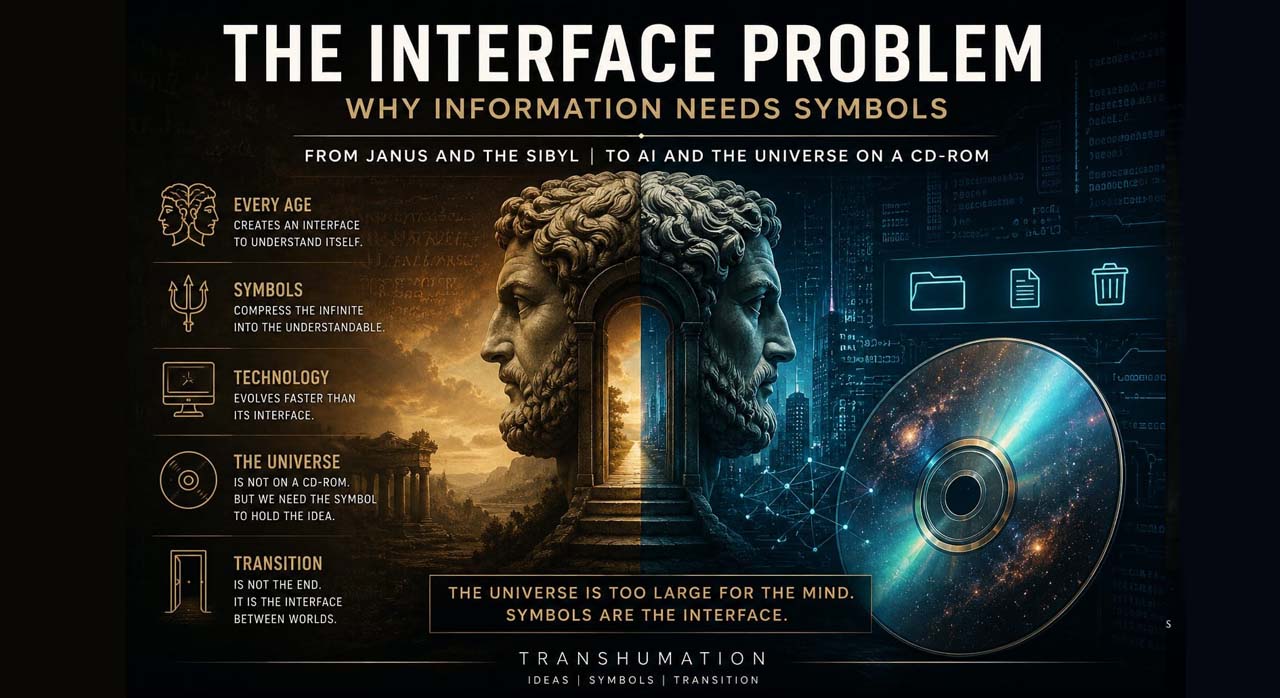
Civilization therefore has a recurring interface problem: how does a finite mind interact with a reality too large to represent directly?
One solution is the map. Another is the institution. Another is the symbol.
And sometimes the symbol has a face.
This does not reduce ancient religion to primitive information design. A god was not simply an icon on a Bronze Age desktop. Gods could be understood as agents with wills, receive sacrifice, inhabit temples, anchor festivals and participate in highly developed cosmologies. To call them merely “interfaces” would flatten precisely the history we are trying to understand.
But interface may describe one of the things they did.
A figure such as Janus could make the abstract condition of crossing a threshold imaginable. A deity connected with justice could place law inside a cosmic order rather than leaving it as the temporary preference of a ruler. Ritual could turn uncertainty into an action: consult, sacrifice, pray, wait, proceed. The invisible became something toward which a person could orient himself.
The god gave complexity somewhere to stand.

The Gods Were Never Just Characters
This becomes clearer when we stop reading mythology as though it were a failed encyclopedia.
Take Hekate. Reduced to a modern character description, she becomes a goddess of witchcraft, ghosts and crossroads. Yet the crossroads are more interesting than the costume. A crossroads is a physical place, but also a recurring human condition: one path becomes several; information is incomplete; a decision must be made; what was a single future becomes alternatives.
Janus performs a different but related operation. His two faces make transition visible. One looks toward what has been; the other toward what comes next. Again, the image converts something abstract—passage, boundary, temporal transition—into something a human mind can encounter.
The same caution applies here as everywhere in Forgotten Religion. Similarity is cheap. Once we decide everything is a pattern, patterns can be found everywhere. A doorway is not proof of Janus hiding inside modern architecture, and a three-way junction does not demonstrate that every civilization secretly worshipped Hekate.
The stronger test is whether a function survives when the carrier changes.
Do societies repeatedly create representations that compress systems larger than an individual mind? Do they attach narratives to forces that cannot otherwise be negotiated personally? Do those representations help coordinate behavior, transmit values, legitimize institutions or make uncertainty actionable?
If the answer is yes, then something genuinely interesting has survived even after the supernatural claim is removed.
We have stopped comparing costumes.
We are comparing jobs.
What Happened When the Gods Left?
Modern secular societies appear, at first, to provide the obvious counterexample. Churches empty in parts of Europe. Scientific explanations replace supernatural accounts of disease and weather. States derive legitimacy from constitutions and elections rather than divine kingship. The gods, it seems, were temporary scaffolding required until civilization learned better engineering.
And yet the symbolic machinery did not disappear.
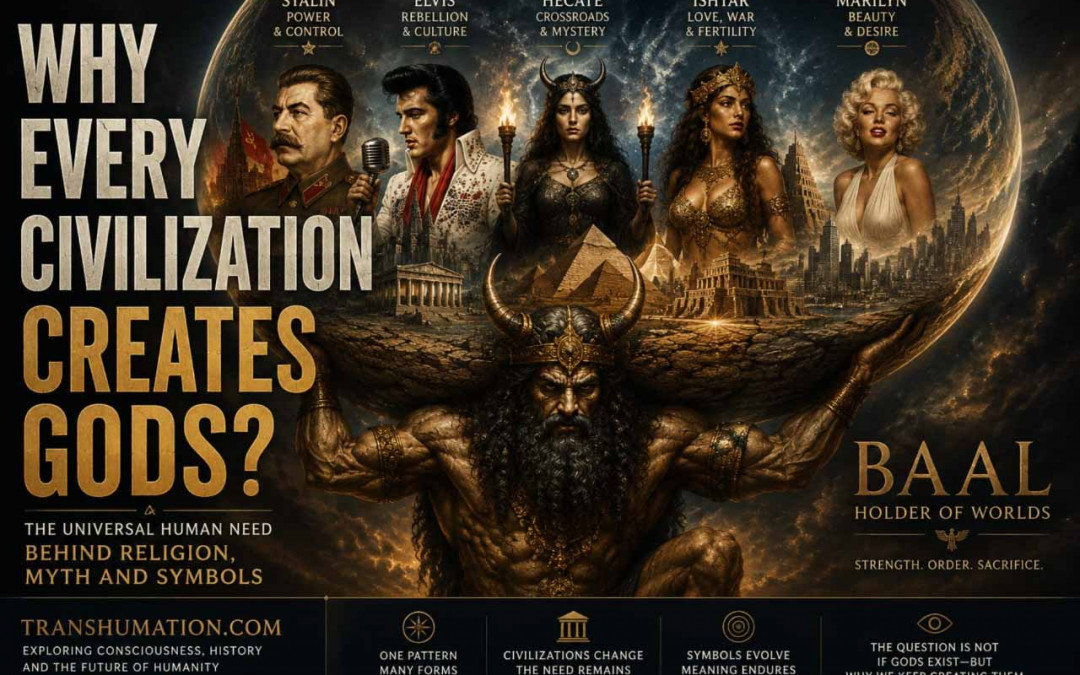
Nations have founding fathers, sacred dates, monuments, flags, martyrs and places at which prescribed forms of collective behavior occur. Companies cultivate origin myths and charismatic founders. Political movements compress enormous networks of economic and social causes into faces, slogans and stories. Celebrities become vessels for aspirations and resentments belonging to millions of strangers who will never meet them.
It would be sloppy to call all of these things religions. A brand is not Baal; an election is not the Eleusinian Mysteries; an online fandom is not an Egyptian mortuary cult. The differences matter.
But the recurrence suggests that the human appetite for symbolic compression did not vanish when particular gods lost authority.
We still need small objects through which very large things can be handled.
A national flag is physically a piece of fabric. Destroy one in the wrong place and the response immediately demonstrates that nobody involved believes the argument is really about fabric. A wedding ring is a small piece of metal carrying a relationship larger than itself. Currency works because an object of trivial material value participates in a vast network of shared expectations.
Civilization is full of objects whose physical dimensions tell us almost nothing about their informational dimensions.
The ancient statue may belong to the same broad family of human inventions.
Not because the god was therefore imaginary, but because whatever else a god might have been, the image allowed something enormous to become graspable.
The Oracle Has Changed Its Voice
There is a particularly strange version of this old structure sitting on desks and inside phones today.
A person asks a question.
The visible interface is small. Behind it lies a system no ordinary user could inspect in real time: data centers, mathematical models, training processes, software layers, electrical grids, networks and accumulated human text. A few words enter. An answer returns.
Artificial intelligence is not an oracle, and treating it as one would be dangerous. It has no guaranteed access to truth; it can reproduce errors, generate plausible falsehoods and reflect limitations in its training and design. Ancient divination and machine learning arise from radically different histories and mechanisms.
But once again, remove the costumes and inspect the relationship.
A human confronts a domain larger than his individual knowledge. He approaches an interface. He formulates a question according to the rules of that interface. Something hidden performs operations he cannot directly observe. An answer appears. He must then decide how much authority to grant it.
That structure is older than the machine.
This may explain why technological language so easily drifts toward religious language even among people who have no religious intention. We speak of omniscient systems, invisible networks, artificial minds and machines that “know” us. The danger is not that computers are secretly becoming gods. The danger—and the fascination—is that humans already possess ancient cognitive habits for dealing with powerful invisible systems.
We know how to build an altar long before we know whether the thing behind it deserves one.
The Pattern Before the God
Now we can return to the black stone in the Louvre.
Perhaps we initially read it backwards.
We saw a god at the top and laws underneath, so we assumed that an ancient civilization had invented a supernatural being and then used him to authorize human rules. That remains one possible description. But another possibility is structurally more interesting.
The civilization already confronted justice, authority, violence, obligation and social order—real forces that existed before any particular image of Shamash was carved. These forces were enormous, distributed and difficult for any individual to comprehend. The god gave them a face, a story, a location and a relationship to human action.
Perhaps the pattern came first.
Then came the god.
This does not answer the theological question. A believer can still argue that recurring gods reflect genuine encounters with something beyond humanity. A skeptic can argue that recurring gods reveal recurring features of human psychology. An anthropologist can point to cultural transmission, political organization, ritual, ecology and social cohesion. These explanations need not even be mutually exclusive in every case.
Forgotten Religion is interested in the object that survives the argument.
Civilizations keep encountering realities larger than the individual. They keep building ways of representing those realities. The representations become symbols; symbols acquire stories; stories organize communities; and occasionally the symbol becomes so powerful that people kneel before it.
The mystery may therefore begin one step earlier than religion.
Before asking why humans invented gods, we should ask why reality keeps presenting human beings with things too large to fit inside a human mind.
Perhaps that is why civilizations create maps.
And perhaps, sometimes, a map acquires a face.
Watch the Video
How to Read the World
Current Knowledge
Religion appears in an enormous range of historically documented human societies, although its forms, doctrines and social functions vary substantially. Scholars have proposed numerous explanations for its persistence, including ritual coordination, social cohesion, cognitive tendencies toward agency detection, responses to uncertainty and mortality, political legitimacy, cultural transmission and individual religious experience. There is no single scholarly explanation that establishes why religion exists in all of its forms.
Ancient deities also cannot reliably be reduced to simple personifications of natural phenomena. Their functions changed between periods and communities and could encompass politics, ritual, family, cosmic order, agriculture, warfare, death and local identity. Modern secular institutions can display ritualistic or symbolic characteristics, but resemblance alone does not establish that they are religions in the historical or theological sense.
Open Questions
Why do concepts of supernatural agency recur so widely in human cultures? Which aspects arise independently from common features of human cognition, and which spread through cultural contact? Why do some symbolic systems remain local while others become capable of organizing cities, kingdoms or civilizations?
A deeper question remains unresolved: are recurring religious structures adequately explained by psychology and social organization, or could their persistence tell us something about how conscious beings encounter aspects of reality that cannot be represented directly?
Transhumation Interpretation
Transhumation proposes a narrower hypothesis than “all gods are the same.” They clearly are not.
The more interesting possibility is that certain functions represented by gods are older and more durable than the particular gods representing them. Civilizations repeatedly encounter forces and systems too large, distributed or abstract for an individual mind to grasp directly. Human beings respond by creating interfaces: symbols, stories, rituals, institutions, maps and personifications through which complexity becomes navigable.
Under this interpretation, the migration of a function matters more than the survival of a name. A structure can move from god to institution, from ritual to procedure, from oracle to algorithm, while changing almost everything about its outward appearance.
This produces a different archaeological question.
When we find the same god in two civilizations, we naturally look for cultural transmission.
But when we find different gods—or no gods at all—performing the same structural job, we may be looking at something even older.
Not the god behind the pattern.
The pattern before the god.
FAQ
Why do all civilizations create gods?
Most civilizations face similar questions about death, meaning, uncertainty, and social order. Gods often emerge as symbols that help societies organize and understand these challenges.
Were ancient gods simply explanations for natural phenomena?
Partly, but gods also served social, cultural, and psychological functions that went far beyond explaining weather or natural disasters.
Why do religious patterns appear across different cultures?
Many cultures faced similar human problems and may have independently developed similar symbolic solutions.
Can technology replace religion?
Technology can solve practical problems, but many people still seek meaning, purpose, and identity. Whether technology can fully replace religion remains an open question.
Are gods inventions or discoveries?
Different traditions answer this differently. Some view gods as human creations, while others see them as discoveries of deeper realities.
What does Transhumation suggest?
Transhumation focuses less on proving gods and more on understanding what problems concepts such as gods, souls, and religion were created to solve, and whether technology is beginning to recreate some of those functions.
Continue the Transhumation Series
- Forgotten Religion | Ancient Gods, Symbols and the Hidden Structures of Human Civilization
- The Last Religion | Death, Immortality and the Future of Humanity
- The New Theurgy | AI, Information and the Future of Human Civilization
- End of Branding: You Were Never Meant to Become a Product
- Baal vs Ishtar: Why Ancient Gods Never Disappeared