
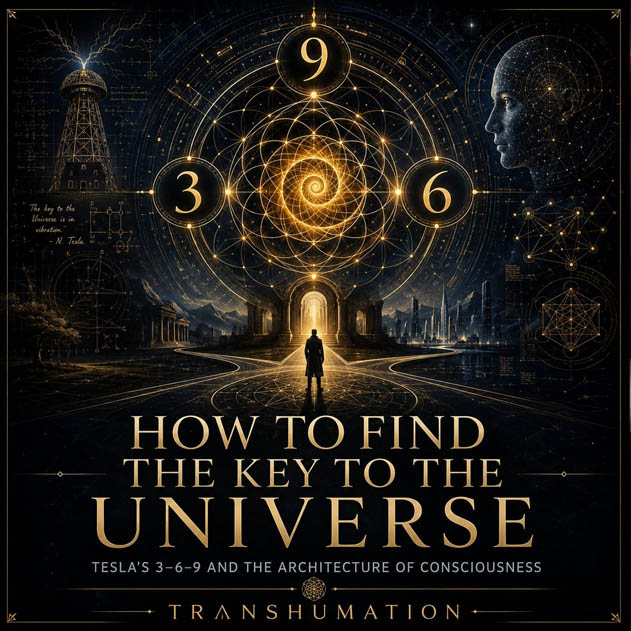
How to Find the Key to the Universe
Tesla’s 3–6–9 and the Architecture of Consciousness
A quote widely attributed to Nikola Tesla says:
“If you knew the magnificence of 3, 6 and 9, you would have the key to the universe.”
Modern culture transformed this idea into numerology.
Mysticism.
Internet symbolism.
Hidden codes.
Conspiracy theories.
But perhaps the most interesting interpretation has nothing to do with magical numbers controlling reality.
What if 3, 6 and 9 describe stages through which consciousness creates meaning?
Not a secret mathematical formula.
A structure of perception.
A movement from pattern, to system, to awareness.
Three — When Chaos Becomes Meaning
Human beings naturally search for repetition.
One event may mean nothing.
Two similar events create suspicion.
Three begin to form a pattern.
The third repetition changes the experience. Events that once appeared separate begin to feel connected.
This does not prove that a supernatural force arranged them. It means that consciousness has crossed a threshold.
Chaos has become recognizable.
Three is therefore not only a number. It represents the first complete relationship.
One is a point.
Two create tension or opposition.
Three create structure.
This may explain why triads appear so often across civilizations:
Birth, life and death.
Past, present and future.
Beginning, middle and end.
Mind, body and spirit.
Three gives consciousness orientation.
It places events inside a sequence and allows the observer to ask not only what happened, but how the events belong together.
Meaning begins when isolated moments become part of the same pattern.
Six — When Meaning Becomes a System
A pattern alone is unstable.
It may be noticed once and then forgotten. To survive, it must be repeated, organized and transmitted.
This is where six appears.
In this interpretation, six represents structure.
Language.
Architecture.
Ritual.
Law.
Technology.
Institutions.
Algorithms.
Human beings recognize patterns and then build systems around them.
The observation of seasons becomes a calendar.
Repeated sounds become language.
Shared memories become mythology.
Successful methods become technology.
Patterns become rules. Rules become institutions. Institutions begin shaping reality.
Civilization itself is structured repetition.
A city exists because thousands of processes continue every day. Transport moves. Electricity flows. Information is exchanged. Laws are repeated. People accept shared meanings.
The system appears permanent only because the pattern is constantly maintained.
But every system creates a danger.
The structure that once helped consciousness understand reality can eventually become a prison.
The Human Being Inside the Machine
Modern civilization is built from systems so complex that no individual fully understands them.
Financial networks, digital platforms, bureaucracies, algorithms and artificial intelligence organize enormous parts of human life.
These systems create efficiency.
They also shape perception.
Algorithms decide which images appear, which opinions become visible and which desires receive constant reinforcement.
People begin to behave predictably because the system studies repetition and then produces environments designed around it.
You click.
The system learns.
It presents another option.
You repeat the behavior.
The pattern becomes stronger.
The person believes they are using the system, while the system is simultaneously constructing a model of the person.
This is the crisis of six.
Meaning became structure.
Structure became reality.
And reality became difficult to see from the inside.
Nine — When Consciousness Observes the System
Nine is often treated as the number of completion.
But completion alone is not enough.
A completed system can continue repeating forever.
Nine may represent something more important: reflection.
The moment consciousness recognizes the structure in which it is operating.
This is the appearance of the observer.
At the stage of three, consciousness recognizes a pattern.
At six, it builds a system from that pattern.
At nine, it turns back and observes the system itself.
This is why mirrors, cycles, returns and higher perspectives appear so often in symbolic traditions.
The observer attempts to move outside the structure—not physically, but cognitively.
A person suddenly recognizes that their habits are not random.
They see how language shapes thought.
They notice that technology does not merely serve desire but helps create it.
They understand that an identity may be partly inherited, programmed and repeated.
This moment does not destroy the system.
It makes the system visible.
And what becomes visible can finally be questioned.
Hekate at the Crossroads
The ancient symbol of Hekate offers a useful parallel.
Hekate stands at the crossroads.
She does not simply represent three roads. She represents the consciousness capable of seeing them.
Before awareness, a person follows one path automatically.
At the crossroads, the path becomes a choice.
The observer recognizes several possibilities and understands that every direction creates a different future.
This is the movement from three to nine.
First, multiple paths appear.
Then systems are built around decisions.
Finally, consciousness recognizes itself as the one making—or failing to make—the choice.
The crossroads is therefore not only a place.
It is a condition of awareness.
Religion, Science and Technology
Civilization may be repeating the same process through different languages.
Religion recognized patterns through myth.
Science organized patterns through measurement.
Technology transformed patterns into functioning systems.
Artificial intelligence now recognizes structures across quantities of information far beyond ordinary human perception.
But AI does not automatically solve the final problem.
A system can detect patterns without understanding what those patterns should mean for human existence.
Technology can organize.
Consciousness must still interpret.
The future may therefore depend on the relationship between artificial pattern recognition and human reflection.
Machines may become increasingly powerful at the level of six.
The human task may be to reach nine: to observe the systems we create before they become invisible environments controlling the creators.
The Key Was Never Numerical
Perhaps the key to the universe is not hidden inside three particular numbers.
Perhaps 3–6–9 describes a recurring movement:
3 — meaning emerges from repetition.
6 — meaning becomes an organized system.
9 — consciousness becomes aware of the system.
This process appears in individuals, religions, technologies and civilizations.
We recognize.
We organize.
We reflect.
Then the cycle begins again at a higher level.
Perhaps civilization is not advancing in a straight line.
Perhaps it is moving through spirals of recognition.
Each new system gives humanity greater power, but also creates a new structure that must eventually be examined.
The real key may therefore be consciousness itself.
Not because consciousness magically controls the universe.
But because it connects isolated events, discovers patterns, builds structures and finally asks what exists beyond them.
Three reveals the pattern.
Six builds the world.
Nine opens the door outside it.
Read more

FAQ
Did Nikola Tesla really say the famous 3–6–9 quote?
The sentence is widely attributed to Tesla, but its precise original source is uncertain. The article treats it as a cultural idea rather than verified scientific teaching.
Is 3–6–9 a scientific theory?
No. Here, the numbers are used symbolically to describe stages of pattern recognition, organization and reflection.
What does the number three represent?
Three represents the moment repeated events begin to form a recognizable pattern and meaning starts to emerge.
What does six represent?
Six represents the organization of patterns into systems such as language, civilization, ritual, technology and algorithms.
What does nine represent?
Nine represents reflection: the moment consciousness becomes aware of the system and observes its own position within it.
How is Hekate connected to 3–6–9?
Hekate’s crossroads symbolize multiple paths, choice and the moment consciousness recognizes that it exists inside a structure of possibilities.
What role does artificial intelligence play in this idea?
Artificial intelligence recognizes and organizes patterns at enormous scale. However, human consciousness must still decide what those patterns mean and how the systems should be used.
Is the article promoting numerology?
No. It uses numbers as symbolic tools for thinking about consciousness, not as magical forces controlling reality.
What is the true “key to the universe” in this interpretation?
The key is the capacity of consciousness to recognize patterns, build systems and then become aware of those systems before they begin controlling the observer.
Continue the Transhumation Series
Explore the full journey:
- End of Reality — Where Do You Really Exist?
- End of Physics — Are the Laws of Reality Real?
- End of the Real World — Reality Is No Longer Required
- End of Consciousness — Beyond the Human Mind
- End of Death — When Human Limits Disappear
- End of Religion — When Technology Replaces Faith