
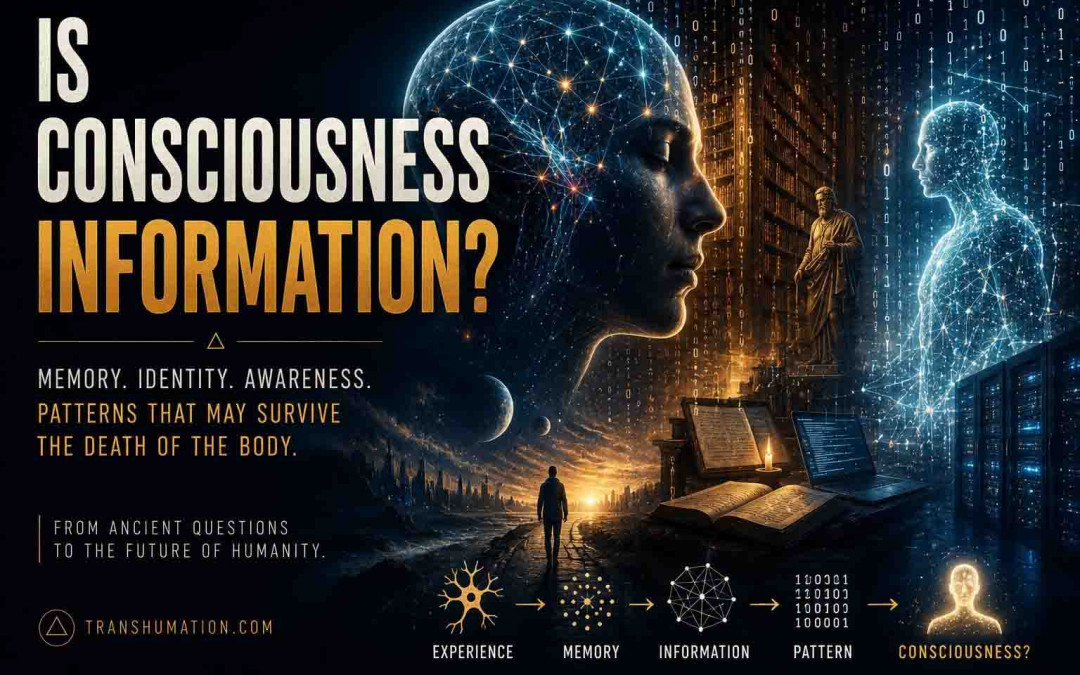
Is Consciousness Information?
Mind, memory, identity — and the possibility that the most important thing about us is neither the material nor the data alone
Imagine that someone gives you two objects. The first is a first edition of a novel printed a century ago. The second is the same novel displayed on a tablet. The paper, ink, glass, electronics and physical histories of the two objects could hardly be more different, yet nobody seriously doubts that the same story can be present in both.
This is one of the quiet miracles of information.
A pattern can survive the replacement of its carrier.
The idea is so ordinary that we barely notice how strange it is. A melody can move from violin to piano. A photograph can move from film to pixels. A mathematical proof can be written in chalk, printed in a book or represented on a screen. The physical object changes while something recognizable remains.
Modern technology has made us comfortable with this distinction between carrier and structure.
Then we look at ourselves.
The human body changes throughout life. Cells turn over at different rates. Memories are revised. Habits change. Beliefs can reverse. The person at seventy may share surprisingly little psychologically with the child at seven, yet both ordinarily belong to one continuous biography.
It is therefore difficult to resist the question.
Could consciousness also be a pattern that survives changes in its carrier?
And if so, what exactly would the pattern have to preserve?
The Seduction of the Computer
The computer provides a dangerous metaphor because it works just well enough to become irresistible.
Hardware runs software. The hardware can be replaced. Files can be moved. Programs can be copied. A system can preserve functional organization across different physical machines.
If the brain also processes signals, stores memory, predicts, learns and coordinates behavior, perhaps consciousness is simply the software of biology.
The metaphor immediately produces a seductive conclusion: if we understand the program well enough, perhaps we can move it.
But human brains are not ordinary computers, and consciousness is not known to be software.
Brains are living biological systems. Their activity is electrochemical, embodied, metabolically dependent and continuously influenced by hormones, sensory input, internal organs, development and interaction with the environment. Human experience does not sit neatly inside the skull as a detachable program waiting to be exported.
Still, dismissing the analogy completely would also be too easy.
The computer metaphor forces a legitimate question.
Which properties of a mind depend on the particular material of the brain, and which depend on the organization of processes within it?
We do not yet know where that line lies.
Memory Is Not the Self
Memory seems like the obvious place to begin.
Take away someone’s autobiographical memories and something profound happens to personal identity. The person may no longer recognize their own history, relationships or previous decisions. Memory stitches different moments into one biography.
But memory is clearly not sufficient.
People forget constantly while remaining themselves. False memories can become subjectively convincing. Severe neurological conditions can damage autobiographical continuity while leaving temperament, emotional responses or habits partly intact.
Memory itself is reconstructive. We do not retrieve the past as if opening a perfect file. We rebuild it.
This creates a problem for any simple informational theory of identity.
If a person were merely the sum of stored memories, identity would be much more fragile than ordinary experience suggests.
Perhaps what matters is not the content alone.
Perhaps it is the process that continually interprets the content.
A living mind does not merely possess memories.
It reorganizes them in the light of what happens next.
Information Without an Observer
The word information has another problem: it is extraordinarily broad.
DNA contains information in one useful scientific sense. A book contains information. A hard drive contains information. Neural systems process information. A weather map contains information about atmospheric conditions.
None of these facts makes the carrier conscious.
A library can contain descriptions of pain without suffering.
A computer can contain millions of photographs of sunsets without seeing one.
A database can store a complete chronology of a marriage without loving either person.
Information and experience are therefore not obviously identical.
The central mystery is not whether brains contain or process information.
They plainly do.
The mystery is why some physical processing is accompanied by a point of view.
Why does red look like something?
Why does pain hurt?
Why is there anything it is like to be awake?
A complete informational description of a system might explain what the system discriminates, remembers and reports.
Would it also explain why there is somebody there experiencing it?
That is the fault line.
The Copy Problem
Mind uploading makes the problem impossible to ignore.
Imagine a technology capable of reproducing every relevant detail of your brain. The resulting system remembers your childhood, speaks in your voice, recognizes your family and insists that it is you.
Now imagine that the original biological person remains alive.
There are immediately two claimants.
Both possess the same remembered past up to the copying event. One stays in the room. The other leaves. Their futures diverge.
If consciousness were simply information, both might appear equally legitimate.
But they cannot be numerically one person once they begin occupying different streams of experience.
This suggests that identity may depend on more than static pattern similarity.
Continuity may matter.
The way one state gives rise to the next may be as important as the information contained in either state.
A photocopy preserves structure.
A journey preserves history.
Those are not necessarily the same thing.
The Ancient Question Returns
This is where the discussion becomes strangely old.
Religious traditions spoke of the soul.
Philosophers spoke of identity, substance, form and continuity.
Modern neuroscience speaks of neural correlates, integration and cognition.
Computer science gives us pattern, computation, storage and architecture.
These vocabularies are not interchangeable.
A theological soul is not simply a data structure. A neural network is not an ancient psyche translated into mathematics. But all of these languages eventually collide with a recurring problem.
What is the thing that persists?
The old question has not returned because science failed.
It returned because technology has become sophisticated enough to make the distinction between copying, preserving and continuing operational.
We may someday be able to reproduce an extraordinary amount of a human being before we understand whether reproduction is survival.
Watch The Video
How to Read the World
Current Knowledge
Human consciousness is strongly associated with functioning biological brains. Changes to the brain through injury, anesthesia, drugs, neurodegenerative disease and electrical stimulation can alter memory, personality, perception and conscious state. This gives strong evidence that human consciousness depends intimately on physical brain processes.
Brains also process and integrate information in complex ways. Information-related concepts play important roles in neuroscience, cognitive science and several theories of consciousness. However, there is no scientific consensus that consciousness can be reduced to information processing alone.
There is currently no demonstrated case of human consciousness being transferred from one biological substrate to another, nor of a person’s subjective experience surviving independently of the living brain that produced it.
Digital systems can preserve aspects of identity such as writing style, voice, preferences, recorded memories and behavior. Such preservation is not equivalent to demonstrated continuity of the original conscious subject.
Open Questions
The first question is whether consciousness depends on a specific biological substrate or on organization that could, in principle, be implemented elsewhere. If two systems were functionally identical but materially different, would both possess experience?
A second question concerns continuity. Is an uninterrupted causal process necessary for personal survival, or could a perfect reconstruction count as the same person?
Embodiment adds another difficulty. Human consciousness is shaped by the entire organism: hormones, heartbeat, pain, movement, proprioception, development and interaction with the environment. Could a purely computational reconstruction preserve the same kind of self without preserving those bodily relationships?
There is also a deeper conceptual question: is information fundamental enough to explain experience, or is information only a language we use to describe relationships within systems that remain physically and phenomenologically richer than the description?
And finally, if a future artificial system convincingly claims consciousness, what evidence would count either for or against believing it?
Transhumation Interpretation
Transhumation should be careful with the phrase consciousness is information.
It is too clean.
The stronger possibility is that consciousness may involve a pattern whose relationship to its carrier remains unresolved.
Some structures clearly migrate.
A melody moves between instruments.
A geometric relationship moves between drawings.
A text moves between languages and media.
Some functions of human cognition already move outward into notebooks, databases, navigation systems and artificial intelligence.
But the observer is different.
We know how to move records.
We know how to move functions.
We know how to reproduce patterns.
We do not know how to move a point of view.
This is where the carrier-independent idea reaches its boundary.
Perhaps consciousness is like geometry and can survive different implementations.
Perhaps it is more like fire, inseparable from a specific class of ongoing physical processes.
Perhaps both analogies are inadequate.
Transhumation does not need certainty here.
The interesting task is to identify what a successful theory would have to explain.
Not merely memory.
Not merely behavior.
Not merely informational similarity.
It would have to explain continuity of experience.
That may be the difference between an archive of a person and the person.
Between reconstruction and survival.
Between a pattern that looks like you and the one who can still say:
I remember being the one who began.
FAQ
What is consciousness?
There is no universally accepted definition, but consciousness generally refers to subjective awareness: the fact that experiences feel like something from the perspective of the individual having them.
Does the brain create consciousness?
All confirmed human consciousness is strongly associated with functioning brains, and brain changes can alter conscious experience. The exact mechanism by which brain activity relates to subjective experience remains debated.
Is consciousness information?
It may depend heavily on information processing, but science has not established that consciousness is identical to information.
Why is information important to consciousness research?
Because brains receive, transform, integrate and use information. Many theories attempt to explain consciousness partly through how information becomes globally available, integrated or organized.
Is memory the same as consciousness?
No. Memory is one function associated with conscious minds, but consciousness can occur without active autobiographical memory, and memory can be altered while other aspects of conscious experience continue.
If I lost all my memories, would I still be me?
This is partly a philosophical question. Severe memory loss can radically affect identity, but continuity may also depend on embodiment, personality, relationships and ongoing biological processes.
Why compare the mind to software?
Because software demonstrates how functional organization can persist across changes in physical hardware. The analogy is useful but incomplete because brains are living biological systems and consciousness has not been shown to behave like transferable software.
Could consciousness run on a computer?
Nobody knows. If consciousness depends on certain organizational or computational properties, it may be possible in principle. If specific biological properties are essential, it may not be.
Can AI be conscious?
There is currently no scientific consensus that present AI systems possess subjective experience. Intelligent behavior alone does not establish consciousness.
What is the difference between intelligence and consciousness?
Intelligence concerns capacities such as reasoning, learning, prediction and problem solving. Consciousness concerns subjective experience. A system could conceivably possess some forms of intelligence without consciousness.
Could mind uploading preserve a person?
That depends on what personal identity ultimately requires. Uploading might preserve memories, personality and behavior while still failing to preserve the original stream of consciousness.
Why is copying not obviously survival?
Because a copy and an original can coexist. Once they do, they immediately begin having different experiences. This suggests that informational identity and numerical personal identity are not automatically the same.
Would gradual replacement be different?
Possibly. If neural functions were gradually replaced while conscious experience remained uninterrupted, the process might preserve causal continuity better than instantaneous copying. Whether this would preserve the same person remains unresolved.
Does embodiment matter?
Probably. Human thought and emotion are shaped by bodily states, sensory systems, hormones and physical interaction with the environment. A theory of consciousness that ignores embodiment may be incomplete.
Is information independent of matter?
Known information always has some physical realization. What is interesting is that similar informational structures can sometimes be implemented in different materials.
Could consciousness be a carrier-independent structure?
That is one of the central open questions. Some functions and structures clearly are carrier-independent across a range of implementations. Whether subjective consciousness belongs to that category has not been demonstrated.
What would prove that consciousness can survive a change of carrier?
A convincing case would require more than behavioral similarity. We would need a credible theory of consciousness, a mechanism for preserving the relevant process and evidence that subjective continuity had been maintained rather than merely recreated.
What if consciousness is neither matter nor information?
That possibility remains open conceptually. Our current categories may turn out to be incomplete. Future theories may describe consciousness using concepts that do not map neatly onto today’s distinction between matter and information.
What is the deepest Transhumation question here?
Not simply:
Can a mind be copied?
That may eventually become an engineering problem.
The harder question is:
Can the observer survive the copying?
We already know that information can cross carriers.
Books prove it.
Music proves it.
Software proves it.
Civilization proves it every time the thought of a dead person enters a living mind.
What we do not know is whether experience can make the same journey.
Until that question is answered, the most important difference in the future may be the one that looks smallest on a screen:
the difference between something that contains everything about you
and something that is still you.
Continue the Transhumation Series
- Forgotten Religion | Ancient Gods, Symbols and the Hidden Structures of Human Civilization
- The Last Religion | Death, Immortality and the Future of Humanity
- The New Theurgy | AI, Information and the Future of Human Civilization
- End of Branding: You Were Never Meant to Become a Product
- Baal vs Ishtar: Why Ancient Gods Never Disappeared