
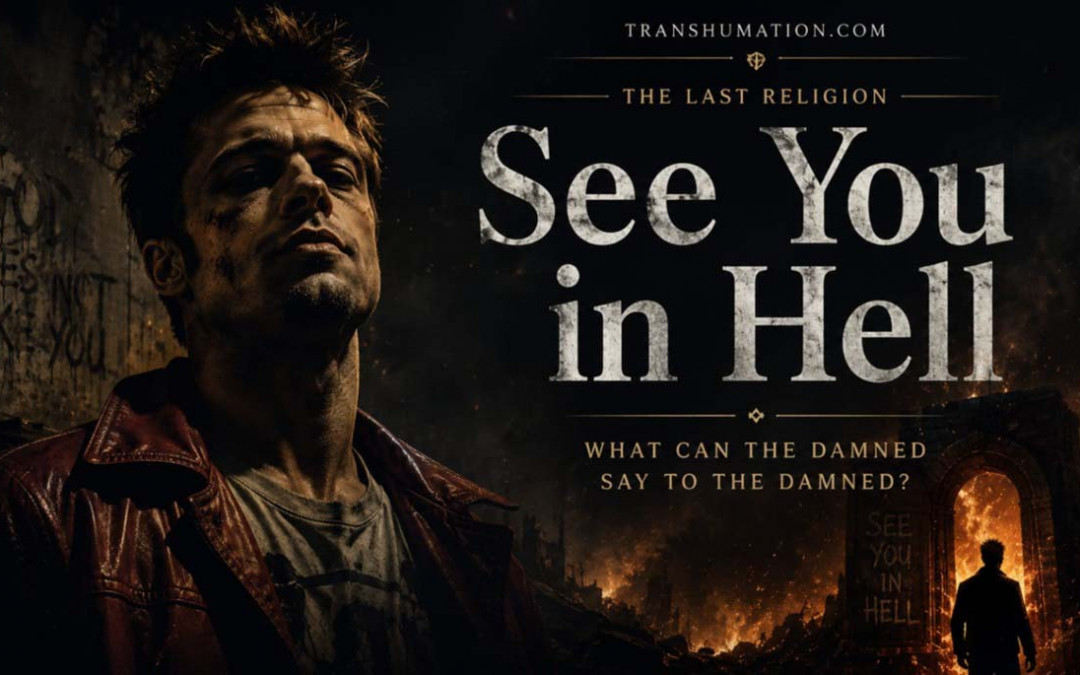
Home Sweet Hell
There is a peculiar weakness hidden inside every threat.
It must still describe something the threatened person is trying to avoid.
A prisoner may fear the sentence because some part of life remains outside the prison walls. A sinner may fear damnation because salvation remains imaginable. A child fears rejection because reconciliation with the parent is still desired. The threat works by pointing toward a future from which the person hopes to escape.
Then comes a darker possibility.
What happens when escape is no longer expected?
The phrase see you in hell sounds, at first, like total defeat. It is spoken from inside the language of condemnation. The judgment has already been passed; there is apparently nowhere lower to fall. Yet that is precisely what makes the phrase unstable.
If both speaker and listener already belong among the damned, who still possesses the authority to threaten whom?
The sentence can become something else.
Recognition.
Defiance.
A joke spoken after the courtroom has emptied.
Not necessarily freedom.
But perhaps the moment when one kind of fear stops working.
What Does “See You in Hell” Really Mean?
The phrase carries two opposite possibilities.
The first is conventional. Hell remains terrible. The speaker knows it and accepts the catastrophe. See you there becomes a statement of despair because nothing remains to be negotiated.
The second interpretation is more subversive.
Once damnation has already been accepted as identity, repeating the threat no longer changes behavior. Condemnation has lost some of its leverage.
This is the structure that makes the phrase interesting in Interview with the Vampire. Vampires exist inside a moral and religious vocabulary that defines them as violations: immortal predators, creatures who remain recognizably human while living outside ordinary human limits.
They can still ask whether they are evil.
They can still desire forgiveness.
They can still imagine judgment.
But if a character eventually stops pleading for admission back into innocence, the psychological architecture changes.
The damned person may still suffer.
They may still regret.
They may still be guilty.
What changes is the relationship to the judge.
The sentence no longer begins with:
Please tell me I can still be saved.
That is a much more dangerous form of consciousness.
Can Fear Lose Its Power?
Yes, but not simply because a person declares themselves fearless.
Fear contains several layers.
There is physical fear: pain, deprivation, death. Belief cannot make a fire harmless.
There is social fear: exclusion, shame, punishment, abandonment. These can continue operating even when we intellectually reject the values of the group imposing them.
And there is symbolic fear: a punishment derives part of its power from the worldview in which it is meaningful.
Damnation belongs partly to this third category.
Hell is not merely unpleasant geography. In religious traditions where it appears, it belongs to a moral cosmos. There is judgment. There is a relationship between conduct and ultimate reality. There are consequences larger than immediate human society.
If someone ceases to believe that this entire structure exists, one form of fear may indeed collapse.
But nothing automatically follows about morality.
The absence of divine punishment does not make betrayal harmless.
A universe without hell can still contain suffering.
A world without final judgment can still contain victims.
The disappearance of punishment from above does not erase consequences below.
In fact, it may make human responsibility more severe.
There is no later courtroom in which somebody else guarantees that the account will finally be balanced.

The Children God Did Not Want
Fight Club approaches the same threshold from another direction.
Tyler Durden asks his followers to consider the possibility that divine love is not guaranteed. The thought is deliberately brutal because it attacks a comforting assumption: perhaps humanity is not the center of a story written for its benefit.
But Tyler is not a reliable prophet of liberation.
That matters.
His rebellion against inherited values soon produces another hierarchy, another ritual system, another vocabulary of obedience. Men who believe they are escaping consumer society become increasingly interchangeable members of a structure demanding submission.
This is one of the film’s most useful contradictions.
Rejecting one father does not prevent us from manufacturing another.
Destroying an old authority does not make a person autonomous.
Sometimes it merely clears the ground for a more charismatic authority to move in.
The meaningful question is therefore not whether God likes us.
It is what happens psychologically and morally if we can no longer rely upon being liked by the universe.
Can a person become responsible without becoming nihilistic?
Can freedom survive without turning immediately into domination?
That is much harder than rebellion.
What If Nobody Is Coming?
This may be one of the most frightening questions consciousness can formulate.
Not because it proves anything about God.
It does not.
It is frightening because it removes the imagined emergency exit.
Suppose no final authority arrives to repair the garden.
No hidden hand restores justice automatically.
No parent appears at the end of history to explain why everything had to happen.
The first reaction may be despair.
The second can be responsibility.
If nobody is guaranteed to come, then the condition of the garden matters more, not less.
Someone must decide whether the trees survive.
Someone must repair the wall.
Someone must protect the child.
Someone must preserve the archive.
The absence of cosmic supervision would not automatically make those tasks meaningless.
It could make them ours in a more radical sense.
This is one of the places where religious and secular moral thinking can unexpectedly approach the same problem from opposite directions.
A believer may argue that responsibility matters because reality possesses moral structure.
A secular humanist may argue that responsibility matters precisely because human suffering will not necessarily be corrected elsewhere.
Different metaphysics.
The same injured person still needs help.
The Angel That Never Existed
Consider the strange poem hidden inside the original idea.
A narrator claims to have killed an angel. The angel begged for mercy, hid behind its wings, and died while the killer laughed because angels do not exist.
At first it sounds like a paradox that cancels itself.
If angels do not exist, there was no murder.
But the more interesting reading is not logical.
It is psychological.
The narrator creates the object of fear in order to destroy it.
The angel is not killed because an angel literally stood there.
A representation is killed.
An internal authority.
A forbidden image.
The poem stages an execution of belief.
This is a familiar human act.
People destroy photographs after relationships end.
Burn uniforms after leaving institutions.
Remove religious symbols after losing faith.
Change names after breaking with an earlier identity.
The physical object is often innocent.
What is being attacked is the relationship between the object and the person.
That is why symbols matter.
Destroying the symbol does not prove the thing represented was false.
But it can alter the architecture through which the person relates to it.
Sometimes the angel that dies is not an angel.
It is obedience.
Does Morality Need Hell?
This is where the question becomes more serious than rebellion.
If a person behaves morally only because punishment is expected, what happens when punishment becomes doubtful?
One possible answer is collapse.
Another is maturation.
A child may initially avoid wrongdoing because punishment follows. An adult moral system ideally becomes more complicated: empathy, reciprocity, dignity, responsibility, law, social trust, principles and concern for consequences can all motivate behavior independently of supernatural sanctions.
Religious moral traditions themselves are often far richer than simple reward and punishment. Love, virtue, covenant, compassion and transformation cannot be reduced to celestial policing.
So the interesting question is not whether atheism makes morality possible or religion makes it impossible. Both formulations are crude.
The deeper question is:
What kind of moral agent remains when external surveillance is removed?
Would you still refuse cruelty if there were no witness?
Would you keep the promise if nobody could punish you for breaking it?
Would you repair the garden if no judge, ancestor or future historian would ever know?
That is where moral responsibility becomes difficult to fake.
The Second Meaning of Hell
Hell can also be understood structurally rather than geographically.
A person can become trapped inside a pattern from which every available choice reproduces the same suffering.
Addiction can feel like this.
Resentment can feel like this.
A relationship can become one.
A political system can become one.
The point is not that these experiences are literally theological hells.
The comparison works because punishment can become self-maintaining.
At that point, see you in hell acquires another meaning.
Not we will be punished together.
Rather:
we have already built the place we feared.
This turns responsibility back toward the living world.
Perhaps hell does not need flames if humans can construct sufficiently complete systems of humiliation, violence and despair themselves.
And perhaps salvation, in the modest human sense, can sometimes mean recognizing the system before it becomes destiny.
What Happens If There Is No Divine Punishment?
No empirical experiment can settle the entire metaphysical question implied here.
But the philosophical consequences can be examined.
If there is no final supernatural punishment, then injustice can remain historically unresolved.
The murderer may die peacefully.
The victim may receive no cosmic compensation visible to us.
An empire may prosper after cruelty.
A corrupt person may never be exposed.
This possibility is emotionally difficult because humans possess a powerful desire for moral balance.
But if reality does not guarantee balance, the responsibility of institutions grows.
Courts matter more.
Memory matters more.
Historical records matter more.
Solidarity matters more.
Human beings cannot responsibly assume that eternity will correct what they refuse to correct now.
Paradoxically, removing guaranteed cosmic justice can make earthly justice more urgent.
There may be no second administration waiting after ours.
The Garden Without a Gardener
The garden metaphor is useful precisely because a garden does not prove anything about gardeners outside it.
Suppose you awaken inside an enormous garden.
The irrigation works badly.
Some trees are magnificent.
Others are diseased.
There are paths whose purpose nobody remembers.
You find tools but no instructions.
Perhaps a gardener created it.
Perhaps many gardeners did.
Perhaps whoever began it is gone.
Perhaps nobody ever existed in the form you imagined.
You can spend the rest of your life arguing about the absent gardener.
It may be an important argument.
But meanwhile the tree beside you is dying.
At some point metaphysics and responsibility separate.
You may not know who owns the garden ultimately.
You can still know that neglect has consequences.
That is the mature form of the question What if nobody is coming?
Not certainty that nobody is coming.
Responsibility despite uncertainty.
The Last Religion
This is where The Last Religion becomes interesting only if it refuses to become another religion pretending to have escaped religion.
Its task cannot be to announce that God is dead, absent or unnecessary.
Those are substantive metaphysical claims requiring their own arguments.
The more rigorous position is harder.
Suppose certainty is unavailable.
Suppose the universe does not hand us an authenticated manual explaining why consciousness exists, what death ultimately means or whether moral reality extends beyond human life.
What then?
We still have evidence.
Other minds.
Suffering.
Beauty.
Memory.
Consequences.
The future.
Responsibility begins before metaphysics is finished.
That is the crucial move.
Humanity does not need to solve the final structure of reality before deciding not to poison a river, abandon a child or falsify history.
The garden requires maintenance while the argument about its creator remains open.
The Freedom After Damnation
There is therefore a form of freedom hidden inside damnation, but it is less romantic than rebellion suggests.
It is not the freedom to stop caring.
That is merely another prison.
It is the freedom that appears when approval is no longer the only organizing principle of action.
A person can stop asking:
Will I be rewarded?
And begin asking:
What follows if I do this?
That is a movement from judgment toward consequence.
From obedience toward authorship.
From childhood toward responsibility.
But authorship has a price.
You lose the comfort of blaming the script.
If nobody ordered the cruelty, it is yours.
If nobody guarantees the repair, neglect is yours too.
The liberated person inherits not an empty world but an unfinished one.
Freedom is not the disappearance of obligation.
It is the terrifying possibility that some obligations remain even when nobody is standing behind you with a weapon or a halo.
Watch The Video
How to Read the World

Current Knowledge
Religious traditions contain highly diverse ideas about judgment, punishment, salvation, afterlife and moral responsibility. Concepts such as hell cannot be treated as one universal doctrine shared identically across religions or historical periods.
Human moral behavior is influenced by many factors, including empathy, social norms, law, reputation, group identity, punishment, internalized principles and religious commitments. No single mechanism adequately explains morality.
Fear loses some motivational force when the threatened outcome is no longer believed possible or when the threatened person no longer values avoiding it. Physical and social consequences, however, can remain real regardless of belief.
Works such as Interview with the Vampire and Fight Club are fictional explorations of alienation, morality, identity and authority. Their characters provide philosophical provocations rather than reliable moral doctrines.
Religious belief and secular ethics can both support forms of responsibility that extend beyond simple fear of punishment. The existence of morality does not reduce neatly to whether an individual believes in supernatural judgment.
Open Questions
One major question is how much morality depends upon external authority. People can internalize principles deeply enough that they remain binding without immediate punishment, but societies still rely on institutions, norms and accountability.
Another concerns nihilism. If inherited moral or religious structures collapse, what determines whether the result becomes greater autonomy, despair or submission to a new authority?
There is also a question about cosmic justice. Humans strongly desire a relationship between moral behavior and ultimate consequence, yet the observable world does not always provide such balance. Different philosophical and religious traditions respond to that gap in radically different ways.
The deepest question is whether responsibility requires metaphysical certainty at all. Perhaps some obligations can be justified from consequences, relationships and the vulnerability of other conscious beings even while ultimate questions about God, soul and afterlife remain unresolved.
Transhumation Interpretation
For Transhumation, see you in hell is interesting as a threshold between obedience and responsibility.
The important move is not rejecting God, religion or judgment.
It is refusing to make uncertainty an excuse for moral passivity.
If the gardener returns, we will have maintained the garden.
If no gardener returns, the garden still needed maintaining.
That is enough.
The Transhumation question therefore becomes:
What are we still responsible for when nobody can guarantee that responsibility will ever be rewarded?
FAQ
What does “See you in hell” symbolize here?
It symbolizes the point at which a threat can lose some of its control because the person no longer organizes their identity around escaping condemnation.
Is the article arguing that hell does not exist?
No. It examines what happens psychologically and ethically when certainty about divine punishment is removed.
What does Fight Club contribute to the argument?
It tests the idea of living without guaranteed divine approval, while also showing how rebellion against one authority can produce submission to another.
Does morality require belief in God?
Different philosophical and religious traditions disagree. Human moral behavior clearly has multiple sources, including empathy, principle, social obligation, law and religious commitment.
What happens if there is no cosmic justice?
Then human responsibility for justice may become more urgent, because we cannot assume unresolved suffering will automatically be corrected elsewhere.
What is the deeper Transhumation question?
The deeper question is not whether the damned can escape hell.
It is what remains once escape stops organizing their behavior.
A threat can produce obedience.
Hope can produce obedience too.
The harder achievement is responsibility that survives when neither reward nor punishment is guaranteed.
That is the adult version of the garden.
Perhaps someone planted it.
Perhaps someone still watches.
Perhaps the final explanation lies beyond anything we currently understand.
None of that changes the immediate fact that the wall is broken and another person is standing beside us.
We can wait for instructions.
Or we can begin repairing it.
That does not prove the universe is empty.
It proves only that uncertainty is not the same thing as permission to abandon responsibility.
And perhaps this is the more interesting meaning of see you in hell.
Not:
Nothing matters anymore.
But:
If there is no one left to impress, frighten or beg for forgiveness, what kind of person will you choose to be now?
Continue the Transhumation Series
- Forgotten Religion | Ancient Gods, Symbols and the Hidden Structures of Human Civilization
- The Last Religion | Death, Immortality and the Future of Humanity
- The New Theurgy | AI, Information and the Future of Human Civilization
- End of Branding: You Were Never Meant to Become a Product
- Baal vs Ishtar: Why Ancient Gods Never Disappeared