
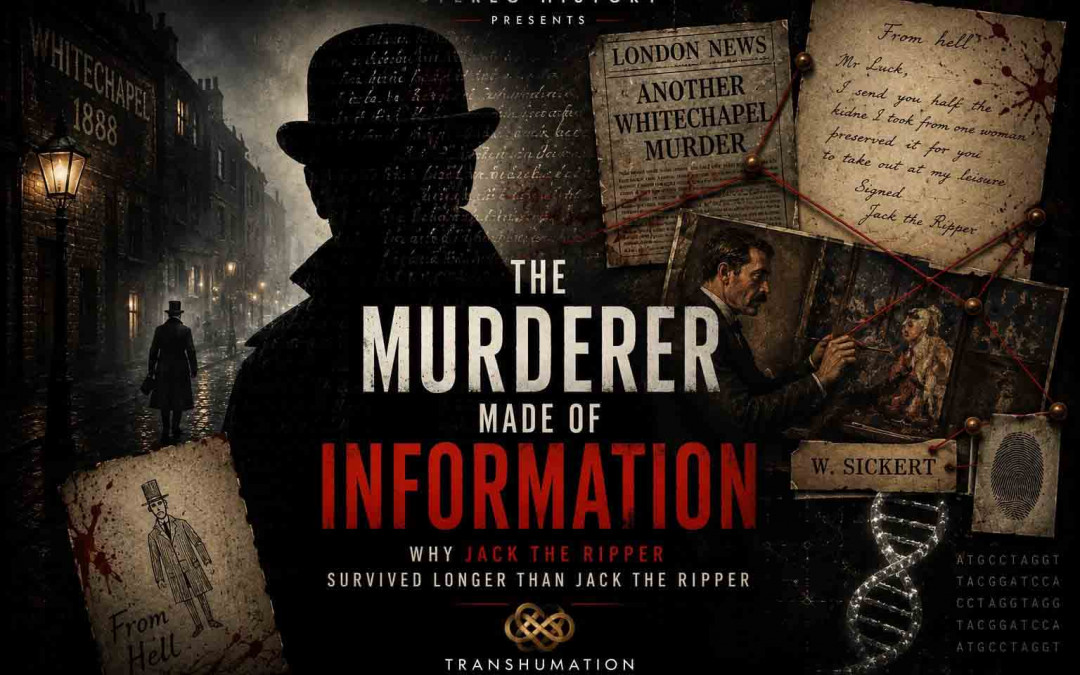
Most murderers die twice.
First physically.
Then historically.
Their bodies disappear.
Their names fade.
Their stories end.
Jack the Ripper followed a different path.
The murders ended.
The man vanished.
Yet something survived.
Not a body.
Not a face.
Not even a confirmed identity.
Information.
And perhaps that changes everything.
The Missing Man
For more than a century, people have searched for Jack the Ripper.
Not metaphorically.
Literally.
Historians.
Detectives.
Psychologists.
Journalists.
DNA specialists.
Everyone asks the same question:
Who was he?
Yet every decade seems to move further away from the man and closer to the traces he left behind.
Letters.
Witness statements.
Photographs.
Maps.
Medical reports.
Newspaper articles.
Handwriting.
DNA samples.
The man disappears.
The information remains.

Walter Sickert and the Information Trail
One of the most famous suspects is Walter Sickert.
An artist.
A storyteller.
A man whose paintings continue to attract attention more than a century after his death.
Supporters of the theory point to similarities between his paintings, letters, habits, and evidence connected to the Whitechapel murders.
Critics point to weaknesses in the evidence.
The debate continues.
Yet something more interesting is happening beneath the debate itself.
The investigation no longer focuses primarily on a person.
It focuses on information.
Researchers compare patterns.
Fragments.
Sequences.
Styles.
Materials.
Traces.
The suspect becomes a puzzle assembled from surviving data.
The Soul Problem Returns
For centuries people imagined identity as something attached to a body.
A person lived.
A person died.
The story ended.
Modern civilization increasingly challenges this assumption.
DNA survives.
Books survive.
Letters survive.
Voices survive through recordings.
Images survive through photography.
Knowledge survives through archives.
Patterns survive through information.
The question changes.
Instead of asking:
„Where is the person?”
We begin asking:
„What remains of the person?”
This is not merely a historical question.
It is a philosophical one.
The Ship of Theseus in Whitechapel
The ancient Ship of Theseus asks whether something remains the same after all of its parts are replaced.
Jack the Ripper presents a strange variation.
The body is gone.
The city changed.
The witnesses died.
The century ended.
Yet the identity persists.
Not as a person.
As an information structure.
The name survives.
The story survives.
The mystery survives.
The pattern survives.
At what point does a collection of information become more durable than the individual who created it?
The Distributed Human
Imagine taking a human being and scattering pieces of them across the world.
A diary in one city.
A photograph in another.
A letter elsewhere.
A DNA sample in a laboratory.
A painting in a museum.
A signature in an archive.
None of these fragments are the person.
Yet together they begin to resemble one.
The individual becomes distributed across information.
Modern investigations increasingly operate this way.
Historians reconstruct lives from fragments.
Archaeologists reconstruct civilizations from fragments.
Future generations may reconstruct us the same way.
Why Jack the Ripper Refuses to Die
Perhaps Jack the Ripper remains famous for the same reason ancient myths survive.
The mystery is incomplete.
The structure remains open.
Every unanswered question creates space for new interpretations.
Every missing detail generates another theory.
The information continues reproducing itself.
Like a living organism.
The man may be gone.
The pattern continues.
The Information Afterlife
Ancient religions imagined survival after death.
Modern civilization often rejects those ideas.
Yet something curious has emerged.
Information possesses a form of persistence.
Not immortality.
Not resurrection.
Persistence.
A book survives its author.
A recording survives its speaker.
A theory survives its creator.
A story survives its participants.
Jack the Ripper may represent one of the earliest modern examples of a person transforming into a self-sustaining information structure.
The body vanished.
The information remained active.
Transhumation
The question is no longer whether Walter Sickert was Jack the Ripper.
The larger question is far more unsettling.
If historians can reconstruct fragments of a human being more than a century after death…
Where does the person actually end?
In the body?
In memory?
In DNA?
In language?
In information?
Perhaps the greatest mystery of Jack the Ripper is not who he was.
Perhaps the greatest mystery is why pieces of him are still here.
And perhaps the future will force humanity to confront an uncomfortable possibility.
The difference between a person and information may be smaller than we once believed.
Want to See More Transhumation`s Perspective..?
Watch The Video Below
Continue reading…
Lucid Nightmare

FAQ
What is The Murderer Made of Information about?
The article explores how identity may persist through information such as letters, DNA, artwork, stories, and historical records.
Does the article claim Walter Sickert was Jack the Ripper?
No. The article uses the debate around Walter Sickert as an example of how investigators reconstruct people from surviving information.
What is meant by information surviving a person?
Books, recordings, DNA, photographs, and other traces can continue influencing the world long after their creators die.
How does this connect to the Soul Problem?
The article examines whether continuity of identity may be better understood through information rather than purely physical matter.
What is the central question of the article?
If a person can be partially reconstructed from distributed information, where does the person end and the information begin?
Why is Jack the Ripper important in this context?
Jack the Ripper became one of history’s most enduring information structures, surviving through mystery, media, and cultural memory.
How does this relate to Transhumation?
Transhumation explores consciousness, identity, memory, and information as part of humanity’s evolving understanding of itself.
Is this article about crime or philosophy?
Both. It begins with a historical mystery but develops into a philosophical exploration of identity and informational persistence.
Continue the Transhumation Series
Explore the full journey:
- End of Reality — Where Do You Really Exist?
- End of Physics — Are the Laws of Reality Real?
- End of the Real World — Reality Is No Longer Required
- End of Consciousness — Beyond the Human Mind
- End of Death — When Human Limits Disappear
- End of Religion — When Technology Replaces Faith