
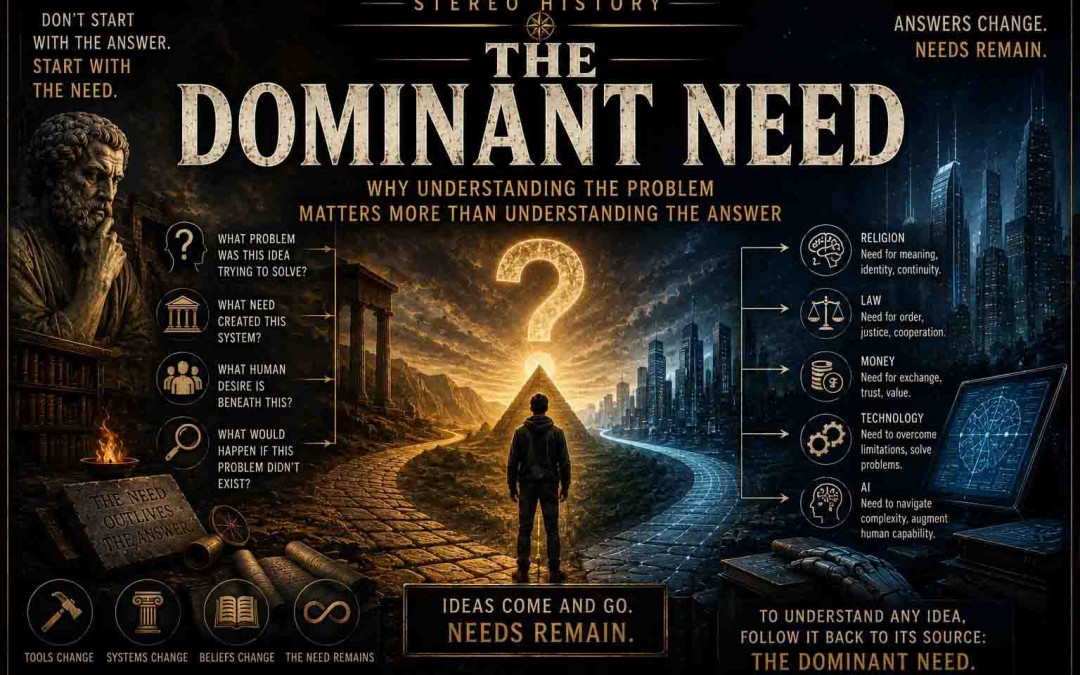
Most people study answers.
Few people study problems.
This may be one of the biggest mistakes in human thinking.
When we encounter a religion, we ask:
Is it true?
When we encounter a technology, we ask:
Does it work?
When we encounter a philosophy, we ask:
Is it correct?
These questions are useful.
But they often miss something more important.
What problem was this idea trying to solve?
The Forgotten Question
Imagine a person discovering a hammer.
The hammer itself is not the important part.
The important part is the nail.
Without the nail, the hammer makes no sense.
The same applies to ideas.
Every idea exists because someone encountered a problem.
Every tool exists because something was difficult.
Every philosophy exists because somebody was dissatisfied with existing answers.
The answer is rarely the beginning of the story.
The problem is.
The Dominant Need
Behind every system lies a dominant need.
Sometimes it is obvious.
A bridge solves the need to cross a river.
A wheel solves the need to move objects.
A library solves the need to preserve information.
Sometimes the need is hidden.
Religion may solve the need for meaning.
Law may solve the need for cooperation.
Money may solve the need for exchange.
Artificial intelligence may solve the need to navigate overwhelming complexity.
The visible solution changes.
The underlying need often remains.

Why Answers Become Obsolete
Most answers belong to a specific time.
Ancient medicine provided answers.
Modern medicine replaced many of them.
Ancient astronomy provided answers.
Modern astronomy replaced many of those.
Yet the underlying needs survived.
People still want health.
People still want understanding.
People still want meaning.
The dominant need outlives the answer.
Looking Beyond the Surface
Consider the idea of the soul.
The usual debate asks:
Does the soul exist?
But another question may be more useful:
What problem was the concept of the soul attempting to solve?
Identity.
Continuity.
Responsibility.
Meaning.
The same approach can be applied to almost anything.
Heaven.
Money.
Governments.
Technology.
Artificial intelligence.
The question remains the same.
What need created this idea?
Why Great Thinkers Ask Better Questions
Many philosophers are remembered because they identified problems others ignored.
Socrates questioned certainty.
Plato questioned reality.
Marcus Aurelius questioned perception.
Thomas Aquinas questioned perfection.
Their answers differed.
The questions survived.
This is often how progress occurs.
Not through better answers.
Through better questions.
Technology as a Tool
Modern people often imagine technology as machines.
Computers.
Robots.
Smartphones.
This is too narrow.
Technology is any tool that solves a problem.
Writing is technology.
Money is technology.
Libraries are technology.
Maps are technology.
Even myths can function as technologies.
They help people navigate realities larger than themselves.
The form changes.
The purpose remains.
The Ladder of Needs
History can be understood as a ladder of dominant needs.
Survival.
Security.
Cooperation.
Knowledge.
Identity.
Meaning.
Participation.
Each generation inherits old needs while discovering new ones.
Civilization climbs because its questions become larger.
Not because its answers become permanent.
The Transhumation Method
The easiest way to misunderstand an idea is to begin with the answer.
The most useful approach is to begin with the need.
Before asking whether something is true, ask what problem it attempts to solve.
Before rejecting an idea, ask why it emerged.
Before accepting a solution, identify the need beneath it.
This simple shift changes everything.
Conclusion
Civilizations are often remembered for their answers.
But answers come and go.
The deeper story is found beneath them.
The history of humanity is the history of dominant needs searching for solutions.
Ideas change.
Tools change.
Technologies change.
The needs remain.
To understand an idea, do not begin with the answer.
Begin with the problem.
And follow it to its source.
Want to Explore More..?
Watch The Video Below
Continue reading…
Soul as Information
FAQ
What is a Dominant Need?
A Dominant Need is the primary problem that gives rise to an idea, technology, institution, philosophy, or belief system.
Why is understanding the problem more important than understanding the answer?
Answers change over time, but the problems that create them often remain. Understanding the problem helps explain why ideas emerge and why some survive.
What problem does religion solve?
Different religions may solve different needs, but common examples include meaning, identity, continuity, morality, and community.
What problem does technology solve?
Technology solves practical and cognitive problems. It allows people to overcome limitations and achieve goals that would otherwise be difficult or impossible.
Can myths be considered technologies?
In a broader sense, yes. Myths can function as tools for understanding reality, transmitting values, and navigating uncertainty.
What is the Transhumation Method?
The Transhumation Method begins by identifying the problem an idea attempts to solve rather than immediately debating whether the idea is true or false.
How does this apply to AI?
Instead of asking whether AI is conscious, the Dominant Need approach asks what human problem AI is attempting to solve, such as complexity, information overload, or decision support.
Why do some ideas survive for centuries?
Ideas often survive because they address recurring human needs that continue to exist across generations.
What is the relationship between Dominant Need and the Ladder of Information?
The Ladder of Information can be understood as a progression of increasingly complex needs and the tools created to address them.
What is the main lesson of The Dominant Need?
To understand any idea, first identify the problem it was created to solve. The need is often more important than the answer itself.
The Core Questions of Transhumation
Explore the full journey:
- End of Reality — Where Do You Really Exist?
- End of Physics — Are the Laws of Reality Real?
- End of the Real World — Reality Is No Longer Required
- End of Consciousness — Beyond the Human Mind
- End of Death — When Human Limits Disappear
- End of Religion — When Technology Replaces Faith