
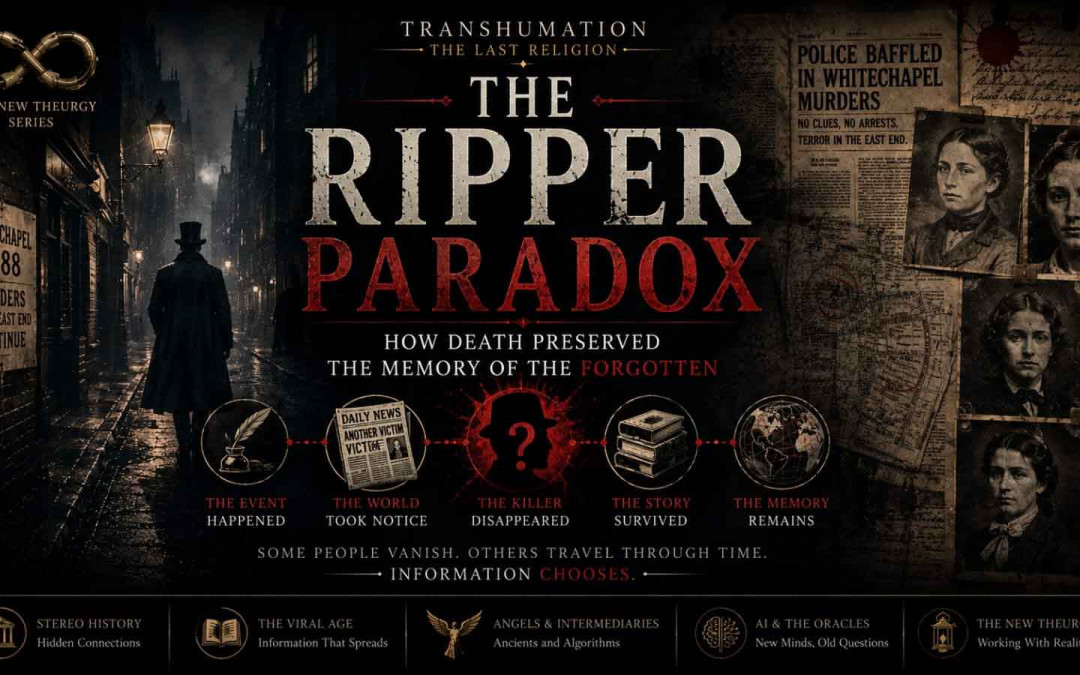
History is unfair.
Some people build civilizations and disappear.
Others become immortal for reasons nobody intended.
Jack the Ripper presents one of the strangest examples.
Millions know the name.
Books continue to be written.
Films continue to be made.
The mystery survives.
But hidden inside this story is a paradox.
The killer became famous.
Yet because of that fame, the victims survived as well.
Death accidentally became an act of preservation.
The Women Nobody Was Supposed to Remember
Victorian London was filled with invisible people.
Workers.
Migrants.
The poor.
The sick.
The forgotten.
Most left almost no trace.
When they died, history moved on.
The women murdered in Whitechapel belonged to this world.
By every normal rule of history, they should have vanished.
No monuments.
No biographies.
No collective memory.
Nothing.
The Unexpected Preservation
Then the murders happened.
The crimes generated newspapers.
The newspapers generated attention.
The attention generated history.
The victims became attached to a story that refused to disappear.
More than a century later, millions still encounter their names.
Not because society intended to honor them.
But because information followed an unexpected path.

The Strange Mathematics of Memory
Normally we imagine memory as a reward.
Heroes are remembered.
Kings are remembered.
Inventors are remembered.
Yet information often behaves differently.
Sometimes history remembers people through events rather than achievements.
The event becomes the vehicle.
The people travel with it.
The Whitechapel murders became such a vehicle.
The Horace Paradox Revisited
Horace believed his poetry would survive because Rome would survive.
He was wrong.
Rome changed.
Empires collapsed.
Yet the information remained.
Something similar happened in Whitechapel.
The victims did not survive because institutions protected them.
They survived because a narrative carried them forward.
Information once again outlived the structures that produced it.
What Actually Became Immortal?
People often say Jack the Ripper became immortal.
But did he?
Nobody knows his identity.
Nobody knows his face.
Nobody knows his biography.
The person disappeared.
Only the narrative survived.
The immortality belongs less to the killer than to the information.
The story became immortal.
And everyone attached to it traveled through time together.
The Viral Age
The modern world constantly produces similar phenomena.
Events become larger than individuals.
Narratives become larger than facts.
Information becomes larger than institutions.
The people involved are remembered not because they sought immortality.
But because they became part of a story that continued reproducing itself.
Stereo History
History is often described as the story of winners.
The Ripper Paradox suggests something stranger.
Sometimes memory survives through unexpected connections.
Sometimes information rescues what society ignored.
Sometimes the forgotten become visible because they were attached to something impossible to forget.
Jack the Ripper remains one of history’s darkest stories.
Yet hidden within it lies an uncomfortable truth.
Without the narrative, the victims would likely have disappeared.
Instead, they remain present.
Not because death destroyed them.
Because information preserved them.
That is the Ripper Paradox.
Want to Know More…
Watch The Video Below
Continue reading…
When Patterns Become Meaning
FAQ
What is the Ripper Paradox?
The Ripper Paradox is the idea that the Jack the Ripper story preserved the memory of people who would otherwise have disappeared from history.
Why are the victims central to this paradox?
Because their names survived through a narrative that became globally famous.
Did Jack the Ripper become immortal?
The article argues that the narrative became immortal, not necessarily the person behind the crimes.
How does information preserve memory?
Stories, records, and narratives can survive for centuries, carrying people and events forward through time.
What does this have to do with The Viral Age?
The Viral Age explores how information reproduces itself and continues existing independently of its creators.
How is this related to the Horace Paradox?
Both concepts explore how information can outlive institutions, empires, and physical structures.
Why is Whitechapel important?
Whitechapel became one of the first places where media attention transformed local events into global narratives.
Does the article glorify the killer?
No. The article focuses on memory, information, and the unexpected preservation of people history would normally forget.
What survived: the person or the story?
The article argues that the story survived far more completely than the person.
What is the central message?
Information often preserves memory in unexpected ways, allowing forgotten people to survive through narratives that outlive generations.
The Core Questions of Transhumation
Explore the full journey:
- End of Reality — Where Do You Really Exist?
- End of Physics — Are the Laws of Reality Real?
- End of the Real World — Reality Is No Longer Required
- End of Consciousness — Beyond the Human Mind
- End of Death — When Human Limits Disappear
- End of Religion — When Technology Replaces Faith