
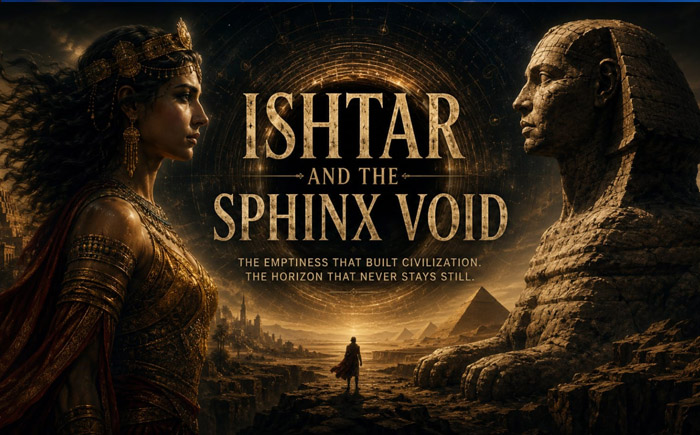
The Emptiness That Built Civilization
Why Reaching the Horizon Never Seems to Be Enough
There is a peculiar moment after buying something you have wanted for a long time. For several weeks it may have occupied an unreasonable amount of mental space: the watch, the car, the house, the object seen through a shop window or saved in a browser tab. Before it belongs to you, it contains possibilities. You imagine using it, owning it, perhaps even becoming slightly different because of it. Then the transaction happens. The box is opened. For a few days the object seems brighter than everything around it.
Six months later, it is simply yours.
Nothing has necessarily gone wrong. You may still like it. The mistake was subtler: somewhere between wanting and having, the object had acquired responsibility for a feeling it could never permanently provide. The destination was real; what disappeared was its distance. Once reached, it could no longer function as a horizon.
Children discover this with toys. Adults repeat the experiment with careers, relationships, money, travel, status, knowledge and sometimes entire empires. We give the destination increasingly sophisticated names, but the strange mechanism survives. Something is missing. We move toward it. For a moment the gap closes.
Then another gap appears.
Psychology has explanations for parts of this process. Evolution has others. Religion and mythology approached it through stories and figures long before either discipline existed. In the Ishtar Cycle, Transhumation gives the recurring absence a working name of its own:
the Sphinx Void.
Not because the Sphinx is empty.
Because it keeps asking another question.
When Enough Stops Being Enough
It is tempting to begin with hunger. An animal needs calories; it searches for food; it eats. The loop appears beautifully simple. Human beings possess the same biological machinery, but human motivation cannot be reduced to it. Once immediate survival becomes reasonably secure, desire does not retire. It changes clothes.
The person who wanted food may begin wanting comfort. Comfort makes freedom imaginable. Freedom makes achievement possible. Achievement introduces comparison. Comparison can generate status. Status may create a desire for significance. Someone who once dreamed of earning enough money to stop worrying can eventually possess more than he could reasonably spend and discover that the number itself has become a game.
This does not mean animals are creatures of perfect satisfaction while humans alone suffer metaphysical hunger. Other animals display play, exploration, social competition and complex motivations. Nor does it mean poverty or insecurity are secretly useful because dissatisfaction creates progress. Material deprivation is real, and removing it matters.
The interesting problem begins after the obvious explanation stops working.
Why can abundance coexist with incompleteness?
Part of the answer may lie in adaptation. Human beings often become accustomed to changed circumstances; pleasures that initially dominate attention can become ordinary. Part may lie in social comparison. Part may simply follow from imagination. A creature capable of constructing futures can compare the present not merely with the past but with worlds that do not yet exist.
That ability is astonishing.
It is also dangerous.
A zebra cannot be disappointed that it never became emperor of France.
A human being can be disappointed by almost anything he can imagine.
The Sphinx Does Not Need an Answer
The Sphinx Void is not meant as another name for unhappiness. A perfectly content person can still wonder what lies beyond the mountain. An artist can love a finished painting and want to begin another. A scientist can celebrate an answer precisely because it has revealed a better question.
The distinction matters.
Ordinary lack points toward an object. Hunger asks for food. Cold asks for warmth. The Sphinx Void is stranger because its object can change while the underlying structure remains. The promotion arrives, but the question survives. The journey ends, but another map appears. The book is written, and almost immediately its author sees what the next book would have to solve.
This is why the Sphinx is a useful symbol. A riddle creates movement not by physically pushing the traveler but by creating an unresolved relation between what is known and what might be known. Until the answer arrives, there is tension. When the answer arrives, a sufficiently curious mind does not necessarily become peaceful. It discovers the next boundary.
Every answer increases the coastline of the unknown.
The Sphinx Void therefore need not be a hole waiting to be filled. It may be something closer to a difference between the present world and an imaginable world.
And once an imaginable world exists, movement becomes possible.

Ishtar Enters Through the Wrong Door
This is where Ishtar becomes tempting—and where we have to resist making her too convenient.
Historically, Ishtar was not the Mesopotamian goddess of the Sphinx Void. Ancient texts do not present a doctrine in which she represents humanity’s permanent dissatisfaction with achieved goals. She was a major and complicated deity associated, in different traditions and contexts, especially with sexuality and love, warfare and political power, and she was connected with Venus. Her Sumerian counterpart Inanna had an equally rich religious and literary history.
Turning all of that into “Ishtar means ambition” would tell us more about ourselves than about Mesopotamia.
But telling us something about ourselves is precisely what a modern interpretation can legitimately do, provided we label it as such.
Ishtar is interesting because the domains surrounding her are rarely static. Desire pulls one person toward another. War violently changes political order. Kingship seeks and performs power. In the myths surrounding Inanna and Ishtar, boundaries are crossed, statuses altered, powers contested, consequences unleashed. Even Venus—the brilliant celestial body with which she was associated—appears alternately as morning and evening star.
The historical goddess does not reduce to transformation.
But transformation seems remarkably comfortable in her company.
So instead of claiming that Ishtar was the Sphinx Void, we can ask whether she offers an ancient mirror for a modern structural question: what happens when desire becomes a force that changes the world?
Sometimes it produces a lover.
Sometimes a conqueror.
Sometimes a civilization.
Alexander Reaches the End of the World
Alexander the Great is often recruited into stories about insatiable ambition because his biography seems almost designed for the role. Before reaching thirty-three, he had inherited Macedonia, defeated the Persian Empire, taken Egypt, campaigned through Central Asia and crossed into the Indian subcontinent. A person looking at a modern atlas can trace the achievement with one finger.
Alexander had no such view.
His world appeared incrementally. Every conquered territory changed what could be reached next. Every victory supplied resources, political obligations, enemies and possibilities that had not existed in the same form before the victory. Success did not merely satisfy an ambition. It enlarged the field in which ambition could operate.
We should be suspicious of the familiar psychological portrait of Alexander as a man who simply “couldn’t stop.” Ancient sources were written under particular political and literary conditions, and famous anecdotes about his limitless ambition should not be mistaken for access to his private mind.
But the structure of expansion is visible without psychoanalyzing him.
Capability changes the horizon.
Before Persia falls, Persia is the enormous objective. After Persia falls, the territories beyond it become imaginable in a different way. Yesterday’s impossible boundary becomes tomorrow’s logistical problem.
This may be one of the hidden engines of progress. We often imagine civilization moving because a destination attracts it. Yet movement itself creates destinations that could not previously be seen.
The first ship does not merely reach another shore.
It reveals that there are more shores.
The Emptiness Gets an Engineering Department
Once this structure is visible, ordinary history begins to look different.
Why build a taller building after learning to build a tall one? Why construct a more powerful telescope after the previous telescope has already shown us more of the universe than any human generation had seen? Why go to the Moon and then immediately begin discussing Mars? Why build artificial intelligence capable of navigating enormous quantities of information and then ask whether it can reason better, remember longer, discover independently or perhaps eventually become conscious?
“Because we can” is usually treated as a shallow answer.
It may be deeper than it sounds.
New capability changes the boundary between possible and impossible. Once the boundary moves, possibilities that previously belonged to fantasy become available for desire. Nobody in ancient Babylon was frustrated by the absence of Wi-Fi. Nobody in eighteenth-century Europe felt deprived because his telephone lacked a camera. A technology can create the expectation by which its successor will be judged.
Civilization therefore does not merely satisfy needs.
It manufactures new categories of need.
The first library solves the problem of preserving books and creates the problem of organizing them. The catalogue solves organization and reveals the problem of finding relationships across an enormous collection. The search engine solves part of that problem and produces an ocean of results. Artificial intelligence promises to help navigate that ocean, and almost immediately we encounter a new problem: how do we evaluate a guide capable of reading more than we can personally verify?
The library grows.
So we need a librarian.
Then the librarian becomes powerful enough that we need to understand the librarian.
The Sphinx has not disappeared.
It has upgraded the question.
The Machine That Cannot Say “Enough”
This is where the romantic version of dissatisfaction becomes dangerous.
It is easy to praise the Void while standing in front of a cathedral, a spacecraft or a scientific breakthrough. The same structure looks different in an addict, an empire unable to stop expanding, a market that requires endless growth, or a person who has converted every experience into preparation for the next achievement.
Movement has no built-in moral direction.
More is not a synonym for better.
The Sphinx Void can drive a scientist toward a cure, but it can also make success psychologically invisible the moment it is achieved. It can turn curiosity into discovery and appetite into consumption without limit. A civilization organized entirely around dissatisfaction might become extraordinarily productive while losing the ability to recognize what its productivity was supposed to achieve.
This produces a more interesting question than whether dissatisfaction is good or bad.
Can intelligence know when to stop?
The problem becomes especially important in the age of optimization. Machines can be given goals. Institutions can maximize metrics. Algorithms can improve engagement, efficiency or profit. Yet optimization is not wisdom. A system can become extraordinarily effective at moving toward a measurable horizon without possessing any independent reason to ask whether the horizon was worth reaching.
Humans are not immune to the same mistake.
Perhaps we invented it first.
The Treasure Behind the Treasure
Most adventure stories begin with an object. A treasure. A missing person. A mysterious island. A door that should not be opened. The object gives the child a reason to unfold the map.
But the best adventures quietly change the value of the object while the journey is taking place.
By the time the treasure is reached, the traveler is no longer exactly the person who wanted it.
That may be the crucial distinction between desire and meaning. Desire creates motion by pointing toward what is absent. Meaning asks whether the person produced by the journey still recognizes the destination as valuable.
Civilization has become extraordinarily good at the first operation.
We are getting better at crossing oceans, genomes, planetary distances and informational spaces. Artificial intelligence may accelerate the process dramatically. We may soon possess tools capable of turning questions into capabilities at a speed no earlier civilization experienced.
The old problem will remain waiting for us.
Not Can we reach the horizon?
We have become very good at that.
The Sphinx asks something worse:
What if the horizon was never the thing we were looking for?
Watch the Video
How to Read the World

Current Knowledge
Ishtar was one of the major deities of ancient Mesopotamia and was closely identified with the Sumerian Inanna. Her historically attested associations include sexuality and love, warfare and political power, and the planet Venus. She should not historically be described simply as a goddess of dissatisfaction, progress or “becoming”; those are modern interpretive categories.
Alexander III of Macedon conquered the Achaemenid Persian Empire and campaigned as far as the northwestern Indian subcontinent before his death in 323 BCE at the age of thirty-two. Although later tradition frequently presents him as possessing limitless ambition, his private psychological motivations cannot be reconstructed with certainty from surviving ancient sources.
Psychological research supports phenomena broadly associated with adaptation to changed circumstances, including forms of hedonic adaptation. Human motivation and well-being, however, are affected by many factors, and there is no established psychological entity called the “Sphinx Void.”
Open Questions
We still do not have a simple explanation for why human aspirations so often expand after earlier goals have been achieved. Biological drives, reward systems, social comparison, cultural expectations, imagination and individual personality may all contribute.
It is also unclear how much dissatisfaction civilization actually requires. Curiosity and ambition can generate discovery without necessarily requiring chronic unhappiness. A society capable of contentment might still innovate; conversely, a society incapable of recognizing “enough” could generate enormous progress while undermining its own well-being.
AI introduces a new version of the question. If technology lowers the cost of solving problems and creating new possibilities, will humans become more satisfied—or will the production of new horizons accelerate faster than our ability to choose among them?
Transhumation Interpretation
The Sphinx Void is a Transhumation hypothesis, not a recovered ancient doctrine.
It begins with a simple structure:
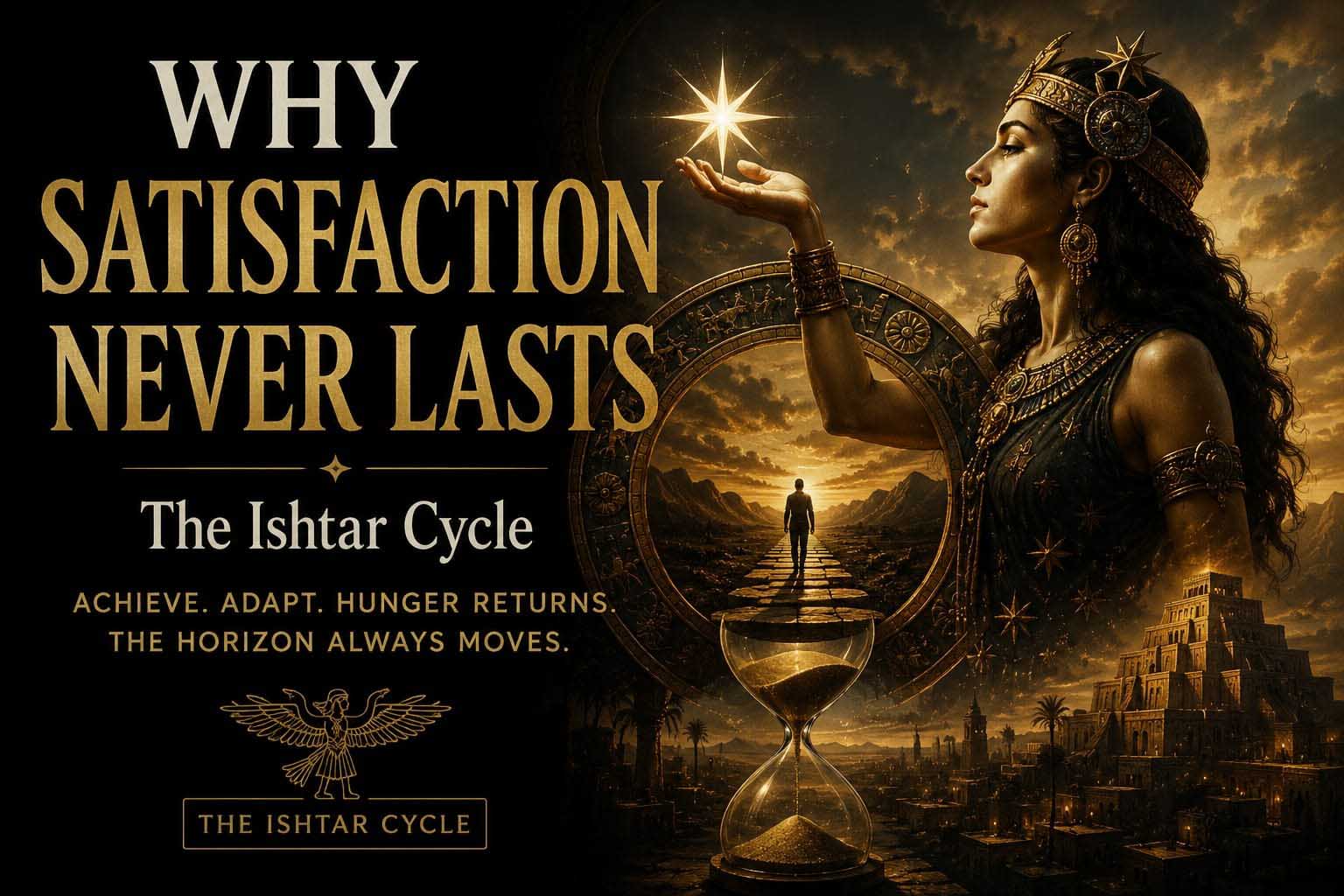
absence → desire → movement → achievement → adaptation → new absence.
The object can change while the structure survives. Once the desired object was territory. It can become knowledge, wealth, beauty, technological capability, longevity or intelligence. Each new carrier gives the ancient movement another form.
Ishtar enters this model not because Mesopotamians secretly encoded a theory of progress in a goddess, but because her historical complexity gives us an unusually powerful mirror for desire that transforms what it touches. She cannot safely be reduced to “progress,” because she also carries conflict, danger and power. That ambiguity is precisely what the model needs.
The Sphinx adds the second half.
Ishtar moves.
The Sphinx asks why.
Together they expose a problem at the center of Transhumation. Humanity’s ability to become something else may be inseparable from its inability to regard its present condition as final. That dissatisfaction helped produce civilization. It may eventually produce artificial minds, radical longevity, new forms of human identity and journeys beyond Earth.
But the existence of another horizon is not evidence that we should cross it.
Perhaps maturity—personal or civilizational—begins when we can preserve the force that moves us without becoming its servant.
The Void says there is more.
Ishtar says move.
The Sphinx asks the question that neither progress nor desire can answer for us:
Why?
FAQ
What is the Sphinx Void?
It is a Transhumation concept describing the recurring gap between reaching one goal and discovering another horizon beyond it.
Is the Sphinx Void a psychological condition?
No. It is a philosophical model, not a recognized diagnosis or scientific term.
Was Ishtar historically the goddess of dissatisfaction?
No. Ishtar was associated particularly with love, sexuality, warfare, power and Venus. Her connection with the Sphinx Void is a modern Transhumation interpretation.
Why is Alexander the Great used as an example?
His expanding conquests illustrate how increased capability can reveal new possible horizons, although we cannot know his private motivations with certainty.
Does dissatisfaction create civilization?
It can contribute to exploration, invention and ambition, but civilization also depends on cooperation, necessity, curiosity and many other forces. Dissatisfaction alone is not an explanation of progress.
Why can success fail to satisfy permanently?
Humans can adapt to improved circumstances, while new possibilities and comparisons can create new goals after earlier ones have been achieved.
What does AI have to do with the Sphinx Void?
AI may accelerate our ability to solve problems while simultaneously creating possibilities—and therefore questions—that previously did not exist.
Is the Sphinx Void good or bad?
Neither inherently. The same drive can produce discovery or obsession. The important question is whether movement serves a worthwhile destination.
How does this connect to Transhumation?
It asks whether humanity can continue transforming without assuming that every possible transformation is automatically worth pursuing.
Continue the Transhumation Series
- Forgotten Religion | Ancient Gods, Symbols and the Hidden Structures of Human Civilization
- The Last Religion | Death, Immortality and the Future of Humanity
- The New Theurgy | AI, Information and the Future of Human Civilization
- End of Branding: You Were Never Meant to Become a Product
- Baal vs Ishtar: Why Ancient Gods Never Disappeared