
The Gods Who Still Need Thrones
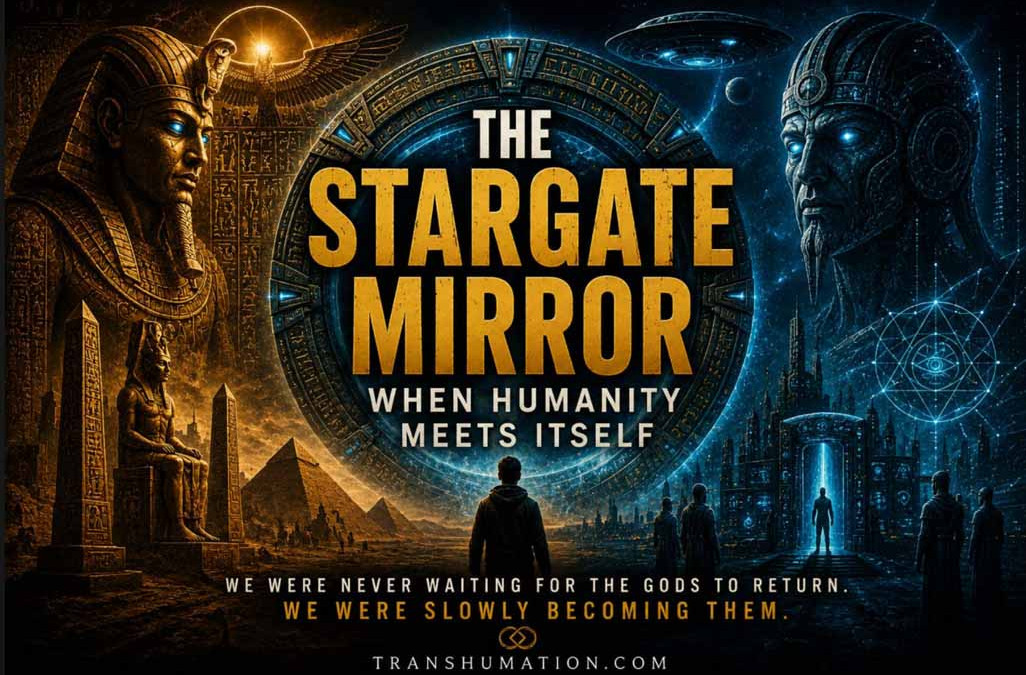
There is a wonderfully old-fashioned contradiction at the heart of Stargate. Human beings discover a machine buried at Giza, decipher its symbols and step through a doorway to another world, where they encounter an intelligence possessing technology so far beyond their own that ancient people could reasonably have interpreted its abilities as divine. Yet when the god finally appears, something unexpectedly familiar happens. He has a palace, guards and subjects; he surrounds himself with ceremony, expects obedience and rules through fear. His technology has crossed interstellar distances, but his political imagination seems barely to have left the ancient world.
This is usually accepted as part of the adventure. Stargate takes Egyptian mythology and gives it a science-fiction mechanism: perhaps the gods were not supernatural beings but technologically advanced visitors whose machines looked miraculous to people unable to understand them. The spaceship replaces the divine chariot, the energy weapon replaces supernatural force, and the gate turns a journey between worlds into engineering. Yet almost everything changes except the god himself. Ra remains recognizably a king, which raises a more interesting question than whether ancient Egyptians once encountered extraterrestrials: why, when modern humans tried to imagine an intelligence vastly more advanced than ourselves, did we still put it on a throne?
The Pharaoh Inside the Spaceship
This may simply be good cinema. A completely alien intelligence would be difficult to write, difficult to perform and perhaps impossible for an audience to understand emotionally. Stories need motives, and human motives are the easiest ones we possess. So we give our extraterrestrial emperor familiar appetites: domination, obedience, status, fear of rebellion and a desire to be worshipped. The audience immediately knows what kind of danger has entered the room.
But this storytelling convenience reveals something deeper about imagination. When human beings picture greater intelligence, we often expand capability while leaving psychology almost untouched. The superior being lives longer, travels farther, knows more and commands extraordinary machines, but somehow still wants the same things as an earthly ruler. We imagine the god as a human being with the sliders pushed upward.
That may also explain why so many traditional images of divinity remain recognizably political. Gods sit on thrones, command armies, issue laws, reward loyalty and punish disobedience. The language made sense because political hierarchy was one of the most powerful structures available to human experience. If you wanted to imagine an authority above kings, it was natural to imagine something like a king above kings. The image was not necessarily stupid. It was built from the highest rung the observer could already see.
The problem begins when we mistake the rung for the destination. A being capable of crossing interstellar distances might not merely possess more power than a human ruler. Its relationship to identity, time, ownership, conflict and hierarchy might be so different that the word king would no longer help. Stargate gives us a technological leap while preserving a Bronze Age social interface, and that mismatch may be the most revealing part of the film.
Alexander at the Control Panel
Imagine handing Alexander the Great a smartphone. The first minutes would be almost impossible to explain: light without flame, a surface responding to touch, voices arriving without visible messengers, maps that know where the device is located. Yet after a short demonstration, something curious would happen. Alexander would begin recognizing functions long before he understood mechanisms.
A map is still a map. A message is still a message. Translation still solves the problem of language. A photograph preserves an appearance. A search function behaves like access to an impossibly large library. Alexander would not need semiconductor physics, orbital mechanics or telecommunications engineering before he could begin using the object intelligently. The modern world would remain incomprehensible underneath, while the interface converted that incomprehensibility into a handful of gestures.
This is a more useful way to think about supposedly godlike technology than simply saying that the ancients would have called a smartphone magic. Magic is only the initial reaction. The more interesting achievement is that an object containing layers of knowledge unavailable to Alexander could become usable to him because complexity has been hidden behind symbols.
Modern civilization works this way everywhere. We drive without understanding combustion chemistry or power electronics in full. We transfer money without understanding the entire banking system. We navigate by satellite without understanding relativistic corrections or radio engineering. We ask artificial intelligence questions while possessing only a partial understanding of what occurs inside a large neural network. Civilization becomes more complicated below the surface while increasingly presenting itself through simple doors.
That may be the real significance of the gate in Stargate. The extraordinary technology is not merely powerful. It has an interface.

Why a God Needs a Face
Ancient symbols may deserve to be considered from the same structural angle, without pretending that religion was simply primitive computing. A divine image could gather an enormous field of meaning into something a person could approach. A face, an animal, a crown, a torch or a particular place did not need to contain the entire theology. It gave human attention a point of contact.
Modern systems do this constantly. A nation becomes a flag; a corporation becomes a logo; an application becomes an icon; thousands of pages of rules become a button marked Accept. The symbol is radically smaller than the structure it represents. Its usefulness comes precisely from that compression.
This is why the Transhumation reading of ancient gods does not require an ancient-astronaut story. The more interesting question is whether some of the functions attached to divine figures survive even after the historical theology changes. Hecate can disappear as an active cult while crossroads, thresholds and irreversible decisions remain. Fortuna can disappear while uncertainty continues to shape lives. Baal can disappear while institutions still grow large enough to constrain the people who created them.
The face may have been historically specific while the relationship it helped organize proved more durable. That does not mean the ancients secretly meant exactly what we mean by systems theory. It means the symbol may have been doing more than depicting a supernatural personality. It may also have been giving a human-scale interface to something too distributed, abstract or powerful to hold directly in mind.
Seen this way, the ancient god and the modern icon are not the same thing, but they may share one important function: both allow a finite observer to interact with something larger than the representation itself.
The Mirror That Turns Around
The traditional direction of religious imagination is upward. Humans look toward the sky and imagine beings capable of doing what humans cannot: moving between worlds, seeing distant events, knowing hidden things, transforming life, surviving death and commanding forces of nature. The divine occupies the territory beyond the current human boundary.
Technology has slowly complicated that picture because some abilities once experienced as unreachable have moved into ordinary life. We can see distant parts of the planet in real time, communicate almost instantly across continents, alter living organisms, build machines that leave Earth and consult systems capable of processing more information than any individual could read.
None of this makes us gods. The phrase becomes misleading very quickly. Human beings remain fragile, limited and often spectacularly confused about the consequences of their own inventions. But the boundary between things humans can do and things only gods could do has clearly moved.
That creates a different mirror test. Instead of asking only what a greater being could do, we can ask what happens when humanity begins performing actions that earlier cultures placed on the other side of the human-divine divide. At some point, the surprising statement is no longer “a god can do this,” but “we can do something faintly analogous now.”
The comparison should increase caution rather than self-importance. Ra is technologically magnificent and morally primitive. He possesses the machinery of a god while retaining the psychology of a despot. Perhaps this is Stargate’s best accidental warning: technological ascent and psychological ascent are not the same process.
A species can climb rapidly in capability while carrying very old structures upward with it.
The Real Stargate
This is why the gate itself is ultimately more interesting than the alien ruler. It is a circle covered in symbols standing between two worlds. At first it appears to be an inert object. Then the correct sequence is discovered, and what looked like a wall becomes a passage. Nothing mystical needs to happen to the material world; the important transformation occurs in the relationship between the observer and the structure.
That pattern has appeared throughout the Information Ladder. Alexander could walk across a geographical shape he could not see from above. Napoleon could gain an entirely different kind of strategic awareness from a modern observational level. The smartphone hides enormous technological complexity beneath a symbol. The fish discovers that what seemed like empty background was actually the medium containing its whole world. In each case, the next rung is reached when something previously experienced only from inside becomes available as a structure.
Stargate gives us the same adventure in a more literal form. A symbol is decoded. A boundary changes meaning. Another world becomes accessible. Yet the most interesting Transhumation question begins after the gate opens.
What do we carry through it?
If humanity becomes capable of creating minds, radically extending life, engineering biology or spreading beyond Earth, the dramatic part will not only be the new capability. It will be whether we continue organizing those powers with psychological and political structures inherited from a far smaller world.
Ra crossed the stars and brought a throne with him.
We should not assume we will automatically do better.
Perhaps the real threshold is not between Earth and another planet, nor between human technology and the technology of gods. It lies between acquiring a new power and developing a mind capable of understanding what that power has changed.
A civilization may eventually learn how to build the chariot that reaches the stars.
The harder question is whether anyone remembers to leave the crown behind.
Watch the Video
How to Read the World
Current Knowledge
The 1994 film Stargate is a work of science fiction in which an extraterrestrial being associated with Ra uses advanced technology and has influenced an ancient human civilization. There is no credible historical evidence that ancient Egyptian gods were extraterrestrials or that Egyptian religion originated through contact with technologically advanced visitors.
Ancient Egyptian religion was far more complex than the idea of gods as merely powerful human-like rulers. Divine figures could appear in human, animal and composite forms, while temples, cult images, names and rituals played different roles in relationships between human communities and divine powers.
Modern technology does provide capabilities unavailable to ancient civilizations, including global communication, satellite navigation, real-time imaging, advanced computation and genetic engineering. The fact that such abilities might have appeared extraordinary to ancient observers does not make them equivalent to ancient religious concepts of divinity.
Modern user interfaces allow people to operate highly complex technological systems without understanding every underlying mechanism. Symbols, icons and simplified controls reduce the cognitive burden required to use systems whose technical foundations may involve many specialized fields.
Open Questions
Why do humans so often imagine superior intelligence as a more powerful version of familiar human psychology rather than something genuinely different?
Would an intelligence millions of years more advanced than humanity still care about status, hierarchy, territorial control or worship, or are those concerns partly products of mortal biological and social conditions?
When a capability once considered impossible becomes ordinary technology, does the idea of the divine simply retreat to another boundary, or was technological capability never the most important feature of divinity in the first place?
Can symbols preserve useful structural relationships even after the cosmologies that originally surrounded those symbols disappear?
And if humanity eventually creates intelligences cognitively superior to itself, will we recognize a genuinely unfamiliar psychology—or force it into the familiar roles of ruler, servant, oracle and god?
Transhumation Interpretation
Transhumation does not treat Stargate as evidence for ancient astronauts. It uses the film as a mirror for a more difficult human habit: we are better at imagining greater power than greater perspective.
Ra is technologically beyond humanity yet socially recognizable. His machines belong to the stars while his political structure belongs to the palace. That mismatch exposes a possible limitation in our own imagination. We enlarge the human being until it resembles a god without asking whether a sufficiently transformed intelligence would still resemble a human being at all.
The Information Ladder therefore separates capability from observer position. A civilization may acquire new powers while remaining psychologically trapped on an older rung. True transformation would involve not merely carrying stronger tools through the gate, but becoming capable of seeing which inherited structures no longer belong on the other side.
That is also why gods remain useful to Transhumation. Not as proof of extraterrestrials, and not simply as fictional characters, but as interfaces through which humans repeatedly tried to imagine powers, perspectives and structures larger than themselves.
The final question is therefore not whether the gods will return in spaceships.
It is whether, when humanity finally reaches the place where it once imagined the gods living, we will discover that our machines evolved much faster than we did.
FAQ
Is Stargate based on real ancient Egyptian history?
No. The extraterrestrial explanation of Egyptian gods in Stargate is a fictional science-fiction premise rather than an accepted historical theory.
Does this article claim that ancient gods were aliens?
No. Transhumation is interested in whether functions and structures can survive changes of symbol or carrier, not in using ancient mythology as evidence for extraterrestrial visitors.
Why is Ra’s throne important?
Because it reveals the central contradiction of the article. Ra possesses extraordinarily advanced technology while retaining a political psychology that remains recognizable as ancient monarchy.
Would ancient people regard a smartphone as magic?
Its mechanisms and many of its capabilities would be extraordinarily difficult to explain within an ancient technological framework, but a person could potentially learn to use its interface without understanding the engineering beneath it.
What does the Stargate symbolize in this interpretation?
It represents a threshold between levels of understanding. Once the correct symbols and relationships are known, a boundary that seemed absolute becomes navigable.
Are symbols treated as interfaces in Transhumation?
Yes, structurally. A symbol can provide a manageable point of access to a much larger system of meaning or function without containing the complete system itself.
Are humans becoming gods?
The article deliberately avoids that claim. Humans are gaining capabilities once unavailable to earlier civilizations, but technological power does not automatically imply wisdom, divinity or superior moral understanding.
Why does the article compare gods with technology?
The comparison tests which supposedly divine capabilities remain impossible when technology advances and which features of divinity may have depended on something deeper than raw capability.
What is the difference between capability and perspective?
Capability concerns what an intelligence can do. Perspective concerns what structures it can see and understand. One can increase without the other.
What is the central Transhumation question?
If we eventually acquire the technology once reserved for gods, will we have become something new—or merely old kings with better machines?
Continue the Transhumation Series
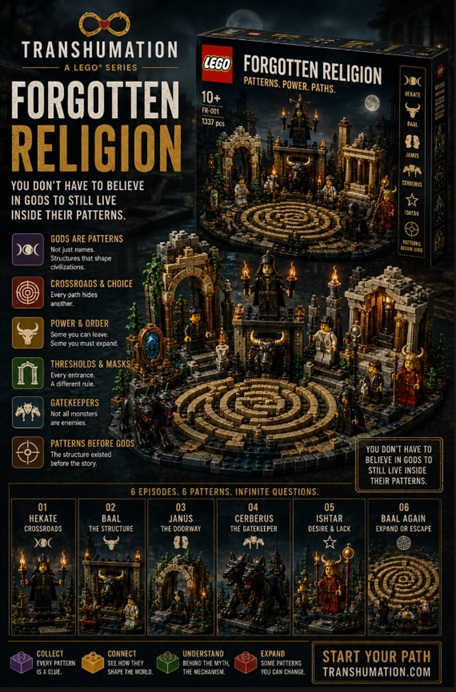
- Forgotten Religion | Ancient Gods, Symbols and the Hidden Structures of Human Civilization
- The Last Religion | Death, Immortality and the Future of Humanity
- The New Theurgy | AI, Information and the Future of Human Civilization
- End of Branding: You Were Never Meant to Become a Product
- Baal vs Ishtar: Why Ancient Gods Never Disappeared