
How Simple Instructions Create Worlds
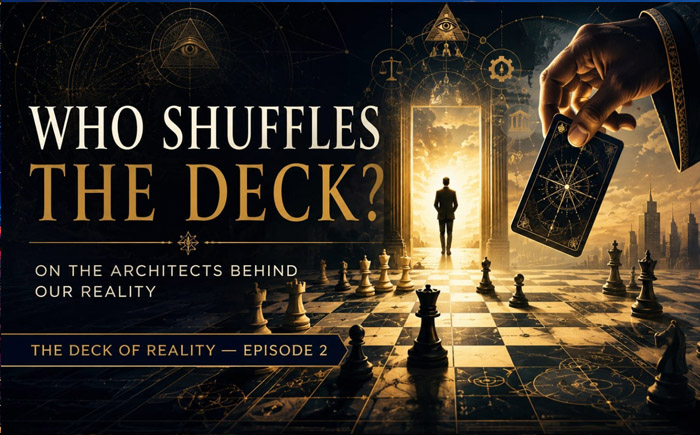
A chessboard is a remarkably small universe.
Sixty-four squares. Thirty-two pieces. A limited set of movements that can be taught in an afternoon. Nothing about the basic geometry is hidden. Both players can see the same board, count the same pieces and consult the same rules.
And yet the first thing an experienced player learns is how little the rules tell them about the game.
A pawn advances one square and a weakness appears twenty moves later. A bishop that seems useless becomes decisive after the center opens. A harmless exchange changes the character of an endgame that does not yet exist. Two players can agree completely about what is legal and disagree profoundly about what the position means.
This is one of the quiet mysteries of structured systems.
The rules may be clear.
Their consequences may not be.
A civilization fascinated by hidden codes often looks for mystery outside structure: secret forces, lost knowledge, concealed intentions. But some of the deepest mystery may require nothing hidden at all.
Sometimes everything is visible.
There is simply too much consequence inside the rules for one observer to see at once.
How Can Simple Rules Create Complex Worlds?
Complexity does not always require complicated foundations.
A small alphabet can participate in the construction of an enormous literature. A relatively compact set of grammatical conventions can support sentences nobody has previously spoken. A market can arise from countless local exchanges without any single participant designing the total pattern of prices, shortages, fashions and bubbles that emerges.
Games make this easier to see because the world has been deliberately reduced.
The chessboard is bounded.
The pieces are known.
The legal actions are explicit.
Still, possibility expands rapidly because every move changes the set of meaningful moves that follow.
The important distinction is between rules and state.
Rules describe what transformations are permitted.
The current state records where the system happens to be.
History is produced by repeated interaction between the two.
That is why the same rules can generate radically different games.
The rules have not changed.
The path has.
The Creator Does Not Own Every Consequence
A designer creates a game by specifying constraints.
Players then discover what those constraints allow.
The distinction seems obvious, but it carries a surprisingly large philosophical implication: creating a system is not the same as exhausting its possibility space.
Game designers regularly encounter strategies, combinations and exploits they did not explicitly imagine. Programmers build software that users appropriate in unexpected ways. Social platforms create features for one purpose and discover that communities have turned them into something else entirely.
Nothing supernatural has occurred.
The rules interacted with participants.
Once a system contains enough possible combinations, the intentions of the founder become only one influence among many.
This complicates a comforting idea of creation.
We often imagine creators as possessing a privileged understanding of what they created.
Sometimes they do.
But knowing why a system was built is not identical to knowing everything the system can become.
A creator may know the source code and still misunderstand the culture produced around the product.
They know the entrance.
Not necessarily the entire building that later grows around it.
What Is Emergence?
The word emergence is useful precisely because it names patterns that are easier to describe at one level than another.
A single ant follows relatively local signals. A colony can nevertheless display organized foraging, nest construction and collective responses that no individual ant appears to represent as a complete plan.
No individual speaker controls a language.
Still, pronunciations shift, meanings migrate, grammatical forms appear and disappear, and eventually children inherit a language slightly different from the one their grandparents learned.
No single internet user designs internet culture.
Millions of local actions nevertheless produce communities, fashions, memes, conflicts and institutions.
The higher-level pattern is not imaginary simply because no central planner designed it.
But emergence should not become a mystical escape hatch.
A pattern can emerge for different reasons: repeated interaction, feedback, network structure, nonlinear dynamics, adaptation, competition or simple combinatorial growth.
Saying that something emerged is often the beginning of explanation.
Not the end.
The Rule and the Consequence
A rule tells us what an action does immediately.
It rarely tells us everything the action will eventually cause.
Move the pawn and the board records a simple change.
But the move may also close a diagonal, expose a square, alter a future exchange, change the safety of the king and influence which plan becomes viable ten turns later.
The visible act is local.
The consequence belongs to a larger structure.
This distinction appears constantly outside games.
A government changes one tax rule and behavior adjusts around it.
A social platform changes a recommendation system and creators begin optimizing for whatever the algorithm rewards.
A company adds a performance metric and employees start shaping work around the metric, sometimes at the expense of the purpose the metric was intended to measure.
Rules do not merely constrain behavior.
Behavior adapts to rules.
Then the adapted behavior changes the environment in which the rules operate.
At that point cause and consequence begin circling one another.
This is why institutions can become so difficult to reform.
Nobody needs to misunderstand the written rule.
The hidden difficulty lies in everything that has grown around it.
Does Freedom Require Rules?
Rules look like the opposite of freedom because they remove possibilities.
The bishop cannot suddenly behave like a rook.
A tennis player cannot catch the ball and run.
A pianist cannot call every random sound a performance of a Beethoven sonata without abandoning the structure that made the claim intelligible.
Yet complete absence of constraint does not automatically produce meaningful freedom.
If every chess piece could move anywhere at any time, much of strategy would disappear because differences between choices would collapse.
Constraint creates a landscape.
Some paths become impossible.
Others become valuable precisely because they are difficult.
This does not prove any theory of metaphysical free will.
It tells us something more modest and more useful.
Meaningful choice often depends upon structured limitation.
A choice matters because alternatives differ.
Rules create those differences.
The strange relationship between freedom and constraint is therefore not necessarily antagonistic.
Sometimes the boundary is what gives the action shape.
Why Prediction Fails Even When the Rules Are Known
This is where the problem becomes more serious.
If we know the rules, why can we not simply calculate the future?
Sometimes we can.
The orbit of a simple physical system can be predicted with extraordinary accuracy.
But other systems become difficult for several different reasons.
The number of possible configurations may grow too rapidly.
The system may be sensitive to tiny differences in initial conditions.
Participants may adapt to predictions about their own behavior.
Relevant variables may be impossible to measure precisely enough.
The model may omit something that later becomes important.
Weather provides a classic example.
Atmospheric behavior is governed by physical processes rather than magic, yet long-range detailed prediction becomes increasingly difficult because small uncertainties grow and interact.
Markets add another complication.
People inside the system are themselves predicting the system, and their predictions influence what they do.
A forecast can therefore become part of the thing being forecast.
Knowledge of structure does not guarantee omniscience.
Sometimes the future is difficult precisely because the structure is productive.
What Is Computational Irreducibility?
There is an even stranger possibility: for some systems, there may be no useful shortcut to knowing what they will do other than allowing something close to the process itself to unfold.
The idea is often associated with discussions of computational irreducibility.
A simple rule can generate a sequence whose later state is not conveniently available through a much shorter calculation.
To know what happens after many steps, you may effectively have to perform the steps.
This is philosophically important because it challenges a seductive assumption.
If the universe is lawful, we sometimes imagine that a sufficiently intelligent observer should be able to leap directly from rules to outcomes.
But lawfulness and easy predictability are not the same thing.
A world can be highly structured without being compressible into a convenient preview of itself.
Perhaps some futures are not hidden behind a curtain.
Perhaps they have not become available until the process gets there.
The System Becomes Larger Than the Player
Institutions produce a social version of this problem.
A few people create a procedure.
The procedure becomes routine.
New roles grow around it.
Budgets depend upon it.
Employees learn how to navigate it.
Exceptions require new rules.
The new rules create departments.
The departments acquire incentives.
Eventually someone asks why the process exists, and nobody in the room can explain the whole chain.
The system is still human-made.
Yet participants experience it as something external.
“This is how the system works.”
“The market requires it.”
“The algorithm decided.”
“There is nothing we can do.”
This is where the metaphor of Baal becomes useful if handled carefully.
Not a literal ancient deity returning through bureaucracy.
Baal is the moment when a human structure acquires the psychological status of an independent power.
We feed it because it demands feeding.
We obey it because everyone else obeys it.
We forget that the apparently inevitable structure contains earlier choices that could, in principle, be examined again.
The dangerous system is not merely complex.
It is the system whose creators and participants stop remembering that its rules were ever choices.
When the Metric Becomes the God
Imagine a company that wants better service.
Management invents a metric.
At first the metric represents quality.
Soon promotions depend upon it.
Employees learn how to maximize the number.
Management begins judging departments primarily through dashboards.
Eventually the organization optimizes the representation of good service more reliably than good service itself.
Nothing sinister was required.
Each local decision may even have appeared rational.
The problem emerged from feedback.
A symbol created to measure reality began influencing reality strongly enough that the system reorganized itself around the symbol.
This is one way human-created structures become Baal-like.
The metric was an interface.
Then the interface began governing the thing it was meant to describe.
The same risk appears in algorithms, rankings, standardized tests, financial indicators and even social media metrics.
A representation gains power.
Behavior bends toward it.
Soon the map starts redesigning the territory.
Can AI Surprise Its Designers?
Yes, although the word surprise needs precision.
Modern AI systems are built from known architectures, mathematical operations, training procedures and datasets selected through human processes. There is no need to invoke mystery to explain why their behavior can nevertheless exceed what individual designers anticipated.
Scale matters.
Training matters.
Interactions among learned representations matter.
The space of possible inputs matters.
No engineer manually writes each response produced by a large model.
This makes AI another useful example of the difference between constructing a system and explicitly specifying every behavior the system will later exhibit.
But surprise should not automatically be called emergence in a deep philosophical sense.
Some unexpected behavior results simply from insufficient testing.
Some from data.
Some from optimization.
Some from the sheer size of the state space.
The interesting question is not whether AI feels mysterious.
It is which kind of mystery we are dealing with.
Ignorance?
Complexity?
Opacity?
Novel behavior?
Or genuinely new organizational properties?
A mature science needs those distinctions.
The Game Designer’s Humility
Beginners often imagine that rules are the hard part.
Once they have memorized how the pieces move, they believe they understand chess.
Experienced players know that memorizing the rules merely grants entry.
The game begins afterward.
The same humility should accompany our understanding of civilization.
Knowing the law does not mean understanding the legal system.
Knowing a platform’s terms of service does not mean understanding the culture it creates.
Knowing an AI architecture does not mean predicting every social consequence of deploying it.
Knowing an economic incentive does not mean knowing how millions of people will respond once they begin responding to one another.
The rulebook is necessary.
It is not the world.
This distinction becomes more important as we build systems whose complexity exceeds any individual’s capacity to survey them.
The mature designer is not the person who says, “I created the rules, therefore I understand the outcome.”
It is the person who keeps watching after the system begins to play.
The Rules Inside the Story
Stories also contain rules.
A vampire cannot walk freely in sunlight.
A detective story promises that clues matter.
A tragedy establishes expectations about consequence.
A fictional universe remains persuasive partly because events respect the structure the story has taught us.
When those rules break arbitrarily, the audience feels cheated.
This suggests something interesting about meaning.
Rules do more than restrict events.
They make interpretation possible.
If anything can happen for any reason, consequence becomes difficult to read.
A world with structure allows us to ask why one event followed another.
This is why mystery does not require lawlessness.
Quite the opposite.
A mystery becomes interesting because enough structure exists for the unexplained event to stand out.
The unknown needs a border.
Without rules, there is no anomaly.
Only noise.
Reality Has Rules, but Not Necessarily a Rulebook
Games are seductive metaphors because their rules were written by somebody.
Reality is different.
Physics gives us regularities and increasingly powerful models, but nature does not hand us a printed instruction manual explaining why those regularities exist or whether our current formulations are final.
We infer rules from repeated observation.
Then we test them.
Then reality retains the right to reject our model.
This is why the circus remains relevant here.
The performer operates inside constraint.
The scientist does too.
The difference is that the game designer knows the legal rules because they created them.
Science does not enjoy that privilege.
We are players attempting to reconstruct the rulebook from inside the game.
That may be why reality is stranger than chess.
In chess, we know where the rules end.
In nature, even that boundary remains part of the investigation.
Watch the Video
How to Read the World
Current Knowledge
Simple rule systems can generate extremely large spaces of possible states. Chess is a familiar example: its legal moves are explicit, but the number of possible game sequences and positions makes exhaustive human calculation impractical.
Complexity can arise through different mechanisms, including combinatorial growth, feedback, nonlinear interaction, adaptation and sensitivity to initial conditions. These mechanisms should not all be treated as one phenomenon.
Emergence generally refers to higher-level patterns or properties produced by interactions among lower-level components. The term is useful but does not by itself explain the mechanism responsible for the higher-level behavior.
Predictability and determinism are not identical. A system may follow lawful dynamics while remaining difficult to predict in detail because of computational limits, incomplete measurements or sensitivity to initial conditions.
Artificial systems, including AI and social platforms, can produce behavior their designers did not specifically anticipate. This does not imply that the systems have escaped causality or become independent of their implementation; it means creator knowledge can be incomplete.
Open Questions
One major question concerns explanation. When we describe a phenomenon as emergent, have we genuinely explained the higher-level pattern, or merely named the fact that it appeared from interactions below?
Another concerns prediction. Some systems may eventually become tractable with better computation and measurement, while others may contain limits that make efficient long-range prediction inherently difficult.
AI introduces a practical version of the problem. As systems become more capable, how much understanding of internal mechanisms is necessary before they can responsibly be trusted in high-stakes domains?
The deepest social question may concern institutions. How can humans preserve the benefits of complex systems without allowing those systems to acquire an aura of inevitability that prevents their rules from being questioned?
Transhumation Interpretation
For Transhumation, the important distinction is between rule, state and consequence.
Knowing the rule does not give us the entire future.
Creating the rule does not grant complete knowledge of what will emerge from it.
And living inside a system does not mean the system is beyond revision merely because it has become difficult to understand.
The boundary test is simple:
Can we still distinguish what is necessary from what merely became normal?
That question may matter more as the systems surrounding us grow increasingly complex.
FAQ
How can simple rules create complexity?
Because repeated interactions can produce a rapidly expanding number of possible states and relationships. Simplicity at the level of rules does not guarantee simplicity at the level of outcomes.
Does complexity mean the rules are unclear?
No. The rules can be completely explicit while their long-term consequences remain difficult to calculate or predict.
Is freedom possible inside rules?
Rules can create meaningful spaces of choice by making some actions possible and others impossible. This does not settle the philosophical problem of free will, but it shows that constraint and meaningful choice are not necessarily opposites.
What is emergence?
Emergence describes higher-level patterns arising from interactions among lower-level components. The important next question is which mechanism actually produced the pattern.
Can a system exceed its creator’s understanding?
Yes. A creator can define a system without anticipating every interaction, strategy or consequence that later appears inside it.
What is the deeper Transhumation question?
The deeper question is not whether reality contains rules.
It is whether knowing the rules would ever be enough.
A chess player can possess the entire rulebook and still lose because the position contains relationships they failed to see. A programmer can know every intended function and still watch users create behaviors nobody planned. A government can write a regulation clearly and then discover that millions of people reorganize themselves around it in ways the authors never imagined.
The unsettling possibility is that complexity does not always hide behind ignorance.
Sometimes it is created by clarity itself.
Define a few reliable relations. Let them interact long enough. Allow memory, feedback and adaptation to accumulate. Eventually the system begins producing consequences larger than any participant’s view of it.
At that point we face two opposite mistakes. One is to call the system magical because we no longer understand it. The other is to assume that because humans created it, humans must therefore understand it completely.
Both are forms of arrogance.
The game teaches something quieter.
The rules matter.
The player matters.
History matters.
And between them appears a field of possibility that belongs completely to the system while belonging entirely to no single mind.
Perhaps mystery does not begin where the rules stop.
Perhaps mystery begins the moment the rules start interacting.
Continue the Transhumation Series
- Forgotten Religion | Ancient Gods, Symbols and the Hidden Structures of Human Civilization
- The Last Religion | Death, Immortality and the Future of Humanity
- The New Theurgy | AI, Information and the Future of Human Civilization
- End of Branding: You Were Never Meant to Become a Product
- Baal vs Ishtar: Why Ancient Gods Never Disappeared