
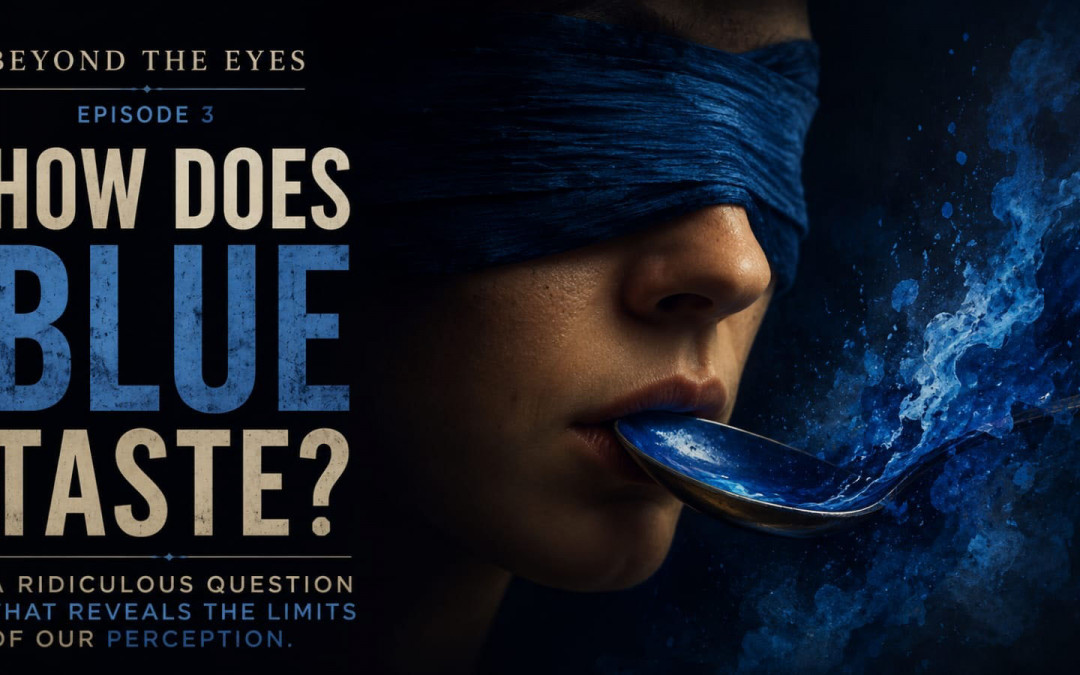
A Ridiculous Question Reveals How Little of Reality May Ever Reach Consciousness
Imagine interrupting a serious scientific conference with a question that sounds as though it belongs to a child rather than a philosopher.
How does blue taste?
The room would probably respond with a mixture of amusement and irritation. Blue is a color. Taste belongs to another sensory system. Unless the discussion concerns synesthesia, artificial flavoring or some elaborate psychological experiment, the obvious answer seems to be that blue tastes like nothing at all.
And yet the question has performed its work before anyone answers it.
It has crossed a boundary we normally do not notice.
Human beings experience color and taste as belonging to different categories because the nervous system gives them to us that way. We do not wake each morning and decide that wavelengths of visible light will become colors while dissolved chemicals will become tastes. The division arrives already built into the architecture through which the world becomes experience.
Blue feels naturally visual because we have never known a version of consciousness in which it was anything else.
The absurdity of the question may therefore reveal less about blue than about us.
Perhaps consciousness does not simply receive reality.
Perhaps it gives reality a format.
The World Arrives Already Translated
Open your eyes and the room appears immediate. There seems to be a red chair, a pale wall, sunlight, distance, depth. Nothing in ordinary experience announces the enormous translation required to produce that scene.
Photons interact with receptors in the retina. Neural signals move through highly organized visual pathways. The brain integrates information involving edges, contrast, motion, color, depth and prior expectation until something astonishing happens: there is simply a room.
Hearing performs another transformation. Mechanical vibrations traveling through a medium become the experience of pitch, rhythm, speech and music. Taste and smell begin with molecular interactions. Touch involves several sensory systems responding to pressure, vibration, temperature, tissue damage and bodily position.
None of these descriptions means that perception is fictitious.
The external world constrains what can be perceived. Closing your eyes does not remove the building. Believing that the wall is ten meters farther away does not move it.
But what reaches consciousness is not the external world in some untouched form.
It is the result of interaction between world and organism.
That distinction is easy to state and extraordinarily difficult to feel, because there is no control room outside our own nervous system from which we can compare the translation with the original.
We experience the interface from inside the interface.
Every Sense Has a Vocabulary
Try explaining red to a person who has never had visual experience.
You can describe wavelengths. You can explain how cones respond. You can talk about blood, warning signs, heat and roses. You can describe cultural associations and contrast red with blue.
But at some point the description stops.
The experience itself is not contained in the definition.
The same difficulty appears with music. An equation can describe frequency. A waveform can display sound visually. A physicist can explain exactly what happens when a string vibrates. None of those descriptions automatically provides the subjective experience of hearing a violin.
This is one reason sensory categories resemble languages.
They make particular distinctions available.
Vision gives us color and spatial organization. Hearing gives us pitch and timbre. Taste divides chemistry into experiential categories such as sweetness, bitterness, sourness and saltiness. Proprioception gives us an often overlooked sense of where parts of the body are located without requiring constant visual inspection.
The analogy should not be pushed too literally. A sensory system is not simply a language encoded somewhere in the brain.
But the comparison reveals an important limitation.
If a language contains no word for a distinction, the speaker may still perceive the distinction and eventually invent a word.
If an organism possesses no sensory pathway for a category of information, the problem is deeper.
There may be no experience waiting to be named.

Imagination Has Building Materials
Human imagination has an excellent public-relations department.
We like to describe it as limitless.
Try the following experiment.
Imagine a completely new primary color—not turquoise, not some impossible mixture of familiar colors, not brighter violet or darker red. Imagine an experience of color that does not belong anywhere inside the structure of ordinary human color vision.
Most minds immediately stall.
We can manipulate the inventory we possess. A purple sun. Transparent mountains. An animal with the face of one species and the body of another. A city suspended above an ocean.
The combinations can become spectacularly strange.
The components are suspiciously familiar.
This does not make imagination trivial. Recombinative imagination created mathematics, literature, engineering and worlds that did not previously exist. But it suggests that imagination may be less like creation from nothing and more like architecture.
The architect can rearrange the available materials with extraordinary freedom.
The architect still needs materials.
“How does blue taste?” exposes the problem because it demands a bridge between categories normally delivered separately. Most people respond by borrowing familiar associations: blueberries, cold water, mint, artificial candy, perhaps something metallic.
We answer the impossible sensation with memories.
The mind searches its warehouse.
The Fish That Cannot See Water
There is an old philosophical image of the fish that does not notice water because water is not another object inside its world. It is the condition under which the world appears at all.
Human perception may contain a similar blind spot.
We have become extremely skilled at asking what exists within experience. We classify matter, measure radiation, map galaxies and reconstruct events that occurred billions of years before biological eyes appeared.
But we rarely have occasion to ask what the world would be like through an organism built around entirely different channels of access.
Other species offer hints.
Bats use echolocation in ways radically unlike ordinary human spatial perception. Bees detect ultraviolet patterns inaccessible to unaided human vision. Many animals use chemical information with a sophistication humans do not possess. Some species are sensitive to polarized light; others appear capable of exploiting information connected to Earth’s magnetic field.
It would be misleading to imagine that these creatures simply inhabit our world with several extra icons switched on.
Their perceptual worlds are organized differently.
The biologist Jakob von Uexküll used the term Umwelt for the meaningful perceptual world available to an organism. A tick, a dog and a human can occupy the same physical environment while inhabiting radically different experiential environments because different signals matter to each nervous system.
There is no obvious reason to assume ours is the complete edition.
What the Interface Hides
Every useful interface performs two operations simultaneously.
It reveals.
And it removes.
A map shows roads precisely because it refuses to show every blade of grass. A computer desktop presents files while concealing voltages, machine instructions and physical memory addresses. The interface succeeds by turning complexity into a form appropriate to the user.
Biological perception may operate under a similar principle.
Human vision detects only a limited region of the electromagnetic spectrum. This is not a defect in the sense that evolution somehow forgot to install the premium package. Biological sensory systems evolve under pressures involving survival, energy, reproduction and ecological usefulness, not philosophical completeness.
An organism does not need access to everything.
It needs access to enough.
That distinction changes the question.
Instead of asking why human beings cannot perceive all reality, perhaps we should ask why we ever expected an evolved primate nervous system to provide a comprehensive representation of the universe.
We would never assume that one scientific instrument detects every physically relevant phenomenon. We construct different detectors precisely because different interactions require different instruments.
And yet the human mind often behaves as though the biological detector at the center of the laboratory is somehow exempt from the same limitation.
AI Meets a World Humans Cannot Read
Artificial intelligence introduces another version of the same problem.
Machine-learning systems can identify statistical relationships in datasets containing dimensions and correlations difficult for humans to inspect directly. A model can exploit patterns without presenting those patterns to us in anything resembling a human sensory experience.
We then ask the system for an explanation.
And the translation begins.
Words.
Graphs.
Scores.
Heat maps.
Probabilities.
Categories.
The machine’s useful internal structure is compressed into an interface compatible with human cognition.
This creates an unusual situation. Humanity may increasingly build systems capable of operating on patterns we cannot intuitively perceive, while remaining dependent on translations that inevitably discard some of the structure.
The old interface problem therefore repeats one level higher.
First, biology mediates the external world.
Then instruments mediate signals biology cannot receive directly.
Then artificial intelligence mediates patterns too complex for unaided human interpretation.
At each level, access expands.
At each level, another translator enters the room.
The important question may eventually be less Can the system detect it? than Can the thing detected be translated into a form in which a human being can genuinely understand it?
That is no longer only a problem of perception.
It is a problem of communication between different architectures of intelligence.
Consciousness May Not Be the Largest Room
Human beings often imagine greater intelligence as a quantitative expansion of ordinary cognition.
More memory.
Faster calculation.
More attention.
More facts.
Better prediction.
That may be part of it.
But another possibility is that intelligence and consciousness have dimensions we should not collapse into one scale.
A system could process information unavailable to human intuition without possessing a richer subjective world. Conversely, a creature might possess experiential categories that humans lack without outperforming us at mathematics.
The distinction matters because our greatest cognitive limitation may not simply be insufficient processing power.
It may be the architecture into which information has to fit before it becomes experience.
More data does not automatically create another sensory category.
A trillion measurements of ultraviolet radiation do not tell a normally sighted human what ultraviolet would “look like” if our biology supported a genuinely distinct experiential quality for it.
We can know without experiencing.
We can measure without intuiting.
We can model without inhabiting.
Perhaps civilization’s increasing intelligence will therefore make one mystery more obvious rather than less:
how much of reality can be represented inside consciousness at all?
Watch the Video
How the Read the World

Current Knowledge
Human sensory experience depends upon specialized biological systems that transduce physical and chemical interactions into neural activity. Vision, hearing, taste, smell, touch, proprioception and other sensory processes contribute different forms of information that the nervous system integrates into coherent experience.
Human sensory ranges cover only portions of physically measurable phenomena. Other animals possess sensitivities and perceptual capacities that differ substantially from ours, including ultraviolet sensitivity, echolocation and specialized detection of chemical or magnetic information.
Synesthesia demonstrates that sensory categories are not completely isolated in every human brain. Some people experience reliable additional associations, such as colors triggered by letters, sounds or other stimuli, although synesthesia should not be interpreted as literal evidence that physical color possesses an intrinsic taste.
Sensory-substitution technologies can translate information usually associated with one modality into another, and people can learn to use such signals effectively. Research continues into how far training and neuroplasticity can make artificial channels feel perceptually intuitive.
Scientific instruments extend human access to phenomena outside biological sensory ranges, but they generally do so by translating measurements into familiar outputs such as images, sounds, numbers or language.
Open Questions
One major question is how flexible the architecture of human perception actually is. Could the nervous system integrate a genuinely novel source of information until it became an effortless new perceptual category, or would every artificial sense ultimately remain an interpretation built from existing sensory experience?
There is also the philosophical problem of subjective qualities. Neuroscience can increasingly describe how sensory information is processed, but why particular neural processes are accompanied by the felt quality of blue, bitterness or pain remains connected to the wider unresolved problem of consciousness.
Artificial intelligence introduces a different uncertainty. Machine systems can operate over representational spaces humans cannot inspect intuitively, but it is unclear how much of those structures can be translated into human-understandable form without losing the relationships that made them useful.
And finally there is the largest question: are there aspects of physical reality for which humans possess no natural experiential category at all? We know that our sensory ranges are limited. We do not know whether every scientifically relevant structure can, even in principle, be made intuitively available to a human consciousness.
Transhumation Interpretation
“How does blue taste?” belongs in Transhumation because it performs a very specific operation.
It makes us notice the water.
The human interface is so continuous with ordinary experience that we rarely experience it as an interface at all. We say that the sky is blue rather than that a particular range of electromagnetic interaction, processed through a particular visual system under particular conditions, produces the experience we call blue.
Ordinary language is not wrong to speak that way.
But philosophy occasionally needs to remove the shortcut.
The world exists.
The organism exists.
Experience occurs in the relationship between them.
This offers an important correction to both naive realism and fashionable simulation rhetoric. We do not need to claim that reality is an illusion, a computer program or a hallucination in order to recognize that conscious experience is mediated.
The interface can be real.
The world behind it can also be real.
A cockpit display does not make the airplane imaginary.
It gives the pilot one usable representation of a system too complex to encounter all at once.
Human perception may be something similar.
This is where the New Theurgy becomes relevant without requiring any supernatural claim. Its central problem is mediation: how does a finite observer interact with a reality larger than its direct capacity?
Eyes are interfaces.
Language is an interface.
Mathematics is an interface.
Scientific instruments are interfaces.
Artificial intelligence increasingly becomes an interface to archives and patterns that exceed individual cognition.
Each increases access by performing translation.
And every translation raises the same question:
what did not cross?
This may eventually matter more than increasing raw intelligence.
Suppose a future human has an implant capable of detecting magnetic fields directly. At first, perhaps the information arrives as vibration. After years of neural adaptation, the person begins reporting an effortless sense of direction that no longer feels like vibration at all.
Has the person acquired a new sense?
Now connect another system capable of detecting patterns in atmospheric chemistry, radiation or complex computational environments.
At some point Transhumation stops being a metaphor.
We may begin modifying the interface through which reality becomes experience.
That possibility is more philosophically disruptive than merely giving humans better eyesight.
A telescope makes the existing visual world larger.
A genuinely new sensory category could make the experienced world different in kind.
And if that becomes possible, the oldest question about consciousness changes.
We usually ask whether a machine can enter our experiential world.
Does it see?
Does it feel?
Does it understand?
Perhaps we should also ask whether humans can enter experiential spaces our present biology cannot provide.
The distinction is important because we have spent centuries extending outward while keeping the final translation remarkably conservative.
The telescope speaks vision.
The radio speaks sound.
The computer speaks text and image.
Even artificial intelligence usually meets us through the ancient channels of eyes and ears.
Our machines have become exotic.
The doorway remains Paleolithic.
Perhaps this is the next boundary.
Not uploading the mind.
Not escaping the body.
Not proving that hidden dimensions surround us.
Something much more concrete: discovering whether the architecture of human experience itself can be enlarged.
“How does blue taste?” is useful precisely because the ordinary answer remains simple.
For most people, it does not.
But once the question has been asked, another possibility appears.
There may be truths we cannot imagine not because they are mystical, secret or forbidden, but because imagination itself operates inside an interface whose boundaries are usually invisible to the creature using it.
A fish can explore an ocean without ever leaving water.
Humanity may explore the universe while doing something strangely similar.
We build better instruments.
We collect deeper data.
We expand the map.
And almost everything eventually returns through the same narrow gates into consciousness.
Perhaps the final frontier is not another place.
Perhaps it is another way of receiving the place we already inhabit.
FAQ
Does blue actually have a taste?
Not in ordinary human sensory organization. Color and taste arise through different sensory pathways, although synesthesia can produce stable cross-sensory experiences in some people.
Why can’t we simply imagine a completely new sense?
Imagination relies heavily on material drawn from prior experience. We can recombine known sensations very creatively, but constructing an entirely unfamiliar mode of experience appears much harder.
Do animals experience a different reality from humans?
They inhabit the same physical world, but their sensory systems make different information behaviorally and perceptually available. Their experienced worlds can therefore differ substantially from ours.
Do telescopes and sensors give us new senses?
They extend access to information beyond biological limits, but usually by translating that information into familiar forms such as images, sounds or numbers. Whether technological augmentation could produce genuinely new perceptual qualities remains an open question.
Could AI understand patterns humans cannot experience directly?
AI can already operate on high-dimensional statistical relationships that humans cannot intuitively inspect in full. Whether that amounts to experience is a separate and unresolved question.
What is the deeper Transhumation idea?
The most important boundary of consciousness may not be how much information the mind can process.
It may be which kinds of information can become experience at all.
We spend enormous effort trying to see farther into the universe.
Perhaps one day the more unsettling project will be changing what it means to see.
Continue the Transhumation Series
- Forgotten Religion | Ancient Gods, Symbols and the Hidden Structures of Human Civilization
- The Last Religion | Death, Immortality and the Future of Humanity
- The New Theurgy | AI, Information and the Future of Human Civilization
- End of Branding: You Were Never Meant to Become a Product
- Baal vs Ishtar: Why Ancient Gods Never Disappeared