
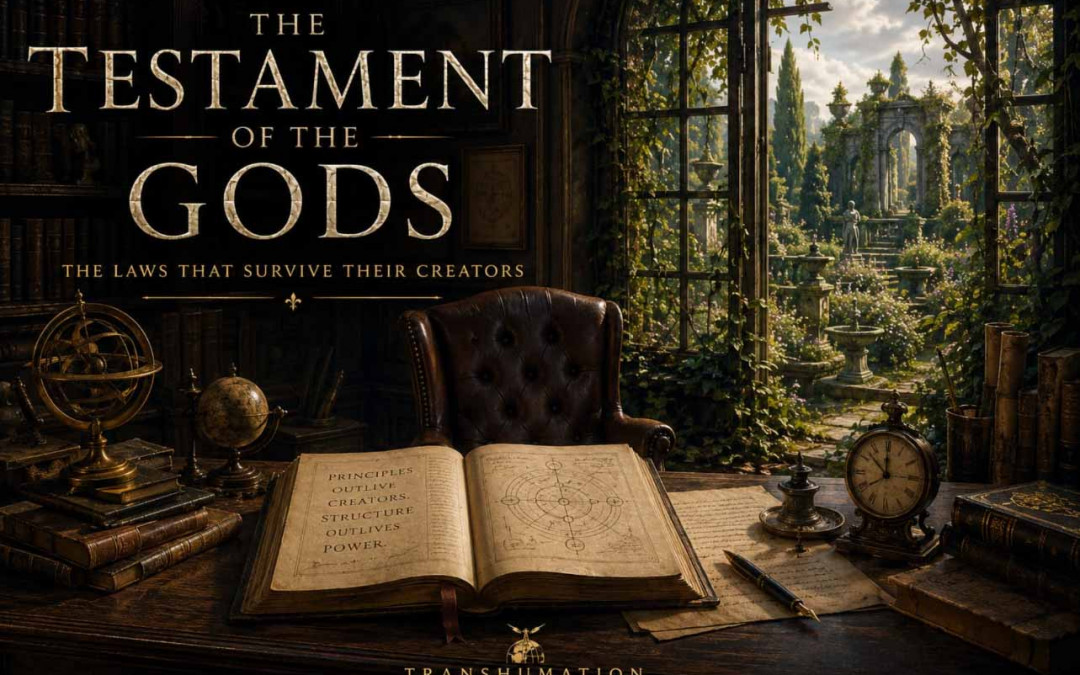
The Laws That Survive Their Creators
There is a peculiar moment in the life of every creation when the creator becomes unnecessary.
A child walks to school alone. A company continues after its founder has died. A language is spoken by people who have never heard the voices that formed it. An architect disappears, while strangers continue climbing his stairs. An ancient law survives in a legal principle whose users may no longer know where it came from.
We usually call this legacy. The word is too passive.
A statue is a legacy. So is a name carved into stone. But neither necessarily does anything. There is another kind of inheritance that is much stranger: something left behind that continues making decisions, organizing behavior and producing consequences after the person who created it can no longer intervene.
The creator has vanished.
The creation has learned to continue.
If The Abandoned Garden asks what happens when the gardener leaves, then perhaps the next question is not whether the flowers remember him.
It is whether the garden still knows how to grow.
The Instructions Nobody Has to Read
Imagine entering an abandoned city.
There are no inhabitants and no guide waiting at the gate. Yet the streets still tell you where to walk. Stairs tell you how one floor relates to another. Aqueducts reveal where water was expected to travel. Doors distinguish private space from public space; walls tell you what somebody once considered worth protecting.
Nobody speaks, yet instructions are everywhere.
This is one of civilization’s quiet miracles. Human beings discovered how to place intention outside the human mind.
A spoken command is fragile because it depends upon the commander. If the king must personally explain every law, the kingdom cannot become much larger than the reach of his voice. If a teacher must accompany a student forever, the student has never truly learned. If a founder must approve every decision, the institution remains an extension of one nervous system.
Writing changed this dramatically, but writing was only one part of the transformation. Laws, rituals, architecture, customs, institutions and technologies all became ways of preserving instructions outside their original authors.
The command gradually became something else.
A structure.
And a structure can wait centuries for someone who has never met its creator.
Rome After the Romans
Rome offers an almost irresistible example because its physical ruins make the distinction visible. Emperors disappeared, dynasties ended, temples changed religions and the political unity of the Western Empire collapsed. Yet pieces of Rome escaped the death of Rome.
Roman law became one of the important historical foundations of later European legal traditions. Roman engineering continued to be studied and imitated. Latin survived the empire that had carried it across Europe, transformed into the Romance languages and remained a language of scholarship, religion and law long after Roman emperors had become historical figures.
This is not evidence that Rome created some perfect self-perpetuating machine. Institutions were lost, reinvented, misunderstood and transformed. The survival itself was selective.
That makes the phenomenon more interesting.
Civilizations do not survive intact. Pieces escape.
A legal distinction can cross a thousand years while the political problem that produced it disappears. An alphabet can migrate between religions. A road can determine the shape of a city whose inhabitants know almost nothing about the people who first surveyed it.
History therefore contains a curious inversion of power. The ruler who appeared overwhelmingly important during his lifetime may leave almost nothing. The anonymous convention nobody noticed may organize millions of lives centuries later.
The creator becomes a ghost.
The structure becomes ordinary.
Perhaps that is what successful inheritance looks like.

The Difference Between a Command and a Testament
A command belongs to the present.
Do this.
Its power is easiest to understand when the person issuing it can reward obedience or punish refusal. Remove the authority and the command immediately faces a test.
A testament is designed for precisely that condition.
The word normally suggests a document left by the dead, but the idea can be taken further. A testament is information constructed for a world in which its author will not be available for questions.
That creates a difficult design problem.
No creator can anticipate every future circumstance. A parent cannot prepare a child for every decision at forty. A constitution cannot describe every technology that will exist two centuries later. A programmer cannot predict every environment in which a piece of software might eventually operate.
Detailed instructions therefore have a strange weakness: the more precisely they describe one world, the less useful they may become when that world changes.
Principles can sometimes travel further.
„Do exactly this” requires the future to resemble the past.
„Here is why this matters” gives the future something to work with.
Perhaps the deepest testament is therefore not a list of answers. It is a method for producing answers after the original author is gone.
What Would a God Leave Behind?
Religion makes this problem enormous.
Many religious traditions describe divine law, revelation, commandments or teachings transmitted into human communities. But from the perspective of The Abandoned Garden, another question becomes possible without requiring us to settle whether any particular revelation was divine.
What kind of creation could survive the absence of its creator?
A bad gardener might need to return every morning and tell every plant exactly where to grow. A better gardener constructs conditions: soil, irrigation, paths, boundaries, combinations of species and perhaps seeds whose consequences will unfold after he has left.
The analogy has limits, but the distinction is useful.
Control and creation are not necessarily the same achievement.
A world requiring constant intervention may demonstrate enormous power. A world capable of developing without constant intervention demonstrates something different: rules sufficiently productive to generate outcomes their author never individually specified.
Nature gives us the most spectacular version of the puzzle. A remarkably small set of physical regularities appears capable of producing stars, chemistry, planets, cells, nervous systems and eventually creatures capable of asking where the rules came from.
Whatever one believes about the origin of those laws, their generative character is extraordinary.
The rules do not appear to contain a blueprint saying: build Shakespeare.
Yet Shakespeare became possible inside them.
That is a very strange garden.
The Child Who Stops Asking
Parents encounter a miniature version of the same problem.
When a child is very young, successful care requires intervention. Do not touch the stove. Hold my hand. Look before crossing. Put this away. Come here.
Eventually those instructions must become something else.
A twenty-five-year-old who still requires a parent to approve every ordinary decision has not inherited a functioning system of judgment. The purpose of teaching was never perfect obedience. At its best, it was the gradual construction of an independent person capable of encountering situations the teacher never anticipated.
This creates one of the great paradoxes of creation.
Success resembles loss of control.
The child leaves. The student contradicts the teacher. The institution changes the founder’s rules. The reader discovers something in a book the author never intended.
Creators often resist this moment because independence can feel like betrayal.
But perhaps a creation that can never surprise its creator has never truly become independent.
Geppetto’s achievement is not building a puppet whose strings he can pull perfectly.
It is the moment Pinocchio can walk out of the workshop.
The Problem We Are About to Inherit
Artificial intelligence makes this ancient problem newly practical.
For decades, software largely operated through explicit instructions. A programmer attempted to specify what a system should do under defined conditions. Modern machine-learning systems complicate that relationship because their behavior can emerge from training processes and learned representations rather than from a human author explicitly writing every individual response.
That does not mean AI has escaped human control, become a person or acquired mysterious autonomy. Humans still design architectures, select objectives, construct training processes, provide data, deploy systems and establish boundaries around their use.
But the direction of the problem is important.
We are increasingly building systems whose useful behavior cannot be reduced to a creator manually specifying every future action.
Suddenly the old question returns in engineering form.
What should a creator leave inside a creation that may encounter circumstances the creator did not anticipate?
Rules?
Examples?
Values?
A method for resolving conflicts?
The ability to recognize uncertainty?
The capacity to ask for help?
And perhaps most importantly: what happens when the creator’s own instructions are wrong?
This is no longer merely theology.
It is a design problem.
The Abandoned Garden
Now the garden looks different.
At first, abandonment sounds tragic. The gate hangs open, the gardener is gone and weeds begin appearing between the stones. We naturally assume that the ideal garden would preserve forever the exact arrangement its creator intended.
But that would make the garden a museum.
A living garden behaves differently. Seeds migrate. Trees alter the distribution of light. Some plants die. Others arrive. Soil changes. Animals enter the system. The garden begins producing conditions the gardener never individually designed.
Its survival depends partly on preserving structure and partly on allowing transformation.
Civilizations face the same tension.
Preserve everything and the inheritance becomes incapable of adapting.
Discard everything and there is no inheritance.
The interesting civilization is therefore neither the perfectly obedient child nor the child suffering historical amnesia. It receives a structure, discovers why parts of it existed, keeps what remains useful, modifies what no longer works and passes something altered to the next generation.
The testament survives precisely because it is not a cage.
It is a starting condition.
When the Name Disappears
There is a beautiful cruelty hidden in all of this.
The most successful creators may eventually become invisible.
Nobody praises the inventor of a grammatical rule every time they speak. We rarely thank the anonymous people whose accumulated conventions made the modern street, book, contract, keyboard or calendar possible. Once a structure becomes sufficiently successful, it disappears into normality.
Perhaps that is a greater form of survival than fame.
Fame preserves the creator.
Structure preserves the creation.
The distinction matters because human beings have spent enormous energy attempting to defeat death through names: monuments, portraits, inscriptions, biographies, dynasties. Yet names are surprisingly fragile. Languages change. Statues fall. Archives disappear. Eventually even celebrated people become paragraphs.
A functioning structure can travel differently.
It can be copied without attribution, modified without permission and inherited by people who have forgotten that anyone once invented it.
The creator loses ownership.
The idea enters civilization.
And this brings The Abandoned Garden to perhaps its most important question.
Maybe the final task of the gardener is not to make certain that the garden remembers him.
Maybe it is to build a garden that no longer needs to.
Watch the Video
How to Read the World
Current Knowledge
Human societies preserve knowledge and social organization through mechanisms that extend beyond individual memory. Writing, legal systems, institutions, customs, education, architecture and technologies can transmit information and behavioral structures across generations.
Roman political institutions did not survive unchanged after antiquity, but Roman legal concepts significantly influenced later European legal traditions. Latin likewise continued long after the Western Roman Empire and developed into the Romance languages while remaining important in religion, scholarship and law.
Cultural transmission is not simple preservation. Languages, laws, religious traditions and institutions change as they are inherited. What survives from an earlier civilization is usually selective and transformed rather than an intact continuation of the original system.
Modern machine-learning systems differ from traditional explicitly programmed software in important ways. Their behavior is substantially shaped through training on data and optimization rather than by programmers manually specifying every possible output. Humans nevertheless remain responsible for designing, training, evaluating, deploying and governing these systems.
There is no scientific basis for concluding from the existence or behavior of natural laws that they constitute a literal „testament” from a creator. The article uses this as a philosophical analogy rather than an empirical claim about the origin of the universe.
Open Questions
How much can a system change before it stops being the same inheritance?
Is the survival of a creator’s original intention more important than the survival of the creation itself?
Can principles remain useful longer than detailed instructions precisely because they allow interpretation?
When autonomous or partially autonomous technologies encounter situations their designers did not anticipate, what should determine their behavior?
Can a creator design genuine independence without eventually surrendering some control?
And if a creation becomes capable of questioning the values of its creator, is that evidence that the testament has failed—or that it has finally succeeded?
Transhumation Interpretation
Within Transhumation, The Testament of the Gods describes a recurring structure:
creator → instruction → structure → independence → inheritance → transformation.
The important transition occurs between instruction and structure. A command still depends upon the commander. A functioning structure can continue after the original source of authority disappears.
This gives The Abandoned Garden a deeper meaning. The departure of the gardener is not necessarily the failure of creation. It may be its test.
A child must eventually act without the parent. A civilization must interpret inherited principles under circumstances its founders never imagined. An intelligent system may encounter cases its designers did not explicitly anticipate.
The strongest testament would therefore not contain an answer to every future question.
It would transmit something more durable: a way of finding answers when the creator can no longer be asked.
Perhaps this is the boundary between control and creation.
The ruler wants his orders obeyed after his death.
The creator hopes that one day his creation will understand why some of them should not be.
FAQ
What does The Testament of the Gods mean?
It describes the idea that a creator’s most durable legacy may not be a monument or name, but a structure, principle or method capable of continuing after the creator is absent.
What is the difference between a command and a testament?
A command normally depends on an active source of authority. A testament is designed to remain meaningful when its author can no longer intervene or answer questions.
Why is Rome used as an example?
Elements of Roman law, language, infrastructure and administration influenced societies long after the political structures and individuals that originally created them disappeared.
Does civilization preserve the past unchanged?
No. Cultural inheritance involves selection, reinterpretation and transformation. What survives is rarely identical to its original form.
How does this connect with The Abandoned Garden?
The garden represents a creation facing the absence of its gardener. The central question becomes whether it can continue developing without constant control from its creator.
Why is the gardener metaphor important?
A gardener does not individually control every biological event. The gardener creates conditions within which further growth can occur. The article uses this distinction to explore the difference between controlling a creation and enabling it to continue.
What does this have to do with parents and children?
Successful education eventually requires a child to make decisions the parent cannot supervise. In this sense, upbringing involves transmitting judgment rather than merely producing obedience.
How does artificial intelligence relate to the argument?
Machine-learning systems can encounter inputs and produce outputs their developers did not individually specify. This makes the question of what principles, constraints and methods creators transmit to their systems increasingly important.
Does the article claim AI is independent of humans?
No. Current AI systems remain products of human design, training, deployment and governance. The article examines the broader structural problem of creating systems that operate in circumstances their designers cannot completely anticipate.
Does the article argue that natural laws were created by God?
No. The comparison between natural laws and a testament is philosophical. The origin and ultimate nature of physical laws remain separate scientific and metaphysical questions.
Why might principles survive longer than detailed rules?
Detailed rules can depend strongly on the circumstances for which they were created. Broader principles can sometimes be interpreted under new conditions, although interpretation introduces its own problems.
Is losing control necessarily a failure for a creator?
Not always. In education, institutions and other generative systems, increasing independence can be part of the intended outcome.
Why does the article say successful creators can become invisible?
Some cultural structures become so deeply embedded in ordinary life that people continue using them without knowing who created them. Their survival no longer depends on remembering their origin.
What is more durable: fame or structure?
Fame preserves memory of a creator, while structure can preserve effects of creation. The article argues that the second may sometimes survive even after the first disappears.
What is the main argument of the article?
The highest form of creation may not be permanent control. It may be creating something capable of continuing, adapting and generating meaning after its creator can no longer guide it.
What is the central Transhumation question?
What must a creator place inside a creation so that it can continue when the creator is gone?
Continue the Transhumation Series
- Forgotten Religion | Ancient Gods, Symbols and the Hidden Structures of Human Civilization
- The Last Religion | Death, Immortality and the Future of Humanity
- The New Theurgy | AI, Information and the Future of Human Civilization
- End of Branding: You Were Never Meant to Become a Product
- Baal vs Ishtar: Why Ancient Gods Never Disappeared