
The Sisyphean Future
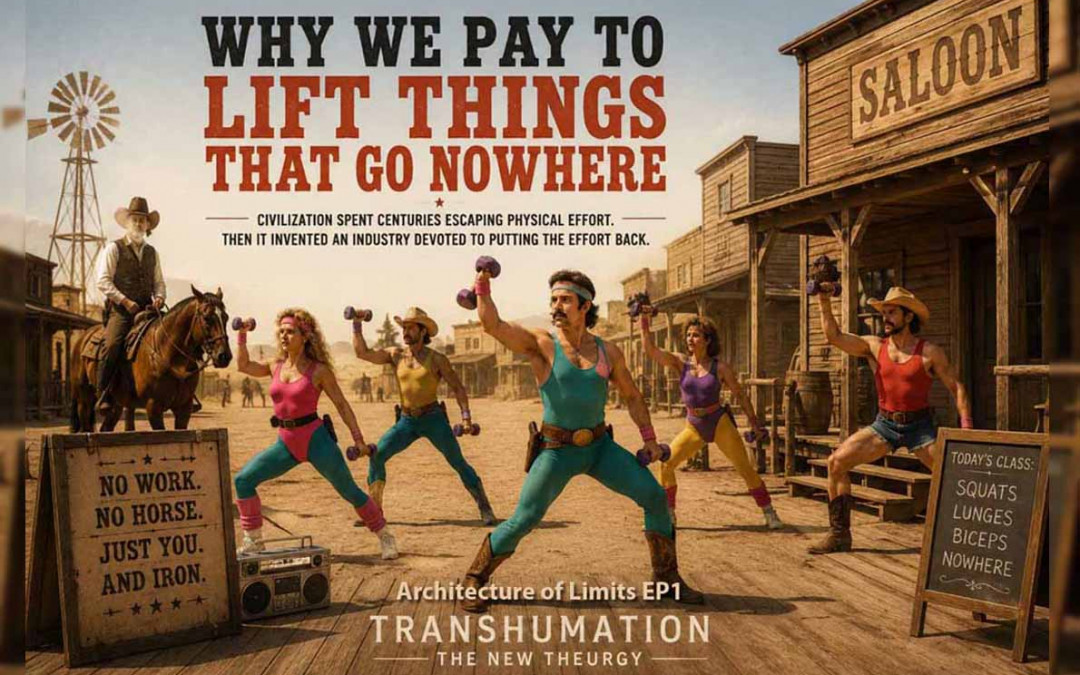
Civilization spent centuries escaping physical effort. Then it invented an industry devoted to putting part of the effort back.
Imagine explaining a modern gym to someone whose life had been organized around physical necessity. Not the machines themselves—the purpose. A room full of people who have already paid for cars, elevators, washing machines, supermarket deliveries and office chairs now pay again for the privilege of lifting heavy objects and putting them back exactly where they began. One person climbs stairs that lead nowhere. Another runs five kilometres without travelling the length of the building. A third repeatedly pulls a weight toward the body, releases it, and begins again. At the end, a watch congratulates them for having expended energy that much of civilization was designed to save.
The joke works because the gym is not irrational. It is almost the opposite.
It is a sophisticated correction to a problem created by technological success.
For most of human history, movement was attached to consequence. Walking carried you somewhere. Lifting moved something. Chopping produced fuel. Hunting produced food. Physical effort belonged to the machinery of survival. Industrialization, motorized transport, domestic appliances and digital work progressively separated the useful outcome from the muscular cost required to obtain it. We became extraordinarily good at removing effort from daily life.
Then we discovered that the body had been using part of that effort for something else.
So we brought it back.
Not as necessity.
As design.
The Machine That Reversed Its Meaning
The treadmill is almost too perfect an object for this argument.
In the nineteenth century, prison treadwheels were used as instruments of labor and punishment. Prisoners stepped continuously, sometimes powering machinery, sometimes performing work whose economic usefulness was secondary to the discipline itself. The cruelty lay partly in repetition: effort stripped of destination.
Two centuries later, descendants of the same mechanical idea occupy expensive health clubs, hotels and private homes.
The movement is similar.
The meaning is almost inverted.
The modern runner is not trapped on the machine. He has chosen the machine precisely because ordinary life no longer demands enough of his body. He may regard the hour spent running nowhere as protected time, even a form of luxury.
This reversal reveals something important about the usual story of progress.
We often describe technological development as the removal of intermediate steps. Cars remove walking. Elevators remove climbing. Calculators remove arithmetic labor. Software removes clerical repetition. Interfaces remove the need to understand the machinery underneath.
Civilization repeatedly asks: what can be made easier?
But every removed difficulty carried more than one effect.
Sometimes we discover the secondary function only after the burden is gone.
The Gym Is an Edited Version of the Past
Recreational exercise did not suddenly appear because industrial society invented sedentary life. Gymnastics, athletic training and deliberate physical culture have long histories, and nineteenth-century Europe already possessed organized exercise movements.
What changed was the relationship between ordinary life and deliberate movement.
As work, transport and domestic life became less physically demanding for many people, physical activity increasingly had to be separated from necessity and reconstructed as a chosen activity.
That distinction matters. The gym is not nostalgia for manual labor. Nobody lifting a barbell is asking to return to a world without cranes, forklifts or tractors. The point is not to restore the hardship.
It is to isolate one useful consequence of the hardship and reproduce it under controlled conditions. Resistance without harvest. Running without escape. Climbing without destination.
The old necessity becomes a voluntary dose. This may be a much larger principle than fitness.
Progress Does Not Always Mean Removal
There is a seductive image of technological development in which every successful invention subtracts a limitation.
Less pain.
Less waiting.
Less effort.
Less distance.
Less disease.
Perhaps eventually less aging, less dependence on the biological body and less exposure to unwanted risk. Much of this is worth wanting. But the gym suggests that the relationship between limitation and value is not simple. We do not want famine, yet people voluntarily fast.
We do not want predators chasing us through forests, yet people pay for horror films, roller coasters and extreme sports.
We do not want transportation to fail, yet people drive to mountains in order to walk for hours.
We do not want material scarcity imposed upon us, yet games often become dull when every weapon, resource and ability is available from the beginning. What disappears as unavoidable hardship can return as chosen structure. That is not hypocrisy.
It may be a sign that some constraints perform functions distinct from the suffering historically attached to them.
The crucial task is learning to separate the two.
Value Lives Close to Constraint
Economics begins from scarcity because choice requires exclusion.
Money is one way of organizing that condition. Spend here and less remains for elsewhere. Time behaves similarly. An hour matters partly because it cannot be spent twice.
Many human values appear to contain the same architecture. A gift matters partly because something was surrendered. Courage requires risk. Commitment matters because alternatives are closed.
Attention matters because we cannot attend equally to everything at once.
Achievement means something partly because failure remained possible.
This does not mean deprivation is morally desirable. It means that value often emerges where possibility encounters a boundary. Remove every boundary and something unexpected may disappear with it.
Games make this visible because designers can manipulate scarcity deliberately. A game in which every resource is infinite, every decision reversible and every achievement automatically unlocked may offer more possibilities while producing less reason to care about any of them.
So the designer adds limits.
Lives.
Levels.
Distances.
Costs.
Cooldowns.
Difficult choices.
The limitation is artificial.
Its function is real.
The Problem With a Perfect World
Now move the thought experiment beyond exercise. Imagine a civilization capable of producing almost any material object cheaply. Disease has been radically reduced. Automation handles most unpleasant labor. Virtual environments can provide enormous varieties of experience. Perhaps aging itself has become controllable. The usual futuristic language describes such a society as liberated.
But liberated for what?
If a life becomes indefinitely long, does urgency weaken or do larger ambitions become possible?
If material scarcity declines dramatically, does competition lose meaning or simply move elsewhere?
If every mistake can be reversed, does commitment remain commitment?
If a conscious being can duplicate itself and pursue several futures simultaneously, what becomes of choosing one?
Technology may eventually discover that some of the limitations it removes were also providing architecture to experience. At that point the problem changes. The challenge is no longer escaping limitation. It is deciding which limitations deserve to return.
Do Not Romanticize the Prison
This idea can become dangerous very quickly. Human beings are extremely good at finding moral beauty in conditions they had no power to escape. Disease becomes a lesson. Poverty becomes character. War becomes purification. Death becomes necessary because poets wrote beautifully about it.
That reasoning should be resisted.
The fact that people sometimes develop courage through suffering does not make suffering intrinsically valuable. Poverty should not be preserved because scarcity can produce ingenuity. Disease does not deserve protection because illness occasionally changes someone’s priorities.
The distinction is between the harmful condition and the useful function that may have existed inside it.
The nineteenth-century laborer needed strength because the world forced heavy work upon him.
The modern gym preserves resistance training without preserving the laborer’s lack of choice.
That is the intelligent version of the principle.
Do not preserve the prison because something valuable once happened inside it.
Extract the valuable structure.
Leave the prison behind.
Watch the Video
How to Read the World
Current Knowledge
Human societies have long practiced deliberate physical training, sport and gymnastics, so modern fitness culture should not be described as the invention of exercise itself. What changed significantly with industrialization, motorized transport and increasingly sedentary forms of work was the amount of physical movement required by ordinary daily life for many populations.
Modern exercise therefore increasingly became separated from practical necessity. Activities such as jogging, gym training and recreational endurance exercise could be performed specifically for health, fitness or experience rather than transportation or production.
The treadmill provides a particularly striking historical reversal because treadwheel devices were once associated with prison labor and punishment, while modern treadmills are voluntarily used to reproduce sustained exertion in environments where ordinary life may no longer require it.
There is also substantial evidence that physical activity is important for human health. None of this implies that older conditions of physical labor were healthier overall or should be restored. Modern deliberate exercise is better understood as a controlled reconstruction of selected physiological demands.
Open Questions
The gym gives us a relatively easy example because the biological effects of physical exertion can be studied and reproduced. The harder problem is identifying which psychological and existential constraints perform comparable functions.
Would a radically longer lifespan weaken urgency, or would humans simply construct longer projects? Would declining scarcity eliminate ambition or release ambition from survival? Can meaningful risk exist when every loss can be reversed?
There is also a political question. If future societies deliberately design constraints into human experience, who decides which constraints are beneficial? A voluntarily chosen challenge is one thing. A limitation imposed by institutions “for your own good” is something entirely different.
And perhaps the deepest problem is whether we can distinguish a genuinely functional constraint from one that merely feels sacred because humanity endured it for a long time.
Transhumation Interpretation
Transhumation does not have to imagine progress as the steady abandonment of biology.
The gym suggests a different model.
Biology contains arrangements created under conditions we may eventually escape. Some of those arrangements may remain valuable even after their original environment disappears.
The task is therefore not necessarily to preserve the old carrier.
It is to preserve the useful function.
We did not preserve agricultural labor in order to preserve muscular resistance. We built the barbell. We did not preserve compulsory long-distance walking. We built the treadmill.
The function migrated into a new environment where it could be selected, measured and stopped.
This may eventually apply to much stranger things.
Perhaps empathy does not require precisely the biological vulnerability humans possess today, but some form of vulnerability may remain necessary.
Perhaps commitment does not require an eighty-year lifespan, but still requires genuine exclusion of alternative futures. Perhaps value does not require poverty, but some form of scarcity may remain necessary for preference to have weight. Perhaps consciousness can survive the removal of many biological limitations while becoming unrecognizable if every constraint disappears.
This reverses one of the most familiar images of technological divinity. We imagine godlike civilization as unlimited capability.
Unlimited life.
Unlimited knowledge.
Unlimited energy.
Unlimited experience.
But perhaps maturity is not maximum power. Perhaps maturity begins when power becomes selective. A primitive civilization is trapped inside necessity. A technological civilization learns to escape necessity. A mature civilization may acquire something more difficult: the ability to choose which necessities are worth reconstructing.
The person running on the treadmill already performs a tiny version of this sequence.
His ancestors walked because they had to.
His machines made walking optional.
He now chooses to run.
He has not returned to the past.
He has extracted a structure from it.
Perhaps that is what progress looks like after the easy victories are over. Not a world without boundaries. A civilization intelligent enough to distinguish the wall that imprisoned us from the wall that gave the room its shape.
FAQ
Did people exercise recreationally before modern gyms?
Yes. Deliberate exercise, athletics, gymnastics and physical culture have long histories. Modern gym culture represents a newer organization and commercialization of practices that existed in earlier forms.
Why is the treadmill such a good example?
Because it reverses the meaning of the same basic action. Continuous stepping once appeared as forced labor; today a similar movement is voluntarily used for health and fitness.
Does this mean old-fashioned physical labor was healthier?
No. Historical manual labor often involved injury, exhaustion and lack of choice. The modern goal is to reproduce useful physiological stress without restoring the harmful conditions surrounding it.
Does the argument imply that suffering is necessary?
No. It distinguishes suffering from functions that may sometimes accompany difficult conditions. Resistance, risk or scarcity can matter without poverty, disease or coercion becoming desirable.
Could a post-scarcity society invent artificial limitations?
Humans already do this in sports, games, exercise and other voluntary challenges. Whether a radically advanced civilization would do the same on a larger scale remains speculative, but the behavior already exists in miniature.
What is the deeper Transhumation idea?
Progress may eventually become less about removing every constraint and more about understanding constraints well enough to choose among them.
The future question may not be:
How free can we become?
It may be:
What must remain difficult for freedom to continue meaning anything?
Continue the Transhumation Series
- Forgotten Religion | Ancient Gods, Symbols and the Hidden Structures of Human Civilization
- The Last Religion | Death, Immortality and the Future of Humanity
- The New Theurgy | AI, Information and the Future of Human Civilization
- End of Branding: You Were Never Meant to Become a Product
- Baal vs Ishtar: Why Ancient Gods Never Disappeared