
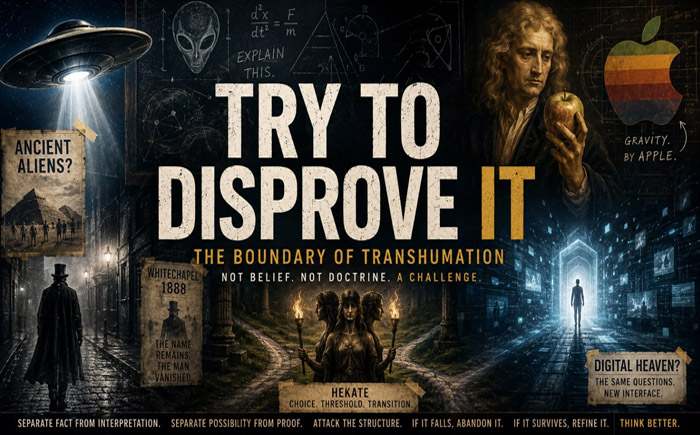
The Boundary of Transhumation
A serious idea should know where it can die.
That is an uncomfortable requirement because intellectual systems are usually built for survival. Religions develop interpretation. Political doctrines develop exceptions. Philosophies acquire vocabulary capable of absorbing criticism. Technological movements explain failure as temporary. Even scientific theories can become culturally protected long after their original evidence has weakened.
Human beings are remarkably good at defending ideas once the ideas become part of identity.
The danger begins when a framework becomes impossible to lose.
If every confirming example counts as evidence and every contradiction can be reinterpreted as another form of confirmation, the framework is no longer learning from reality. It has become an architecture designed to protect itself from reality.
Transhumation should not work that way.
Its strongest form is not a doctrine asking for allegiance. It is a method for comparing structures across mythology, technology, history, religion, information and human identity while remaining constantly vulnerable to the possibility that the comparison is wrong.
That vulnerability is not an embarrassment.
It is the boundary that keeps the library from becoming a temple.
The challenge can therefore be stated simply:
Try to disprove it.
But first we have to define what disprove actually means.
What Does It Mean to Falsify an Idea?
In science, falsifiability is usually associated with the possibility that observations could count against a hypothesis. If a claim predicts that something should happen under specified conditions and it repeatedly does not, the claim becomes weaker or fails.
But not every idea is a scientific hypothesis.
A historical interpretation may be undermined by documents that contradict its chronology. A philosophical argument can fail because its premises conflict or because its conclusion does not follow. A symbolic interpretation may become useless because it is so broad that it explains every possible outcome equally well.
Different claims therefore require different forms of pressure.
This is crucial for Transhumation because the project moves among several levels of discourse.
“John Henry Steel was in London on a particular date” is an empirical historical claim.
“Hekate can be used as a symbol of thresholds” is an interpretive claim.
“Personal identity may depend on continuity rather than similarity” is a philosophical proposition.
“Information can survive changes of carrier” can be partly formal, partly technological and partly metaphorical depending on what exactly we mean.
We should never allow one category to borrow the authority of another.
A metaphor does not become historical evidence because it is elegant.
A possibility does not become probability because it cannot be ruled out.
A philosophical question does not become scientific fact because it uses technological vocabulary.
The first discipline of Transhumation is therefore classification.
Before attacking an idea, identify what kind of thing it is.
Agreement Is Cheap
Modern conversation tends to reduce ideas to a binary reaction.
Do you agree?
Do you disagree?
Do you believe it?
Do you reject it?
These questions are socially efficient and intellectually weak.
A person can agree with an argument because it matches existing preferences. Another can reject it because its language feels strange. Neither reaction tells us much about the structure of the argument.
A better question is:
What would have to be true for this idea to fail?
That question immediately exposes a difference between serious thinking and intellectual decoration.
Suppose somebody argues that a hidden ancient civilization transmitted advanced technology around the world. We should not begin with whether the story feels plausible or exciting. We should ask what archaeological evidence the theory predicts, which dates must align, what transmission routes should exist and what discovery would make the proposed genealogy impossible.
Now suppose somebody says that every missing artifact simply proves the civilization hid its tracks successfully.
The theory has protected itself from evidence.
It can no longer lose.
That is precisely when we should stop trusting it.
The Däniken Problem
Erich von Däniken is useful here not because unusual ideas should be mocked, but because ancient-astronaut claims demonstrate how quickly possibility can substitute for evidence.
Could extraterrestrial intelligence exist somewhere in the universe?
Possibly.
Could technologically advanced beings theoretically have visited Earth?
That is not logically impossible.
Did extraterrestrials therefore build, design or instruct ancient human civilizations?
That is a completely different claim.
The third proposition requires historical evidence.
Archaeological structures should be interpreted first through what we know about the societies that made them: their tools, labor systems, engineering traditions, religious practices and documented development. An extraordinary external intervention should not be introduced merely because an artifact looks mysterious to a modern observer.
This is the correct boundary.
Strange is not evidence.
Possible is not evidence.
Unexplained to me is not evidence.
A claim grows stronger only when it explains observations better than competing explanations while surviving attempts to break it.
That rule must apply to Transhumation as aggressively as it applies to anyone else.
Can Science Disprove God?
This question exposes another boundary.
Science is exceptionally powerful when a proposition generates observable consequences. If a religious claim predicts a measurable physical event, empirical evidence can bear on that claim.
But the concept of God is not one standardized scientific hypothesis.
Some theological conceptions make historical or physical claims that can be investigated. Others define God as a metaphysical ground of existence, a necessary being or a reality outside the class of entities investigated experimentally.
Science can demonstrate that a particular physical process does not require supernatural intervention within a scientific model.
That is not logically identical to demonstrating that every possible conception of God is impossible.
The reverse mistake is equally important.
If science cannot rule out every metaphysical conception of God, this does not constitute evidence that God exists.
Unknown territory is not automatically divine territory.
This is one reason the phrase God is always plus one should remain an epistemic metaphor rather than an argument for theology.
It describes the moving horizon beyond current explanation.
It does not tell us what occupies that horizon.
Knowing where knowledge ends is valuable precisely because we resist filling the darkness too quickly.
How Do You Tell a Pattern from a Coincidence?
This may be the central methodological problem of Transhumation.
Patterns are seductive.
Place Hekate beside crossroads, modern decision theory, branching software, psychological transition and threshold rituals, and structural resemblance appears almost immediately.
But resemblance alone proves almost nothing.
If the abstraction is simply “things sometimes involve transitions,” then the pattern is too cheap. Every biography contains transitions. Every computer program changes state. Every political system crosses thresholds. A model that fits everything has very little discriminatory power.
The useful question is not whether Hekate can symbolize thresholds.
Of course she can.
The useful question is whether the symbolic structure reveals something specific that remains visible after historical detail returns.
Which attributes belong genuinely to Hekate’s ancient cult and mythology?
Which are modern reinterpretations?
Does the comparison illuminate the structure of a threshold more effectively than another symbolic system?
What disappears if Hekate is removed from the analysis?
If nothing disappears, then the symbol may be beautiful but unnecessary.
This is where the Test of Unnecessary Choice becomes useful.
If the pattern survives only because we selected the examples that fit it, we have discovered ourselves.
Not the world.

The Ripper Problem
Jack the Ripper provides another test because the case invites pattern-making almost aggressively.
The unidentified murderer disappeared.
The public name remained.
The correspondence multiplied.
Newspaper representation became enormous.
A cultural persona developed without a confirmed face or biography.
It is reasonable to observe that the informational representation became more stable than the historical identity of the offender.
But we should stop there before making the interpretation grander than the evidence.
Whitechapel did not prove that information suddenly “detached from the individual” for the first time in history. Anonymous legends, pseudonymous texts, rumor, criminal mythology and reputations separated from historical persons existed long before 1888.
The Ripper case is interesting because a particular combination of mass journalism, metropolitan density, rapid communication, unresolved identity and public participation produced an unusually visible modern example.
That is a much stronger claim because it can survive historical correction.
The boundary protects the insight.
Without it, an elegant metaphor becomes a false historical origin story.
Digital Heaven and the Problem of Shared Needs
Digital Heaven is useful for exactly the same reason.
Technology increasingly preserves photographs, voices, messages and behavioral traces. AI systems may eventually generate responsive representations of deceased people. Virtual environments can create experiences of continued social presence.
These technologies can overlap with needs historically addressed by religions: memory, reunion, continuity, grief, hope and the desire that death should not erase everything.
That overlap is worth examining.
But overlap is not identity.
A digital avatar is not heaven.
A memory archive is not resurrection.
A simulation of a deceased person’s language does not establish the continuation of their consciousness.
Religion also involves metaphysical claims, ritual traditions, moral worlds and concepts of transcendence that cannot be reduced to psychological functions.
The comparison works only when we preserve the boundary.
It asks whether technology is beginning to occupy some of the functional territory once occupied primarily by religious practices.
It does not announce that Silicon Valley has technologically completed theology.
The distinction is precisely what makes the comparison interesting.
Does Panspermia Count as Science?
Panspermia provides a useful test for another common error: confusing non-impossibility with evidential support.
The broad idea that life or its precursors might travel between astronomical bodies is scientifically discussable because material does travel through space and microorganisms can be studied under extreme conditions. Various forms of panspermia have been considered seriously as hypotheses.
But demonstrating that transfer is physically possible does not demonstrate that terrestrial life actually originated through such a process.
The question requires evidence.
Possible mechanisms.
Survival conditions.
Transfer probabilities.
Biochemical signatures.
Astronomical context.
“Perhaps it happened” is a starting point.
It is not an explanation.
This matters because speculative thought needs room to breathe without being granted immunity from probability.
A claim can be logically possible and evidentially weak at the same time.
Transhumation should preserve that middle category.
Not true.
Not false.
Open, but constrained.
Can a Philosophy Be Falsified?
Not always in the strict scientific sense.
A philosophy may contain conceptual claims rather than predictions. We cannot place the Ship of Theseus inside a laboratory and obtain a final empirical reading of personal identity. Nor can we experimentally settle every metaphysical dispute about consciousness.
But philosophical frameworks can still fail.
They can contradict themselves.
They can rely on ambiguous definitions.
They can explain nothing beyond what simpler concepts already explain.
They can ignore counterexamples.
They can quietly change the meaning of a key term whenever criticism arrives.
And they can become so elastic that no conceivable case counts against them.
That last danger matters especially for Transhumation.
If every recurrence is called a carrier-independent pattern, every difference is called a change of carrier and every contradiction is explained as another scale of the same structure, the framework has become invulnerable.
That would be failure.
The method must therefore contain explicit exit doors.
Some similarities are coincidence.
Some symbols do not travel.
Some ideas disappear completely.
Some functions are inseparable from their original carriers.
Some apparent patterns dissolve when historical context returns.
Transhumation becomes stronger every time it is willing to say:
This comparison did not survive.
What Would Disprove Transhumation?
Not one single fact, because Transhumation is not one empirical hypothesis.
It is a framework containing several propositions of different kinds.
But parts of it can fail.
The claim that some structures can survive changes of carrier would be weakened if supposedly carrier-independent structures repeatedly ceased to function whenever their material implementation changed.
The idea that recurring patterns can be meaningfully compared across cultures would fail whenever detailed historical analysis consistently showed that the similarities existed only at such a high level of abstraction that they explained nothing.
The Library of Mirrors would fail as a model if interpretive mediation systematically reduced understanding rather than improving access to evidence.
Arguments about informational continuity would fail if they quietly confused persistence of representation with persistence of subjective identity.
A historical hypothesis about a particular person must die when chronology, geography or documentary evidence makes the person impossible.
That last rule is especially important.
A favored candidate does not earn special protection because the surrounding theory is elegant.
If the train could not arrive in time, the train could not arrive in time.
If the person was demonstrably elsewhere, the hypothesis falls.
If the document is later than the event, it cannot be used as prior evidence.
No amount of symbolism is allowed to repair chronology.
That is the boundary.
Watch the Video
How to Read the World
Current Knowledge
Falsifiability is most directly applicable to empirical hypotheses that make claims vulnerable to observation or experiment, but it is not the only standard used to evaluate ideas. Historical claims are tested through documentary evidence, chronology, provenance and competing explanations, while philosophical arguments can be evaluated for coherence, explanatory value and susceptibility to counterexamples.
Scientific uncertainty should not be confused with evidential equality. Two possibilities can both remain logically open while one has far stronger empirical support than the other. Absence of disproof is therefore not proof.
Pattern recognition is a normal and valuable feature of human cognition, but humans also detect meaningful-looking patterns in random or weakly related information. Structural comparisons require controls against selection bias, confirmation bias and excessive abstraction.
Interpretive frameworks can become unfalsifiable when they absorb every contradiction as confirmation. A useful analytical method should therefore specify what observations, details or counterexamples would weaken or eliminate a proposed interpretation.
AI may intensify both sides of this problem. Large-scale comparison can reveal relationships that humans would otherwise miss, but the ability to search enormous archives also increases the number of accidental similarities available for convincing narratives.
Open Questions
One unresolved problem is how strict falsification should be outside experimental science. Historical interpretation often depends on incomplete evidence, and philosophical arguments may remain valuable even when no single observation can destroy them. The challenge is developing standards strong enough to constrain interpretation without pretending every intellectual field operates like physics.
Another question concerns the correct scale of comparison. A pattern may disappear when examined too closely but become meaningless when viewed too broadly. There is no automatic formula for identifying the level at which structural resemblance becomes informative rather than decorative.
Artificial intelligence creates a further uncertainty. Models may become extraordinarily good at proposing cross-domain patterns. The scarce intellectual skill may therefore shift from discovering analogies to designing tests capable of killing the attractive ones.
The deepest question is psychological. Can a human being genuinely attack an idea after investing identity, years of work and public reputation in it? Falsification is not only a logical method. It requires institutional and personal conditions in which being wrong remains survivable.
Transhumation Interpretation
The boundary of Transhumation is not skepticism for its own sake.
It is constraint.
Separate fact from interpretation, genealogy from resemblance, possibility from probability and representation from continuity. Then ask what would make each claim fail.
A pattern that survives serious pressure becomes more interesting.
A pattern that collapses has still taught us something.
The only unacceptable result is a framework designed so cleverly that reality is never allowed to say no.
That is when a library becomes dogma.
FAQ
What does “Try to Disprove It” mean?
It means Transhumation should be treated as a framework to test and refine rather than a set of propositions that must be protected from criticism.
Is disagreement the same as disproof?
No. Disagreement can be based on preference or intuition. Serious criticism identifies contradictory evidence, logical failure, weak provenance, better explanations or conditions under which the argument no longer works.
Can every Transhumation idea be scientifically falsified?
No. Some are historical claims, some philosophical arguments and some symbolic interpretations. Each must be tested using standards appropriate to the kind of claim being made.
Does an idea become stronger simply because nobody can disprove it?
No. An idea may be impossible to disprove because it is vague or infinitely flexible. A strong claim specifies what would count against it.
How do we distinguish a real pattern from coincidence?
Return the details that abstraction removed. Check chronology, context, counterexamples and competing explanations. If the apparent structure disappears when specificity returns, discard it.
What is the deeper boundary of Transhumation?
The boundary is reached when a beautiful pattern becomes more important than the evidence supposed to constrain it.
Transhumation should never ask reality to preserve the theory.
It should ask the theory to survive reality.
And when it does not, the correct response is not to build another explanation around the failure.
It is to let the idea fall.
Continue the Transhumation Series
- Forgotten Religion | Ancient Gods, Symbols and the Hidden Structures of Human Civilization
- The Last Religion | Death, Immortality and the Future of Humanity
- The New Theurgy | AI, Information and the Future of Human Civilization
- End of Branding: You Were Never Meant to Become a Product
- Baal vs Ishtar: Why Ancient Gods Never Disappeared