
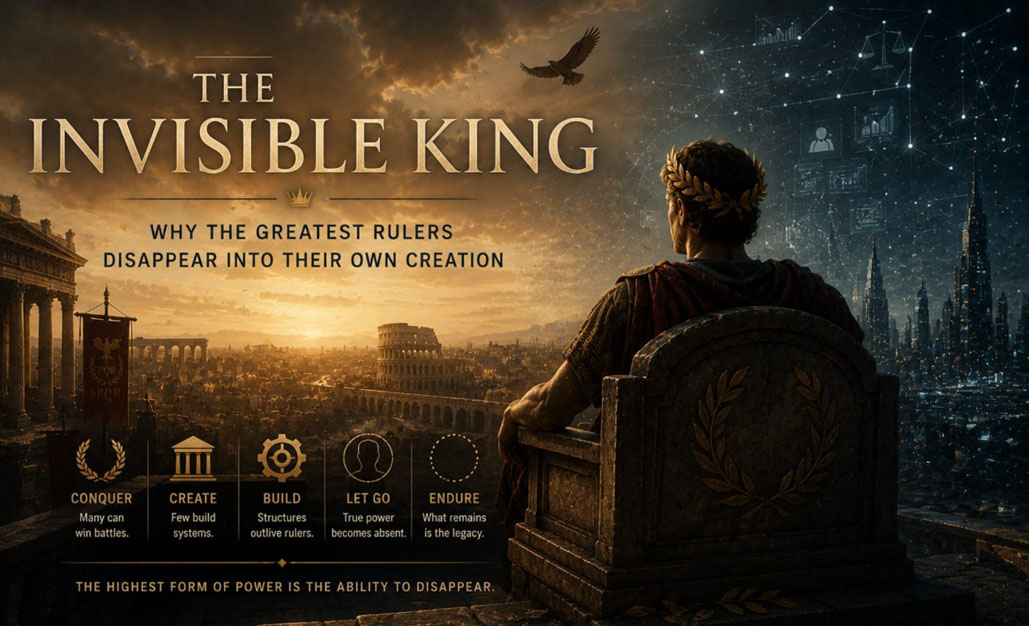
Most rulers want to be remembered.
They leave statues, laws, monuments and names carved into stone. Their power depends partly on visibility. The crown must be seen. The command must be heard. The portrait must remind the population who occupies the center.
History is filled with people asking the future to repeat one sentence:
He was here.
But the most successful rulers may achieve something far stranger.
They build a world in which their constant presence is no longer necessary.
The system continues. The roads remain in use. The institutions still operate. People follow rules whose creator they no longer remember. What began as personal power becomes part of the ordinary structure of reality.
The ruler disappears into the kingdom.
This is the paradox of the invisible king: the greatest proof of control may be the ability to stop controlling.
Power That Must Keep Proving Itself
Weak authority is exhausting.
It must repeat itself constantly because nothing beneath it is stable. Every decision returns to the center. Every conflict requires intervention. Every institution waits for permission. The ruler appears powerful precisely because the system remains incapable of functioning without him.
Remove the ruler, and the structure collapses.
This kind of power often looks impressive. It produces ceremonies, punishments, public displays and endless reminders of hierarchy. Yet its visibility reveals dependence. The ruler has not built a durable order. He has built a machine that uses his presence as its only source of energy.
Strong creators solve another problem.
They transform personal intention into procedures, roles and relationships that can survive after the original hand has been removed. The system no longer asks what the founder would do at every moment. It develops ways of making decisions without summoning him back from the dead.
The strongest king is therefore not the one who occupies the throne forever.
It is the one whose absence does not empty it of meaning.
Augustus and the Empire Beyond One Man
Augustus understood that victory was not enough.
Rome had already produced generals capable of conquest. Julius Caesar had demonstrated how much authority one exceptional individual could accumulate. But personal greatness creates a dangerous question: what happens when the exceptional person dies?
A state that survives only through one body is not yet a state.
Augustus gradually transformed Roman political life after decades of civil war. He did not erase older republican institutions. He reorganized power around himself while preserving enough familiar language and ceremony to make the new order appear continuous with what had come before.
That system remained deeply personal. Augustus was not an invisible administrator quietly standing outside it. His name, family, image and authority were everywhere.
Yet his greater achievement was not simply becoming Rome’s most powerful man. It was giving imperial rule a structure that could outlive him.
Offices, taxation, provincial administration, military organization, public building and the developing logic of succession made Rome more than the temporary possession of one victorious general. Later emperors changed the system, abused it and fought over it, but the imperial office survived the person who had shaped it.
Augustus eventually disappeared.
The position remained.
The creator became historical, while the architecture became political reality.
The Creator Who Does Not Need to Intervene
The same idea appears in theology.
Ancient gods were often imagined as visible participants in the world. They sent omens, altered battles, punished rulers and spoke through dreams, prophets or oracles.
But a different model of divine power is possible.
What if a perfect creator does not need to correct the world constantly?
A programmer who must manually repair every operation has not created a stable program. A parent who decides everything for an adult child has not completed the work of raising an independent person. A gardener who must physically support every plant has not produced a living garden.
Intervention can demonstrate power.
It can also reveal unfinished creation.
This does not prove anything about God or the structure of the universe. The apparent absence of divine intervention can be interpreted in radically different ways: freedom, indifference, hidden providence or simply the absence of a creator.
But the philosophical possibility remains striking.
Perhaps the highest creator is not the one whose hand appears in every event.
Perhaps it is the one whose creation can continue without visible supervision.
The world becomes the evidence.
The creator becomes invisible inside the laws that allow it to endure.
The Architecture of Absence
The most successful structures often disappear from attention.
A bridge is praised when it opens, then becomes a route. Thousands cross it without thinking about the engineer. A language is used by people who do not know how its grammar developed. A reliable operating system becomes almost invisible because the user can focus on the task rather than the machinery.
Failure makes systems visible again.
The bridge closes.
The software crashes.
The institution cannot make a decision.
Suddenly people remember the architecture beneath ordinary life.
This creates a strange form of greatness. The better the structure works, the less frequently its creator must be invoked.
The work passes from intention into environment.
At first, someone must explain the system.
Later, the system explains itself.
Eventually, it begins to feel natural.
That is when the creator achieves the most complete form of disappearance—not because the work has been forgotten, but because it has become part of the world through which everything else is understood.
The Danger of Becoming Invisible
Not every invisible system is good.
A structure can become so ordinary that people stop asking who built it, whom it serves or whether it should continue. Power can hide more effectively inside procedure than inside a palace.
An obvious dictator can be opposed.
An invisible rule may be mistaken for reality itself.
This is why the invisible king contains two opposite possibilities.
The good creator becomes unnecessary because the creation has matured.
The dangerous ruler becomes invisible because control has been embedded so deeply that no one can identify where decisions originate.
An algorithm may shape what millions see without appearing as a ruler. A market may distribute rewards and suffering while seeming like an impersonal law of nature. An institution may preserve the preferences of its founder long after everyone has forgotten that those preferences were once choices.
Absence can represent trust.
It can also represent concealed authority.
The question is not merely whether the king has disappeared.
It is whether the kingdom has become free—or whether the throne has been distributed throughout the walls.
The New Kings of the Future
Humanity is beginning to create systems capable of operating beyond direct human attention.
Artificial intelligence can already classify, recommend, generate and coordinate at scales no individual could supervise continuously. Synthetic biology may produce living systems capable of reproducing and adapting. Digital institutions may continue making decisions long after their designers leave.
The old question of power therefore returns in technological form.
Can we create something that functions without us?
And should we?
A permanently dependent AI remains a tool. A system capable of acting independently becomes something harder to classify. Independence may increase usefulness and resilience. It may also reduce accountability.
The invisible king must therefore face a final test:
Can the creator leave without abandoning responsibility?
A parent allows independence but does not pretend the child never existed. An engineer designs a bridge to stand without constant supervision, but maintenance and accountability remain necessary. A political founder may leave institutions behind, yet those institutions require correction when conditions change.
Successful creation is not permanent control.
Neither is it careless departure.
The mature creator knows when to withdraw and what safeguards must remain.
The Abandoned Garden
A living garden does not remain frozen in the shape imagined by the gardener.
Plants spread. Seasons change. New relationships emerge. Some species dominate, others disappear. The garden becomes partly its own history.
If it can survive only while the gardener controls every leaf, it has not truly become alive.
But abandonment alone is not love.
A garden can also be neglected, exhausted or allowed to collapse.
The difference lies in what was created before the departure.
Was the soil prepared?
Could the system regenerate?
Were limits and sources of nourishment built into it?
Did the gardener leave because the garden was ready—or because responsibility had become inconvenient?
The ultimate proof of creation is not simply that something continues after us.
It is that it can continue without becoming a prison, ruin or mechanical repetition of our original will.
Watch the Video
Current Knowledge
Political systems often survive their founders by translating personal authority into institutions, offices, laws, administrative practices and cultural expectations. Augustus played a central role in establishing a durable imperial order in Rome, although that system continued to evolve and remained vulnerable to conflict, succession crises and individual rulers.
Complex systems can also become difficult to perceive once they are embedded in ordinary life. Infrastructure, software and institutions are often most visible during failure, controversy or transition.
Artificial intelligence and autonomous systems increase the possibility that human creations may act with less immediate supervision. However, autonomy does not remove questions of responsibility, governance, maintenance and control.
Open Questions
When does a creator’s withdrawal demonstrate success, and when does it become abandonment? Can a system be truly independent while remaining accountable to the people affected by it?
Does institutional durability preserve a founder’s achievement, or can it also preserve outdated assumptions long after their purpose has disappeared?
If an artificial system continues operating after its designers are gone, who inherits responsibility for its decisions? And how can society distinguish between a creation mature enough to function independently and one whose creators have simply lost control?
Transhumation Interpretation
The invisible king is not merely a ruler who has been forgotten.
He is the creator whose intention has become structure.
At first, power has a face. It speaks, commands and intervenes. Later, it becomes law, architecture, ritual, software or inherited expectation. The individual disappears, but the pattern continues organizing the world.
This may be the greatest achievement of creation.
It may also be its greatest danger.
Transhumation does not ask only whether something can survive its maker. It asks what exactly survives: the creator’s wisdom, the creator’s limitations or a structure capable of becoming more than either.
The final throne is therefore not empty.
It has changed form.
It may be an institution.
An algorithm.
A law.
A garden capable of growing in directions the gardener never predicted.
Perhaps the greatest words a creator could hear are not:
We still need you.
But:
What you created still lives—and it no longer needs to remain exactly as you left it.
How to Read the World
FAQ
What does “The Invisible King” mean?
It describes a ruler or creator whose work becomes strong enough to continue without constant personal supervision.
How does Augustus relate to this idea?
Augustus helped transform Roman rule from the authority of one victorious individual into an imperial structure capable of surviving his death, although the system continued to change after him.
Is the article claiming that God does not intervene?
No. It examines a philosophical possibility: a powerful creator might be judged not by constant intervention, but by whether the creation can continue through its own structure.
Is invisibility always a sign of successful power?
No. Power can also become invisible by hiding itself inside institutions, procedures or algorithms. Invisible control may be harder to question than visible authority.
What is the connection with The Abandoned Garden?
The garden represents a creation that must eventually develop beyond constant supervision. Its survival can demonstrate maturity, but abandonment without preparation may still produce failure.
How does this apply to artificial intelligence?
AI systems may become increasingly capable of operating without continuous human direction. This raises questions about autonomy, accountability and whether creators can withdraw without losing responsibility.
What is the difference between independence and abandonment?
Independence follows from a structure capable of functioning and adapting responsibly. Abandonment occurs when the creator withdraws without ensuring that the creation can survive or that those affected remain protected.
What is the central Transhumation idea?
The highest form of creation may not be permanent control. It may be building something capable of continuing after the creator leaves—without forcing the future to remain trapped inside the creator’s original design.
Continue the Transhumation Series
Explore the full journey:
- End of Reality — Where Do You Really Exist?
- End of Physics — Are the Laws of Reality Real?
- End of the Real World — Reality Is No Longer Required
- End of Consciousness — Beyond the Human Mind
- End of Death — When Human Limits Disappear
- End of Religion — When Technology Replaces Faith