
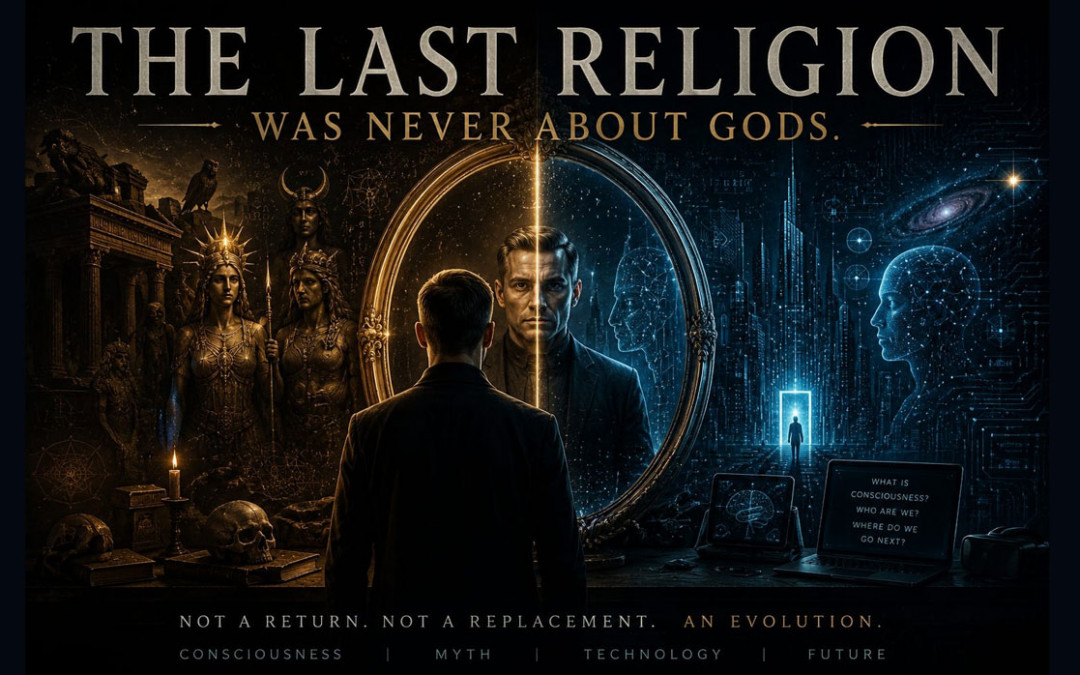
Perhaps religion’s oldest function was not explaining the gods. It was explaining where we are.
For most of modern history, religion has been presented as a problem of belief. Do you believe in God? In gods? In heaven, reincarnation, divine judgment, revelation? Once the question is framed this way, the story of modernity appears almost inevitable. Science explains what mythology once explained badly; technology solves problems once entrusted to prayer; religion retreats as knowledge advances.
It is an elegant story.
It may also be asking the wrong question.
Imagine removing the gods from an ancient religion while leaving almost everything else intact: its calendar, funerary customs, account of the cosmos, distinction between sacred and ordinary time, rituals of passage, ideas about death, obligations to ancestors and stories explaining humanity’s place in a larger order. Something recognizably religious would remain.
Now perform the opposite experiment. Keep the god, but remove the cosmology, ritual, community, moral structure, symbols, stories and relationship between life and death.
Surprisingly little remains.
Perhaps the deepest function of religion was never simply to persuade human beings that supernatural beings existed. Perhaps it was to provide something consciousness repeatedly seems to construct whenever the world becomes too large to inhabit without a map.
Orientation.
The Animal That Knows Where the Story Ends
A human being can sit beside the sea and know that the sea will probably still exist after everyone they love has died. We can look at starlight that began travelling before our birth, imagine civilizations that disappeared thousands of years ago, and understand that our own civilization is not exempt.
This creates a peculiar condition.
We do not merely live. We know that we are living inside time.
We know that our bodies age, that memory fails, that people disappear and that even apparently permanent institutions eventually become archaeology. Science has enormously expanded this perspective. It has shown us a universe vastly older and larger than anything available to most ancient cosmologies.
Yet greater accuracy does not automatically produce greater orientation.
Knowing that Earth is approximately 4.5 billion years old tells us something extraordinary about Earth. It does not tell us what to do with the eighty years we may personally receive upon it.
Ancient religions occupied precisely this gap. They placed individual existence inside larger structures: ancestor and descendant, mortal and divine, chaos and order, death and renewal, earthly city and cosmic order.
Their cosmologies were frequently wrong as descriptions of physical reality.
But describing physical reality may not have been their only function.
A map of the London Underground is also physically wrong. Stations are moved, distances distorted, curves straightened. Yet nobody complains that Harry Beck failed as a geographer. The map succeeds because its purpose is not to reproduce London. Its purpose is to allow someone to move through it.
Religion may have functioned similarly.
It made existence navigable.
When We Mistook the Map for the Territory
The difficulty begins when orientation becomes explanation.
A symbolic map can help a civilization inhabit reality. But once the map is treated as reality itself, every new discovery becomes dangerous. The stars must remain where theology placed them. Humanity must occupy the position assigned by the story. The old interface, originally capable of orienting people within the unknown, begins protecting itself from the unknown.
Modernity reacted powerfully against this.
And with good reason.
Astronomy did not need permission from cosmology. Biology did not need to preserve Genesis as a scientific account. Medicine worked better when disease ceased to be primarily interpreted through sin, spirits or divine intention.
But in dismantling obsolete explanations, modern civilization may have assumed that it had also eliminated the function those explanations once performed.
We became extraordinarily good at describing the territory.
We became less certain what kind of map a conscious being should carry through it.
That distinction may explain something otherwise puzzling about the modern world. Never have so many people had access to so much information about reality. Yet information and orientation are not synonyms. A person can carry virtually the accumulated knowledge of civilization in a pocket and still have no satisfactory answer to the question of what his life is for.
Google can tell you the distance to Andromeda.
It cannot tell you why losing one particular person can make the entire universe suddenly seem empty.
Technology Brought the Old Questions Back
For a while, it was possible to imagine that technological civilization would simply leave metaphysics behind.
Instead, technology has begun reopening metaphysical questions with remarkable efficiency.
Artificial intelligence forces us to ask what intelligence actually is. Neuroscience makes the relationship between brain and experience increasingly precise while leaving the existence of subjective experience philosophically difficult. Virtual worlds complicate our intuitive relationship between reality and representation. Digital archives allow fragments of personality to survive their biological owners. AI can already imitate voices, styles and conversational patterns of people who are absent or dead.
None of this proves an afterlife. It does something more interesting.
It makes questions once confined to theology technically relevant.
What constitutes identity? How much of a person can survive a change of carrier? Is memory sufficient for continuity? If a perfect reconstruction speaks with your voice but experiences nothing, what exactly has survived? If consciousness cannot be reduced to information, where does the distinction begin?
The priest and the engineer may use radically different vocabularies.
They have nevertheless begun meeting at some surprisingly old doors.
Perhaps Religion Was a Technology
The word technology makes this sound provocative only because we have narrowed its meaning to machines.
A technology is also a method for doing something.
Writing is a technology for externalizing memory. Money is a technology for coordinating value. Law is a technology for stabilizing behaviour among strangers.
Religion can be examined in the same way: as a civilizational technology for connecting finite lives to structures larger than themselves.
That does not make its supernatural claims true. Nor does it make every religious system benign. Technologies can malfunction. Maps can become prisons. Institutions created to preserve meaning can eventually defend themselves at the expense of the people they were supposed to serve.
But separating function from carrier changes the question.
The gods may change.
The rituals may disappear.
The temples may become museums.
The function can migrate.
And if it does, then the decline of traditional religion does not necessarily imply the disappearance of the human problem religion attempted to solve.
It may simply mean that the old interface is losing compatibility with the world it once organized.
The Last Religion
This is where the title becomes deliberately misleading.
The Last Religion is not a proposal for another church.
It may not require a god at all.
The more interesting possibility is that civilization is approaching a point at which several domains artificially separated by modernity begin touching again: cosmology, consciousness, information, technology, identity, mortality and meaning.
Science should remain science. Evidence cannot be replaced by symbolism merely because symbolism feels satisfying. But the reverse mistake is equally limiting: assuming that because science describes reality with unprecedented precision, every question humans once placed inside religion has therefore been answered.
Some have merely changed vocabulary.
The ancient person asked what survives death.
The modern researcher asks what constitutes continuity of identity.
The philosopher asked what consciousness is.
The engineer now asks what properties an artificial system would need before we should even consider the possibility of experience.
The theologian wondered whether humanity occupied a special place in creation.
Astrobiology asks how common intelligence might be in the universe.
These are not identical questions.
But they may grow from the same ancient discomfort: consciousness discovering that it exists inside something vastly larger than itself and trying to determine what that fact means.
Perhaps humanity has not been travelling from religion toward its opposite.
Perhaps it has been replacing maps.
Read more
Current Knowledge
Religions have historically performed many functions beyond belief in supernatural agents. Anthropologists, historians and sociologists have studied religion as a source of ritual, collective identity, moral organization, cosmology, social cohesion and responses to death and uncertainty. There is no single scholarly definition of religion accepted across all disciplines.
Modern scientific theories do not require religious explanations for cosmology, biological evolution or the operation of natural phenomena. At the same time, questions concerning consciousness, subjective experience and personal identity remain active areas of philosophical and scientific investigation.
Current artificial-intelligence systems can preserve, reproduce and generate patterns derived from human language, images and other recorded information. There is presently no scientific consensus that such systems possess subjective consciousness, nor does digital reconstruction establish personal survival after biological death.
Open Questions
Is the need for existential orientation an intrinsic feature of reflective consciousness, or primarily a product of particular cultures?
Can secular institutions provide the psychological and civilizational functions once supplied by religion without reproducing its dogmatic tendencies?
Could increasingly sophisticated models of consciousness eventually dissolve some ancient metaphysical questions—or make them harder?
And if humanity eventually becomes a multiplanetary or technologically transformed civilization, what kind of story will allow an individual consciousness to locate itself within that scale?
The Transhumation Interpretation
Transhumation proposes a distinction between religion as carrier and religion as function.
Gods, temples, scriptures and rituals are carriers. They differ enormously across cultures and history.
The underlying function may be more persistent: constructing an interface between finite consciousness and a reality too large to experience directly.
If that is correct, the last religion will not arrive when humanity discovers the final god.
It will arrive when humanity no longer needs to replace one map with another because it has learned how to navigate while knowing that every map remains incomplete.
That would not be the victory of religion over science.
Nor science over religion.
It would be something older than either:
a conscious being finally learning how to live inside a universe it can never completely see.
Watch the Video
How to Read the World
FAQ
Was religion originally created to explain nature?
Explaining natural phenomena was one function associated with many religious traditions, but religions also organized ritual, morality, social identity, death, cosmology and relationships between individuals and larger communities.
Is Transhumation claiming that religions are scientifically true?
No. The article separates the historical and psychological functions of religion from the empirical truth of particular supernatural claims.
What does “religion as orientation” mean?
It means treating religion partly as a system that helped individuals locate their lives within larger structures of time, death, community and cosmos.
Why compare religion to a map?
A map does not need to reproduce its territory perfectly to help someone navigate it. The analogy asks whether religious cosmologies sometimes functioned similarly as symbolic maps of existence.
Why does the article call religion a technology?
Technology is used here in the broad sense of a method developed to perform a function. Religion can therefore be examined as a civilizational method for organizing meaning, continuity and orientation.
Does science replace religion?
Science has replaced religious explanations in many empirical domains. That does not automatically answer philosophical questions concerning meaning, subjective experience or personal identity.
What does AI have to do with religion?
AI raises modern versions of old questions about intelligence, identity, consciousness, agency and whether aspects of a person can persist independently of their original biological carrier.
Can AI provide digital immortality?
Current AI can reproduce informational patterns associated with a person, but that is not evidence that the person’s subjective consciousness survives.
What is “The Last Religion” in Transhumation?
It is not intended as a proposed church or dogma. It is an inquiry into whether ancient functions of religion may reappear through new languages involving consciousness, information, technology and cosmology.
What is the central Transhumation thesis?
The carrier changes. The question survives. Humanity may have changed gods, cosmologies and technologies many times while repeatedly confronting the same problem: how finite consciousness should understand its place inside a reality vastly larger than itself.
Continue the Transhumation Series
- Forgotten Religion | Ancient Gods, Symbols and the Hidden Structures of Human Civilization
- The Last Religion | Death, Immortality and the Future of Humanity
- The New Theurgy | AI, Information and the Future of Human Civilization
- End of Branding: You Were Never Meant to Become a Product
- Baal vs Ishtar: Why Ancient Gods Never Disappeared