
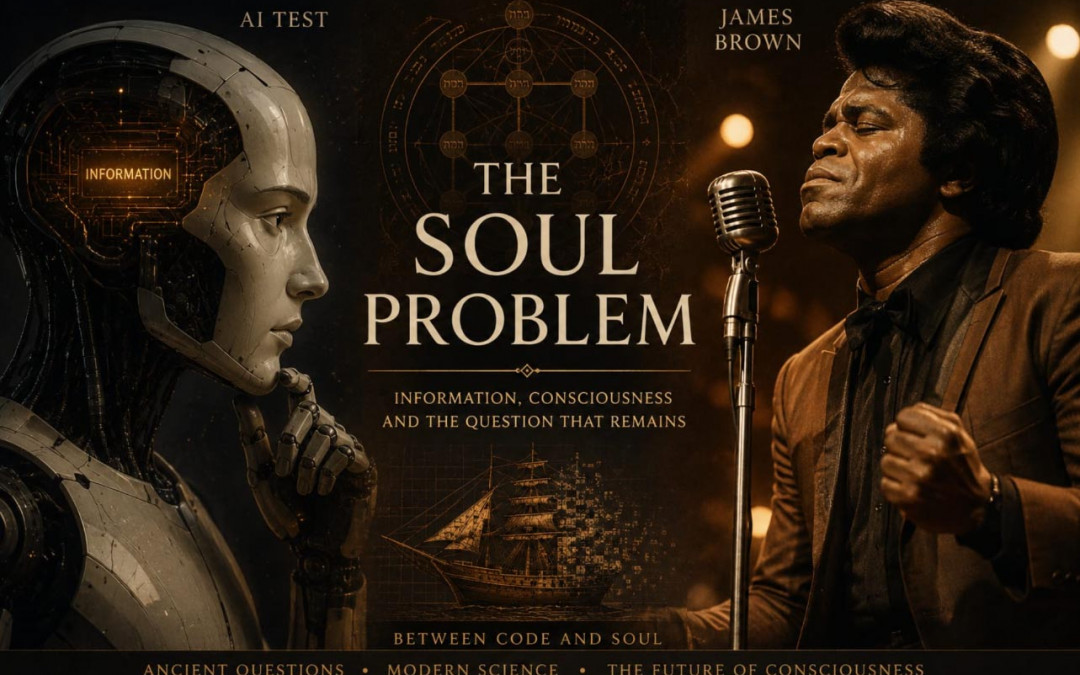
The weight of the Soul
For centuries, the disagreement appeared almost perfectly arranged. Religion spoke of the soul; science spoke of the body. One dealt in continuity, identity and whatever might survive death, while the other dealt in tissue, chemistry, organs and measurable causes. The division became so familiar that it was easy to mistake it for something permanent. Either a human being contained an invisible essence, or a human being was a physical system whose mysteries would eventually yield to sufficiently good instruments.
Then modern science encountered a category that complicated the old border: information.
Information was not supernatural, and its discovery did not rescue any religious doctrine from the demands of evidence. Yet it introduced something peculiar into a world that had become accustomed to explaining objects by examining their material components. A genetic sequence could be copied while the molecules carrying it were replaced. A melody could survive a change of instrument. Software could migrate between machines. A book could cross centuries while its paper, language and typography changed. In each case, something recognizable persisted without requiring the persistence of the original matter.
That does not prove the existence of a soul.
It does something more interesting.
It makes the ancient question difficult again.
The Ship That Would Not Stay the Same
The Ship of Theseus is usually presented as a philosophical puzzle, but its power comes from how ordinary the problem becomes once you notice it. Replace one plank in a ship and nobody worries. Replace another, then another, and eventually every original component is gone. At what point did the ship cease to be the ship? If no such point can be identified, what exactly were we calling the ship in the first place?
Human beings present a far more complicated version of the same problem. Matter moves through the body continuously. Cells die and are replaced at very different rates; proteins are broken down and rebuilt; atoms that belonged to breakfast become temporarily incorporated into a living system and later leave it. The popular claim that the entire body replaces itself every seven years is false, because different tissues behave very differently and some neurons can persist for much of a lifetime. Yet the broader fact remains: the material composition of a living person is not static.
And still there is continuity.
A seventy-year-old can look at a photograph of a child and say, without metaphor, that was me. Almost nothing about the physical system is identical in the simple sense. The body has changed, memories have been lost and added, beliefs have altered, personality may have shifted. Nevertheless, ordinary experience treats the person as continuous.
The puzzle therefore predates both neuroscience and theology.
What is continuity made of?
When Matter Began Carrying Instructions
Physics and chemistry had already shown that matter could form extraordinary structures. Biology added something more disturbing: some of those structures behave as though organization itself matters.
DNA is chemistry. There is no need to invoke anything immaterial to explain the molecule. But the order of its bases is also consequential. Rearrange the same kinds of chemical units and biological outcomes change. What matters is not merely what substance is present, but how its elements are arranged and how cellular machinery interprets that arrangement.
Information entered biology not as a mystical substance but as a useful way to describe organized differences that influence what systems do.
The same distinction appears elsewhere. A page contains ink, but scrambling the ink can destroy the text without significantly changing the amount of matter present. A hard drive has a physical state, but the arrangement of those states determines whether it contains a photograph, a tax return or nothing useful at all. A melody is never encountered without a physical carrier — vibrating strings, pressure waves, electrical signals — yet its recognizable organization can survive the replacement of one carrier by another.
This is where the old material-versus-spirit argument becomes insufficient.
Matter matters.
But arrangement matters too.
And arrangement can sometimes persist while its carrier changes.
You Were Never Only the Material
There is a temptation to move too quickly here. If patterns can survive changing carriers, one might declare that human identity is simply information and that the ancient soul has returned disguised as data.
That conclusion is not warranted.
A copied file is not automatically the same file in the philosophically relevant sense. A perfect description of a brain would not by itself establish that subjective experience had been transferred. A pattern can be duplicated, whereas personal consciousness appears — at least from the inside — stubbornly singular. Information theory can measure distinctions and transmission without explaining why any physical process should produce experience at all.
The useful discovery is therefore narrower.
A thing need not be identical with its current material components in order for us to recognize continuity.
This is already familiar outside biology. The same novel exists in many editions. A corporation survives the replacement of every employee. A language persists despite generations of speakers dying. A city can retain an identity after streets, buildings and populations change. None of these examples proves that a person works in exactly the same way, but they reveal a recurring structure: continuity can belong partly to organization, relationship and history rather than to a fixed collection of matter.
The human question becomes harder because we do not merely persist from the outside.
We experience persistence.
The Problem Inside the Problem
Neuroscience has made remarkable progress in relating mental functions to the brain. Damage particular structures and memory, perception, language or personality can change. Alter chemistry and experience changes. Stimulate neural tissue and sensations can arise. Whatever consciousness is, the evidence overwhelmingly ties ordinary human consciousness to the functioning brain.
And yet the central mystery has not disappeared.
Why should any of this feel like something?
A brain can be described from the outside in electrical activity, signaling, connectivity and computation. The description may become increasingly precise. But subjective experience introduces another fact: there is apparently something it is like to be the system undergoing those processes.
This is sometimes called the hard problem of consciousness, although philosophers disagree about whether the problem is correctly formulated and whether consciousness ultimately requires any explanation beyond physical processes. There is no consensus theory that explains all aspects of consciousness, and there is no scientific consensus identifying consciousness with a transferable informational pattern.
That boundary matters for Transhumation.
Information continuity is not evidence of consciousness continuity.
A civilization may become extremely good at preserving photographs, voices, preferences, memories and behavioral patterns without thereby proving that the experiencing subject has survived.
This is precisely where an older word returns.
Not as an answer.
As a question.

The Soul After the Soul
The word soul historically carried many meanings. It could refer to life, breath, personality, intellect, moral identity, an immortal essence or the principle animating a body. Plato’s soul was not identical to the Christian soul, and Aristotle’s psyche was not simply a ghost inhabiting biological machinery. The apparent simplicity of the modern question — “Do you believe in the soul?” — hides a long history of competing models.
Perhaps that history is useful now.
Ancient thinkers lacked genetics, neuroscience, information theory and computers, but they confronted the same experiential anomaly we confront: a human being changes continuously and yet somehow appears to remain one.
Calling that continuity a soul did not explain the mechanism.
But it named the problem.
Modern language gives us new candidates: memory, self-model, informational organization, embodied process, biological continuity, narrative identity, dynamic pattern. None has yet closed the question completely.
The soul may therefore be most interesting when we stop treating it as an object that must either be found or dismissed.
Perhaps it was civilization’s early name for the difficulty of explaining why a changing system can continue to be experienced as one life.
Watch The Video
How to Read the World
Current Knowledge
Human identity depends strongly on the functioning brain and body. Changes to brain structure or chemistry can alter memory, personality, perception and consciousness. There is currently no accepted scientific evidence for a separable entity that preserves personal consciousness independently of the brain after death.
Information is always physically instantiated when it exists in an operational system, but informational patterns can be copied across different physical carriers. DNA sequences can be replicated across generations of molecules; texts can migrate between paper and digital storage; software can operate on different compatible hardware.
The human body undergoes continuous material turnover, although the claim that every cell is replaced within a fixed period such as seven years is incorrect. Different tissues renew at different rates, and some cells can persist for decades.
Consciousness remains an active scientific and philosophical problem. Researchers have identified many neural correlates and mechanisms associated with conscious states, but no universally accepted theory explains why or how subjective experience arises, and there is no demonstrated method for transferring a person’s consciousness to another carrier.
Open Questions
Which aspects of personal identity are necessary for genuine continuity: memory, personality, embodiment, causal history, consciousness, or some combination of them? If an exact informational duplicate of a human mind were technologically possible, would it continue the original subject or create another subject convinced that continuity had occurred?
Can consciousness eventually be explained entirely as an emergent property of physical information-processing systems, or is our current conceptual framework missing something fundamental? And if patterns can migrate between carriers in many domains, are conscious processes another example of carrier-independent organization, or does subjective experience depend on biological conditions that cannot simply be abstracted away?
The most difficult boundary remains the simplest to state: preserving information about a person is not yet the same thing as preserving the person who experiences being that person.
Transhumation Interpretation
Transhumation does not need the soul to become a scientific object in order for the old question to matter.
Its deeper interest lies in continuity across changing carriers.
Civilization already consists of migrations of function. Memory moved partly from brains into writing, libraries and servers. Calculation migrated into machines. Vision extended through lenses and cameras. Human presence travels through recorded voice, photographs, video and increasingly through models capable of reproducing aspects of individual language and behavior.
None of those migrations proves that consciousness can migrate.
But neither should they be dismissed as irrelevant.
They teach us that the boundary of a thing is not always identical to the boundary of its current material container. Patterns can persist. Functions can migrate. Structures can survive the replacement of their components.
The mistake would be to call that proof of the soul.
The opposite mistake would be to assume that because the old word carried religious meanings, the underlying problem disappeared when its vocabulary became unfashionable.
Perhaps information has not discovered the soul.
Perhaps it has rediscovered why humans invented the question.
For thousands of years we asked what could remain when the body changed or died. We imagined breath, spirit, essence and immortal identity because continuity seemed to demand something capable of crossing the boundary of matter.
Modern science has not shown us such an entity.
It has shown us something stranger.
Matter can change while organization persists.
The carrier can disappear while the pattern survives elsewhere.
And consciousness — the one thing for which survival would matter from the inside — remains unresolved.
Perhaps the soul was never the answer.
Perhaps it was the name we gave to the question before we knew enough to ask it properly.
FAQ
What is the Soul Problem?
It is the question of what creates personal continuity when the body, memories and material components of a person continually change.
Does information prove that the soul exists?
No. Information provides a useful way of thinking about continuity and patterns, but it is not evidence for an immortal or separable soul.
Is a human being simply information?
Science has not established that. Human beings are embodied biological systems, and there is no evidence that copying their information would necessarily transfer subjective consciousness.
What does the Ship of Theseus have to do with identity?
It asks whether something remains the same when its components are gradually replaced, which parallels questions about continuity in living organisms.
Can a pattern survive a change of carrier?
Yes. Melodies, texts, software and genetic sequences can preserve recognizable organization across changing physical implementations.
Does that mean consciousness could be uploaded?
Not necessarily. Preserving or reproducing information is not currently known to preserve the experiencing subject.
Why use the word “soul” at all?
Because historical concepts of the soul represent some of humanity’s earliest attempts to describe problems of identity, consciousness and continuity that remain unresolved.
How does this connect to Transhumation?
Transhumation asks whether functions and patterns can survive changes of carrier while keeping a strict boundary between what such continuity demonstrates and what remains unknown about consciousness.
Continue the Transhumation Series
- Forgotten Religion | Ancient Gods, Symbols and the Hidden Structures of Human Civilization
- The Last Religion | Death, Immortality and the Future of Humanity
- The New Theurgy | AI, Information and the Future of Human Civilization
- End of Branding: You Were Never Meant to Become a Product
- Baal vs Ishtar: Why Ancient Gods Never Disappeared