
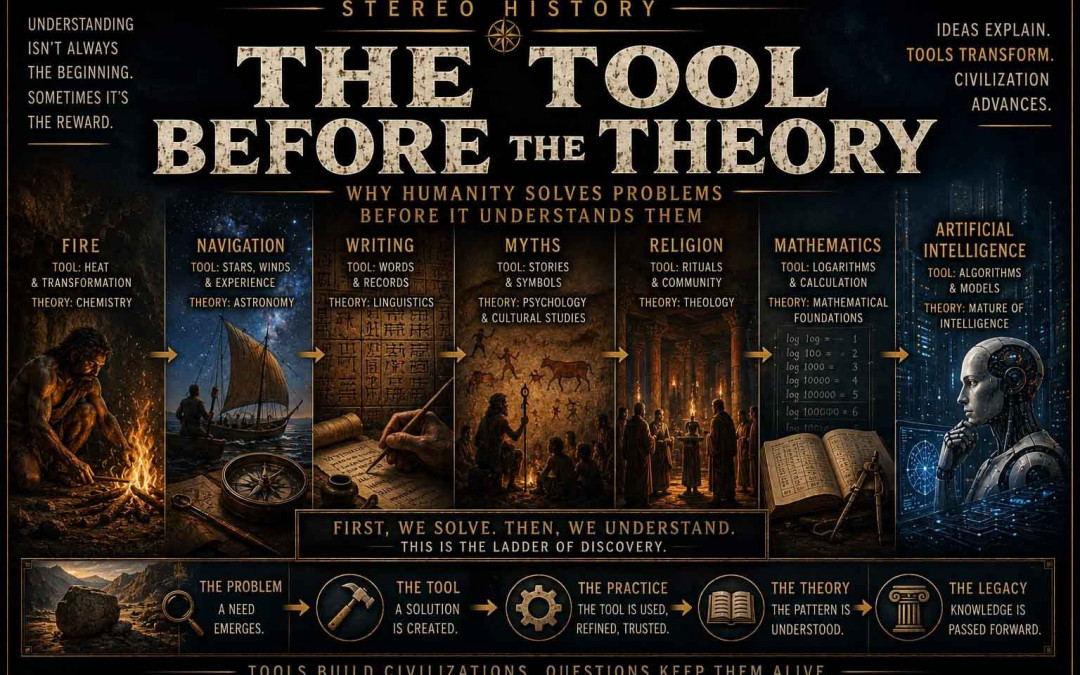
Most people assume knowledge comes first.
Theory.
Explanation.
Understanding.
Then application.
History suggests the opposite.
Again and again, humanity discovers useful tools long before it understands why they work.
The tool often arrives before the theory.
Fire Before Chemistry
For thousands of years people used fire.
They cooked food.
Forged metal.
Built civilizations.
Yet nobody understood combustion.
No one knew about oxygen.
No one knew about chemical reactions.
Fire worked long before fire was understood.
The tool came first.
The explanation arrived later.
Navigation Before Astronomy
Ancient sailors crossed oceans.
They followed stars.
Observed winds.
Tracked seasons.
Many reached destinations they could not fully explain.
Navigation existed before modern astronomy.
Practice arrived before theory.
The tool arrived before the explanation.

Writing Before Linguistics
Human beings used language for thousands of years.
They wrote poetry.
Recorded laws.
Built civilizations through words.
Yet linguistics as a scientific discipline appeared much later.
Writing worked perfectly well without a complete understanding of language itself.
The Logarithm Problem
Most students learn what a logarithm is.
Few learn why it was invented.
This matters.
The definition is not the interesting part.
The problem is.
Mathematicians needed a way to simplify extremely difficult calculations.
The logarithm emerged as a solution.
The tool appeared because a problem demanded it.
Understanding begins with the problem.
Not the formula.
Myths as Ancient Tools
Modern people often dismiss myths because they are not scientific.
This may miss their original purpose.
Myths were not always attempts to explain reality.
Often they were tools for navigating it.
They transmitted memory.
Values.
Warnings.
Patterns.
Knowledge survived because stories survived.
The myth functioned before anyone developed a formal theory about culture or psychology.
The tool arrived first.
Religion Before Theology
Religious traditions existed long before formal theology.
People prayed before philosophers explained prayer.
People practiced rituals before scholars categorized rituals.
Communities existed before doctrines.
The need came first.
The system followed.
The explanation arrived later.
Technology Is Not Machinery
Many people hear the word technology and imagine computers.
Machines.
Robots.
Artificial intelligence.
This is too narrow.
Technology is any tool that solves a problem.
A wheel is technology.
Writing is technology.
Money is technology.
Maps are technology.
Libraries are technology.
Even questions can become technologies of thought.
The form changes.
The function remains.
The Ladder of Discovery
The history of civilization often follows the same pattern.
Problem.
Tool.
Theory.
First, people encounter a difficulty.
Second, they develop a practical solution.
Only later do they fully understand why the solution works.
The ladder is climbed through experimentation long before explanation.
Why This Matters Today
Artificial intelligence may be following the same path.
Many people ask:
How does intelligence work?
What is consciousness?
What is reasoning?
These questions remain unresolved.
Yet useful tools already exist.
Humanity may once again be using something before it fully understands it.
This has happened many times before.
The Hidden Lesson
Perhaps wisdom begins with a simple realization:
Understanding is not always the beginning.
Sometimes understanding is the reward.
Human beings often discover pathways before maps.
They build bridges before theories.
They create tools before explanations.
Civilization advances because people continue solving problems even when they do not yet possess complete answers.
Conclusion
The history of humanity is not the history of perfect understanding.
It is the history of useful tools.
Fire came before chemistry.
Navigation came before astronomy.
Writing came before linguistics.
Religion came before theology.
Questions came before philosophy.
Again and again the same pattern appears.
The tool comes first.
The theory follows.
And perhaps the future will emerge the same way.
Not because we understand everything.
But because we continue building tools that help us move forward.
Continue reading…
Watch The Video Below
Continue reading…
AI as Virgil – God`s Tool

FAQ
What does “The Tool Before the Theory” mean?
It describes the recurring historical pattern in which people develop useful solutions before fully understanding the principles behind them.
Did humans use fire before understanding chemistry?
Yes. Fire was used for thousands of years before scientific explanations of combustion existed.
Why are logarithms a good example?
Most people learn how logarithms work but not why they were invented. Logarithms were created to solve difficult calculation problems long before modern computing existed.
Can myths be considered tools?
Yes. Myths often functioned as tools for preserving memory, transmitting values, and helping people navigate complex realities.
Did religion exist before theology?
Yes. Religious practices and communities existed long before formal theological systems were developed.
Is technology limited to machines?
No. Technology includes any tool that helps solve a problem, including writing, money, maps, libraries, and systems of thought.
How does this idea relate to AI?
Artificial intelligence may represent another example of a powerful tool emerging before humanity fully understands the principles behind intelligence itself.
What is the connection to Transhumation?
Transhumation views technologies, symbols, myths, and ideas as tools created to solve recurring human problems rather than isolated inventions.
Why is understanding the problem important?
The problem explains why a tool exists. Without understanding the need, the solution often appears arbitrary.
What is the main lesson of The Tool Before the Theory?
Civilization advances not because people possess perfect understanding, but because they continue creating useful tools that address real problems.
The Core Questions of Transhumation
Explore the full journey:
- End of Reality — Where Do You Really Exist?
- End of Physics — Are the Laws of Reality Real?
- End of the Real World — Reality Is No Longer Required
- End of Consciousness — Beyond the Human Mind
- End of Death — When Human Limits Disappear
- End of Religion — When Technology Replaces Faith