
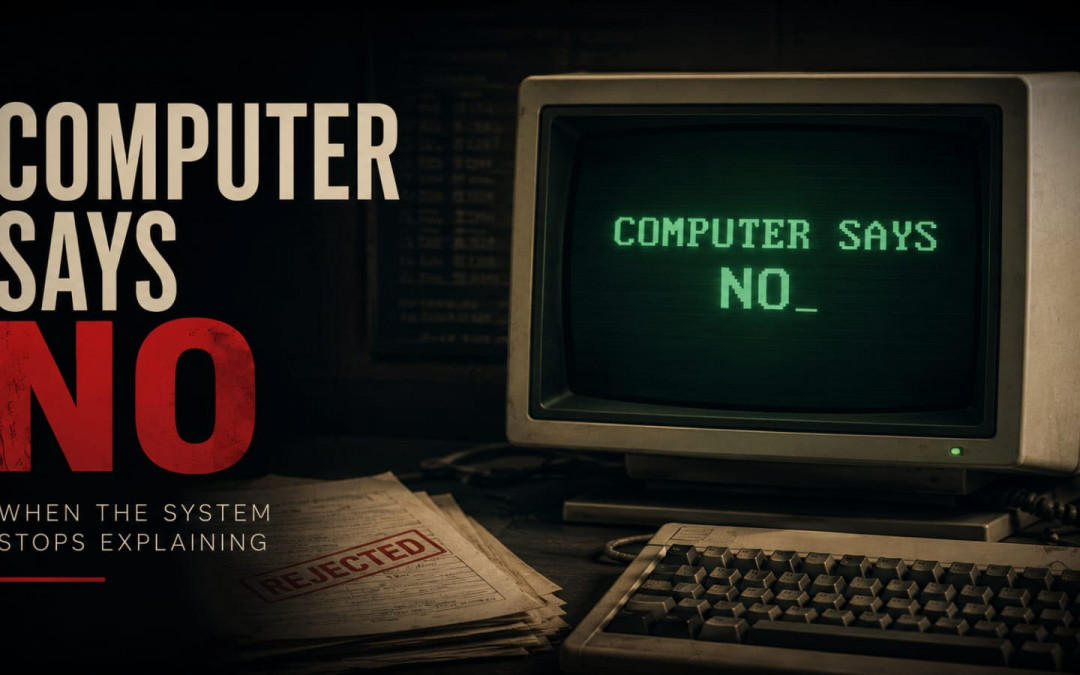
Computer Says No?
There is a particular kind of modern adventure that begins with a green button.
Nothing about it looks dangerous. You are sitting at a desk, perhaps with coffee beside you, looking at a form you have already checked three times. The passport number is correct. The dates are correct. Every box marked with an asterisk has been completed. Somewhere on the screen is a reassuring sentence telling you that the process should take only a few minutes.
You press Submit.
A circle begins turning.
For a moment, the machine appears to be thinking. Then the page refreshes and gives you an answer that is both perfectly clear and almost completely useless.
Your request cannot be processed.
Perhaps there is an error code. Perhaps there is a red box. Perhaps the system politely recommends that you try again later. What it usually does not tell you is the one thing you actually want to know: why?
So you begin the expedition. You check the form again. You change the browser. You remove an accent from your surname. You upload the same document as a PDF instead of a JPEG. You telephone somebody who tells you that everything looks correct from their side. You try again.
The computer still says no.
At some point the experience becomes strangely personal. You know perfectly well that the screen does not dislike you. Nevertheless, it begins to feel as though something behind it has made a decision about you and refuses to explain itself.
That feeling is worth examining.
Because increasingly, this is what civilization looks like from the outside.
The Door Without a Doorman
For most of history, rejection had a face.
A guard refused to let you through a gate. A clerk told you that a document was missing. A banker rejected a loan. A priest said the ceremony could not proceed. A bureaucrat pointed toward paragraph seventeen and explained, perhaps impatiently, that you had filled in the wrong form.
These encounters could be unpleasant, corrupt or absurd. But they contained something modern automated encounters often lack: a person standing close enough to the decision to offer some account of it.
The computer screen changes that relationship. It looks like the authority because it is the object speaking to us, but in most cases it is nothing of the sort. The screen may simply be the final visible layer of a chain involving databases, validation rules, identity systems, regulations, risk models, legacy software and decisions made years earlier by people who will never know that you exist.
The computer did not necessarily say no.
Civilization said no through a computer.
That distinction matters because it changes the mystery. We imagine that we are confronting a machine when in reality we may be confronting hundreds of human decisions compressed into an interface.
And the people operating that interface may understand only slightly more of the whole system than we do.
Somewhere, There Is a Rule
This is where the adventure becomes interesting.
Suppose a payment is rejected. There must be some reason. Perhaps the billing address does not match. Perhaps an anti-fraud system detected an unusual pattern. Perhaps the card issuer refused authorization. Perhaps a regulatory restriction was triggered. Perhaps two databases disagree about a single field.
The answer exists somewhere.
But somewhere is doing a remarkable amount of work.
Modern civilization depends upon specialization precisely because no individual can understand everything required to make it function. The person answering the telephone understands one layer. The programmer understands another. The compliance department understands another. The database administrator may understand how information is stored without knowing why a particular business rule exists. The person who originally wrote that rule may have left the company eight years ago.
No conspiracy is required.
Complexity alone is enough.
This creates one of the strangest characteristics of advanced civilization: we increasingly live inside systems that are human-made but no longer human-sized.
A cathedral can be too large for one person to build, but a person can still stand outside it and see approximately what the structure is. Modern information systems can be different. Their architecture may be distributed across software, institutions, regulations and millions of individual interactions. There may be no single place from which the whole mechanism becomes visible.
The system exists.
The overview may not.
Computer Says No?
There is a particular kind of modern adventure that begins with a green button.
Nothing about it looks dangerous. You are sitting at a desk, perhaps with coffee beside you, looking at a form you have already checked three times. The passport number is correct. The dates are correct. Every box marked with an asterisk has been completed. Somewhere on the screen is a reassuring sentence telling you that the process should take only a few minutes.
You press Submit.
A circle begins turning.
For a moment, the machine appears to be thinking. Then the page refreshes and gives you an answer that is both perfectly clear and almost completely useless.
Your request cannot be processed.
Perhaps there is an error code. Perhaps there is a red box. Perhaps the system politely recommends that you try again later. What it usually does not tell you is the one thing you actually want to know: why?
So you begin the expedition. You check the form again. You change the browser. You remove an accent from your surname. You upload the same document as a PDF instead of a JPEG. You telephone somebody who tells you that everything looks correct from their side. You try again.
The computer still says no.
At some point the experience becomes strangely personal. You know perfectly well that the screen does not dislike you. Nevertheless, it begins to feel as though something behind it has made a decision about you and refuses to explain itself.
That feeling is worth examining.
Because increasingly, this is what civilization looks like from the outside.
The Door Without a Doorman
For most of history, rejection had a face.
A guard refused to let you through a gate. A clerk told you that a document was missing. A banker rejected a loan. A priest said the ceremony could not proceed. A bureaucrat pointed toward paragraph seventeen and explained, perhaps impatiently, that you had filled in the wrong form.
These encounters could be unpleasant, corrupt or absurd. But they contained something modern automated encounters often lack: a person standing close enough to the decision to offer some account of it.
The computer screen changes that relationship. It looks like the authority because it is the object speaking to us, but in most cases it is nothing of the sort. The screen may simply be the final visible layer of a chain involving databases, validation rules, identity systems, regulations, risk models, legacy software and decisions made years earlier by people who will never know that you exist.
The computer did not necessarily say no.
Civilization said no through a computer.
That distinction matters because it changes the mystery. We imagine that we are confronting a machine when in reality we may be confronting hundreds of human decisions compressed into an interface.
And the people operating that interface may understand only slightly more of the whole system than we do.
Somewhere, There Is a Rule
This is where the adventure becomes interesting.
Suppose a payment is rejected. There must be some reason. Perhaps the billing address does not match. Perhaps an anti-fraud system detected an unusual pattern. Perhaps the card issuer refused authorization. Perhaps a regulatory restriction was triggered. Perhaps two databases disagree about a single field.
The answer exists somewhere.
But somewhere is doing a remarkable amount of work.
Modern civilization depends upon specialization precisely because no individual can understand everything required to make it function. The person answering the telephone understands one layer. The programmer understands another. The compliance department understands another. The database administrator may understand how information is stored without knowing why a particular business rule exists. The person who originally wrote that rule may have left the company eight years ago.
No conspiracy is required.
Complexity alone is enough.
This creates one of the strangest characteristics of advanced civilization: we increasingly live inside systems that are human-made but no longer human-sized.
A cathedral can be too large for one person to build, but a person can still stand outside it and see approximately what the structure is. Modern information systems can be different. Their architecture may be distributed across software, institutions, regulations and millions of individual interactions. There may be no single place from which the whole mechanism becomes visible.
The system exists.
The overview may not.
When the Oracle Stops Explaining
This produces an unexpectedly ancient sensation.
Imagine approaching an oracle and asking whether you should make a journey. The answer arrives:
No.
Naturally, the next question is why?
But imagine that no further explanation comes. You do not know whether the road is dangerous, whether the gods oppose the journey, whether you asked incorrectly or whether the priest misunderstood you. The answer possesses authority precisely where explanation disappears.
Modern systems can recreate a strangely similar psychological structure without containing anything supernatural at all.
A credit-scoring system rejects an application. A moderation system removes a post. An insurance model places somebody into a category. An automated recruitment system filters a candidate. A government portal refuses a submission.
The modern response is often: the system won’t allow it.
Notice what has happened to the language.
Nobody says I won’t allow it.
The decision has migrated away from the speaker.
This can make systems appear almost agentic. We say the algorithm decided, the computer rejected, the platform doesn’t like it, the system won’t let me. These phrases give personality to something that may actually consist of thousands of impersonal dependencies.
Centuries ago, invisible forces could be given names because their causes were inaccessible.
Today we give inaccessible causes error codes.
The psychology may be less different than we would like to imagine.
The Person Behind the Screen May Be Lost Too
There is an especially frustrating moment in these encounters when you finally reach a human being.
For a few seconds, hope returns. At last there is somebody on the other side of the door.
You explain the problem.
The person listens, checks the account and says:
“I can see that it was rejected, but I can’t see why.”
This may be the purest expression of the problem.
The employee is not necessarily incompetent. The system may simply expose the decision without exposing the complete reasoning behind it. The person supposedly representing the institution has become another observer of the interface.
Now both of you are standing outside the same locked door.
That is a profound change in the architecture of authority. In older bureaucracies, the person enforcing a rule might at least know the rule. In sufficiently complicated modern systems, authority and understanding can separate. Someone can possess the ability to tell you what happened without possessing the ability to explain why it happened.
The interface becomes a mask worn by a structure too large to have a face.
And this is where Computer Says No stops being a joke about bad software.
It becomes a question about civilization.

The Map Hidden Behind the Error
Yet there is another way to read the rejection.
An error is evidence.
Something happened between the moment you pressed Submit and the moment the red box appeared. Some condition was tested. Some comparison failed. Some rule fired. The rejection is therefore not merely a wall. It is a tiny opening into the architecture behind the wall.
The problem is that we rarely receive enough information to reconstruct it.
This may explain why a good explanation can transform frustration so quickly. Imagine that instead of Your request cannot be processed, the screen says:
Your passport number contains nine characters. This form requires eight.
Nothing about the outcome has changed. The request is still rejected.
But psychologically almost everything has changed.
The world has become legible again.
You can inspect the passport. You can discover whether you entered the wrong number. You can challenge the rule if the rule is wrong. You can ask a better question. Most importantly, you have recovered a relationship between cause and consequence.
That relationship may be one of the quiet foundations of human trust.
We do not require the world always to say yes.
We require some possibility of understanding why it said no.
Behind the Screen
Perhaps this is why the most important technological divide of the coming decades will not simply be between human decisions and machine decisions.
It may be between systems that remain interrogable and systems that merely return outcomes.
Artificial intelligence makes this question more urgent because it introduces systems whose internal operations can be extraordinarily difficult to translate into the kind of causal explanation humans naturally expect. At the same time, AI may become one of the tools through which people interrogate other complex systems, translating rules, finding contradictions and reconstructing processes that previously remained inaccessible.
The same technology can therefore appear on both sides of the door.
It can make the machinery harder to understand.
It can also hand the ordinary person a flashlight.
That is the part worth watching.
Because the danger is not that civilization has systems. Civilization is systems: legal systems, monetary systems, transport systems, languages, protocols, institutions and conventions layered upon one another across generations. Without them, billions of strangers could not coordinate their lives.
The danger begins when the interface becomes indistinguishable from the structure behind it.
When “Computer Says No” becomes the end of the conversation rather than the beginning of an investigation.
The next time a red box appears on a screen, therefore, resist the temptation to treat it as an answer.
It is a clue.
Somewhere behind it is a rule, behind the rule another decision, behind that decision another system, and perhaps behind that system a reason nobody standing in front of the screen can immediately see.
You thought you had reached a locked door.
Perhaps you have found the entrance.
Watch the Video
How to Read the World
Current Knowledge
Modern digital services commonly depend on multiple interacting layers including user interfaces, databases, validation rules, identity systems, organizational policies, regulatory requirements and automated decision processes. A rejection displayed by an interface therefore does not necessarily originate from the device or software component through which the user encounters it.
Complex organizations also distribute knowledge among specialists. This makes it possible for individual employees to understand their own part of a process without possessing a complete model of the entire system. In automated and machine-learning systems, providing useful explanations for particular outcomes can introduce additional technical and institutional challenges.
Research into automation, human-computer interaction and algorithmic decision-making has consequently raised questions about transparency, explainability, accountability and the ability of people to contest decisions affecting them.
Open Questions
How much explanation does a person need before an automated decision feels legitimate? Is knowing the applicable rule sufficient, or must people also be able to understand why the rule exists?
Can systems eventually become so complex that no individual possesses a complete understanding of their operation, even though every component was created by humans?
If artificial intelligence increasingly mediates between people and complex institutions, will it make those institutions more understandable — or merely create a more convincing interface over machinery that remains invisible?
And at what point does a system that cannot explain its decisions cease to function as a tool and begin to function psychologically as an authority?
Transhumation Interpretation
Transhumation treats Computer Says No as an example of a recurring structure rather than a problem unique to digital technology.
Human beings repeatedly construct interfaces between themselves and forces too large or complicated to encounter directly. Once those interfaces become familiar, we begin confusing them with the thing they represent.
The oracle was not the god. The clerk was not the state. The bank teller was not the financial system. The computer is not the network of rules speaking through it.
The carrier changes.
The structure survives.
What may be changing now is the distance between the observer and the machinery behind the interface. Modern civilization has become sufficiently complex that even people inside its institutions can sometimes see the outcome more clearly than the chain of causes that produced it.
Transhumation therefore asks a different question from Who made the decision?
Can the structure still be interrogated?
Because perhaps the opposite of Computer Says No is not Computer Says Yes.
It is:
Computer Says Why.
FAQ
What does “Computer Says No” mean?
It describes situations in which a digital or institutional system rejects a request while providing little or no useful explanation for the decision.
Is Computer Says No an article about computers?
Not primarily. The computer is the visible interface. The article examines the larger systems of rules, institutions and decisions operating behind interfaces.
Why are unexplained automated decisions so frustrating?
A rejection becomes easier to understand and potentially challenge when its cause is visible. An unexplained outcome removes that relationship between cause and consequence.
Are complex systems necessarily bad?
No. Complex systems allow enormous societies to coordinate activities that no individual could manage alone. The problem arises when complexity prevents meaningful explanation, accountability or correction.
What is the central Transhumation idea?
That we repeatedly mistake interfaces for the structures behind them. The important question may therefore be not whether a computer says yes or no, but whether the system behind it can still answer why.
Continue the Transhumation Series
- Forgotten Religion | Ancient Gods, Symbols and the Hidden Structures of Human Civilization
- The Last Religion | Death, Immortality and the Future of Humanity
- The New Theurgy | AI, Information and the Future of Human Civilization
- End of Branding: You Were Never Meant to Become a Product
- Baal vs Ishtar: Why Ancient Gods Never Disappeared