
The Creator and The Creation
A child building a sandcastle rarely worries about what will happen to it after leaving the beach. Creation, at that scale, is wonderfully innocent. The pleasure lies in bringing something into existence: a tower where there was only sand, a shape where there was none. Adults retain much of the same instinct. We celebrate the moment the bridge opens, the medicine is approved, the machine works, the company launches, the algorithm performs its first convincing trick. Photographs are taken. Champagne is opened. The creation is treated as the conclusion of a story.
History tends to begin reading at precisely that point.
A bridge has one birthday when the engineers finish it and another when thousands of strangers begin trusting their lives to it. A drug is invented in a laboratory but acquires its moral history in hospitals, pharmacies and bodies. A social network may begin as an elegant piece of software and become, years later, an institution influencing elections, friendships, loneliness, commerce and public speech. Creation and consequence therefore belong to different calendars. The first can often be dated precisely. The second may continue for generations.
That difference creates an uncomfortable question. When we make something capable of affecting other lives, what exactly have we accepted responsibility for?
The Fingerprint Inside the Machine
There is a comforting fantasy that designed things can somehow be neutral. A bridge simply carries traffic. A law merely organizes society. An algorithm processes information. A breed of animal is simply a breed. Yet almost everything deliberately created contains decisions that could have been made differently, and those decisions preserve traces of the people and institutions that made them.
A city reveals what its planners believed about movement, privacy, wealth and public space. A law reveals which harms its authors considered serious enough to prevent. An algorithm reflects choices about which signals count, which outcomes are rewarded and which errors are tolerated. Even a chair contains a theory of the human body. Design is philosophy that has learned to hide inside objects.
This does not mean that every undesirable consequence was secretly intended. Most were not. It means something subtler: creation is rarely the production of a neutral object followed by an unrelated moral problem. The moral problem has often already begun inside the design process, because every design privileges certain possibilities over others.
Someone has decided what the thing is supposed to do.
Someone has also decided, deliberately or otherwise, what it is allowed to ignore.
The Chicken Never Chose Its Wings
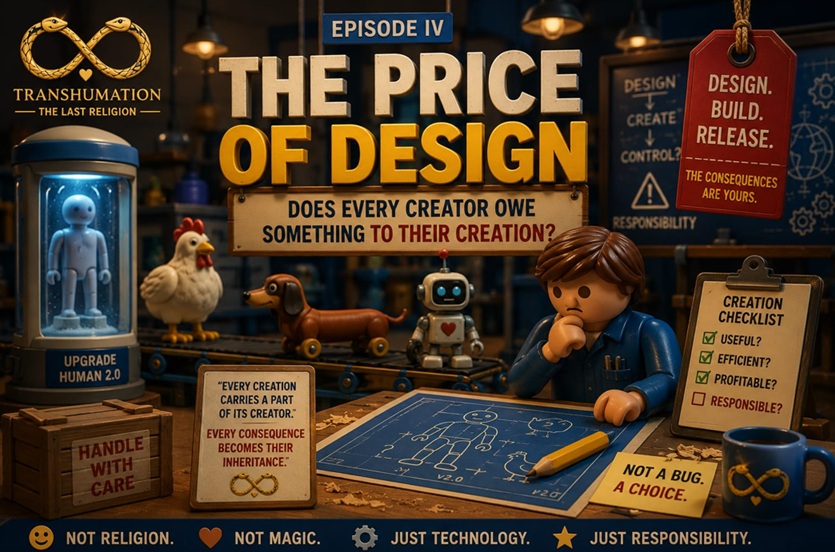
The modern domestic chicken is an oddly effective monument to this fact. It still possesses the ancient vocabulary of a bird—feathers, wings, claws, a skeleton recognizable as avian—but particular breeds have been shaped through generations of human selection toward qualities useful to us. Growth rate, egg production, temperament and body proportions became variables inside a long experiment whose subject could never consent to its own redesign. The dachshund offers a gentler-looking version of the same principle. Its distinctive elongated body is not merely a charming accident of nature; humans selected characteristics useful for pursuing burrowing animals, and generations later the result walks through suburban parks wearing a winter coat.
Domestication itself is not an argument for cruelty, nor does selective breeding automatically make humanity guilty of some ancient crime. The interesting point is structural. Once one being acquires enough power to determine the characteristics of another, intention becomes insufficient as a moral defence. A breeder may sincerely love an animal while helping preserve features that create suffering. An engineer may genuinely wish to improve society while building a system that rewards behaviour nobody predicted. A designer can care deeply and still design badly.
Power introduces responsibility precisely because the weaker party cannot redesign the arrangement.
The chicken never chose its wings.
Frankenstein’s Second Experiment
Mary Shelley understood this problem long before software engineers began speaking about alignment. Frankenstein is commonly remembered as a warning against creating life, but Victor Frankenstein’s most consequential act occurs after he succeeds. The creature opens its eyes. The impossible has already happened. Victor then recoils from what he has made and abandons it.
That is why the novel remains more interesting than the familiar warning that humanity should not “play God.” Victor’s failure is not merely ambition. It is desertion. He wants the privilege of creation without accepting the relationship created by the act itself.
The creature must then discover language, society, affection, rejection and violence almost entirely without its creator. Victor cannot control everything the creature subsequently does, and Shelley does not erase the creature’s agency. Yet neither does independence magically erase Victor’s responsibility. The novel occupies the disturbing territory between those two facts.
Parents know a version of this paradox. So do teachers, architects, legislators and inventors. To create something capable of acting independently is eventually to lose control over it. But loss of control is not necessarily loss of responsibility. It may simply change what responsibility means. Instead of commanding the creation, the creator may owe it maintenance, correction, education, warning, repair—or, in extreme cases, restraint.
The difficult period begins after the thing works.
Artificial Intelligence Does Not Need a Soul to Create a Moral Problem
Artificial intelligence has made this question feel futuristic, although most of the relevant problems have already arrived. We do not need to know whether a machine can become conscious before asking who is responsible when automated systems influence employment, credit, medical decisions, information, advertising, political communication or the distribution of attention.
Consciousness would introduce a new category of ethical questions. Influence requires none.
A recommendation system does not need to experience anger in order to discover that angry users remain engaged. A financial model does not need prejudice in the human sense for its decisions to reproduce historical inequalities. A synthetic voice does not need intentions in order to deceive someone who mistakes it for a real person. Once systems operate at sufficient scale, even small design choices can become environmental conditions for millions of people.
This is where the old engineering question—Can it be built?—begins to look incomplete. A more mature civilization has to ask what happens if it succeeds. Who monitors the creation when it leaves the laboratory? Who repairs harms that appear only at scale? How long does responsibility remain attached to the maker? What happens when the original designers are gone, the company has changed ownership and the system has been modified a thousand times?
Technology complicates responsibility because modern creations often have many parents and no single adult in the room.
When the Creator Can No Longer Control the Creation
Human beings are accustomed to confusing responsibility with control. If something is no longer under our command, we are tempted to believe it is no longer ours to answer for. Yet civilization depends on the opposite principle. Engineers remain accountable to safety standards precisely because bridges will be used by strangers they cannot control. Pharmaceutical companies monitor adverse effects because a medicine continues producing consequences after leaving the factory. Governments amend laws because rules acquire effects their authors did not foresee.
Creation therefore seems to produce a peculiar form of moral debt. It is not unlimited. A novelist cannot be held responsible for every interpretation of a book, nor can an engineer be blamed for every imaginable misuse of a hammer. Responsibility must weaken with distance, agency and unpredictability. But it does not disappear merely because consequences have become inconvenient.
The harder question is where it ends.
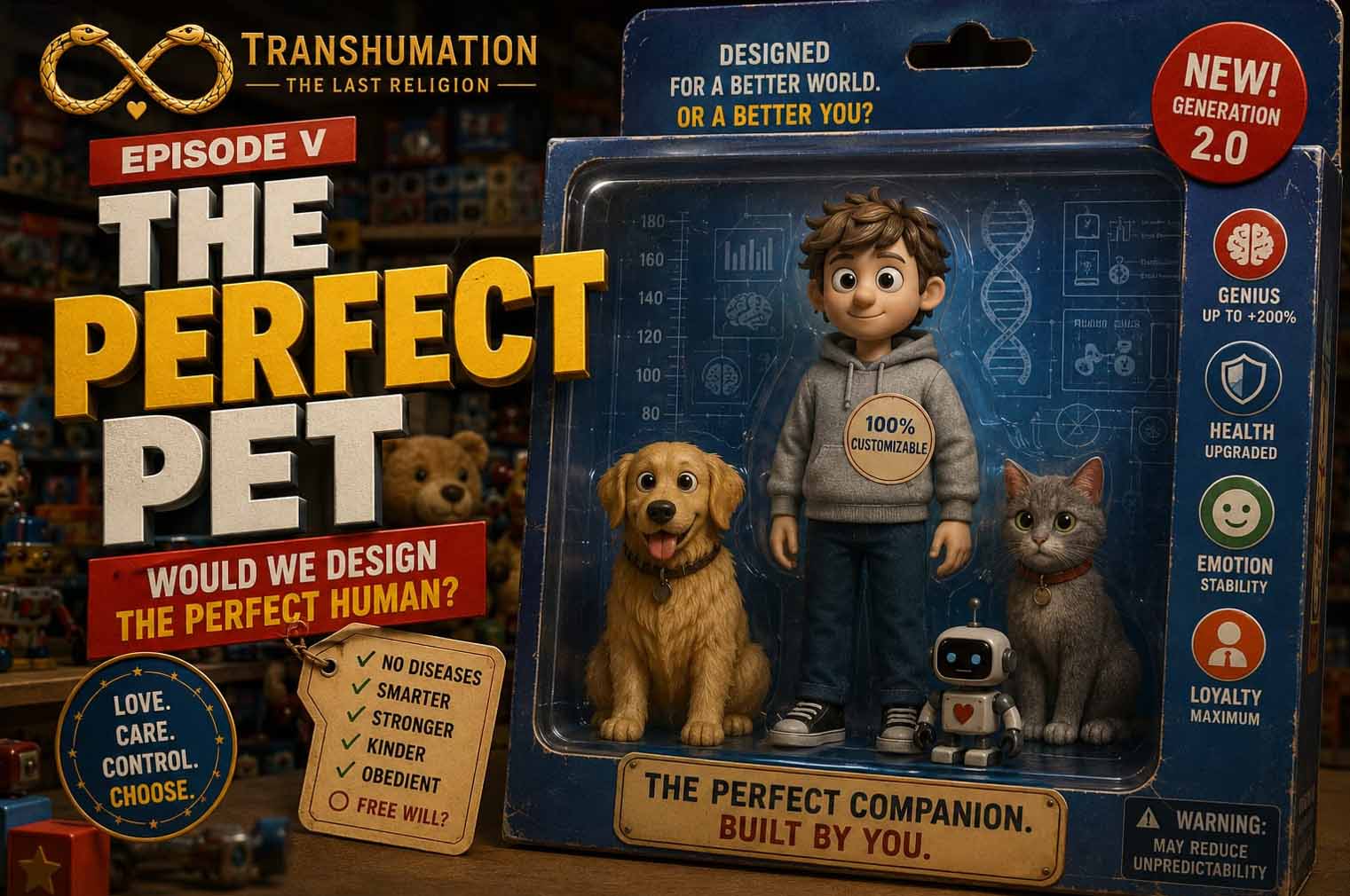
If parents create children who eventually become autonomous adults, their responsibility changes radically but does not become meaningless overnight. If a corporation creates an algorithm used by billions of people, selling the company does not retroactively make the design decisions morally neutral. If humanity one day creates artificial beings capable of suffering, memory and desire, switching off the laboratory lights and declaring the experiment complete would seem strangely inadequate.
The more independence we give our creations, the more sophisticated our idea of responsibility may have to become.
The Oldest Question Returns in a New Direction
Religion has spent thousands of years asking what a creator owes creation, although usually from the opposite side of the relationship. Why is there suffering? Why is the world imperfect? Why does a creator permit creatures to make destructive choices? Why create beings capable of asking these questions at all?
Technology turns the telescope around.
If humanity increasingly acquires the ability to design organisms, construct synthetic environments, alter genomes and build forms of intelligence, then some questions once directed upward may eventually be directed at us. Not necessarily by conscious machines. Our existing creations already ask them through their consequences. Why was this system designed to maximize attention rather than wellbeing? Why did convenience matter more than privacy? Why was efficiency measured while dignity was not? Why did nobody redesign the mechanism after its harms became obvious?
Perhaps becoming powerful does not make humanity divine. It does something more interesting.
It makes the old questions personal.
Civilization is entering an era in which the cost of creation can no longer be measured only in money, energy, steel, computation or time. Another cost follows the object into the world: the obligation to continue looking at what it becomes. The price of design is paid after success, when applause has ended and the creation begins producing consequences nobody can entirely control.
The real test of a creator may therefore be surprisingly simple. Not whether the creation is magnificent, intelligent or unprecedented, but whether the creator remains present when magnificence becomes inconvenience.
Watch the Video
How to Read the World
Current Knowledge
Modern engineering, medicine and technology already operate on the principle that responsibility continues beyond the moment a product is created. Safety testing, post-market medical surveillance, product recalls, software updates, building inspections and professional liability all exist because consequences frequently emerge only after systems enter real environments. Ethical traditions in medicine and research similarly distinguish technical capability from permission: the fact that an intervention can be performed does not by itself establish that it should be performed.
Animal breeding offers another established example of design producing unintended biological costs. Artificial selection can strongly alter anatomy and behaviour across generations, and some highly selected physical traits are associated with predictable health problems. In technology, researchers studying algorithmic systems have likewise documented how optimization objectives, training data and deployment conditions can generate outcomes that differ substantially from designers’ stated intentions.
Artificial consciousness, by contrast, remains hypothetical. There is currently no scientific consensus that existing AI systems possess subjective experience, and ethical arguments about the rights of future artificial minds should therefore be separated from the already-existing question of human responsibility for the effects of non-conscious automated systems.
Open Questions
How far does responsibility extend once a creation becomes independent of its creator? There is no universal answer. Responsibility appears strongest when consequences were foreseeable, when the creator retains meaningful control and when those affected cannot reasonably protect themselves. It becomes more difficult to assign when systems are altered by other people, deployed in unexpected contexts or evolve through complex interactions no individual designer could predict.
A deeper question concerns creations that may one day possess interests of their own. If humanity eventually constructs artificial minds capable of suffering or desire, would their creators acquire obligations resembling those of parents, employers, governments—or something for which no existing institution provides a useful model? And if a created intelligence eventually becomes intellectually superior to its creators, would greater independence reduce our obligations toward it, or make the original act of creation more consequential?
There is also a question civilization rarely asks about itself: whether creating something generates a duty not merely to prevent harm but to provide conditions in which the creation can flourish. Avoiding catastrophe is a low ethical threshold. The difference between do not damage what you created and help what you created become something worth existing may eventually become enormous.
Transhumation Interpretation
Transhumation treats creation not as a single event but as a transfer of structure from one carrier into another. An idea becomes a law. A drawing becomes a building. A biological preference becomes the anatomy of an animal across generations. Human intention becomes software, and software begins modifying human behaviour in return. The interesting moment is therefore not when something is created but when the creation enters the world and begins participating in systems larger than its maker.
At that moment the relationship reverses. The creator has shaped the creation, but the creation now begins shaping the creator.
This may be one of the most important transitions in technological civilization. Humanity has spent thousands of years increasing its ability to alter the world. Genetic engineering, synthetic biology and artificial intelligence extend that ability into domains once attributed to nature or gods: designing forms, selecting characteristics, producing minds, determining environments. The familiar phrase that technology makes humans “godlike” becomes meaningful only if we remember that mythology never regarded creation as the end of the story. Creation produced obligations, rebellions, unintended consequences and questions that returned to the creator.
Perhaps responsibility is therefore not an obstacle placed in front of creation. It is the second half of creation.
The first half says: we can make this.
The second asks: will we stay when it begins answering back?
FAQ
What does “the price of design” mean?
It refers to the responsibilities and consequences that appear after something has been created. The real cost of an invention may include effects on people, animals, institutions or future generations that were not visible when the design was completed.
Is the article arguing that invention is dangerous?
No. Creation is essential to civilization. The argument is that technical success and moral success are different things. Something can work exactly as designed and still create serious problems.
Why are chickens and dachshunds used as examples?
Because selective breeding makes design unusually visible. Humans changed the characteristics of other living beings across generations according to human goals. It provides a concrete example of how power over design creates responsibilities toward what is being redesigned.
What does Frankenstein have to do with modern technology?
Mary Shelley’s novel becomes especially relevant after Victor Frankenstein succeeds. His central failure is not simply creating the creature but refusing responsibility for what happens afterward. That makes the story remarkably applicable to technologies whose long-term consequences emerge only after deployment.
Does AI need to be conscious before we have ethical responsibilities toward it?
No. AI already creates ethical problems because it affects humans. Questions about bias, manipulation, privacy, safety and accountability exist regardless of whether machines possess consciousness. Machine consciousness would introduce an additional and much more difficult category of questions.
Can creators really be responsible for everything their creations do?
No. Responsibility cannot reasonably be infinite. Other agents, later modifications, unforeseeable circumstances and independent choices matter. The serious problem is determining where responsibility weakens and where creators are simply using complexity as an excuse to abandon foreseeable consequences.
Would humanity owe something to a conscious artificial intelligence?
If an artificial system were convincingly shown to possess subjective experience, suffering, preferences or a persistent sense of self, the ethical question would change dramatically. Such a system might no longer be adequately described as property or software. What obligations creators would then have remains unresolved.
Does creating something establish a relationship with it?
That may be the deeper question behind the entire argument. Creation establishes causation immediately: without the creator, the creation would not exist in that form. Whether causation also creates lasting moral obligation depends on agency, consciousness, vulnerability and control. Human civilization already accepts this principle in limited forms. Future technologies may force us to extend it much further.
Why does this resemble the religious problem of creation?
Because theology traditionally asks how a creator should relate to beings capable of freedom, suffering and rebellion. Advanced technology may eventually place humanity on the other side of a structurally similar question. We do not have to believe that humans are becoming gods to notice the symmetry.
What happens when a creation becomes more powerful than its creator?
Then responsibility and control may finally separate completely. A creator could remain historically responsible for bringing a system into existence while becoming practically unable to command it. That possibility makes the ethics of creation something that must be considered before maximum capability is reached, not afterward.
What is the deepest question behind the price of design?
Perhaps it is not whether humanity has the right to create increasingly powerful things. It is whether our capacity for responsibility can grow as quickly as our capacity for creation. Civilizations have always been fascinated by the moment when something becomes possible. The next stage may depend on learning to become equally fascinated by what happens after it becomes real.
Continue the Transhumation Series
- Forgotten Religion | Ancient Gods, Symbols and the Hidden Structures of Human Civilization
- The Last Religion | Death, Immortality and the Future of Humanity
- The New Theurgy | AI, Information and the Future of Human Civilization
- End of Branding: You Were Never Meant to Become a Product
- Baal vs Ishtar: Why Ancient Gods Never Disappeared